Wednesday, March 16, 2016

ANS -- Marc Ash Writes a Piece, "Merrick Garland, What's the Point?" Here's the Point

Here's a short article (always a surprise from Andy Schmookler, who tends to be wordy) about strategic thinking in regards to replacing the Supreme Court Justice.  
--Kim


Wednesday Mar 16, 2016 · 2:44 PM PDT

I just got an email from Marc Ash, editor of the progressive news site, "Reader Supported News." The title of the piece gives a clue about how exasperated Ash is at President Obama's pick for his Supreme Court nominee. "Merrick Garland, What's the Point?"

In the piece, he describes how Garland was someone that Senator Orin Hatch, conservative from Utah, had suggested would be a good pick. And then Ash writes:  "Battle? Ideological confrontation? Reshaping of the Court? Forget it - Garland is a safe pick for America's ruling class. Obama punted. Hatch defeated him without a fight."

I don't suppose he's really asking a question when he writes, "What's the point?" More likely he's declaring that he sees no point. But I'm going to venture an answer to the question anyway, because I think that Ash is likely missing the point.

The first issue to be examined is this: what chance is there that Merrick Garland, oranyone else President Obama might have nominated, will be confirmed.

I don't really know, but if anyone offered to bet me that Garland or anyone else would be confirmed, I'd take the bet. Even if the odds were 2:1 to the no side, I think it would still be a good bet. The Republicans have dug themselves so deeply into this hole, and they have proved themselves so completely committed to an obstructionist approach to the whole Obama presidency, that I just don't see them backing down and doing the right thing. I hope I'm wrong, but that's my bet.

If neither Garland nor any other possible nominee would get confirmed, then the question is: What's the best strategy for punishing the Republicans for their disgraceful behavior?

Here's probably the main answer to Marc Ash's "What's the Point?" question. If we cannot fill the vacancy opened up on the Court by the death of Scalia because the Republicans are so fixated on power above all -- American tradition and the spirit of the Constitution be damned -- then the job at hand is to use their conduct to bludgeon them in the court of public opinion in this election year.

Ash writes that "Obama will leave the Presidency as he began it, wrapping his policy and legacy around not offending white Republicans. It's a travesty and an abdication."

If that's what the President is doing, that surely would be a shame. But I'm betting that what the President is doing is not trying to appease the Republicans but rather using this moderate and apparently first-rate and unobjectionable judge to give him and the Democrats a bigger club with which to bludgeon them the harder.

But what if I'm wrong about the Republicans continuing to refuse to confirm the President's nominee? What if Garland does get a seat on the Supreme Court.

Ash writes: "We fight for a better, more just nation." He thinks Garland is clearly not worth fighting for. But just what do we really need in the person who fills this vacancy?

I must confess I have not yet studied the record of Judge Garland. But I do have some thoughts about what is, and what is not, of true importance in the filling of this seat. What does not matter terribly much is whether we get a justice who is way out on the progressive end of the spectrum. The question that would be important to me is simply this: If this judge had been sitting on that bench instead of Antonin Scalia, how many of the terrible 5-4 decisions would have gone the other way?

My sense is that one does not need anyone very far to the left to shift that balance in the right direction. Some of those 5-4 decisions have been truly terrible -- like on campaign finance and on the Voting Rights Act. To wager once again: I would bet that even if Sandra Day O'Connor had been on her old seat, rather than Justice Alito who replaced her, even that Reagan appointee would have spared us some of these travesties.

What we need on the Court, then, is someone sane and reasonably fair-minded, who is not altogether signed on to assisting the corporatist takeover of the nation.

So even though I don't expect Judge Garland to be confirmed, and even though I am hoping that a President Hillary Clinton and a Democratic-controlled Senate will appoint a first-rate progressive judge next year, I doubt that Marc Ash's alarm at the nomination of this centrist judge is the terrible news Marc Ash thinks it is.

Monday, March 14, 2016

ANS -- Someone Will Die

This is a serious editorial about the effects of mob behavior when violence is encouraged. It's a good article, but sad subject.  
--Kim


TPM EDITOR'S BLOG

Someone Will Die

Us09x2swrnlmk8zwok6r
AP Photo / Nati Harnik
ByJOSH MARSHALLPublishedMARCH 12, 2016, 11:16 PM EST248864 Views

Today we appear to be going further and further into uncharted territory. After the cancellation of Trump's event yesterday in Chicago, we had the incident at the rally in Dayton, Ohio in which a protestor, Thomas Dimassimo, jumped the security perimeter surrounding Trump and tried to rush the speaking platform. Dimassimo was charged with disorderly conduct and inducing panic and later released on bail. At a subsequent event and on Twitter, Trump claimed that Dimassimo was tied to ISIS, apparently on the basis of a hoax video his staff found on Youtube. At yet another event this evening Trump called for the mass arrest of protestors, noting that arrest records would leave an "arrest mark" and "ruin the rest of their lives." Trump also repeatedly blamed "communist" Bernie Sanders for what now appear to be the almost constant protests and disruptions at his rallies.

This evening at an event in Kansas City there were numerous protest interruptions inside the rally and a chaotic scene outside in which, according to a report on MSNBC, police used pepper spray on at least one group of protestors.

For all the talk about Mussolini, let alone Hitler, George Wallace is the best analog in the last century of American politics - the mix of class politics and racist incitement, the same sort of orchestrated ratcheting up of conflict between supporters and protestors. As all of this has unfolded over the course of the day there have been numerous instances of Trump supporters calling for protestors to "go back to Africa" and another on video calling on them to "go to fucking Auschwitz."

Is the man invoking Nazi concentration camps in that video an anti-Semite or just a ramped hater in a frenzy of provocation? I'm not sure we know. And as I'll argue in a moment, in a climate of incitement and crowd action, it doesn't necessarily matter.

It may sound like hyperbole. But this is the kind of climate of agitation and violence where someone will end up getting severely injured or killed. I do not say that lightly.

I want to go back to something that happened earlier this month. At a Trump rally in Louisville on March 1st, a number of African-American protestors were ejected from the event. As they were being led out, they were heckled, pushed and shoved. One of the men doing the shoving was 75 year old Alvin Bamberger, a veteran and member of a local Korean War veterans association. Bamberger was videoed yelling at and repeatedly shoving a female, African-American protestor and the video went viral.

A few days later he sent a letter of apology to the head of his local veterans organization.

Here's part of the text ...

At first, he wrote, "everything seemed to be under control and mostly orderly. All that changed when Trump got to the stage. Protestors in the crowd became vocal and began pushing and shoving their way toward the stage. At one point I was physically knocked down and fell to the ground, losing my jacket (which was eventually returned to me). The protestors were holding up signs, chanting 'black lives matter' and pushing and shoving Trump supporters.

"Trump kept saying 'get them out, get them out' and people in the crowd began pushing and shoving the protestors," Bamberger said. "Unfortunately a lot of this behavior was happening right next to where I was standing and having been pushed to the floor myself, my emotions got the best of me, and I was caught up in the frenzy. I physically pushed a young woman down the aisle toward the exit, an action I sincerely regret."

Bamberger said he learned only afterwards that some of the Trump supporters "standing right next to me" were members of a white supremacist group.

"Unfortunately my state of mind after being knocked down and hurt myself, and being caught between a group of white supremacists and Black Lives Matter protestors contributed to my behavior however, there is no excuse for my actions," he wrote.

I've seen various responses to this apology, some seeing it as insufficient and insincere, others seeing it as genuine and contrite. Some say he shifts the blame. If nothing else, this is no mere 'I'm sorry if anyone took offense' type nonsense non-apology. It is abject and unflinching. But set all that aside. That's not what concerns me here. Bamberger's overarching explanation rings very true to me. Indeed, it is backed up by decades of social science: People act very differently in crowd or mob situations than they do on their own. There are various theories as to just why this is the case - again, there's a whole social science and group psychology literature about it. But crowd/mob situations are profoundly disinhibiting events. People sometimes do things they themselves not only regret but almost literally can't believe they did.

None of this is meant to absolve people of responsibility for their actions. Having watched the video I have little doubt Bamberger came into the event with a lot of pretty intense feelings and beliefs that set him up for this confrontation. But would he have acted this way without all the outside stimulus he describes in his letter? Probably not. We all have angers and prejudices and hostilities which our socialization keeps in check, sometimes even hidden from ourselves. Some of us, of course, have much more than others. But in crowd settings, with what can now only be called Trump's almost nonstop incitement to eject or beat "thug" protestors, jostling and shoving, ramped up emotions, things can escalate very rapidly. And let's be honest, it can happen on both sides. A hypothetical: a Trump supporter shoves a black protestor, the protestor punches back, others join in. We don't need to equate the two sides, which I do not, to see that there is a lot of anger and animus on each side. This kind of atmosphere can unleash it.

What we have seen over the last two weeks isn't just an escalation of chaos and low level violence but a progressive normalization of unacceptable behavior - more racist verbal attacks, more violence. This is in turn clearly attracting more people who want trouble - on both sides. If you're an angry racist who wants to act out on his anger, can you imagine any better place to go than a Trump rally? If you hate Trump, his supporters and all he stands for and want to get physical about it, where best to go?

Again, this is not meant to equate the two sides. As I mentioned yesterday, Trump has repeatedly claimed that instances of crowd violence at his rallies occurred when protestors - "bad dudes" - attacked his supporters and his supporters fought back. Until the events last night in Chicago, there is no evidence that anything like this ever happened. Not once. It is all lies. It's still not clear exactly what happened last night in Chicago. I have seen numerous reports from the event that show that the great majority of protestors were peaceful, in many cases there as families, from various political and community organizations. But clearly there were scuffles and disorderly behavior inside that both sides participated in - who started what, I have no idea. It was a qualitative advance, or descent, from what had come before it.

But let's go back to the incident with Dimassimo, who appears to be a left wing activist affiliated with Black Lives Matter and similar groups. This is not only totally unacceptable behavior, it is also totally unhinged behavior. When you try to rush the stage when a presidential candidate with Secret Service protection is speaking, you are literally taking your life in your hands. This is the kind of crazy thinking, which even if Dimassimo didn't intend to hurt Trump, leads to very bad outcomes. And this is from the anti-Trump side!

The climate Trump is creating at his events is one that not only disinhibits people who normally act within acceptable societal norms. He is drawing in, like moths to a flame, those who most want to act out on their animosities, drives and beliefs. It is the kind of climate where someone will eventually get killed.

ABOUT THE AUTHOR

P8kice8zq6szrqrmqxag

Josh Marshall is editor and publisher of TalkingPointsMemo.com.

Sunday, March 13, 2016

ANS -- Five “Truths” about the US Political Circus Non-Americans Should Question

Here's another different view of what's happening in American politics.  The author seems to have a pretty clear vision of what's really happening.  Fairly short article.
--Kim


Go to the profile of Christian Christensen
Christian Christensen3 days ago4 min read

Five "Truths" about the US Political Circus Non-Americans Should Question

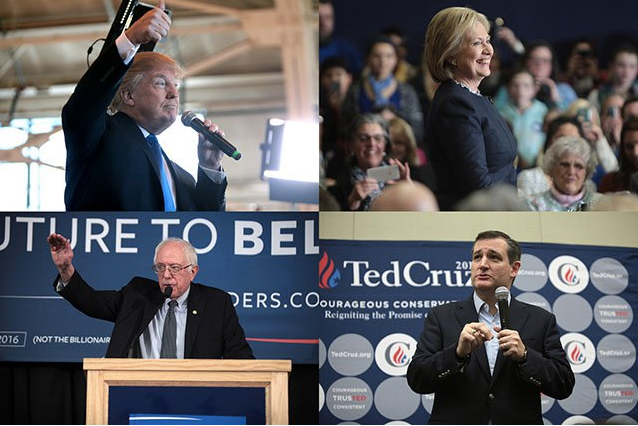
(Photos by Gage Skidmore under Creative Commons)

As an American academic living in Europe, I am often asked by journalists to offer my opinion about what is going on with US politics, Trump and the media. A number of issues regularly crop up during these discussions that suggest a somewhat blinkered view of events. Here are five issues ("truths") that I think are worth considering in a more critical fashion.

Truth #1: "Trump is revolutionizing US politics…"

A recent editorial in the Washington Post argued that the success of Donald Trump and Bernie Sanders in the 2016 election cycle is evidence that money, while clearly important in US politics, is not everything. The editorial was half right. It is hard to see how a self-funding billionaire, famous for his role in reality television, is in any way a poster-child for the decreasing power of money in US politics. A billionaire buying his way to the Presidency is no less bound to the interests of capital than a millionaire like Hillary Clinton getting corporations to help her buy her way to the Presidency. Either way, the Presidency is for sale. This is why Bernie Sanders is far more revolutionary than Trump: a candidate with no personal wealth, and no Super Political Action Committee ("Super PAC") money, is mounting a serious challenge against a candidate (Clinton) who has massive financial support from US corporations. That's the story.

Truth #2: "Trump is getting ahead with no advertising…"

Trump is a ratings goldmine. Trump knows it. The media know it. And the figures on the levels of media coverage given to Trump show it. Yet, when the negative influence of money on US politics is discussed, the conversation is often limited to campaign finance, and not to things like media profit margins. Trump's ability to forego expensive advertising might be revolutionary to political pundits, but it's entirely rational…if not utterly banal. Trump has leveraged his personal and cultural capital (wealth, celebrity and outrageousness) into free coverage, and a salivating corporate US media have obliged. In this sense, US media act like the contributors Trump proudly announces that he does not have: corporations donating valuable resources to his cause in the expectation of financial reward. This is also where the notion of Sanders and Trump as somehow linked by their financial "outsider" status falls apart: Sanders still has traction (and is winning states) despite a media that finds his message of solidarity and equality unsexy and unappealing. Trump, on the other hand, is being pumped acres of media oxygen despite message that is vile, juvenile and offensive…because it gets eyeballs. Trump may not be buying ads, but he is still getting them.

Truth #3: "Trump is the creation of right-wing media like Fox News…"

With the media over-exposure I have just mentioned, it is easy to blame outlets like Fox News as key culprits the rise of Donald Trump. In fact, for pundits and journalists in the US it's convenient to do so, as these outlets deflect attention away from the historical failure of the US news media to engage in critical analyses of politics, as well as a willingness on the part of US journalism to push the nationalist/patriotism card when it suits them to do so. The road Donald Trump now drives upon was paved many years ago by a US news media that championed shallow horse-race coverage of elections devoid of substantive analysis of policy. And, the fact that Trump's blatant racism and Islamophobia is resonating cannot be divorced from decades of media coverage in which the wholesale slaughter of Muslims in Afghanistan, Iraq and Yemen as a direct result of US military action (and sanctions) was not only not investigated, but actively cheer-led by the news media.

Truth #4: "The Democrats are a progressive alternative to Republicans…"

The desire on the part of the international press to understand US politics as "left versus right" leads to a dangerous misrepresentation of the Democrats. US politics is center-right and far-right. To take the most obvious argument: if we assume that what you are willing to do abroad cannot be seen as irrelevant to your political ideology, post-9/11 Democratic politics is anything but progressive. Support for the occupation and destruction of Iraq and Afghanistan, support for the killing of civilians in drone strikes, rearming Israel as it killed civilians in Gaza? These are not the hallmarks of leftist politics. Progressivism is not a zero-sum game where you offset hawkish militarism abroad with mildly progressive politics at home. Unless, that is, you believe that human life somehow has less value in Baghdad than it does in Boston. And, domestically, there is another clear example: it's hard to see how a party whose leading candidate does not support the abolition of the death penalty — considered barbaric in most developed democracies — can pass itself off as progressive. So, yes, the Democrats are to the left of Trump…but that's hardly difficult.

Truth #5: "Trump is about harnessing citizen anger and disaffection with politics…"

This is likely true…but Trump is also about harnessing xenophobia, Islamophobia and racism. A good place to start is to watch Van Jones tear apart Donald Trump supporter Jeffrey Lord on CNN in what has become an iconic moment in this election cycle. The interaction came after 6 or 7 hours of coverage by CNN where racism and Islamophobia was not addressed. The fact that it took an African-American to bring it up at the end of the evening is an indictment of a mainstream US press that has not addressed Trump's racism in a substantive manner.


Thoughts on Media is a community publication, curated by ReadThisThing. Follow us on Medium or check out our newsletter.

Thursday, March 10, 2016

ANS -- EPA expands methane rules to all oil and gas wells

Some good news for a change.  Lame ducks rule! The EPA cracks down.  Let's hope this works.  I have no doubt that the drillers will still make a hefty profit.  They will figure out how. 
The distinction here, as I understand it, is that the rules have been expanded to include all wells as opposed to just new wells.  This should make a big difference.   
--Kim


EPA expands methane rules to all oil and gas wells

Posted on March 10, 2016 | By 

A well is drilled at an Apache Energy site in the Permian Basin in Midland, Texas, Feb. 14, 2012. (Jim Wilson/The New York Times)

A well is drilled at an Apache Energy site in the Permian Basin in Midland, Texas, Feb. 14, 2012. (Jim Wilson/The New York Times)

The U.S. Environmental Protection Agency is expanding its crackdown on methane emissions from oil and natural gas drilling to all existing wells.

The announcement from the White House Thursday came as part of a joint agreement with Canada on climate change, curbing methane emissions from North America and taking steps to protect the Arctic region from rising temperatures and oceans.

The EPA had announced plans to cut methane emissions from new oil and gas wells last year. But if the United States was to reach the goal set out by President Obama of cutting methane emissions at least 40 percent by 2025, existing wells have to be included, said EPA Administrator Gina McCarthy.

"Based on this growing body of science it's become clear it come time for EPA to take additional action," she said in a press conference. "We'll start this work immediately and we intend to work quickly."

The announcement came ahead of Obama's meeting with Canadian Prime Minister Justin Trudeau at the White House Thursday, where the two were expected to discuss how the countries could work together in meeting the goal agreed to by the leaders of close to 200 countries in Paris last year – not allowing the world temperature to rise more than 2 degrees Celsius.

The White House said Thursday morning both Canada and the United States were planning to make public their plans on climate change before the end of the year and ahead of the schedule laid out in Paris.

"The thinking is both countries are very committed," said John Morton,  senior director for energy and climate change in the administration. "We want to lead other countries."

The methane announcement quickly drew condemnation from the oil and gas sector. Lowering methane emissions will largely entail seeking out and repairing gas leaks in storage tanks and pipelines, time-consuming tasks companies have largely avoided so far.

The American Petroleum Institute said expanded methane regulation could reduce oil and gas activity in the United States, potentially leading to lost jobs and increased energy costs.

"The administration is catering to environmental extremists at the expense of American consumers," API vice president of regulatory and economic policy Kyle Isakower said.

Central to the joint announcement by the United States and Canada was the Arctic.

Interior Secretary Sally Jewell said both countries must take a close eye to what commercial activities were allowed in the region, as climate change posed a particularly acute risk to communities and wildlife there.

The Interior department is expected to release its plans for offshore drilling in the weeks ahead. Along with an expansion into U.S. Atlantic waters, the possibility of increased drilling in the Arctic Ocean off Alaksa's north coast has drawn fierce opposition from environmentalists

Jewell did not rule out drilling in the Arctic Thursday  but said if it were done it would need to be done under "a science-based standard" on the potential risk of oil spills.

See images from ConocoPhillip's drilling project in Alaska in the gallery below.

ConocoPhillips taps Alaskan oil reserve
This Feb. 9, 2016, photo shows an ice covered ConocoPhillips sign at the Colville-Delta 5, or as it's more commonly known, CD5, drilling site on Alaska's North Slope. ConocoPhillips in October 2015 became the first to drill for oil in the National Petroleum Reserve-Alaska, a region the size of Indiana set aside by President Warren G. Harding in 1923. Getting to this point took compromises with Alaska Natives while keeping environmental concerns in mind.  (AP Photo/Mark Thiessen)
This Feb. 9, 2016, photo shows a million-pound drilling rig looming in the distance at the CD5 drilling site on Alaska's North Slope. ConocoPhillips in October 2015 became the first to drill for oil in the National Petroleum Reserve-Alaska, a region the size of Indiana set aside by President Warren G. Harding in 1923.  (AP Photo/Mark Thiessen)
This Feb. 9, 2016, photo shows a truck driving on an ice bridge constructed near the Colville-Delta 5, or as it's more commonly known, CD5, drilling site on Alaska's North Slope. ConocoPhillips in October 2015 became the first to drill for oil in the National Petroleum Reserve-Alaska, a region the size of Indiana set aside by President Warren G. Harding in 1923.  (AP Photo/Mark Thiessen)
This Feb. 9, 2016, photo shows Steve Thatcher, the Alpine operations manager for ConocoPhillips, standing on an ice bridge near the CD5 drilling site on Alaska's North Slope. ConocoPhillips in October 2015 became the first to drill for oil in the National Petroleum Reserve-Alaska, a region the size of Indiana set aside by President Warren G. Harding in 1923.  (AP Photo/Mark Thiessen)
This Feb. 9, 2016, photo shows an ice covered sign at the Colville-Delta 5, or as it's more commonly known, CD5, drilling site on Alaska's North Slope. ConocoPhillips in October 2015 became the first to drill for oil in the National Petroleum Reserve-Alaska, a region the size of Indiana set aside by President Warren G. Harding in 1923.  (AP Photo/Mark Thiessen)
This Feb. 9, 2016, photo shows Isaac Nukapigak, president of the Kuukpik Corp., talking to reporters at the ConocoPhillips Alpine Field on Alaska's North Slope. ConocoPhillips in October 2015 became the first to drill for oil in the National Petroleum Reserve-Alaska, a region the size of Indiana set aside by President Warren G. Harding in 1923. The oil is being drilled on surface land which is owned by Kuukpik Corp., an Alaska Native village corporation for the nearby community of Nuiqsut. (AP Photo/Mark Thiessen)
This Feb. 9, 2016, photo shows ice forming on pipelines built near the Colville-Delta 5 field, or as it's more commonly known, CD5, drilling site on Alaska's North Slope. ConocoPhillips in October 2015 became the first to drill for oil in the National Petroleum Reserve-Alaska, a region the size of Indiana set aside by President Warren G. Harding in 1923.  (AP Photo/Mark Thiessen)
This Feb. 9, 2016, photo shows a million-pound drilling rig at the CD5 drilling site on Alaska's North Slope. ConocoPhillips in October 2015 became the first to drill for oil in the National Petroleum Reserve-Alaska, a region the size of Indiana set aside by President Warren G. Harding in 1923. Getting to this point took compromises with Alaska Natives while keeping environmental concerns in mind. (AP Photo/Mark Thiessen)
This Feb. 9, 2016, photo shows ice forming on pipelines built near the Colville-Delta 5, or as it's more commonly known, CD5, drilling site on Alaska's North Slope. ConocoPhillips in October 2015 became the first to drill for oil in the National Petroleum Reserve-Alaska, a region the size of Indiana set aside by President Warren G. Harding in 1923.  (AP Photo/Mark Thiessen)
IMAGE 1 OUT OF 11
Associated Press
This Feb. 9, 2016, photo shows an ice covered ConocoPhillips sign at the Colville-Delta 5, or as it's more commonly known, CD5, drilling site on Alaska's North Slope. ConocoPhillips in October 2015 became the first to drill for oil in the National Petroleum Reserve-Alaska, a region the size of Indiana set aside by President Warren G. Harding in 1923. Getting to this point took compromises with Alaska Natives while keeping environmental concerns in mind. (AP Photo/Mark Thiessen)

She added, all decisions " will depend in part on ensuring commercial activity does not diminish our ability to address climate change."

With less than a year left in office, Obama faces a tight schedule to get an expanded rule on methane emissions finalized.

EPA is preparing a data request to the energy industry and regulatory agencies, to try and get a handle on the level of methane emissions from oil and gas operations. But whether it will have time to finalize a rule before next January was the subject of speculation Thursday.

"Certainly it will be difficult," Isakower said. " If they moved the [data request] quickly, they could get a regulation through before they're out the door."

The EPA announced it's plan to regulate methane from new wells in January 2015, and that rule is still under development.

Asked about the timing during a press conference, McCarthy avoided specifics.

"We'll do whatever we can to move forward on greenhouse gas," she said.

Monday, March 07, 2016

ANS -- To See Why Trump is Winning, Ask This Question

The theorists are heating up as the election comes nearer.  Here is another take on why Drumpf (Trump) is popular.  It's by Jeffery Feldman, who is quite good.  It's fairly short.  
--Kim


To See Why Trump is Winning, Ask This Question

MAR 6, 169:21 PM

George Lakoff has a long essay out on the topic of why Trump is winning. If you are a fan of Lakoff (ehem!), you will recognize the familiar moral logic of strong father conservatism. In a nutshell, Lakoff draws our attention to a conservative view of the family to explain how Trump's brash arrogance appeals to some and not to others.  I do not disagree with Lakoff, but I think there might be a more basic way to understand why Trump is winning: by asking a very simple question.

Try this simple exercise.  Start by reading this question:

How should I live?

Now, before you answer this question–ask yourself where you as an individual tend to look for answers to this question: religion or culture? Do you go to church and find there the basic answers to how you should live or do you read a novel or a book of philosophy or a compelling film, for example, and find therein the big answers to the question.

My sense is that how we answer this question for ourselves divides the electorate into two basic groups: (1) people who get the answer to "How should I live?" from some kind of organized religion and (2) people who get the answer to "How should I live?" outside of religion.

It is not a foolproof method, but it does seem to provide a general guideline.

For Republicans who find answers to "How should I live?" in Christianity, a good portion of them initially supported Ted Cruz.  Republican voters guided, by contrast, by more secular and cultural sources tended to be supporters of trump.

As the primary progressed, however, two things happened that changed the dynamic.

First, Cruz supporters switched their focus from "How should I live?" to a more ardent version of this question:

How should my religion make the whole country live?

That is a version of the question that winnows down the pile of Cruz supporters. At the same time, a second development happened: Trump started explicitly telling voters that he answered the question "How should I live?" by consulting the Bible–that he is a big Bible guy.

To many outsiders, Trump's appeal to voters on the basis that he was religious seemed shallow, fake, phony–and of course it is. Trump is less religious than Leatherface Sawyer on a good day. But Trump's basic communication to voters that he answers the question by consulting the Bible was enough to assure Christian voters–those not radicalized by Cruz' more extreme version of the question.

The remaining Trump supporters find answers to the question "How should I live?" in (a) white supremacist discourse and (a) popular get-rich-quick literature–in particular, the version of the get-rich-quick genre found on TV and embodied by Trump.

I have long suspected that one of the reasons Trump is winning is because he has built a coalition that includes one of the most fundamental groups in American culture–one that is almost never identified by political scientists: people who organize their lives according to one or more schemes found in the 'self-help' section of the bookstore.  For example, if you have read and consciously live your life by the principles found in George Clason's 1926 classic The Richest Man in Babylon–you're a Trump fanatic.


Why is Trump's support so durable in the face of so many gaffes and offensive statements?

Well, the white supremacists want a racist nativist candidate, so they will never walk away.  The Evangelicals will not abandon Trump because he has told them that he answers the big question by consulting the Bible. The think about Evangelical voters is that they take you at your word and allow for slip ups. All that matters to them is that the candidate keep telling them that he or she goes to the Bible to answer "How should I live?" The candidate can even live in ways flagrantly opposed to their principles and it still holds.

But the last group is the key. For the most part, no matter what Trump does or says, no matter how obnoxious, still seems to feed into the get-rich-quick, devil-may-care ideal type.  The issue is not "political correctness," but any kind of correctness. All that matters to this group is that Trump embody the maxim that one should live to increase one's wealth. He does that 24/7.

Curiously, there is has been no real effort to date to show that Trump is a bad role model for the get-rich-quick types.  Trump's image as a successful deal maker is untarnished.

What's the opposite of a self-made man in the American imagination?

What's the opposite of a religious man who answers big questions about his life by consulting the Bible?

What's the opposite of a white supremacist?

Show Trump to be these opposites–instead of repeatedly pointing out how shocking it is that Trump embodies these ideals–and his support amongst Republicans will likely wain.

"How should I live?" A simple question that plays a big role in the election.

Sunday, March 06, 2016

ANS -- Foundational Series --RWA+SDO=involuntary BDSM w/no safeword? Altemeyer's "The Authoritarians"

This is an old one, done while Bush was president, but I think it's important to re-read periodically.  I think it's especially relevant now that it looks like Drumpf (Trump) is going to be the Republican candidate. Several articles have said Drumpf appeals to authoritarians.  
 
--Kim


The Infamous Brad - RWA+SDO=involuntary BDSM w/no safeword? Altemeyer's "The Authoritarians"

http://bradhicks.livejournal.com/312114.html


Date:

2007-02-14 02:03

Subject:

RWA+SDO=involuntary BDSM w/no safeword? Altemeyer's "The Authoritarians"

Security:

Public

Mood:

good

Music:

Supperclub presents Vol. 6 - Rome - La Salle Neige (D I G I

Tags:

books, politics, science

Speaking of books being given away online, alienne sent me a link to University of Manitoba associate professor of social psychology Bob Altemeyer's web page, where he's serializing his new book, The Authoritarians. The introduction and chapters 1 to 5 (of 7) are available right this minute, and I'm enjoying it thoroughly. Once again, I'm feeling that tug to study social psychology myself. Anyway, the backstory to this book is that former Nixon chief counsel and convicted Watergate co-conspirator John Dean noticed something a couple of years back: even as bad as he now realizes his former boss and some of his former co-workers were, there's just plain something "off" about the 21st century Republican Party, something that would lead them to a scandal that he insists is Worse than Watergate. The thing that was inexplicably weird to him wasn't just the criminal and impeachable fraud (in his opinion as a lawyer who's been through it) by which the Bush administration lied us into Iraq, but more importantly how strangely few people in the Republican Party had any kind of a problem with it.

The Republican Party that he knew was the one that rebuilt itself from the ground up off of the work of deeply principled thinkers like William F. Buckley's 1951 God and Man at Yale and more importantly Barry Goldwater's 1960 The Conscience of a Conservative. The Republican Party, after decades of electoral disaster, re-invented itself as the party of principles. The Democrats, from FDR on, were (and mostly still are) the party of pragmatism and of outcomes. And the public was, understandably, grateful for such outcomes as repairing the Dust Bowl, ending the Great Depression, creating the "land grant" colleges, founding Social Security, winning World War II, creating the whole modern economy through the GI Bill, and eliminating polio and smallpox. But at the bottom of it, the Republicans' electoral strategy was to convince the voters that the then-ongoing corruption of the post-Prohibition America, the mafia dominance of so much of our politics, was an inescapable result of a politics of pragmatism, a politics without absolute moral principles. By 1980, that sounded really good to Americans, and the Republicans have dominated the American political landscape pretty thoroughly, if not always completely, ever since.

But what Dean was noticing was the the Republicans under George W. Bush had for all practical purposes sacrificed every shred of commitment to any kind of a principle other than one: a "principled" commitment to gaining and holding power at any cost. And in his reading to try to figure out just where America went wrong, he stumbled across the academic work of Bob Altemeyer and began corresponding with him, and Altemeyer's analysis of authoritarianism forms the theoretical framework for Dean's latest book, Conservatives without Conscience (or so I'm told, I haven't read it). So after the moderate success of Dean's book, it occurred to Altemeyer that he wanted a much broader public to understand the scientific and experimental basis for the claims that Dean was making, to learn just what social psychologists have discovered over the last 60 years of verifiable scientific research into what makes authoritarianism possible. And being only a few years short of retirement, he obviously felt no particular unhappiness that Internet web pages don't count as publication credit towards tenure, or not enough to slow him down. To try to get a bigger audience for his book than an academic press would bring him, he's giving it away free.

I was aware of some of this research, and if you've been reading this journal long enough, so are you, because I never stop hyping the book that is the founding work on the social psychology of authoritarianism, the grand-daddy of all scientific research on the subject that came after, Eric Hoffer's book The True Believer. Hoffer's analysis, which has been mostly borne out by the research since, is that authoritarian mass movements begin when people who want very badly to join such a movement, who cannot be emotionally complete without an authoritarian mass movement to follow, find a charismatic leader whose message meets certain pre-conditions for a mass movement. But what I didn't realize until I started reading Altemeyer is just how much scientific research has been done to improve upon, verify, and quantify Hoffer's subjective historian's opinion, and that's exactly what Altemeyer wrote this book hoping that more people would find out. And the main finding is that the authoritarian cycle is driven by the confluence of two distinct and measurable personality types: when people who are Right Wing Authoritarian find, and are found by, people with a Social Dominance Orientation.

A Right Wing Authoritarian is Altemeyer's subjective label for someone who want very badly to believe that their parents' and grandparents' ways were the best, that society is at all times seriously threatened by dangerous outsiders (usually foreigners, homosexuals, and identifiable ethnic groups within the country), and that any political leader who isn't one of those dangerous outsiders or allied with them is never wrong and should be obeyed absolutely, unhesitatingly, and uncritically. Such people are putty in the hands of people who combine sociopathic indifference toward outsiders and unlimited willingness to lie who believe that it is a law of nature and a law of God that some groups of people will always dominate other groups and who cannot ever feel safe unless their group is one of the ones doing the dominating. Those who share these interrelated beliefs about how the world works are said to display Social Dominance Orientation. Social psychologists have spent decades now fine-tuning diagnostic questionnaires for both conditions, and in both cases have come up with short lists of statements that very tightly correlate with each other for one, and a separate list for the other. That is to say, if someone scores very high on the RWA scale, if they agree with a very unusually high number of the statements on that test, they will also demonstrate the behavior of seeking to find an authoritarian leader to uncritically follow. If someone scores very high on the SDO scale, they will also demonstrate the behavior of seeking to dominate others at all costs.

And what's been making Altemeyer very nervous for this whole decade is that early on in the research into SDO, they realized that there were a tiny number of people who score very high on both RWA and SDO. And when he set out to study such people, he found out that the combination is truly terrifying. To pick one example, my blood ran cold when I read about one of those "world simulation games" where the subjects didn't realize that they had been selected to all be high RWA, and where each continent was carefully seeded with one RWA+SDO each. When you read the step by step way in which RWA+SDOs ran the world when they were given a chance, your blood will run cold, too. For what seemed to them to be obvious inescapable reasons, entirely not their own fault, they made decisions that resulted in global economic collapse, global environmental collapse, and brushfire nuclear wars that killed 1.6 billion people. And Altemeyer was convinced that had the game gone on for one more turn, they would have killed the entire remaining human population, as the nuclear super-powers were all on full nuclear alert and preparing to launch when the time clock ran out. And the RWA+SDOs, and their RWA followers, all sincerely believed that if anybody else had been in charge, they would have made the exact same decisions with the exact same outcomes ... which turns out to be, from the same simulation run with random groups and with people who scored only very low on both RWA and SDO, demonstrably not true. You can argue whether the simulation itself was realistic, but that's not the point in this case. The point in this case is that even when they were getting feedback that they were all losing the game, it was so obvious to them that they were making the obviously right decisions, the only ones that any sincere person who wanted to win would make, that they, unlike others in the same simulation, could not change their strategy in order to win.

And what about that makes Altemeyer very, very nervous is that George W. Bush, and his neocon advisers, have run the entire checklist in their public statements. Yes, it's usually treated as dubious to psychologically analyze someone long distance, someone who's not your patient. But the RWA and SDO scales don't ask any questions that Bush, Cheney, Rumsfeld, Feith, Wolfowitz, and others haven't already answered without being asked. Sure, they could be lying about their beliefs, but a psychologist with a patient sitting across the desk from him has to face that same possibility. No, if you take them at their words when they describe their view of the world, what they believe to be true and don't believe to be true about human nature and how the world works, almost the entire upper ranks of the Bush administration test as perfect textbook RWA+SDOs. That is to say, they all combine the traits of the worst of the worst. They all seek an authoritarian movement that will tell them that they are right to fear outsiders and to want to turn back the clock and that elevates uncritical obedience, and they all believe that in order to feel safe they must dominate everyone else and that there is nothing morally wrong with doing so.

Don't evaluate his theories based on my summary, because he presents none of this as unsubstantiated opinion. He presents extensive laboratory evidence with substantial mathematical verification for every single one of his points. Read the book.

120 Comments | Post A Comment | Add to Memories | Track This | Link