Thursday, March 17, 2022

ANS -- Don’t Hate Trump Voters–Hate the System that Creates Them

Here is an article from November 10, 2016, that I missed then, but it is still relevant.  I share it with you because it describes the difference between right and left very clearly, and then uses that to show us what our positions and attitudes should be about Trumpistas.  You can agree or disagree, but you should read it.  
--Kim


BENJAMIN STUDEBAKER

Yet Another Attempt to Make the World a Better Place by Writing Things

Don't Hate Trump Voters–Hate the System that Creates Them

by Benjamin Studebaker

I've been disappointed in my side over the last 48 hours. On social media aggressive posts are circulating personally blaming and shaming Trump supporters for Trump's victory and for criminal acts motivated by hate. Columnists are lashing out, reductively attributing Trump's victory to racism and sexism alone on the basis of exit polls which show the same kinds of gaps in support among the races and the sexes that we've long seen in previous races dating all the way back to the 70s and beyond. The last time women were more likely to vote for a Republican was 1960 (when they skewed slightly toward Nixon) and black voters haven't gone for a Republican since before the New Deal. Too many people are doubling down on the same failed strategy that brought us to this pass. But just as importantly, by blaming the voters as individual agents, these people are contradicting fundamental left wing principles.


I have long argued that the core difference between the left and the right is that the left thinks of society as a system while the right thinks of society as composed of autonomous, independent units. In left wing social theory, people are constructed by social institutions. This means that our values and our self-concepts are socially acquired. This kind of view necessarily attributes a great deal of responsibility to our state institutions and policies–on a left wing view, the state is not just something that you interact with, it's something that shapes who you are from a very early age. Even when the state chooses to stay out of things and deregulate, it's making a substantive policy decision that will change the way its people understand themselves and each other. Even when things aren't planned, it's a form of planning. So for the left the question is not "should the state do things or not do them?", it's "what should the state do and how can we best do it?". Many left wingers are relatively liberal and embrace spaces where government doesn't regulate, but they do it not out of respect for autonomy but because this achieves something they consider socially valuable. The left believes everything is connected and no man is an island. Societies produce people, so when people behave poorly this reflects on society and necessarily implies that there are policies or institutions that are not functioning as well as they could.

The right thinks that individuals are autonomous and can act independently of the social institutions that structure their lives. They view the relationship between the individual and the state as more transactional, and they strongly object to arguments which blame social institutions and policies for people's behavior on the grounds that this diminishes their personal responsibility. For the left, poverty and crime are deeply troubling because of what they say about the kind of people our institutions are producing. For the right, poverty and crime reflect personal character flaws and little else. The left uses welfare and education policies to target poverty and crime as social problems to be solved collectively. The right objects, claiming that they are being made to subsidize the personal failings of other people. Just as the right accuses the left of undermining personal responsibility, the left accuses the right of undermining collective responsibility.

The two positions sharply contradict, but many on both the left and right frequently indulge in lazy arguments which implicitly contradict their own central theses. Some right wingers will tell you that people are personally responsible for their own character but then tell you that we need to teach character or religious values in our schools–this necessarily implies that character has to be developed socially, and implies the left's thesis. By the same token, left wingers who are personally blaming Trump voters, either individually or as a group, are making the same kind of contradictory argument. Rather than view Trump's victory as evidence of problems with our institutions and policies, they are pinning it on racism and sexism and treating these things as character failings. This is why "call-outs" are fundamentally reactionary.

There are two ways to think like a lefty about Trump's victory, and we ought to be exploring both:

  1. What are the features of our society that have driven people to support Trump, and what flawed institutions and policies are creating and perpetuating those features?
  2. What are the features of our institutions that enable Trump-supporting people to get political power? How could we revise our institutions to ensure power doesn't go to people like Trump?

The first requires an assumption about the value of democracy. If you think democracy is the right way to make political decisions, then you can never view the voters as the problem. When a campaign fails, it must always be because of problems with the message, the messenger, the delivery, or the context. This directs the criticism at the Democratic Party and the Clinton campaign, asking what they did wrong. There are many possible answers–perhaps the Democratic Party platform isn't appealing, perhaps it was sold in an unappealing way, perhaps Clinton was not the right person to sell it, or perhaps the Democrats are viewed as responsible for socioeconomic conditions that made the public hostile to them. Perhaps all of these things are true, to varying degrees. Perhaps we need to make interventions earlier on in the educational process to teach people to engage with politics in a way that immunizes them against Trumpian messages.

The second drops the assumption about the value of our democracy as currently constructed. It might be the case that our institutions are just not able to develop a voting public that can reliably reject the kind of message Trump offers, regardless of how effectively we campaign. It might be the case that reforming institutions to enable them to produce better voters is too difficult or would take too much time. It might be the case that even if we could reform them, this would cost us too much in other areas–instead of studying politics, many people raise families or develop other skills and talents that are just as valuable, and the loss of those skills and talents would be regrettable. If we can't shape voters in a way that immunizes them against a Trumpian message, then we would need to revise our political institutions to create new checks and balances that preserve some role for political expertise in government. The important thing is that while this view is centered around problems with how our society develops its voting population, it never engages in any blaming. It always looks at the voters as products of our institutions.

These two views can fit together to a degree–maybe we campaigned less effectively than we could have and maybe the Democratic Party should have better policies, but maybe we need to campaign too perfectly and struggle to get the kind of Democratic Party we need because voters don't have the necessary expertise to recognize the likely consequences of Trumpian policies in too many cases. But ultimately we have to decide whether we think our democratic institutions are good enough. Because if they're not good enough, they're going to produce bad governments which will produce bad policies which will produce worse voting populations, and so on in a democratic death spiral.

This is an important debate which we can and should have. But it has to be done from a left wing point of view–it needs to be about institutions and policies, not about shaming voters, either individually or as blocs. There's an argument to be made that the Clinton campaign failed in no small part because it adopted a right wing attitude toward voters who were unwilling to support it. Too many Clinton supporters believed that Trump supporters were not just mistaken, but deficient in virtue due to character flaws for which they were responsible. There was nothing left wing about this. It showed no empathy and no willingness to consider the structural factors that create Trump voters. It wasn't just wrong, or just cruel–it was conservative.

Share this:


Tuesday, March 15, 2022

ANS -- How Corporate America Invented Christian America

This is a long one folks, but if you are wondering how the religious right got so political and so right wing and so well-funded, this history will tell you.  
--Kim

How Corporate America Invented Christian America

Inside one reverend's big business-backed 1940s crusade to make the country conservative again.

By KEVIN M. KRUSE


April 16, 2015


150416_kruse_pastor_ap.jpg

HISTORY DEPT.

How Corporate America Invented Christian America

Inside one reverend's big business-backed 1940s crusade to make the country conservative again.

By KEVIN M. KRUSE


April 16, 2015

Continue to article content

Kevin M. Kruse is a professor of history at Princeton and the author, most recently, of One Nation Under God: How Corporate America Invented Christian America, from which this article has been adapted.

In December 1940, as America was emerging from the Great Depression, more than 5,000 industrialists from across the nation made their yearly pilgrimage to the Waldorf-Astoria Hotel in New York City, convening for the annual meeting of the National Association of Manufacturers. The program promised an impressive slate of speakers: titans at General Motors, General Electric, Standard Oil, Mutual Life, and Sears, Roebuck; popular lecturers such as etiquette expert Emily Post and renowned philosopher-historian Will Durant; even FBI director J. Edgar Hoover. Tucked away near the end of the program was a name few knew initially, but one everyone would be talking about by the convention's end: Reverend James W. Fifield Jr.

Handsome, tall, and somewhat gangly, the 41-year-old Congregationalist minister bore more than a passing resemblance to Jimmy Stewart. Addressing the crowd of business leaders, Fifield delivered a passionate defense of the American system of free enterprise and a withering assault on its perceived enemies in Franklin D. Roosevelt's administration. Decrying the New Deal's "encroachment upon our American freedoms," the minister listed a litany of sins committed by the Democratic government, ranging from its devaluation of currency to its disrespect for the Supreme Court. Singling out the regulatory state for condemnation, he denounced "the multitude of federal agencies attached to the executive branch" and warned ominously of "the menace of autocracy approaching through bureaucracy."

It all sounds familiar enough today, but Fifield's audience of executives was stunned. Over the preceding decade, as America first descended into and then crawled its way out of the Great Depression, these titans of industry had been told, time and time again, that they were to blame for the nation's downfall. Fifield, in contrast, insisted that they were the source of its salvation.

They just needed to do one thing: Get religion.

Fifield told the industrialists that clergymen would be crucial in regaining the upper hand in their war with Roosevelt. As men of God, ministers could voice the same conservative complaints as business leaders, but without any suspicion that they were motivated solely by self-interest. They could push back against claims, made often by Roosevelt and his allies, that business had somehow sinned and the welfare state was doing God's work. The assembled industrialists gave a rousing amen. "When he had finished," a journalist noted, "rumors report that the N.A.M. applause could be heard in Hoboken."

It was a watershed moment—the beginning of a movement that would advance over the 1940s and early 1950s a new blend of conservative religion, economics and politics that one observer aptly anointed "Christian libertarianism." Fifield and like-minded ministers saw Christianity and capitalism as inextricably intertwined, and argued that spreading the gospel of one required spreading the gospel of the other. The two systems had been linked before, of course, but always in terms of their shared social characteristics. Fifield's innovation was his insistence that Christianity and capitalism were political soul mates, first and foremost.

Before the New Deal, the government had never loomed quite so large over business and, as a result, it had never loomed large in Americans' thinking about the relationship between Christianity and capitalism. But in Fifield's vision, it now cast a long and ominous shadow.He and his colleagues devoted themselves to fighting the government forces they believed were threatening capitalism and, by extension, Christianity. And their activities helped build a foundation for a new vision of America in which businessmen would no longer suffer under the rule of Roosevelt but instead thrive—in a phrase they popularized—in a nation "under God." In many ways, the marriage of corporate and Christian interests that has recently dominated the news—from the Hobby Lobby case to controversies over state-level versions of the Religious Freedom Restoration Act—is not that new at all.

***

For much of the 1930s, organizations such as the National Association of Manufacturers (NAM) had been searching in vain for ways to rehabilitate a public image that had been destroyed in the Great Depression and defamed by the New Deal. In 1934, a new generation of conservative industrialists took over NAM with a promise to "serve the purposes of business salvation." The organization rededicated itself to spreading the gospel of free enterprise, vastly expanding its expenditures in the field. As late as 1934, NAM spent a paltry $36,000 on public relations. Three years later, it devoted $793,043 to the cause, more than half its total income. NAM now promoted capitalism through a wide array of films, radio programs, advertisements, direct mail, a speakers bureau and a press service that provided ready-made editorials and news stories for 7,500 local newspapers.

Ultimately, though, industry's self-promotion was seen as precisely that. Jim Farley, chairman of the Democratic Party, joked that another group involved in this public relations campaign—the American Liberty League—really should have been called the "American Cellophane League." "First, it's a DuPont product," Farley quipped, "And second, you can see right through it." Even President Franklin D. Roosevelt took his shots. "It has been said that there are two great Commandments—one is to love God, and the other to love your neighbor," he noted soon after the Liberty League's creation. "The two particular tenets of this new organization say you shall love God and then forget your neighbor." Off the record, he joked that the name of the god they worshiped seemed to be "Property."

As Roosevelt's quips made clear, the president shrewdly used spiritual language for political ends. In the judgment of his biographer James MacGregor Burns, "probably no American politician has given so many speeches that were essentially sermons rather than statements of policy." His first inaugural address was so laden with references to Scripture that the National Bible Press published an extensive chart linking his text with the "Corresponding Biblical Quotations." In a memorable passage, Roosevelt reassured the nation that "the money changers have fled from their high seats in the temple of our civilization. We may now restore the temple to the ancient truths."

When Roosevelt launched the New Deal, politically liberal clergymen echoed his arguments, championing his proposal for a vast welfare state as simply the Christian thing to do. The head of the Federal Council of Churches, for instance, claimed the New Deal embodied basic Christian principles such as the "significance of daily bread, shelter, and security." When businessmen realized their economic arguments were no match for Roosevelt's religious ones, they decided to beat him at his own game.

That's where Revered Fifield came in. Nicknamed "The Apostle to Millionaires" by a friendly writer, Fifield took over the elite First Congregational Church in Los Angeles in 1935. The minister was well matched to the millionaires in his pews. Politically conservative but doctrinally liberal, he crafted an interpretation of the Bible that catered to his congregation. Notably, Fifield dismissed the many passages in the New Testament about wealth and poverty, and instead assured the elite that their worldly success was a sign of God's blessings.

Soon after his arrival in Los Angeles, Fifield founded Spiritual Mobilization, an organization whose mission was "to arouse the ministers of all denominations in America to check the trends toward pagan stateism, which would destroy our basic freedom and spiritual ideals." The organization's credo reflected the common politics of the millionaires in his congregation: Men were creatures of God imbued with "inalienable rights and responsibilities," specifically enumerated as "the liberty and dignity of the individual, in which freedom of choice, of enterprise and of property is inherent." Churches, it asserted, had a solemn duty to defend those rights against the encroachments of the state.

Fifield quickly brought the organization into national politics, gaining attention from leading conservatives across America who were eager to enlist ministers in their fight against the New Deal. Former President Herbert Hoover, deposed by Roosevelt and disparaged by his acolytes, advisedand encouraged Fifield in personal meetings and regular correspondence. "If it would be possible for the Church to make a non-biased investigation into the morals of this government," Hoover wrote the minister in 1938, "they would find everywhere the old negation of Christianity that 'the end justifies the means.'" In October 1938, Fifield sent an alarmist tract to more than 70,000 clergymen across the nation, seeking to recruit them in the revolt against Roosevelt. "We ministers have special opportunities and special responsibilities in these critical days," it began. "America's movement toward dictatorship has already eliminated checks and balances in its concentration of powers in our chief executive." Finding the leaflet to his liking, Hoover sent Fifield a warm note of appreciation and urged him to press on.

Within a few years, the minister had the support of not just Hoover but an impressive array of conservative figures in politics, business and religion—"a who's who of the conservative establishment," in the words of one observer. As Spiritual Mobilization's national ambitions grew, Fifield searched for more sponsors to finance the fight. In the mid-1940s, he won a number of powerful new patrons, but none was more important than J. Howard Pew Jr., president of Sun Oil.

Tall and stiff, with bushy eyebrows, Pew had a stern appearance that matched his attitude. He had previously been involved in anti-New Deal organizations like the Liberty League and now believed the postwar era would witness a renewed struggle for the soul of the nation. Looking over some material from Spiritual Mobilization, Pew decided the organization shared his understanding of what was wrong with America and what needed to be done. But to his dismay, the material offered no agenda for action whatsoever, merely noting that Spiritual Mobilization would send clergymen bulletins and place advertisements but ultimately "leave details" of what to do "to individual ministers." Pew thought this was no way to run a national operation. "I am frank to confess," he wrote a confidant, "that if Dr. Fifield has developed a concrete program and knows exactly where he is going and what he expects to accomplish, that conception has never become clearly defined in my mind."

If Pew felt Fifield's touch had been too light, he knew a more forceful approach would fail as well. In February 1945, famed industrial consultant Alfred Haake explained to Pew why NAM's own outreach to ministers had failed. "Of the approximately thirty preachers to whom I have thus far talked, I have yet to find one who is unqualifiedly impressed," Haake reported. "One of the men put it almost typically for the rest when he said: 'The careful preparation and framework for the meetings to which we are brought is too apparent. We cannot help but see that it is expertly designed propaganda and that there must be big money behind it. We easily become suspicious.'"

If they wanted to convince clergymen to side with them, industrialists would need a subtler approach. Rather than treating ministers as a passive audience to be persuaded, Haake argued, they should involve them actively in the cause as participants. The first step would be making ministers realize that they, too, had something to fear from the growth of government. "The religious leaders must be helped to discover that their callings are threatened," Haake argued, by realizing that the "collectivism" of the New Deal, "with the glorification of the state, is really a denial of God." Once they were thus alarmed, they would readily join Spiritual Mobilization as its representatives and could then be organized more effectively into a force for change both locally and nationally.

***

Reverend Fifield worked to make Spiritual Mobilization out of the ranks of the clergy. The growing numbers of its "minister-representatives" were found in every state, with large concentrations in industrial regions like New York, Pennsylvania, Ohio and Illinois. They were overwhelmingly Protestant, though a scattering of priests and rabbis allowed the organization to present itself as part of the new spirit of "Judeo-Christianity." In the previous decade, this innovative "interfaith" approach had taken shape as a way for liberal clergymen to unite in common social causes. Now, in the postwar era, conservative organizations such as Spiritual Mobilization shrewdly followed suit.

The organization grew rapidly. In February 1947, Fifield reported that in three years he had expanded the mass of their minister-representatives from an initial 400 members to more than 10,000 in all. He set them to work spreading arguments against the "pagan stateism" of the New Deal. "It is time to exalt the dignity of individual man as a child of God," he urged. "Let's redouble our efforts."

Clergymen responded enthusiastically. Many wrote the Los Angeles office to request advertised copies of Friedrich Hayek's libertarian treatise  The Road to Serfdom and anti–New Deal tracts by Herbert Hoover and libertarian author Garet Garrett. Armed with such materials, the minister-representatives transformed secular arguments into spiritual ones and spread them widely. "Occasionally I preach a sermon directly on your theme," a Midwestern minister wrote, "but equally important, it is in the background of my thought as I prepare all my sermons, meet various groups and individuals." Everyday activities were echoed by special events. In October 1947, for instance, Spiritual Mobilization held a national sermon competition on the theme "The Perils to Freedom," with $5,000 offered in prize money. The organization had more than 12,000 minister representatives at that point, but it received twice as many submissions for the competition—representing roughly 15 percent of the entire country's clergymen.

Pleased with his progress, Fifield's backers doubled the annual budget. Pew once again set the pace, soliciting donations from officials at 158 corporations, including longstanding supporters of Spiritual Mobilizationsuch as General Motors, Chrysler, National Steel, Firestone Tire and Rubber and Gulf Oil. "A large percentage of ministers in this country are completely ignorant of economic matters and have used their pulpits for the purpose of disseminating socialistic and totalitarian doctrines," Pew wrote in his appeal. "Much has already been accomplished in the education of these ministers, but a great deal more is left to be done."

The success of Spiritual Mobilization brought increased funding, but also scorn from progressives. In February 1948, the  Nation ranan acidic cover story. "A major battle for the minds of the clergy, particularly those of the Protestant persuasion, is now being waged in America," it read. "For the most part the battle lines are honestly drawn and represent a sharp clash in ideologies, but now and then the reactionary side tries to fudge a bit by backing movements which mask their true character and real sponsors. Such a movement is Spiritual Mobilization." The article detailed the scope of its operations, noting its high-rent offices in New York, Chicago and Los Angeles, as well as the hundreds of thousands of pamphlets by pro-business authors it distributed for free. But no one knew who was funding the operation, the  Nation warned. In this withering account, Fifield came off as a charlatan who prostrated himself before the "apostles of rugged individualism" to secure his own fame and fortune and, in return, prostituted himself for their needs.

In response, Spiritual Mobilization redoubled its efforts, taking an even more aggressive approach to public relations. In 1949, it launched  The Freedom Story, a 15-minute radio program consisting of a dramatic presentation and brief commentary from Fifield. In the original scripts, Fifield made direct attacks on Democratic programs at home, but his lawyer warned him they would lose the "public service" designation that gave them free airtime if he were "too plain spoken" with partisan attacks. Instead, he advised, the minister should make use of foreign examples to illustrate the spreading menace of "creeping socialism" at home. Fifield's financial backers helped secure free airtime for these programs across the nation. In 1950,  The Freedom Story was broadcast on over 500 stations; by late 1951, it aired on more than 800.

Meanwhile, Spiritual Mobilization launched a monthly magazine,  Faith and Freedom, showcasing the work of prominent libertarian authors, including Ludwig von Mises, leader of the Austrian School of economics; Leonard Read, founder of the Foundation for Economic Education; and Henry Hazlitt, a founding member of the future American Enterprise Institute. Even though laymen dominated the pages of  Faith and Freedom, the journal purposely presented itself as created  by ministers  for ministers. Spiritual Mobilization had long operated on the principle that clergymen could not be swayed through crude propaganda. "The articulation should be worked out beforehand, of course, and we should be ready to help the thinking of the ministers on it," Haake noted in one of his early musings, "but it should be so done as to enable them to discover it for themselves."

Faith and Freedom thus presented itself as a forum in which ministers could disagree freely. But for all of its claims about encouraging debate, the journaldid little to hide its contempt for liberal ministers. The magazine repeatedly denounced the Social Gospel and, just as important, clergymen who invoked it to advocate for the establishment and expansion of welfare state programs. In a typical article, Irving Howard, a Congregationalist minister, darkly noted the "pagan origin of the Social Gospel" in 19th century Unitarianism and Transcendentalism, claiming it was part of a larger "impetus to a shift in faith from God to man, from eternity to time, from the individual to the group, [from] individual conversion to social coercion, and from the church to the state."

With the Republican gains in the midterm elections of 1950, the forces behind Spiritual Mobilization felt emboldened. In an upbeat letter to Alfred Sloan, the head of General Motors and one of his ardent supporters, Fifield reflected on the recent returns. "We are having quite a deluge of letters from across the country, indicating the feeling that Spiritual Mobilization has had some part in the awakening which was evidenced by the elections," he wrote. "Of course, we are a little proud and very happy for whatever good we have been able to do in waking people up to the peril of collectivism and the importance of Freedom under God."

For Fifield and his associates, the phrase "freedom under God"—contrasted with what they saw as oppression under the federal government—became an effective new rallying cry in the early 1950s. The minister pressed the theme repeatedly in the pages of  Faith and Freedom and in his radio broadcasts of  The Freedom Story, but he soon found a more prominent means of spreading the message to the American people.

***

In the spring of 1951, Spiritual Mobilization's leaders struck upon an idea they believed would advance their cause considerably. To mark the 175th anniversary of the signing of the Declaration of Independence, they proposed for the week surrounding the Fourth of July a massive series of events devoted to the theme of "Freedom Under God."

To that end, in June 1951, the leaders of Spiritual Mobilization announced the formation of a new Committee to Proclaim Liberty to coordinate their Fourth of July "Freedom Under God" celebrations. Despite its apparent spiritual emphasis, the true goal of the Committee was advancing political conservatism. Its two most prominent members had been brought low by Democratic administrations: Hoover, driven from the White House two decades earlier by Franklin Roosevelt, and Gen. Douglas MacArthur, removed from his command in Korea two months earlier by Harry Truman. These conservative icons were joined by military leaders, heads of patriotic groups, conservative legal and political stars, right-wing media figures and outspoken conservatives from the realm of entertainment, such as Bing Crosby, Cecil B. DeMille, Walt Disney and Ronald Reagan. But the majority came from corporate America. J. Howard Pew was joined by other business giants, including household names such as Harvey Firestone, Conrad Hilton, James L. Kraft, Henry Luce, Fred Maytag and J.C. Penney, as well as lesser-known leaders at giant corporations including General Motors, Chrysler, U.S. Steel and Gulf Oil.

The committee's corporate sponsors took out full-page newspaper ads to promote a pinched version of the Declaration. Dropping the founding fathers' long list of grievances about the absence of effective government in the colonies, the sponsors reprinted just the preamble alone. This approach allowed them to reframe the Declaration as a purely libertarian manifesto, dedicated solely to the removal of an oppressive government.

The San Diego Gas & Electric Company, for instance, encouraged its customers to reread the preamble, which it presented with its editorial commentary running alongside:

These words are the stones upon which man has built history's greatest work—the United States of America. Remember them well!

" …  all men are created equal …  " That means you are as important in the eyes of God as any man brought into this world. You are made in his image and likeness. There is no "superior" man anywhere.

" …  they are endowed by their Creator with certain unalienable rights …  " Here is your birthright—the freedom to live, work, worship, and vote as you choose. These are rights no government on earth may take from you.

" …  That to secure these rights, governments are instituted among men …  " Here is the reason for and the purpose of government. Government is but a servant—not a master—not a giver of anything.

" …  deriving their just powers from the consent of the governed …  " In America, the government may assume only the powers you allow it to have. It may assume no others.

The Committee to Proclaim Liberty also enlisted the nation's ministers to promote the "Freedom Under God" festivities. Those on Spiritual Mobilization's mailing list received a prefabricated press release that merely needed clergymen to fill in the blanks with their personal information ("'The purpose of the Committee,' the Reverend _________ declared, 'is to revive a custom long forgotten in America—spiritual emphasis on the 4th of July'"). The committee also established a sermon contest, modeled on the wildly successful "Perils to Freedom" competition of 1947. The 17,000 minister-representatives of the organization were encouraged to compete for cash prizes and other rewards by writing an original sermon on the theme of "Freedom Under God" and delivering it to their congregations on "Independence Sunday," July 1, 1951.

These sermons were amplified by a program broadcast that same evening over CBS's national radio network. Cecil B. DeMille worked with his old friend Fifield to plan the production, giving it a professional tone and attracting an impressive array of Hollywood stars. Jimmy Stewart served as master of ceremonies, while Bing Crosby and Gloria Swanson offered short messages of their own. The preamble to the Declaration was read by Lionel Barrymore, who had posed for promotional photos holding a giant quill and looking at a large piece of parchment inscribed with the words "Freedom Under God Will Save Our Country."

The broadcast featured choral performances of "America" as well as "Heritage," an epic poem composed by a former leader of the US Chamber of Commerce. Gen. Matthew Ridgway interrupted his duties leading American forces in Korea to send a keynote address from Tokyo. He insisted that the founding fathers had been motivated, in large part, by their religious faith. "For them there was no confusion of thought, no uncertainty of objectives, no doubt as to the road they should follow to their goals," he said. "Theirs was a deep and abiding faith in God, a faith which is still the great reservoir of strength of the American people in this day of great responsibility for their future and the future of the world."

The "Freedom Under God" festivities reached a crescendo with local celebrations on the Fourth of July. The Committee to Proclaim Liberty coordinated the ringing of church bells across the nation, timed to start precisely at noon and last for a full 10 minutes. Cities and small towns across the country scheduled their own events around the bell ringing. In Los Angeles, for instance, the city's civil defense agency sounded its air raid sirens in the first test since their installation, resulting in what one newspaper described as "a scream as wild and proud as that of the American eagle." As bells chimed across the city, residents were encouraged by the committee "to open their doors, sound horns and blow whistles and ring bells, as individual salutes to Freedom." After the bell ringing, groups gathered in churches and homes to read the preamble together. Both Mayor Fletcher Bowron and Gov. Earl Warren, like their counterparts in many other cities and states, issued official proclamations that urged citizens, in Warren's words, to spend the day reflecting upon "the blessings we enjoy through Freedom under God."

That night, 50,000 residents attended a massive rally at the Los Angeles Coliseum. Organized under the theme "Freedom Under God Needs You," the night featured eight circus acts, a jet plane demonstration and a fireworks display that the local chapter of the American Legion promised would be the largest in the entire country. Fifield had the honor of offering the invocation for the evening ceremonies, while actor Gregory Peck delivered a dramatic reading of the Declaration's preamble.

In the end, the Committee to Proclaim Liberty believed, rightly, that its work had made a lasting impression on the nation. "The very words 'Freedom Under God' [have] added to the vocabulary of freedom a new term," the organizers concluded. "It is a significant phrase to people who know that everybody from Stalin on down is paying lip service to freedom until its root meaning is no longer apparent. The term 'Freedom Under God' provides a means of identifying and separating conditions which indicate pseudo-freedom, or actual slavery, from those of true freedom." Citing an outpouring of support for the festivities, the committee resolved to make them an annual tradition and, more important, keep the spirit of its central message alive in American life. The entire nation, its members hoped, would soon think of itself as "under God."

And indeed, it did. The Christian libertarianism that propelled this religious rhetoric into American politics proved short-lived, but its slogans thrived long after it was gone. Ironically, language designed to discredit the federal government was soon used to sanctify it instead.

Throughout the 1950s, a new trend of what the Senate chaplain called "under-God consciousness" transformed American political life. In 1953, the first-ever National Prayer Breakfast was convened on the theme of "Government Under God." In 1954, the previously secular Pledge of Allegiance was amended to include the phrase "under God" for the first time, too. A similar slogan, "In God We Trust," spread just as quickly. Congress added it to stamps in 1954 and then to paper money in 1955; in 1956, the phrase became the nation's first official motto.

As this religious revival swept through American politics, many in the United States began to believe their government was formally and fundamentally religious. In many ways, they've believed it ever since.


ANS -- How did Christianity become so toxic?

Here is Doug Muder on the subject of how far modern Christianity has strayed from Jesus.  It's also about why people believe conspiracy theories.  


--Kim


How did Christianity become so toxic?

Six ways conservative theology undercuts the teachings of Jesus.


If you devote much of your time to trying to make the world a better place, you've probably noticed a paradox.

On the one hand, some of your most dedicated co-workers are church people. You may not have realized it right away, because they're not the kind of Christians who say "Praise the Lord" whenever something good happens. Rather than preach at you or try to lead the group in prayer, they just show up and share the work: ladle the soup, stuff the envelopes, hammer the nails, make the phone calls. Only after you spend some down time talking do you start to understand what motivates them: They think some guy named Jesus had some pretty good ideas about healing the sick, feeding the hungry, and welcoming the stranger.

But at the same time, when you look at the bigger picture, it's hard to escape the idea that Christianity is your enemy. The loudest, best-funded, and best-organized groups working to make the world harsher, crueler, and less forgiving are the ones waving the cross. There's nothing subtle about it. All their rhetoric is about what God wants, what God hates, and the "Christian values" that the law should impose on Christians and non-Christians alike.

And strangest of all, those "Christian values" seldom have anything to do with healing the sick, feeding the hungry, or welcoming the stranger. These followers of the Prince of Peace aspire to be "spiritual warriors". They revere a man whose self-sacrifice brought forgiveness to the world, but their focus is on punishment.

The name of Jesus shows up in every paragraph of their rhetoric; his teachings, not so much.

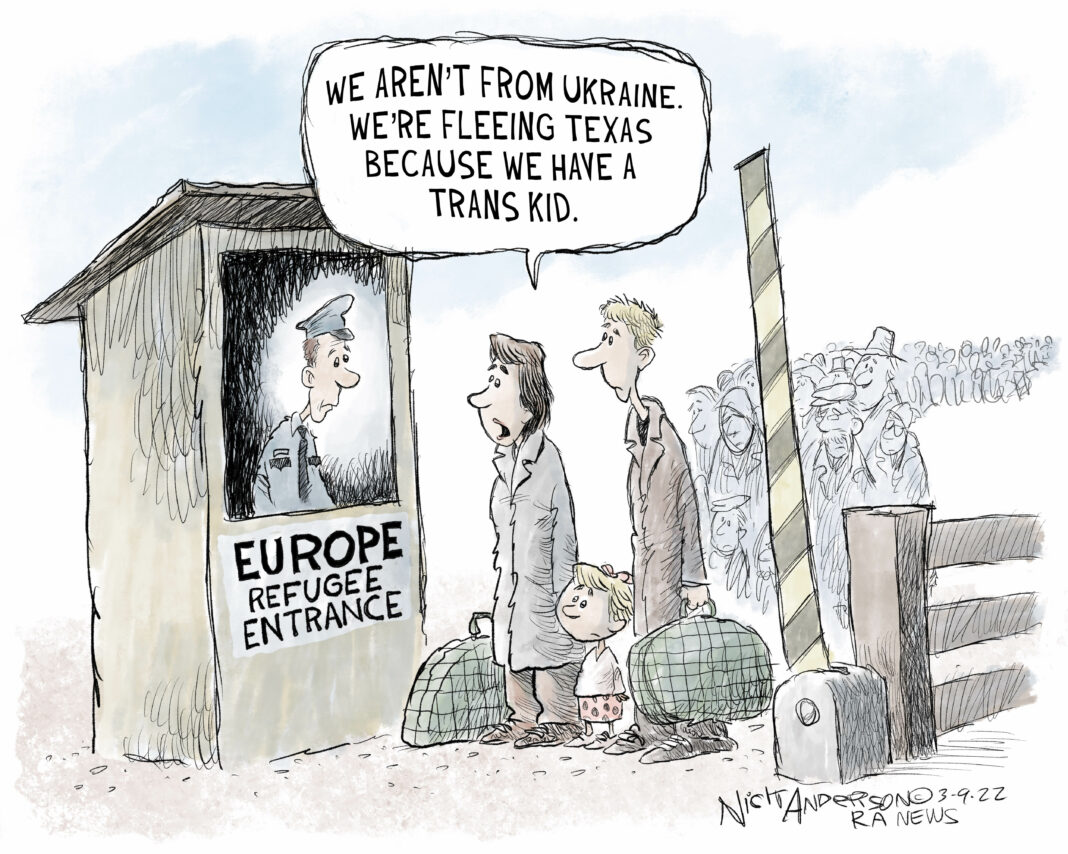
The value of cruelty. Pretty much any time you want, you can pull examples out of the headlines. Recently, the people Christians want to punish have been kids who express the wrong gender identity or sexual orientation, as well as the adults who support them.

Until Friday, when a state judge put a stop to the practice for violating the state constitution, Texas was investigating nine families for "child abuse" because they'd been seeking medically approved treatment for their child's gender dysphoria. One child's mother commented:

I know what the law says. And yet it is terrifying to have a [Child Protective Services] worker come into your home and threaten to take your children away for doing nothing more than loving them unconditionally.

https://www.reformaustin.org/political-cartoons/refugees/

Florida's new Don't Say Gay law will stop kids who are uncertain about their sexual orientation from confiding in teachers or school counselors: By law, school employees have to break their students' trust and out them to their parents; otherwise, the school district could be sued. And if you're a teacher or principal who sees elementary-school kids being bullied because of their gender expression, you can't start a conversation about that without risking a lawsuit, because such topics are not "age appropriate".

As soon as you picture either law in practice, the cruelty is obvious, and it's hard to see who benefits. But if you ask the people behind these efforts what motivates them, one answer almost always comes up: their Christian values. The Tennessee version of Don't Say Gay includes this in its list of justifications:

WHEREAS, the promotion of LGBT issues and lifestyles in public schools offends a significant portion of students, parents, and Tennessee residents with Christian values" …

Where on Earth did these "Christian values" come from? Not Jesus.

Did Jesus have "Christian values"? If you've never read the gospels, but you've listened to the people who invoke his name, you might think Jesus talked about sex and gender constantly. But in fact you'd be wrong. Homosexuality never comes up in his sermons and parables, and Jesus never rebukes his followers for getting their gender roles confused.

Sex is on the mind of the Pharisee who faults Jesus for letting a prostitute touch him, and on the minds of the men he stops from stoning an adulteress, but little in the text indicates that Jesus himself made a big deal out of people's genitals or what they did with them. (Examine, say, the parable of the sheep and the goats. None of the failings that keep people out of Heaven are sexual.)

If you believe that Jesus defines Christianity, then persecuting gay and trans people isn't a Christian value at all.

Other Christian values. Those are recent headlines, but these last few weeks have been nothing special. If I'd written this article in a different month, I might have talked about the Christians who were doing their damnedest to help a deadly virus spread freely and kill as many people as possible.

"Religious liberty" now includes churches' right to host superspreader events, which many of them have been eager to do. Rather than thank God for the scientists who found and tested a vaccine so quickly, many Christians spread lies and conspiracy theories about the vaccines ("For those of you who say you are Christians, what will your life review look like at the end of your life? Will the Lord say to you: 'You coerced people into being injected with this gene-modification technology that irreversibly disrupts your chromosomes?'"). Wearing a mask in church became evidence that you didn't trust God's protection. (But if you really trusted God, wouldn't you jump off a tall building?)

In other weeks, the headlines have been about Christian attempts to shut down discussion of systemic racism, or to stop children from learning America's racist history.

Making women bear their rapist's child is a Christian value. ("As plain as day, God spoke to me. … And I said yes Lord, I will. It's coming back. It's coming back. We are going to file that bill without any exceptions.") But miscarriage-inducing herbs have been part of women's folklore since the beginning of time. Isn't it strange that Jesus never mentioned them?

Keeping refugees and asylum-seekers out of the country is a Christian value. Some prominent pastors defended breaking up immigrant families, while others invented elaborate sophistries to explain why the Bible's many references to immigrants don't mean what they say.

The Bible warns us not to bear false witness. But Christian churches have become the prime breeding ground for the most vicious and baseless conspiracy theories.

Jesus told a young man to "sell your possessions and give to the poor". But now getting rich is a Christian value, and successful Christian preachers live in palaces and travel in personal jets.

Joel Osteen's house

"Put away your sword," Jesus said in Gethsemane. But now gun-toting vigilantes are Christian heroes, and the faithful are carrying concealed weapons in church. (What was that about trusting God's protection?)

You know who's also a Christian hero these days? Vladimir Putin. A Republican candidate for the Senate praised Russia as a "Christian nationalist nation" and told CPAC

I identify more with Putin's Christian values than I do with Joe Biden.

As far back as 2014, Franklin Graham was lauding Putin for the even harsher Russian version of Don't Say Gay:

Isn't it sad, though, that America's own morality has fallen so far that on this issue — protecting children from any homosexual agenda or propaganda — Russia's standard is higher than our own?

And of course I have to mention the righteous politician who in 2020 garnered 80% support from White Evangelicals: a compulsive liar and conman, who has cheated on all three of his wives and traded the first two in for younger models, who can't name a single Bible verse and admits that he has never sought God's forgiveness. What a guy!

How did this happen? You might imagine that the teachings of Jesus would be a pole star for Christians, and that any time they started to drift away, the Sermon on the Mount would guide them back.

Clearly that's not happening. But why not?

The reason is simple: Jesus told stories and gave advice, but he never laid out a systematic theology or worldview. He used imagery that was designed to upend the way his disciples were thinking, but he never told them step-by-step how they should think.

So in Jesus' stories, mustard seeds — which were the scourge of Mediterranean gardeners because once mustard got into your garden you never got rid of it — were good things. An employer paid everyone the same, no matter how many hours they worked. A priest and a Levite could be bad neighbors compared to some nameless Samaritan. It was all pretty confusing.

Jesus hinted that you're not really supposed to understand right away. The Kingdom of God, he said, is like yeast; it works on you invisibly. His images and stories are supposed to sit in the back of your mind and ferment, not proceed logically from axioms to theorems.

And while that's a fine guru-to-disciple teaching technique, it leaves an opening for people who do lay out systematic theologies and worldviews, and do tell people what to think. Over the centuries that's what's happened. A conservative worldview has built up around Jesus' teachings and almost completely sealed them off.

Here's a simple example: According to John, Jesus once made this enigmatic statement: "The Father and I are one." But he never explained exactly how that worked. The result has been centuries and centuries of theological battles about the precise nature of the Trinity, arguments that have occasionally erupted into gruesome executions or even warfare.

In short: People got lost in the mystery of that one line, and wound up on the other side of the world from loving their neighbors.

How conservative theology leads people astray. Today, when you come to an Evangelical church, the main thing you are met with is a worldview that contains simple answers about what's going on in the world and how you should respond to it. Sometimes those answers are proof-texted back to something Jesus said (though more often they point back to Paul or Leviticus or some verse in Revelation that could mean just about anything). But invariably the logic only works one way: After the idea is presented to you, you can squint at one of Jesus' more puzzling statements and say "Oh, that's what he meant." But you can't walk that path in the opposite direction; what Jesus said would never lead you to the idea if some community-endorsed authority hadn't already put it in your head.

I'm not claiming this is a complete list, but here are six ways that a conservative theology and worldview tilts Evangelical thinking in directions that eventually put a wall around Jesus and his teachings.

  1. Focusing on the Devil opens a person to conspiracy theories.
  2. Believing that we're in the End Times justifies suspending normal reasoning.
  3. Traditional religion values tradition more than religion.
  4. A focus on individual souls and individual salvation makes systemic or social reasoning heretical.
  5. Fundamentalism promotes bad-faith reasoning.
  6. Christian imagery and rhetoric tilts towards autocracy.

1. The Devil is the prime conspirator. The conventional wisdom isn't always right, and occasionally powerful people do conspire for nefarious purposes. But the problem with conspiracy-theory thinking is that it's too easy: You can always come up with some way to fit current events into whatever story you want to believe. No matter what actually happens, you can make it prove that whoever you like is the hero and whoever you hate is the villain.

So if you want to live in the real world rather than some dramatic fantasy of your own choosing, you need some standards that filter out the crazy conspiracies. The most important standard is to realize that conspiring is hard. People all have their own motives and purposes, so keeping a large number of them on the same page is difficult, especially if you have to do it secretly.

So the first questions a rational person asks about a conspiracy theory are: How many people would have to commit to this, and why would they? What keeps them all pulling in the same direction? Why don't they rat each other out?

Those questions sink most conspiracy theories. Take the central Q-Anon theory for example: that the world is run by a ring of child-sex traffickers, and has been for a long time. Now picture yourself as a rising star in the world of money and politics. At what point would the conspirators reach out to you? And what if child sex wasn't your particular kink? It just seems really hard to make this work.

But now imagine you believe in the Devil. (Satan does show up in Jesus' stories, but those references are easy to misread. Our current picture of the Devil stitches together diverse Biblical characters with different names, and didn't fully congeal until a century or so after Jesus. Neil Forsyth described the process in The Old Enemy.) The Devil doesn't need a motive to launch some evil plot, because for the Devil, evil is its own reward. Minions of the Devil, likewise, do things just for the sake of being evil.

If you can imagine a core of people like that, who don't need the conspiracy to bring them wealth or power or status or any other visible benefit beyond the simple opportunity to do evil, then just about any conspiracy becomes feasible. The door to believing whatever you want is wide open.

2. Strange things happen during the End Times. In the summer of 2013, 77% of Evangelicals told the Barna Group that they agreed with this statement: "The world is currently living in the 'end times' as described by prophecies in the Bible." Evangelicals not only believe this, they seem to enjoy thinking about it: The Left Behind series of novels (based on a literalistic interpretation of the Book of Revelation) has sold more than 80 million books and inspired six movies.

Paradoxically, a belief that the world is ending soon has always been prominent in Christian circles. As far back as the first or second century AD, St. John could close his Book of Revelation with

He who testifies to these things says, "Yes, I am coming soon." Amen. Come, Lord Jesus.

That's Jesus' second coming he's talking about, the one Christians are still waiting for. Nearly two thousand years later, John's "soon" has still not turned into "now".

But in spite of this extended delay, the persistence of the end-times belief is not hard to understand. Basically, it's a form of self-aggrandizement, because it makes our lifetimes special. Nobody, apparently, wants to believe that they live in a humdrum era.

Now think about the everyday significance of that belief: More than three-quarters of conservative Christians approach the evening news the way the rest of us approach the final chapters of a novel. They expect diverse plot threads to start coming together. Connections that would ordinarily be wild coincidences are almost required. (Of course the serving girl with amnesia is the Duke's long-lost niece! I should have seen that a mile away.)

What's more, as the final battle of Good versus Evil approaches, the participants should become easier to identify. So of course there's an international conspiracy of blood-drinking child molesters. How could there not be?

3. Traditional religion is more traditional than religious. Religious teachings are one of the prime ways that a community maintains its institutions and passes down its folk wisdom. The practices in one part of the world may be completely different than those somewhere else, but you can be pretty sure that in both places, some local deity wants things to work that way.

New empires often bring new religions (which usually complete the circle by justifying the new imperial order). But community practices change much more slowly than military or political power structures. So old practices get woven into the new mythology and the new belief system, as if they had been part of the new religion all along. The annual fertility rite of a pagan deity continues, but instead is blessed by a Catholic saint. And no matter how many Islamic scholars say that the Quran does not endorse honor killings, many common people in Muslim countries keep on believing that it does.

In 21st century America, "traditional values" and "Christian values" are often used interchangeably, but they ought to be very different concepts. Countless varieties of bigotry are traditional in America: racism, sexism, antisemitism, anti-gay prejudice, and many others. Like any dominant religion, Christianity has often been co-opted to justify abusing "outsiders" (however that term has been defined at different times in different places). But custom shouldn't turn prejudices into Christian values.

4. Bias towards individuality. One of Jesus' most mysterious phrases is "the Kingdom of God". He said it a lot, and anyone who claims to know exactly what he meant by it is kidding somebody, most likely himself. Sometimes it sounds like a vision of an ideal future. Other times it seems more like a metaphor for the state of consciousness Jesus had achieved and was trying to teach. Once in a while it resembled an afterlife.

Nobody really knows. It's even possible that Jesus meant different things at different times, or that the gospels occasionally misquote him.

But in the conservative theology I was taught growing up, the Kingdom of Heaven was a literal place that I could hope to reach after death. I'd get there as an individual, because we all have individual souls, which will be judged at the end of time. There's no such thing as a collective soul (except in Ralph Waldo Emerson and Walter Wink's creative reimagining of angels).

My teachers never admitted that all this stuff about souls is speculative. It's not really spelled out anywhere in scripture. (If the sheep and goats story is supposed to be a description of literal events, it's just about the only parable that is.) Heaven is speculative also, and (like the Devil) has meant different things in different eras.

Once you've made that speculative leap, though, any kind of social thinking is going to give you problems. If good and evil are only accounted for in judgments about individuals, then good and evil must only exist in individuals.

Systemic racism, then, can only be a heresy. If racism is evil, then that evil has to be accountable to individuals, not to systems. If stealing is a sin, then the man who steals a loaf of bread is guilty, and not the society that left him no other way to feed his family. If enslaving people is evil, then George Washington, Robert E. Lee, and many other people we might want to admire were evil. Slavery can't be blamed on society, because society will never stand before St. Peter and be sent to Heaven or Hell. So maybe slavery wasn't really so bad.

Theologians created these problems by going too far out on a limb. They've constructed a semi-logical structure around some hints in scripture, and that structure leads them into absurdities and injustices.

5. From apologetics to bad-faith denial. Apologetics is the art of using rational argument to support positions that originate in faith. It often looks like philosophy, but it isn't, because practitioners aren't reasoning in order to find truth. Instead, they believe they've already found truth through their faith, and are now just trying to persuade others. So apologists start with their conclusions already established, and try to tie them to convincing first principles via logic.

Apologetics can be an honorable practice if the apologists are open about what they're doing. (And philosophy can even benefit if the arguments are sharp enough. Aquinas' Summa Theologicae proudly claims to be apologetic, but philosophers still read it.) The practice goes back at least as far as the Middle Ages, and is still taught in seminaries.

But for most of its history, apologetics was an esoteric field of study. Parishioners in the pews might believe what they were taught or doubt it, but they didn't really care whether St. Anselm's proof of the existence of God was sound.

That all changed in the 19th century, when geologists discovered a world far older than Genesis described, and biologists developed a theory of human origins very different from God shaping Adam out of dust. Science was now invading turf that had previously belonged to religion, and many religious people believed they had to fight back.

That was the origin of fundamentalism.

But a problem soon became apparent: If you restrict yourself facts and logic, Genesis is just wrong. If you're going to argue that it's right (without invoking faith), you have to cheat. You have to make bad-faith scientific arguments and hope you can sell them. So fundamentalists did that. They're still doing it.

The result was that fundamentalist churches encouraged their members to reason badly, and to accept any kind of nonsense if it supported a literal interpretation of the Bible. In essence, they built a back door into their members' reasoning processes. But in the long run, that kind of corner-cutting always has unforeseen consequences. In the subsequent decades, self-induced gullibility has made fundamentalists prey to intellectual hackers and conmen of all sorts.

Today, motivated reasoning is the rule in Evangelical churches, and has spread to topics that have little to do with the Bible. So Evangelical churches have become centers of climate change denial and Covid denial, as well as hotbeds of Q-Anon conspiracy thinking. Rose-colored views of American history — where the Founders are latter-day prophets, slavery wasn't really so bad, and the Native American genocide shouldn't be examined too closely — are practically dogma among White Evangelicals.

Evolution denial established the notion that if enough people don't want to believe some true thing, it's OK for them to support each other in denying it. That genie is out of its bottle now, and it will work ever-greater mischief in conservative churches until they recognize the problem they have made for themselves.

The Divine Monarchy. When monotheism replaced polytheism, the Universe began to be viewed as a vast autocratic system. You can see the transition happening already in Aeschylus' Prometheus Bound, written in the fifth century BC. There are still many gods at this point, but the sky god is sovereign to the point of tyranny. In the opening scene, the personification of Power explains to Hephaistos why he must complete the disagreeable job of chaining Prometheus to the mountain: "Zeus alone is free."

Jesus often talked about the Kingdom of Heaven, but St. Paul supported worldly kings in Romans 13:

Let everyone be subject to the governing authorities, for there is no authority except that which God has established. The authorities that exist have been established by God. Consequently, whoever rebels against the authority is rebelling against what God has instituted, and those who do so will bring judgment on themselves.

If we know that Heaven is a kingdom, then maybe Earth should be a kingdom too. Maybe we should find the godliest man we can (of course it has to be a man), and do whatever he says. (And by the way, have I told you about the lying, womanizing, unrepentant, Bible-illiterate conman all the other Christians are voting for? Maybe he's the guy.)

Today, Christians talk about "Christ the King" and say "Jesus is Lord!" with the enthusiasm of football fans saying "We're #1!" But again, Jesus never laid out his political theory. If you think you know what kind of theocracy Jesus wants you to establish, or even who Jesus thinks you should vote for, you're standing at the end of a long chain of speculation.

I can't tell you what Jesus would think, but I can tell you what I think: If that long chain of speculation has you supporting cruelty, and if it gets in the way of healing the sick, feeding the hungry, and welcoming the stranger, then you probably did it wrong.

Share this: