Thursday, May 04, 2017

ANS -- Berkeley author George Lakoff says, ‘Don’t underestimate Trump’

Here is a really good, short, article on what George Lakoff is doing and saying these days.  We need to listen to him more, and support his work.  The comments are good, and lots of them, so you'll have to go there if you want to read them.  
--Kim


Berkeley author George Lakoff says, 'Don't underestimate Trump'

George Lakoff. Photo: Daphne White

George Lakoff, retired UC Berkeley professor and author of Don't Think of an Elephant, is one of a very few people in Berkeley who does not underestimate Donald Trump. "Trump is not stupid," he tells anyone who will listen. "He is a super salesman, and he knows how to change your brain and use it to his advantage."

In fact, Lakoff predicted a year ago that Trump would win with 47% of the vote. (The actual total was 46%.) Lakoff even told Hillary Clinton's campaign and PAC staffers how to counteract Trump's message. But they couldn't hear him.

As far back as 2006, Lakoff saw the writing on the wall. "A dark cloud of authoritarianism looms over the nation," he wrote in his book Thinking Points, A Progressive's Handbook. "Radical conservatives have taken over the reins of government and have been controlling the terms of the political debate for many years." The progressives couldn't hear him, either.

Lakoff's message is simple, but it is couched in the language of cognitive linguistics and neuroscience. The problem is that political candidates rely on pollsters and PR people, not linguists or neuroscientists. So when Lakoff repeatedly says that "voters don't vote their self-interest, they vote their values," progressive politicians continually ignore him. His ideas don't fit in with their worldview, so they can't hear him.

Mobile Replacement BHS fundraiser

But a worldview is exactly what Lakoff is talking about. "Ideas don't float in the air, they live in your neuro-circuitry," Lakoff said. Each time ideas in our neural circuits are activated, they get stronger. And over time, complexes of neural circuits create a frame through which we view the world. "The problem is, that frame is unconscious," Lakoff said. "You aren't aware of it because you don't have access to your neural circuits." So what happens when you hear facts that don't fit in your worldview is that you can't process them: you might ignore them, or reject or attack them, or literally not hear them.

This theory explains why even college-educated Trump voters could ignore so many facts about their candidate. And it also explains why progressives have been ignoring Lakoff's findings for more than two decades. Progressives are still living in the world of Descartes and the Enlightenment, Lakoff said, a neat world governed by the rules of logic. Descartes said, "I think therefore I am," but Lakoff claims that we are embodied beings and that 98 percent of thought is unconscious.

Our thoughts are chemical in nature, and occur within the confines of a physical body: we are not 100 percent rational beings.

So if you are going to craft a message that can reach people who disagree with you, you have to understand their subconscious worldview. Lakoff calls this worldview a "frame," and claims that Republicans have done a much better job with framing over the past 30 or 40 years. Republicans understand the narrative that governs many people in this country, and they target their message directly to that worldview. Democrats, on the other hand, ignore the worldview and focus instead on rationality, facts and policies.

It is a myth that the truth will set us free, Lakoff said. Case in point: Hillary Clinton's well-thought-out policy positions vs. Donald Trump's tweets. The tweets had one central and fact-free message: "Make America great again." Clinton's message was more detailed and fact-based, but also much more diffuse. Heavy on Enlightenment, short on metaphor. "I spoke to people at the center of Hillary Clinton's campaign in 2016, and told them they were doing everything they could to lose," Lakoff said. "It didn't make any difference. People are who they are, and they were going to do things their way. I could see the disaster happening the entire year."

Lakoff started teaching linguistics at UC Berkeley in 1972 and retired as the Richard and Rhoda Goldman Distinguished Professor of Cognitive Science and Linguistics in 2016. Since his retirement, he has spent much of his time traveling around the country, giving talks and interviews. He has written or co-authored 11 books, and is at work on another. Lakoff is the kind of professor who will tell you, in answer to a question, that he wrote a 500-page book about that very topic. "I wrote two 500-page books and three 600-page books," he adds, laughing. "I like to be thorough."

In non-academic circles, Lakoff is best known for his slim book Don't Think of an Elephant. The book, recently reprinted, was a New York Times best-seller when it first came out in 2004, after the "disaster" of the George W. Bush election. Don't Think of an Elephant was mostly a compilation of essays, and the main point was that trying to use Republican's language and theories against them is counter-productive.

"What George has done is tie the question of political belief to cognitive science," said Lawrence Rosenthal, chair and lead researcher of the UC Berkeley Center for Right-Wing Studies. "He understands that the way to get at people's political opinions is by talking about values, rather than specific arguments about specific issues. He believes conservatives are much better at this than liberals and have been for a very long time. They have a much better track record of crafting political appeals by way of the appropriate value statements for their audience."

The reason Democrats have such a hard time with Lakoff's message, Rosenthal said, "is because George is going up against something very deep-rooted, something that goes back to the Enlightenment. He would argue that the Enlightenment approach to political persuasion was never appropriate… Every time I hear a political candidate say the word 'percent,' I think of 'Oh God, they haven't read George'."

Lakoff gave a talk recently at the Center for Right-Wing Studies and pointed out that students who become Democratic operatives tend to study political studies and statistics and demographics in college. "Students who lean Republican study marketing. "And that's his point," Rosenthal said. "It's a very different way of thinking."

Lakoff's core finding revolves around the metaphor of family. He claims there are two core beliefs about the role of families in society, and the belief one holds determines whether one is conservative or liberal. Moderates are people in the middle who are able to hold some ideas from both sides, and being able to understand and persuade them is crucial to winning any election.

Conservatives believe in a what Lakoff calls the "strict father family," while progressives believe in a "nurturant parent family." In the strict father family, father knows best and he has the moral authority. The children and spouse have to defer to him, and when they disobey, he has the right to punish them so they will learn to do the right thing.

"The basic idea is that authority is justified by morality, and that, in a well-ordered world, there should be a moral hierarchy in which those who have traditionally dominated should dominate," Lakoff said. "The hierarchy is God above man; man above nature; the rich above the poor; employers above employees; adults above children; Western culture above other cultures; our country above other countries. The hierarchy also extends to men above women, whites above nonwhites, Christians above non-Christians, straights above gays." Since this is seen as a "natural" order, it is not to be questioned.

Trump and those crafting the Republican message play straight into this strict father worldview, which is accepted in many parts of the country. Even traditionally Democratic groups such as union members and Hispanics include members who are strict fathers at home or in their private life, Lakoff says. The Republican message plays well with them.

The nurturant parent family, on the other hand, believes that children are born good and can be made better. Both parents are responsible for raising children, and their role is to nurture their children and raise them to nurture others. Empathy and responsibility toward your child also extend to empathy and responsibility toward those who are less powerful, or suffering from pollution or disease, or are marginalized in some way.

While Lakoff is an unabashed Berkeley progressive, he said Democrats are decades behind in understanding how to frame issues in a way that can reach swing voters.

"Protection is part of the progressive moral system, but it has not been celebrated enough," Lakoff writes in Don't Think of an Elephant. For example, progressives should start calling federal regulations "protections." If they start re-framing Trump's promise as "getting rid of two-thirds of federal protections" — and spell out what some of those environmental and health and water quality "protections" are — there might be less support for repealing federal regulations, Lakoff said.

"Every progressive knows that regulations are protections, but they don't say it," he added. Similarly, "taxes" are actually "investments in public resources." Government investment pays for the infrastructure on which private industry and everything else is built, Lakoff said. "Roads, bridges, public education, national banks, the patent office, the judicial system, interstate commerce, basic science for drug development — all of that is financed by government investments." Yet Democrats allow Republicans to frame the debate in terms of tax "relief," he said.

Lakoff met with Barack Obama when he was still a Senator, and tried to get him to change the terms of the debate more than 10 years ago. When he arrived at the Senate office, he got a round of applause from Obama's staff and found all of his books in speechwriter John Favreau's office. But when he gave Obama a copy of his book Thinking Points, Obama immediately handed it off to Favreau. "Obama assumed framing was about messaging, and it was about giving speeches. He is a very good speaker, so …" Lakoff trails off. "Obama did a lot of things right in 2008 when he was running, but then he dropped it. He understood the idea, but he didn't apply it consistently. I think he believed he could balance both sides, but he wasn't prepared for the culture wars that he encountered."

Lakoff believes it's a mistake for Democratic politicians to move toward the center in an effort to reach more moderate voters. The Republicans have moved further to the right, and they continue to win elections. What Democrats need to do is articulate their message in terms of metaphors that voters can understand, and stick to their core values, Lakoff said.

In terms of messaging, though, he doesn't believe either Bernie Sanders or Elizabeth Warren have it quite right. "Bernie has a schtick," he said. "He has great goals, I appreciate his goals, but he is very stubborn. He doesn't understand conservatives or framing, and he isn't going to change. He's been successful with what he's doing, and that's enough for him," Lakoff said. "I talked with him several times, with no effect. He wouldn't remember it, and couldn't have cared less."

Elizabeth Warren "has come the closest to articulating the idea about citizens caring about each other and working through government to provide maximum freedom for everybody," he said. "But Elizabeth has a problem: she is shrill, and there is a prejudice against shrill women. It's a terrible prejudice, but it's a prejudice. She has been recognized as one of the most credible presidential candidates by conservatives, and she has been attacked viciously by the right."

Berkeley and the Alt Right

Berkeley could also reframe the word "freedom" when it comes to the demonstrations that have started taking place here, Lakoff said. "The protestors are trying to claim that what they are doing is Free Speech, but assemblage for the purpose of beating people up is not freedom," Lakoff said. "You have the freedom to walk down the street, but not the freedom to keep other people from walking down the street: you don't have the freedom to impose on other people's freedom. The alt-right doesn't have the right to come here and beat people up, and neither does Antifa."

Lakoff has teamed with Gil Duran, former press secretary to Jerry Brown and Sen. Dianne Feinstein, to create a two-person communications company called Frame Lab that will help nonprofits with their framing issues. He is also creating a Citizens' Communication Network, which will offer free information on framing issues for activists. Lakoff is trying to raise money for this nonprofit, but in the meantime, he will share ideas and resources on his Twitter feed, blog and Facebook. "We will do analyses of what works, what doesn't work, and what they need to look out for," Lakoff said.

The unassuming Lakoff is an accidental radical, the rare academic who has stepped outside the confines of his discipline and attempted to scale the battlements of real-world electoral politics. When asked whether he was depressed that his message is still not being heard in the political world, he said, "it's frustrating, and I can be outraged, but I don't get depressed. Every day I do something worthwhile and positive." It's all about the framing.

To read some of Lakoff's writing, click here.

Wednesday, May 03, 2017

ANS -- Is This Small City the Future of Democratic Engagement in America?

This is a really heartening, upbeat article.  But the important point is that democracy is a process, and we need to do it all the time!  
--Kim


Is This Small City the Future of Democratic Engagement in America?

Activists in Lancaster, Pennsylvania, have embarked on a nonstop campaign to resurrect the practice of progressive politics in the heart of Trump country.

It's a fine spring Sunday in Lancaster, Pennsylvania, and most people in this decidedly pious city in the heart of Amish country are at home or at church celebrating the Sabbath. Even the famous Central Market—with its traditionally dressed vendors, its German delicacies, its Muenster cheeses and cured meats —is closed.

When you're trying to create a populist political movement from scratch, however, you don't get a lot of down time. And so Michelle Hines and her partner, Daniel Levin, are out knocking on doors and telling their neighbors about the new grassroots group in town.

Hines, a young white woman who works a day job at a local laboratory, ascends the stoop of a gray stone row house and a middle-aged lady in a dressing gown and slippers answers the door.

Hines introduces herself and then asks the crucial question: "What do you think of the political establishment?"

"It sucks!" says the woman at the door, who gives her name as Judy and describes herself as a Republican who didn't vote in the last election. "It ain't good, I'll put it that way." The woman is open and garrulous, and Hines invites her to the next monthly meeting of the group she represents. It's called Lancaster Stands Up.

The organization, Hines explains, is a way for people who are sick of the status quo "to come together, to get plugged in." It's a polite and strategic description, but there's plenty more to say.

Founded in the wake of Trump's victory and led by a 12-person leadership committee, Lancaster Stands Up aims to upend politics-as-usual in this central Pennsylvania city. It wants nothing less than to break the stranglehold of both the Democratic and Republican establishments here and replace them with a progressive multi-racial political force beholden to the people alone. And it is using the tools of long-haul grassroots activism—canvassing, vetting candidates, bird-dogging political foes, forming unlikely alliances, training leaders, convening meetings—to build its constituency.

A crew of young lifelong Lancastrians, some of whom have been organizing together since high school, launched the group on their own, independent of any national organization, last November. Through huge rallies and intimate conversations and more, they are reminding neighbors like Judy that democracy is a practice that must be pursued constantly and in community. There are no off days. There are no off years. When civil society is at stake, it's campaign time all the time.

After describing her concerns about gentrification and the cost of a movie ticket, after lamenting the fact that "the rich keep getting richer and the poor keep getting poorer," Judy, standing on her stoop under the springtime sun, shares her contact information and tells Hines that she'll try to make the next meeting. She promises to tell her politically active daughter about Lancaster Stands Up, too.

"Nobody cares about anything but themselves anymore," Judy says, as Hines and Levin prepare to leave. "I am glad you are doing this."

Judy's sentiments about the contemporary political climate make sense. Lancaster, after all, is the sort of place that the national Democratic Party has largely surrendered to right-wing control. It is a middle- and working-class city of roughly 60,000, and it is diverse—more than 30 percent of the population is Hispanic, and roughly 16 percent of its residents are black, according to the 2010 census. The city, meanwhile, is situated squarely in an agrarian "red" county, where residents are almost entirely white and where there are tens of thousands more registered Republicans than Democrats. GOP politicians represent the area in the House of Representatives and make up most of its state legislative delegation, too.

Lancaster Stands Up, for its part, is unfazed by such facts. Indeed its members see small cities like Lancaster—situated at the nexus of urban and rural life—as crucial to revitalizing social-democratic values in the American heartland.

"After Trump's election, I knew I had to do something," says Eliza Booth, a 39-year-old black woman, lifelong Lancaster resident, and member of the group's leadership committee. "I needed to get involved and plug in instead of staying at home and being depressed."

A passionate Bernie Sanders supporter, Booth worked on his campaign during the Democratic primary and says she still believes he would have beat Trump in the general election. But Sanders didn't make it that far and Trump, whom she describes as "a monster," made it all the way to the White House. Like so many others, the outcome shocked and dismayed her.

A few days after the election, though, Booth saw a flyer announcing an emergency mass meeting in town. She decided to attend and found a huge turnout. At least 250 people were there. They had come to vent their anger and share their anxieties, to talk to their neighbors and plot a progressive comeback. It was the debut of Lancaster Stands Up, and Booth was smitten. Since then, she has spent 10, sometimes 20 hours a week volunteering for the group on top of her full-time job.

"It makes me feel so inspired every day," she says. "It makes me feel less alone in the fight."

Indeed, Lancaster Stands Up is proving that progressive values are alive and vibrant in Booth's community. Since its first emergency meeting, when outrage motivated people to come together and commiserate, it has seen both rapid growth and significant victories.

In late January, for instance, the group's immigration committee partnered with church and immigrant-rights organizations in the city to hold a rally against the Trump administration's first attempted Muslim ban. At least 2,000 people showed up for what organizers describe as the largest local protest in at least half a century. Lancaster Stands Up is now recruiting people for a rapid-response team to document and protest Immigration and Custom Enforcement raids in town.

The group is laboring in the electoral arena too. Its political committee, lovingly dubbed "Hold Them Accountable," has been particularly adept at hounding recently elected Republican Congressman Lloyd Smucker, who has quickly proved himself a line-toeing party loyalist.

Organizers have staged two raucous rallies outside of his district office, where hundreds gathered to demand that he stand up to Trump. They have denounced his policies on social media and penned op-eds calling on him to hold an in-person town-hall meeting for his constituents (which he has so far failed to do). They have flooded his office with thousands of postcards and phone calls.

Their most aggressive action, though, took place in early March when three Lancaster Stands Up leaders and another supporter paid to attend a Lancaster Chamber of Commerce forum, which featured a question-and-answer session with Representative Smucker. As Smucker prepared to take questions from the crowd, the four infiltrators stood up one by one and interrupted the event.

Becca Rast was one of them. In front of a roomful of Republicans, she denounced Smucker's support for Trump's "racist immigration and economic policies." Michelle Hines stood up immediately afterward—to shouts of "shut up" from old men in the crowd—and told Smucker that she had never seen her neighbors "so fearful for their lives and their families lives since you voted to repeal the ACA."

"Our representatives have not ever been pressured in the way they are being now," says Rast, a group founder who grew up in town. "Congressman Smucker was just so freaked out by it. He didn't know how to respond."

And while Lancaster Stands Up has mostly been playing defense, its leaders aim for something more.

"I feel like everything we have done up until this point is reactive," says Nick Martin, the 28-year-old former regional field director for the Bernie Sanders campaign here. Together with Rast and a few other friends outraged by last year's election, he called the first meeting of Lancaster Stands Up. "Now we are actually going on the offensive and building political power."

I catch up with Martin—who, like Rast, I first met in 2010 when we were involved in a campaign against mountaintop-removal mining in West Virginia—during the organization's April mass meeting. Wearing a camouflage cap and work boots, he is greeting people, a mostly older white set, as they file into a local bar in downtown Lancaster.

"Our goal," he explains, "is to use visionary politics to build a long-term mass-scale organization."

"We also want to scare the shit out of establishment politicians," adds Rafael Díaz, another member of the leadership team who, alongside Martin, is welcoming the roughly 200 people that have arrived for the meeting. "We want to show them we are not just going to hold signs in the town square. We are going to be a threat when they run for office."

Lancaster Stands Up hopes, someday soon, to endorse populist politicians in Democratic primaries and eventually run candidates of its own. On April 7, in an initial foray, the group co-hosted a forum in downtown Lancaster during which its leaders questioned five mayoral candidates in front of a crowd of around 200 people. It has yet to make any endorsements for the upcoming municipal election.

With 18 months to prepare, the group also wants to run Congressman Smucker out of office in 2018.

First, though, it must develop more leaders and recruit more supporters. And so, using voter data that Martin learned to analyze during the Sanders campaign, using scripts that the team developed over beers on a recent Friday evening, the group has decided to start sending canvassers out in both the city and the surrounding county to register voters and to tell people about the movement.

With this plan in mind, Lancaster Stands Up has decided to use part of its April mass meeting as a training camp of sorts. As the meeting enters its second hour, 60 or so people still sit in tight rows in the back of the bar. The coffee is flowing freely. A few people are holding beers. It's a beautiful spring day and the sun is flooding through large glass windows along the wall, but these eager new activists have elected to stay indoors a little longer to learn the art of canvassing.

Going door-to-door is one of "the skills of democracy that have atrophied over the last 40 years," says Jonathan Smucker, another Lancaster Stands Up founder and a veteran of the Occupy Wall Street movement. Tall and thin and white with salt-and-pepper hair, he paces the room and asks the audience to name the social movements that have used canvassing as a key organizing tool. The civil-rights movement, says one person. The labor movement, chimes in another. The suffragists, says still another.

"We think Trump was able to win because Democrats haven't fought visibly for working people," he tells the crowd. "We need a party that knows it has a grassroots force at its back so it doesn't cower to big money anymore." Creating that force will require rehabilitating atrophied civic muscles and that, at its core, is what Lancaster Stands Up is all about.

Smucker instructs the meeting attendees to get up from their seats and form two rows facing each other. One row will play the role of progressive canvassers, the other row will pretend to be apathetic though somewhat sympathetic voters. The clamor of voices reverberates through the room as the trainees talk among themselves, as they learn how to approach strangers and pull them into the political process, as they take part in a small simple practice that could go an awful long way toward rebuilding our democracy.

"Cut!" says Smucker, who, as it happens, is the second-cousin-once-removed of the congressman his group hopes to depose. "Cut! Cut! Cut!"

After a quick debrief, the dress rehearsal is over and the attendees are dismissed. With their new skills, with their willingness to experiment and listen and learn, with their populist anti-establishment platform, the Lancaster Stands Up crew is ready to hit the streets and persuade people to take part in a new kind of politics.

ANS -- Christianists Want Dominion Over America — And It’s Not Rude To Say So

This is really so right!  It's about the difference between Christianists and Christians.  One is a political movement and the other a religion.  
--Kim


Christianists Want Dominion Over America — And It's Not Rude To Say So

American Christianism is a white — and often white-supremacist — identity movement, not a religious one.

When the Christian soldiers of the American right champion their sadistic agenda against the poor and vulnerable, left-leaning Christians, and even non-Christians and secularists who have a passing familiarity with the dominant religion of the West, are understandably confused. You don't need a degree in religion to know that Jesus commanded his followers to care for others — the stranger, the hungry, the sick, and the imprisoned.

When Speaker of the House Paul Ryan called Trumpcare "an act of mercy" (a phrase that has a specific meaning to Catholics), fellow Catholic Representative Joe Kennedy wondered whether he and Ryan were reading the same Bible. "The one I read calls on us to feed the hungry, to clothe the naked, to shelter the homeless, and to comfort the sick.…This is not an act of mercy. It is an act of malice."

Donald Trump's proposed budget, with its devastating cuts to programs for poor families, ignited similar reactions fromreligious leaders outside the hard political right. Rachel Held Evans tweeted, "There are few things the Bible is unambiguously clear about, but from Hebrew Scripture to Matt. 25, care for the poor & needy is one of them." Defense of the rich at the expense of the poor sounds to believers and nonbelievers outside the GOP fold like hypocrisy from politicians who trumpet their religious virtues.

Hypocrisy is too generous a word. It posits a shared set of values and calls on politicians to repent and return to the Christian social justice mission that they must know, deep down in their souls, is what God demands of them. But the accusation of hypocrisy plays right into their hands. Once a person or party has staked out the high ground of orthodoxy, no one arguing from a less orthodox position can win.

They are literally holier than thou. That's why they invent any scriptural justification they can. Erick Erickson's argument that Jesus' definition of "the least of these" includes only fellow Christians is the current favoritedefensive weapon of the religious right against attacks from their progressive co-religionists. The American right enjoys this argument, because they will always win it as long as the public believes that the GOP is grounded in religious principles — that Republican politicians are, in some way that matters, Christians.

Defense of the rich at the expense of the poor sounds like hypocrisy. But hypocrisy is too generous a word.

That, as Evangelicals like to say, is between them and the Lord. The state of their souls is none of my business or yours. I don't know if they're Christians, and I don't care. Neither should you.

But they are Christianists — and that is everybody's business.

Andrew Sullivan first used the word "Christianist" in 2003 to describe Eric Rudolph, an anti-abortion and anti-gay American terrorist. He then expanded his definition in a 2006 article in TIME Magazine:

"Christianism is an ideology, politics, an ism. The distinction between Christian and Christianist echoes the distinction we make between Muslim and Islamist. Muslims are those who follow Islam. Islamists are those who want to wield Islam as a political force and conflate state and mosque. …It is the belief that religion dictates politics and that politics should dictate the laws for everyone, Christian and non-Christian alike."

The neologism made enough of a splash for the late William Safire to note it in his "On Language" column, and the New Yorker's Hendrik Hertzberg makes an admirable effort to use it as often as events require it, which, given the events of the past 15 years, has been often enough.

Sullivan based his coinage on "Islamism," a term scholars have preferred to "Islamic fundamentalism" since the early 1990s to describe movements in the Muslim world whose leaders claim political power in the name of religion. Fox News hounded President Barack Obama for not denouncing "radical Islamic terrorism" by name, but he was correct. Terrorism is never Islamic (any more than Rudolph's murderous bombing campaign was Christian), although Islamists have committed acts of terrorism in their attempts to achieve political goals. Perhaps President Obama (a Christian whom Christianists labelled an Islamist) now has enough free time to savor the irony of Christianists who purport to speak for all Christians excoriating him for refusing to say that Islamists represent all Muslims.

A practicing Catholic, Andrew Sullivan presumed that Christianists were Christians, their faith so powerful, it spilled over into a theocratic urge to enforce their traditions' opposition to the Sexual Revolution on everyone. This interpretation explains their virulent opposition to abortion, same-sex marriage, gender equality, and other issues on which several sects of orthodox Christianity have firm teachings — the same cultural phenomena on which Jerry Falwell's Moral Majority declared war in 1979.

But any pretense of a religious foundation for Christianism breaks down on many of the issues Christianists now consider their highest priority — cutting social services, blocking access to health care, lowering taxes, undermining public education, repealing restrictions on the ownership and use of firearms, endorsing harsh law enforcement methods and restrictions on the right to vote in communities of color, defending the Mexican border, and closing the door to refugees, to name a few.

While overwhelming majorities of African-Americans and Latinxs identify as Christian, American Christianism is a white — and often white-supremacist — identity movement, rather than a religious one. That so much of Trump, Ryan, and Mitch McConnell's agenda contradicts Biblical injunctions to welcome the stranger, do justice to the afflicted, care for the needy, and love one's neighbor hints at how far American Christianism is from the religious principles with which Republicans delight in cudgeling secularists.

Any pretense of a religious foundation for Christianism breaks down on many of the issues Christianists now consider their highest priority.

Another clue to the chasm between Christianity and Christianism lies in polling data. On election day, 58% of non-Catholic Christians of any race voted for Donald J. Trump, but 81% of self-identified white, born-again/evangelical Christians did.

An even more curious phenomenon is revealed in the primary polling for candidate Trump. Among the 40% of GOP primary voters who call themselves Evangelical Christians, Donald Trump had the strongest supportamong people who do not attend church. At first blush, unchurched Evangelicals may seem a contradiction in terms, though we don't blink at secular Jews or lapsed Catholics who still identify with the religion of their communities. "Evangelical" or "born-again" sounds like a personal commitment, rather than a family tradition, but as Jack Jenkins explains:

"…when it comes to understanding Trump's popularity with the evangelical masses, the key lies in a simple reality: Lots of evangelicals — especially Trump supporters — simply aren't that 'religious.'"

Evangelical leaders complain of the Biblical illiteracy of American Christians, and around 40% of white Evangelical Protestants, the core demographic of the theocratically ambitious Republican Party, attend church only occasionally, or never. But they vote the straight "faith, family, and freedom" ticket of values voters. Molly Ball at The Atlantic observes,

"…when cultural conservatives disengage from organized religion, they tend to redraw the boundaries of identity, de-emphasizing morality and religion and emphasizing race and nation. Trump is both a beneficiary and a driver of that shift."

The voting patterns of the Evangelical base of the GOP tell you much more about their identity politics than their faith — that is, about their Christianism, not their Christianity.

This is why Trump's track record on the Ten Commandments and nearly satirical approximations of religious language didn't finish him off with Evangelicals, as his primary opponents and some of our Pundit Overlords thought it would. His clumsily counterfeited piety didn't have to convince anyone that he had a personal relationship with God (there are convicted murderers who exhibit more of the Fruit of the Spirit than the 45th President) — only that he could perform the nationalist flavor of Christianismsatisfactorily. Ted Cruz and Marco Rubio thought Trump had shown he was a fraud, but his very unfamiliarity with theology, church culture, and Scripture proved he was one of the Evangelical-but-unchurched gang. He didn't need to show off his Christianity. Just his Christianism.

The voting patterns of the Evangelical base of the GOP tell you much more about their identity politics than their faith.

Contemporary Islamism holds some of the same contradictions. While ISIS inflicts unspeakable suffering on innocent civilians, particularly women, in the name of restoring the caliphate and imposing what they consider the only pure form of Islam, many ISIS recruits know little to nothing about the religion they profess to fight for. An Associated Press report based on leaked ISIS documents found that 70% of the recruits ISIS tested for their knowledge of Islam scored in the lowest category. Two British recruits ordered Islam for Dummies and The Koran for Dummies from Amazon before embarking to fight in Syria. "…The current generation of jihadists is more likely to be 'Islamized radicals' than 'radical Islamists'… These are loners, misfits and socially maladjusted youths who are vulnerable to the puritanical promises of the Islamic State, and able to embrace its nihilistic agenda," writes Ishaan Tharoor in the Washington Post.

One need not be religious or spiritual to channel desultory violence into an extremist religious identity movement that gives lost people a sense of belonging and purpose. And while there is no Christianist version of ISIS, the cheers from Trump fans for his bombings in Syria and Afghanistan, as well as their behavior at his rallies, point to a similar undercurrent of tribalist blood-lust.

Most American children are taught that it's rude to criticize other people's religion. Christianists are well aware of this cultural norm and use it as a shield. They have every reason to conflate Christianity with Christianism because we grant far greater cultural leeway to religious than to political doctrine.

That's why the Resistance needs the word "Christianist" in our activist vocabulary, and we need to use it often and loudly:

You're persecuting us because we're Christians!

No. Your Christianity is your business. But you've made your Christianism everyone's problem.

You hate our ideas because they're Christian!

No, we oppose your policies because they're Christianist.

You're a bigot who hates Christians!

It's not bigotry to oppose Christianism, which is a political ideology, not a religion.

Refuse to accept their terms. Don't allow vicious fanatics who want to punish the vulnerable hide Grover Norquist, the American Conservative Union, ALEC, Fox News, Steve Bannon, the NRA, and even Donald Trump behind the cross.

We can't be too polite to call Christianists out by name.

Tuesday, May 02, 2017

Fwd: ANS -- Healthy California Act Wins Support from Senate Committee in Push for Universal Healthcare

Hi ANS group -- I usually try not to ask you all to sign things, as I feel I don't want to abuse this newsletter, but the person who sent me the info has asked, so here is her email, and you can use your own judgement as to sign or get involved or just delete.  
Thanks for your tolerance.
--Kim


---------- Forwarded message ----------
From: Mindy 
Date: Tue, May 2, 2017 at 7:30 AM
Subject: Re: ANS -- Healthy California Act Wins Support from Senate Committee in Push for Universal Healthcare
To: Kim Cooper <kimc0240@gmail.com>


Thanks, Kim, for reporting this.

The next step is getting through Senate Appropriations (at this point the financing details will have been added to the bill). Then it goes to the Senate floor. If it passes, it starts again with the Assembly (health, appropriations, and full Assembly floor). Then Governor Brown gets to pass or veto.

Healthy CA is hoping to get this all done in 1 year, but it may go into the second half of the 2 year cycle.

Is it appropriate to ask all your recipients to sign their support at healthycaliforniaact.org ?  Businesses, organizations and faith based affiliates can send an endorsement letter (sample letter on site). Businesses can join Business Alliance for HealthyCA—get businesses to sign up.  https://www.ba4hcal.org/

The only way we can be heard over the powerful special interests (insurance and pharmaceuticals) is to speak up and get active. "The proof that one truly believes is in action." Bayard Rustin (advisor to MLK)

Thanks again, Mindy

On May 2, 2017, at 1:37 AM, Kim Cooper <kimc0240@gmail.com> wrote:

In California, the Healthy California Act, a universal health care bill, SB 562, has passed out of committee.  It needs to go through finance, and then it should get voted on.  California has passed this before, when they knew the governor would veto it.  Let's see what happens this time.  They could lead the country to universal health care (it includes dental!).  
This good news was sent by one of our readers.  
--Kim


Healthy California Act Wins Support from Senate Committee in Push for Universal Healthcare

April 26, 2017

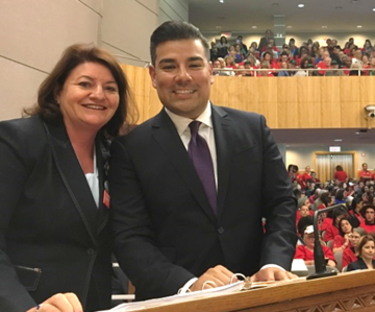
SACRAMENTO, CA – Today California took a major step toward universal health coverage when Senate Health Committee members voted 5-2 to approve the Healthy California Act (Senate Bill 562). Sens. Ricardo Lara (D-Bell Gardens) and Toni G. Atkins (D-San Diego) have proposed to cover all California residents with a publicly run plan.

Click here to read the full text of SB 562.

"With today's vote we are closer to being able to say, once and for all, that healthcare is not a privilege, it's a human right," said Senator Ricardo Lara. "Every family, every child, every senior deserves healthcare that costs less and covers more, and California has a chance to lead the rest of the nation toward universal care."

"I want to thank Senate Health Committee Chairman Dr. Ed Hernandez and the committee members who voted for SB 562 today," said Senator Toni G. Atkins. "They see clearly that the time is right for us to give all Californians the peace of mind that comes with knowing that they and their families will have access to quality healthcare, no matter who they are, how much money they have or who's in power in Washington, D.C."

Hours before the vote, nearly 1,000 people rallied in support of the Healthy California Act at the Sacramento Convention Center and marched to the Capitol for the hearing at the Senate Health Committee.

Supporters thronged the John Burton Hearing Room to speak for the bill.

The Healthy California Act will be heard next by the Appropriations Committee, which Sen. Lara chairs. A fiscal study is underway.

Highlights of the Healthy California Act:

  • Covers Californians for all medical care, including inpatient, outpatient, emergency care, dental, vision, mental health, and nursing home care.
  • Eliminates co-pays and insurance deductibles
  • Californians can choose their doctor from a full list of health care providers, not a narrow network chosen by insurance companies.
  • Referrals are not required for a member to see any eligible provider.
  • Californians are covered when they travel.
  • Physicians and nurses will make decisions about care, and have the ability to override computers or clinical practice guidelines in the best interest of the patient.
  • Healthy California will be governed by a nine-member, unpaid board appointed by the governor and Legislature and a public advisory committee of doctors, nurses, other health care providers, and consumers.