Sunday, December 24, 2017

ANS -- What Do You Call a World That Can’t Learn From Itself?

Is it this hopeless?  Are we this senile as a culture?  Can we do anything about it? It says it's a six minute read.  
--Kim


What Do You Call a World That Can't Learn From Itself?

Why Don't Americans Understand How Poor Their Lives Are?

Whenever I go back and forth between Europe and the States, a curious set of facts strikes me.

In London, Paris, Berlin, I hop on the train, head to the cafe — it's the afternoon, and nobody's gotten to work until 9am, and even then, maybe not until 10 — order a carefully made coffee and a newly baked croissant, do some writing, pick up some fresh groceries, maybe a meal or two, head home — now it's 6 or 7, and everyone else has already gone home around 5 — and watch something interesting, maybe a documentary by an academic, the BBC's Blue Planet, or a Swedish crime-noir. I think back on my day and remember the people smiling and laughing at the pubs and cafes.

In New York, Washington, Philadelphia, I do the same thing, but it is not the same experience at all. I take broken down public transport to the cafe — everybody's been at work since 6 or 7 or 8, so they already look half-dead — order coffee and a croissant, both of which are fairly tasteless, do some writing, pick up some mass-produced groceries, full of toxins and colourings and GMOs, even if they are labelled "organic" and "fresh", all forbidden in Europe, head home — people are still at work, though it's 7 or 8 — and watch something bland and forgettable, reality porn, decline porn, police-state TV. I think back on my day and remember how I didn't see a single genuine smile — only hard, grim faces, set against despair, like imagine living in Soviet Leningrad.

Everything I consume in the States is of a vastly, abysmally lower quality. Every single thing. The food, the media, little things like fashion, art, public spaces, the emotional context, the work environment, and life in general make me less sane, happy, alive. I feel a little depressed, insecure, precarious, anxious, worried, angry — just like most Americans do these day. So my quality of life — despite all my privileges — is much worse in America than it is anywhere else in the rich world. Do you feel that I exaggerate unfairly?

It's not just an anecdote, of course. Americans enjoy lower qualities of life on every single indicator that you can possibly think of. Life expectancy in France and Spain is 83 years, but in America it's only 78 years — that's half a decade of life, folks. The same is true for things like maternal mortality, stress, work and leisure, press freedom, quality of democracy — every single thing you can think of that impacts how well, happily, meaningfully, and sanely you live is worse in America, by a very long way. These are forms of impoverishment, of deprivation — as is every form of not realizing potential that could be.

But I don't wish to write a jeremiad, for I am not a pundit. The question is this: why don't Americans understand how poor their lives have become? Is it even a fair question to ask?

Of course, one can speak of capitalism and false consciousness and class war, of technology hypnotizing people with outrage. But I think there is a deeper truth here. There is a myth of exceptionalism in America that prevents it from looking outward, and learning from the world. It is made up of littler myths about greed being good, the weak deserving nothing, society being an arena, not a lever, for the survival of the fittest — and America is busy recounting those myths, not learning from the world, in slightly weaker (Democrats) or stronger (Republicans) forms. Still, the myths stay the same — and the debate is only really about whether a lightning bolt or a thunderstorm is the just punishment from the gods for the fallen, and a palace or a kingdom is the just reward for the cunning.

Hence, I have never once sees in America a leader saying, "hey! See that British healthcare system? That German union and pension system? Why don't we propose that? They work!!" Instead, the whole American debate is self-referential — pundits debating Andrew Jackson (LOL) instead of, say, what the rest of the world does today in 2017. How can a broken society grow only by looking inwards? If you are a desperate, heart-broken addict, what can you learn from yourself? Won't you only, recounting your pain, reach for the needle quicker? So we must look outwards, always, to learn best and truest — but I will return to that.

Still, though, "why don't Americans get it!" is an unfair question unless we ask it for both sides. So let us look at the picture from the opposite side, to see if our question is worth asking.

Do Europeans "get it" — how good their lives are, relatively speaking? Well, in Europe, regressive forces are at work, too — not as badly as in America, but rising, to be sure, in every single nation. So Europeans, too, at least enough to seat extremist parties in parliaments, take their quality of life for granted a little. Why would that be? Probably because they have now grown up with the gift their grandfathers and grandmothers gave them — constitutions in which healthcare, education, dignity, and so on, are essential rights — which are what underpin Europe's stunningly high quality of life. Hence, regressive forces in Europe say "these people must not have rights!", not understanding that those very rights, enshrined in rewritten constitutions, are exactly how Europe rose in a generation from the ruins of war, to the highest living standards ever, period — and to take them away is to begin erasing history.

So just as Americans don't get how bad their lives really are, comparatively speaking — which is to say how good they could be — so too Europeans don't fully understand how good their lives are — and how bad, if they continue to follow in America's footsteps, austerity by austerity, they could be. Both appear to be blind to one another's mistakes and successes.

Now. What does that really mean? We are living in a world unable to learn from itself. What would sane societies do, watching each other, watching each other's fortunes rise and fall? A sane America would look at Europe, see it's tremendously higher quality of life in every possible regard, and say, "My God! That is what we should reach for, too!". And a sane Europe would look at America, see it's falling life expectancy and imploding middle class, and say, "My God! We must never become that!" But you see, the irony is this: both are doing precisely the opposite. Europe is fighting against becoming more American, and America is not fighting to become more European. (Of course, I don't mean culturally — I mean in terms of constitutions, institutions, economy, polity, and social contracts).

History teaches us tragedy with irony. And this to me is the greatest irony of now. We are making three great mistakes in this age. The first is that we cannot learn from modern history — which is the story of Trump and America and tyranny. The second is that we cannot learn from deep history — that the whole story of human progress has been written by lifting one another up, not keeping anyone else down, and so the seductive ur-myth of the fascist, that I rise by pulling you down, right down into the abyss, is mesmerizing societies whole.

The third mistake we are making, though, is more invisible, and perhaps the greatest of all — what this essay is about: we cannot learn from one another anymore. How do we learn things? We can learn only in these three ways: from our own mistakes, from the mistakes all people have made, or from the fortunes and misfortunes of our peers. And of those three, the swiftest way to learn is to simply look at what others are doing, that work, and copy it.

Mimicry, of course, is how babies learn the most basic things — yet we cannot seem to even handle that much. So here is the unforgiving truth. We, in this age, this time, have regressed to something past an infantile state: we cannot even manage the mimicry that babies perform happily, the most basic form of learning that exists. We have regressed beyond regression itself.

And so we live in an age that feels paralyzed, stuck, unable to even grow like a baby does. It is failing the most basic test of all: the test of ignorance, of folly, of being unable to see, hold, mature, develop, grow. History is easy to forget — and it's easiest of all to take it for granted when you are the one who has not learned from it yet. What do you call a world that can't learn from itself? It is not even a baby. It is something more like an old man, on the edge of darkness.

Umair
December 2017

Saturday, December 23, 2017

ANS -- The Hitler Family Is Alive And Well — But They’re Determined To End The Bloodline

And now for something completely different.  I checked Snopes to see if this is accurate, but they didn't mention it.  I have no reason to doubt it though.  In some ways, it's a positive story.  It's interesting to me how they all came to the same decision, apparently independently.  
--Kim


The Hitler Family Is Alive And Well — But They're Determined To End The Bloodline

The Hitler family has five remaining members of the bloodline. If they have their way, it will end with them.

Hitler Family Adolf Hitler And Eva Braun

Wikimedia CommonsAdolf Hitler with his longtime lover and short-lived wife Eva Braun.

Peter Raubal, Heiner Hochegger, and Alexander, Louis and Brian Stuart-Houston are all vastly different men. Peter was an engineer, Alexander a social worker. Louis and Brian run a landscaping business. Peter and Heiner live in Austria, while the Stuart-Houston brothers live on Long Island, a few blocks from each other.

It would seem the five men have nothing in common, and apart from one thing, they really don't — but that one thing is a big one.

They are the only remaining members of Adolf Hitler's bloodline.

And they're determined to be the last.

Adolf Hitler was only married for 45 minutes before his suicide, and his sister Paula never married. Apart from rumors of Adolf having an illegitimate child, they both died childless, leading many to believe for a long time that the horrific gene pool had died with them.

However, historians discovered that though the Hitler family had been small, five Hitler descendants were still alive.

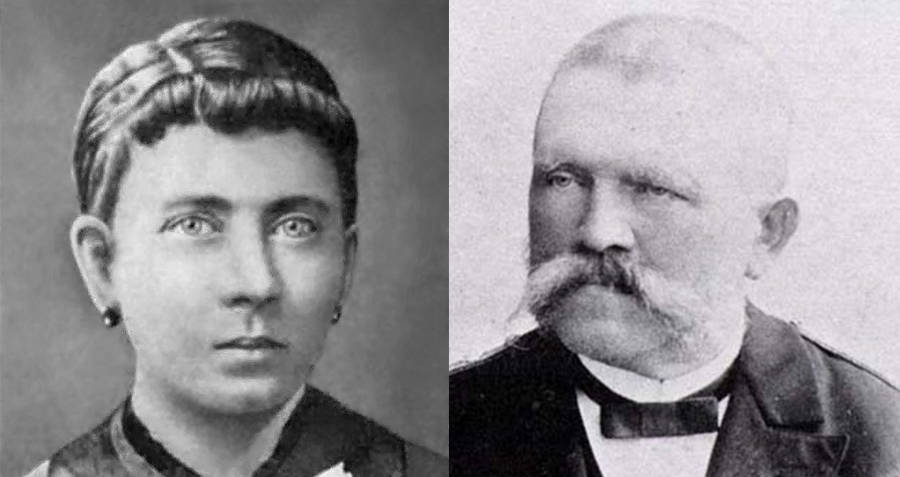
Before Adolf's father, Alois, had married his mother, Klara, he had been married to a woman named Franni. With Franni, Alois had had two children, Alois Jr. and Angela.

Hitler's parents Klara and Alois Hitler

Wikimedia CommonsAdolf's parents Klara and Alois Hitler.

Alois Jr. changed his name after the war and had two children, William and Heinrich. William is the Stuart-Houston boys' father.

Angela married and had three children, Leo, Geli, and Elfriede. Geli was most known for her potentially-inappropriate relationship with her half-uncle and her resulting suicide.

Leo and Elfriede both married and had children, both boys. Peter was born to Leo and Heiner to Elfriede.

As children, the Stuart-Houston boys were told of their ancestry. As a child, their father had been known as Willy. He was also known as "my loathsome nephew" by the Fuhrer.

As a child, the loathsome nephew attempted to make a profit from his famous uncle, even resorting to blackmailing him for money and plush employment opportunities. However, as the dawn of the second world war approached and his uncle's true intentions began to reveal themselves, Willy moved to America and after the war ultimately changed his name. He no longer felt any desire to be associated with Adolf Hitler.

He moved to Long Island, married, and raised four sons, one of whom died in a car accident. Their neighbors remember the family as "aggressively all-American," but there are some who remember Willy looking just a little too much like a certain dark figure. However, the boys have noted that their father's family connections were rarely discussed with outsiders.

Hitler's sister Angela Hitler

Getty ImagesAdolf's sister Angela, and her daughter Geli.

As soon as they knew about their Hitler family history, the three boys made a pact. None of them would have children and the family line would end with them. It also seems that the other Hitler descendants, their cousins in Austria, felt the same way.

Both Peter Raubal and Heiner Hochegger have never married, and have no children. Nor do they plan to. They also have no interest in continuing the legacy of their great-uncle any more than the Stuart-Houston brothers.

When Heiner's identity was revealed in 2004, there was a question of whether the descendants would receive royalties from Adolf's book Mein Kampf. All of the living heirs claim they want no part of it.

"Yes I know the whole story about Hitler's inheritance," Peter told Bild am Sonntag, a German newspaper. "But I don't want to have anything to do with it. I will not do anything about it. I only want to be left alone."

The sentiment is one that all five Hitler descendants share.

So, it seems, the last of the Hitler family will soon die out. The youngest of the five is 48, and the oldest is 86. By the next century, there won't be a living member of the Hitler bloodline left.

Ironic, yet fitting, that the man who made it his life's goal to create the perfect bloodline by eliminating the bloodline of others will have his own stamped out so intentionally.

Tuesday, December 19, 2017

ANS -- Toyota outlines plan for fully electrified lineup by 2025

This is a brief summary for those of you who have not been following what is happening in the world of the internal combustion engine.  Several countries are planning on outlawing new ICE cars very soon, big countries like India and China.  This change is happening whether or not the USA is part of the change.  If Trump has his way, we will be left behind.  
--Kim


Toyota outlines plan for fully electrified lineup by 2025

AUTOMOTIVE
The second-generation plug-in Prius at the New York Auto Show last year

The second-generation plug-in Prius at the New York Auto Show last year(Credit: Angus McKenzie/New Atlas)

Following in the footsteps of other legacy automakers like BMW and Volvo, Toyota has revealed plans to go big on electric vehicles over the next decade. The Japanese company today outlined a roadmap that will see the entire Toyota and Lexus lineup come with electric drivetrain options by 2025, with battery only and plug-in hybrids a key part of this strategy.

In terms of an electric vehicle revolution, things are set to get pretty interesting in the 2020s if recent chest-beating from some of the big names is anything to go by. Lately we've seen BMW move to drop an electric powertrain option into every model series and pump €200 million into its own battery research center, GM reveal plans to launch 20 pure-electric vehicles in the next five years and Volvo commit to launch only EVs from 2019.

Now Toyota, who sold more cars than any other automaker in four of the past five years, is making its move. At the heart of its newly unveiled EV strategy is a heightened focus on its hybrid electric vehicles (HEVs), plug-in hybrid electric vehicles (PHEVs), battery electric vehicles (BEVs), and fuel cell electric vehicles (FCEVs).

It says by 2025, every model in the Toyota and Lexus line-up will be available in one of these forms, meaning that the number of models offered without some kind of electric drivetrain will be exactly zero. It plans to introduce more than 10 new battery electric vehicles in the early 2020s, and expand its fuel cell lineup of passenger and commercial vehicles throughout the decade as well. Together, it hopes to sell more than 1 million zero-emission vehicles (BEVs and FCEVs) and 5.5 million electrified vehicles all up by 2030.

It also expects further work on its Toyota Hybrid System II (THS-II), introduced last year and used as the powertrain in the current Prius, will allow the expansion of its PHEV lineup.

Source: Toyota

ANS -- The Worst Mistake in the History of the Human Race

This was sent to me by one of our readers.  Notice it is not recent.  It is a very profound idea.  Send me feedback about this one.
The formatting doesn't seem to have made it through, so go to the website to read it.  
I believe there is a mistake in the last paragraph -- where he says "one hour" represents 100,000 years, I think he meant "one day".  
--Kim


Discover Magazine May 1987 Opinion 
The Worst Mistake in the History of the Human Race
By Jared Diamond
 University of California at Los Angeles Medical School 
Discover Magazine, May 1987 Pages 64-66 Illustrations by Elliott Danfield 

To science we owe dramatic changes in our smug self-image. Astronomy taught us that our earth isn't the center of the universe but merely one of billions of heavenly bodies. From biology we learned that we weren't specially created by God but evolved along with millions of other species. Now archaeology is demolishing another sacred belief: that human history over the past million years has been a long tale of progress. In particular, recent discoveries suggest that the adoption of agriculture, supposedly our most decisive step toward a better life, was in many ways a catastrophe from which we have never recovered. With agriculture came the gross social and sexual inequality, the disease and despotism, that curse our existence. At first, the evidence against this revisionist interpretation will strike twentieth century Americans as irrefutable. We're better off in almost every respect than people of the Middle Ages, who in turn had it easier than cavemen, who in turn were better off than apes. Just count our advantages. We enjoy the most abundant and varied foods, the best tools and material goods, some of the longest and healthiest lives, in history. Most of us are safe from starvation and predators. We get our energy from oil and machines, not from our sweat. What neo-Luddite among us would trade his life for that of a medieval peasant, a caveman, or an ape? For most of our history we supported ourselves by hunting and gathering: we hunted wild animals and foraged for wild plants. It's a life that philosophers have traditionally regarded as nasty, brutish, and short. Since no food is grown and little is stored, there is (in this view) no respite from the struggle that starts anew each day to find wild foods and avoid starving. Our escape from this misery was facilitated only 10,000 years ago, when in different parts of the world people began to domesticate plants and animals. The agricultural revolution spread until today it's nearly universal and few tribes of huntergatherers survive. From the progressivist perspective on which I was brought up, to ask "Why did almost all our hunter-gatherer ancestors adopt agriculture?" is silly. Of course they adopted it because agriculture is an efficient way to get more food for less work. Planted crops yield far more tons per acre than roots and berries. Just imagine a band of savages, exhausted from searching for nuts or chasing wild animals, suddenly grazing for the first time at a fruit-laden orchard or a pasture full of sheep. How many milliseconds do you think it would take them to appreciate the advantages of agriculture? The progressivist party line sometimes even goes so far as to credit agriculture with the remarkable flowering of art that has taken place over the past few thousand years. Since crops can be stored, and since it takes less time to pick food from a garden than to find it in the wild, agriculture gave us free time that hunter-gatherers never had. Thus it was agriculture that enabled us to build the Parthenon and compose the B-minor Mass. While the case for the progressivist view seems overwhelming, it's hard to prove. How do you show that the lives of people 10,000 years ago got better when they abandoned hunting and gathering for farming? Until recently, archaeologists had to resort to indirect tests, whose results (surprisingly) failed to support the progressivist view. Here's one example of an indirect test: Are twentieth century hunter-gatherers really worse off than farmers? Scattered throughout the world, several dozen groups of so-called primitive people, like the Kalahari bushmen, continue to support themselves that way. It turns out that these people have plenty of leisure time, sleep a good deal, and work less hard than their farming neighbors. For instance, the average time devoted each week to obtaining food is only 12 to 19 hours for one group of Bushmen, 14 hours or less for the Hadza nomads of Tanzania. One Bushman, when asked why he hadn't emulated neighboring tribes by adopting agriculture, replied, "Why should we, when there are so many mongongo nuts in the world?" While farmers concentrate on high-carbohydrate crops like rice and potatoes, the mix of wild plants and animals in the diets of surviving hunter-gatherers provides more protein and a better balance of other nutrients. In one study, the Bushmen's average daily food intake (during a month when food was plentiful) was 2,140 calories and 93 grams of protein, considerably greater than the recommended daily allowance for people of their size. It's almost inconceivable that Bushmen, who eat 75 or so wild plants, could die of starvation the way hundreds of thousands of Irish farmers and their families did during the potato famine of the 1840s. So the lives of at least the surviving hunter-gatherers aren't nasty and brutish, even though farmers have pushed them into some of the world's worst real estate. But modern hunter-gatherer societies that have rubbed shoulders with farming societies for thousands of years don't tell us about conditions before the agricultural revolution. The progressivist view is really making a claim about the distant past: that the lives of primitive people improved when they switched from gathering to farming. Archaeologists can date that switch by distinguishing remains of wild plants and animals from those of domesticated ones in prehistoric garbage dumps. How can one deduce the health of the prehistoric garbage makers, and thereby directly test the progressivist view? That question has become answerable only in recent years, in part through the newly emerging techniques of paleopathology, the study of signs of disease in the remains of ancient peoples. In some lucky situations, the paleopathologist has almost as much material to study as a pathologist today. For example, archaeologists in the Chilean deserts found well preserved mummies whose medical conditions at time of death could be determined by autopsy (Discover, October). And feces of long-dead Indians who lived in dry caves in Nevada remain sufficiently well preserved to be examined for hookworm and other parasites. Usually the only human remains available for study are skeletons, but they permit a surprising number of deductions. To begin with, a skeleton reveals its owner's sex, weight, and approximate age. In the few cases where there are many skeletons, one can construct mortality tables like the ones life insurance companies use to calculate expected life span and risk of death at any given age. Paleopathologists can also calculate growth rates by measuring bones of people of different ages, examine teeth for enamel defects (signs of childhood malnutrition), and recognize scars left on bones by anemia, tuberculosis, leprosy, and other diseases. One straight forward example of what paleopathologists have learned from skeletons concerns historical changes in height. Skeletons from Greece and Turkey show that the average height of hunger-gatherers toward the end of the ice ages was a generous 5' 9" for men, 5' 5" for women. With the adoption of agriculture, height crashed, and by 3000 B. C. had reached a low of only 5' 3" for men, 5' for women. By classical times heights were very slowly on the rise again, but modern Greeks and Turks have still not regained the average height of their distant ancestors. Another example of paleopathology at work is the study of Indian skeletons from burial mounds in the Illinois and Ohio river valleys. At Dickson Mounds, located near the confluence of the Spoon and Illinois rivers, archaeologists have excavated some 800 skeletons that paint a picture of the health changes that occurred when a hunter-gatherer culture gave way to intensive maize farming around A. D. 1150. Studies by George Armelagos and his colleagues then at the University of Massachusetts show these early farmers paid a price for their new-found livelihood. Compared to the hunter-gatherers who preceded them, the farmers had a nearly 50 per cent increase in enamel defects indicative of malnutrition, a fourfold increase in iron-deficiency anemia (evidenced bya bone condition called porotic hyperostosis), a threefold rise in bone lesions reflecting infectious disease in general, and an increase in degenerative conditions of the spine, probably reflecting a lot of hard physical labor. "Life expectancy at birth in the preagricultural community was bout twenty-six years," says Armelagos, "but in the postagricultural community it was nineteen years. So these episodes of nutritional stress and infectious disease were seriously affecting their ability to survive." The evidence suggests that the Indians at Dickson Mounds, like many other primitive peoples, took up farming not by choice but from necessity in order to feed their constantly growing numbers. "I don't think most hunger-gatherers farmed until they had to, and when they switched to farming they traded quality for quantity," says Mark Cohen of the State University of New York at Plattsburgh, co-editor with Armelagos, of one of the seminal books in the field, Paleopathology at the Origins of Agriculture. "When I first started making that argument ten years ago, not many people agreed with me. Now it's become a respectable, albeit controversial, side of the debate." There are at least three sets of reasons to explain the findings that agriculture was bad for health. First, hunter-gatherers enjoyed a varied diet, while early farmers obtained most of their food from one or a few starchy crops. The farmers gained cheap calories at the cost of poor nutrition. (today just three high-carbohydrate plants–wheat, rice, and corn– provide the bulk of the calories consumed by the human species, yet each one is deficient in certain vitamins or amino acids essential to life.) Second, because of dependence on a limited number of crops, farmers ran the risk of starvation if one crop failed. Finally, the mere fact that agriculture encouraged people to clump together in crowded societies, many of which then carried on trade with other crowded societies, led to the spread of parasites and infectious disease. (Some archaeologists think it was the crowding, rather than agriculture, that promoted disease, but this is a chicken-and-egg argument, because crowding encourages agriculture and vice versa.) Epidemics couldn't take hold when populations were scattered in small bands that constantly shifted camp. Tuberculosis and diarrheal disease had to await the rise of farming, measles and bubonic plague the appearance of large cities. Besides malnutrition, starvation, and epidemic diseases, farming helped bring another curse upon humanity: deep class divisions. Hunter-gatherers have little or no stored food, and no concentrated food sources, like an orchard or a herd of cows: they live off the wild plants and animals they obtain each day. Therefore, there can be no kings, no class of social parasites who grow fat on food seized from others. Only in a farming population could a healthy, non-producing élite set itself above the disease-ridden masses. Skeletons from Greek tombs at Mycenae c. 1500 B. C. suggest that royals enjoyed a better diet than commoners, since the royal skeletons were two or three inches taller and had better teeth (on the average, one instead of six cavities or missing teeth). Among Chilean mummies from c. A. D. 1000, the élite were distinguished not only by ornaments and gold hair clips but also by a fourfold lower rate of bone lesions caused by disease. Similar contrasts in nutrition and health persist on a global scale today. To people in rich countries like the U. S., it sounds ridiculous to extol the virtues of hunting and gathering. But Americans are an élite, dependent on oil and minerals that must often be imported from countries with poorer health and nutrition. If one could choose between being a peasant farmer in Ethiopia or a bushman gatherer in the Kalahari, which do you think would be the better choice? Farming may have encouraged inequality between the sexes, as well. Freed from the need to transport their babies during a nomadic existence, and under pressure to produce more hands to till the fields, farming women tended to have more frequent pregnancies than their hunter-gatherer counterparts–with consequent drains on their health. Among the Chilean mummies for example, more women than men had bone lesions from infectious disease. Women in agricultural societies were sometimes made beasts of burden. In New Guinea farming communities today I often see women staggering under loads of vegetables and firewood while the men walk empty-handed. Once while on a field trip there studying birds, I offered to pay some villagers to carry supplies from an airstrip to my mountain camp. The heaviest item was a 110-pound bag of rice, which I lashed to a pole and assigned to a team of four men to shoulder together. When I eventually caught up with the villagers, the men were carrying light loads, while one small woman weighing less than the bag of rice was bent under it, supporting its weight by a cord across her temples. As for the claim that agriculture encouraged the flowering of art by providing us with leisure time, modern hunter-gatherers have at least as much free time as do farmers. The whole emphasis on leisure time as a critical factor seems to me misguided. Gorillas have had ample free time to build their own Parthenon, had they wanted to. While postagricultural technological advances did make new art forms possible and preservation of art easier, great paintings and sculptures were already being produced by hunter-gatherers 15,000 years ago, and were still being produced as recently as the last century by such hunter-gatherers as some Eskimos and the Indians of the Pacific Northwest. Thus with the advent of agriculture and élite became better off, but most people became worse off. Instead of swallowing the progressivist party line that we chose agriculture because it was good for us, we must ask how we got trapped by it despite its pitfalls. One answer boils down to the adage "Might makes right." Farming could support many more people than hunting, albeit with a poorer quality of life. (Population densities of hunter-gatherers are rarely over one person per ten square miles, while farmers average 100 times that.) Partly, this is because a field planted entirely in edible crops lets one feed far more mouths than a forest with scattered edible plants. Partly, too, it's because nomadic hunter-gatherers have to keep their children spaced at four-year intervals by infanticide and other means, since a mother must carry her toddler until it's old enough to keep up with the adults. Because farm women don't have that burden, they can and often do bear a child every two years. As population densities of hunter-gatherers slowly rose at the end of the ice ages, bands had to choose between feeding more mouths by taking the first steps toward agriculture, or else finding ways to limit growth. Some bands chose the former solution, unable to anticipate the evils of farming, and seduced by the transient abundance they enjoyed until population growth caught up with increased food production. Such bands outbred and then drove off or killed the bands that chose to remain hunter-gatherers, because a hundred malnourished farmers can still outfight one healthy hunter. It's not that huntergatherers abandoned their life style, but that those sensible enough not to abandon it were forced out of all areas except the ones farmers didn't want. At this point it's instructive to recall the common complaint that archaeology is a luxury, concerned with the remote past, and offering no lessons for the present. Archaeologists studying the rise of farming have reconstructed a crucial stage at which we made the worst mistake in human history. Forced to choose between limiting population or trying to increase food production, we chose the latter and ended up with starvation, warfare, and tyranny. Hunter-gatherers practiced the most successful and longest-lasting life style in human history. In contrast, we're still struggling with the mess into which agriculture has tumbled us, and it's unclear whether we can solve it. Suppose that an archaeologist who had visited from outer space were trying to explain human history to his fellow spacelings. He might illustrate the results of his digs by a 24-hour clock on which one hour represents 100,000 years of real past time. If the history of the human race began at midnight, then we would now be almost at the end of our first day. We lived as huntergatherers for nearly the whole of that day, from midnight through dawn, noon, and sunset. Finally, at 11:54 p. m. we adopted agriculture. As our second midnight approaches, will the plight of famine-stricken peasants gradually spread to engulf us all? Or will we somehow achieve those seductive blessings that we imagine behind agriculture's glittering façade, and that have so far eluded us? 

ANS -- Why the Trump Era Won’t Pass Without Serious Damage to America

This is a very interesting way to look at what is happening in America right now.  Especially the part about religion.  Many people feel a need for a religion, and when the only thing offered is extremist, they become extremists.  Maybe we need to make sure they have an alternative?  Usually there is a new major religion about every 500 years, but we are overdue now.  
My new religion calls for a three-day weekend for everyone: one for socializing, one for errands, and one for rest and contemplation.  :-) 
--Kim


DEMOCRACY & GOVERNMENT

Why the Trump Era Won't Pass Without Serious Damage to America

Conservatism has turned itself into a civic religion and columnist Neal Gabler fears the damages wrought in the Trump era will be permanent and lasting.

"Here is hope. Even if 40 percent of Americans have gone to the dark side, there are still so many people who are good and decent and self-sacrificing and who will continue to fight for a just society," writes Neal Gabler. (US Map by Mina De La O/Getty Images)

Sad to say, this will be my last column for billmoyers.com, where I have written for the past two years. In recent months, in the process of trying to understand for myself the cataclysm of Nov. 8, 2016, I have tried to examine a number of forces — demographic, economic, cultural, media — that may help explain it. I am certain that the question of  "what happened" will plague us for decades and that Nov. 8, 2016, will join April 12, 1861; Oct. 28, 1929; Dec. 7, 1941; Nov. 22, 1963 and Sept. 11, 2001 as one of the most calamitous and tragic dates in our history.

Historians may determine that Nov. 8, 2016 was the date America's second civil war began.

Historians may determine that it was the date America's second civil war began. By that perspective, just as the first Civil War was the last gasp of slavery, this second is very likely the last gasp of aging white Americans — their full-throated death rattle against an America that they detest for having changed so dramatically the traditions and power structures by which those whites had lived. Regressions are often like that. They are an angry attempt to prevent a threatening future from arriving. Republicans had long preyed upon these discontents, but did so tepidly — a wink-and-nod approach. Trump voiced them and validated them, making racism, nativism and sexism acceptable. It will be his primary legacy.

But I think the real lesson of 2016 lies not in politics, but in religion. We hear a great deal about tribalism as an explanation for the Trump phenomenon. We hear about how Americans have divided themselves into parochial groups that reinforce shared values and interests as well as grievances and hatreds. But if tribalism answers one question — why people seem to hold so firmly to their beliefs in the face of contradictory evidence and even moral opprobrium — it doesn't answer another, more important question: Why did they join these tribes in the first place?

True religion, I believe, begins in doubt and continues in spiritual exploration. Debased religion begins in fear and terminates in certainty.

I believe religion rather than politics may provide that answer. One of the most important shifts in our culture has been the transformation of politics into a kind of civic religion. Religion has always provided a sense of identity — hence the tribalism — but it provided something else, too; something even more fundamental. In what historian Karen Armstrong describes as the Axial Age, from which modern religions grew, it pointed the way to a meaningful life with spiritual values. That was for nurturing the soul. And it provided a cosmology, a systematic way of thinking about and explaining the world and our place in it. That was for the mind.

I have written previously about how conservatism turned itself into a civic religion, which I think is one of the affinities between evangelicalism and conservatism — not just that they share some values, but that they share the very idea of orthodoxy. Armstrong describes in a religious context how the Axial Age lost its spiritualism to dogma. This is especially relevant in a complex, ever-churning world that seems to outrun our capacity to understand it. True religion, I believe, begins in doubt and continues in spiritual exploration. Debased religion begins in fear and terminates in certainty.

Modern conservatism, like debased religion, has an explanation for everything, and there is nothing mysterious or spiritual about it. Trump understood the desire for some all-encompassing answer, as demagogues always do. Demagogues assume the proportions of religious leaders, but without the moral instruction. Through a process of simplification, they purport to tell their followers what happened and who is responsible. In short, they provide cosmology, not for the purpose of enlightenment, but for the opposite — benightedness.

As religious observance has declined in America, as faith has declined and the religious cosmologies have weakened, political passions and political cosmologies have risen, and those old religious/conservative affinities have strengthened as religion tries to save itself by piggybacking on politics, rather than as some believe, the other way around. Roy Moore, the Republican senatorial candidate in Alabama, is the perfect example of religion's surrender to politics. Many evangelicals embrace him despite credible allegations of child molestation, showing how morality has become so politicized that it no longer even makes sense. That is because politics is the new religion of America.

Other observers, many of them brilliant, have been less alarmist than I about the permanent effects of Trumpism. New York Times columnist David Leonhardt wrote this past week that the Republican tax bill, which is like a nuclear bomb to the economy and to economic equality, will likely not have as severe consequences as many critics, myself included, fear. He says that politics change, Democrats sooner or later will take power, and they will revise the law just as Obama revised Bush's tax cuts. Nothing is irrevocable.

But this assumes that politics is still politics, not religion. Religions are not easily reformed, doctrines are not easily changed, disciples are not easily converted. History is punctuated with religious warfare. This new civic religion has already put Republicans in the position of turning every election, every legislative squabble, into Armageddon. Ten years from now they may still be trying to repeal Obamacare. In the long run, perhaps, Leonhardt is right. Things change. They always change. But then again, according to the old saying, in the long run, we are all dead.

And that is why I don't think the Trump moment will pass without serious and permanent damage to America. Trump isn't just a politician with whom one may disagree. Indeed, Trump really has very little interest in politics, none in policy, and no respect whatsoever for the political process, which he ridicules at every turn as "rigged." Instead, Trump, like other creators of a cult of personality, is a self-proclaimed savior, who promises his supporters redemption. In a certain sense, he is right. Trump's is a cosmology of an America — a world, gone wrong — an America decayed by changing values purveyed by nonwhites, non-Christians and nonmales. He tells his supporters he will make it right. They believe him. And they will not be dissuaded. In Trump they trust.

So what to do? When liberal commentators discuss how Obama voters drifted to Trump and must be courted if Democrats are to win, I am deeply skeptical. I am skeptical of the data, which draws questionable conclusions about voting behavior, and I am even more skeptical of the effort to attract them. Thomas Edsall is as wise a columnist as we have, and he has been indispensable in trying to decipher this crisis in national sanity. But I think he too underestimates the forces that feed Trump and that Trump feeds. Last week's column enjoined liberals to take their fingers out of their ears so they could hear the complaints of those Trump voters and win them back, even as he admits to the near impossibility of a liberal democracy, committed to freedom of expression, containing its more extreme elements.

I am not at all opposed to listening to Trump supporters. Quite the opposite. It is an imperative that they be heard and understood. I just don't think there is much common cause between progressives and them. They are not all racists, nativists, sexists, homophobes and Islamophobes, but a healthy percentage are, and I think it's probably a fool's mission to attempt to change their minds. Just watch the people at Trump's rallies. That is what makes the future so perilous. They are not going to convert.

Moreover, I am convinced that the worst is yet to come. Heading into the special election in Alabama, Moore seemed likely to win, confirming the utter depravity of the Republican Party. Thankfully — mercifully — that was not the case. Trump will issue blanket pardons in the Russia investigation and eventually fire Robert Mueller. The attacks on environmental protection, conservation, economic equality, the social safety net, a free press, voting rights, higher education and reason, diplomacy, women and morality itself will continue unabated with the full support of the Republicans. We shouldn't fool ourselves. America is under siege, and this civil war has already taken a grave toll.

I am not hopeful, but I don't want to leave this space with a sense of hopelessness or futility.

So I am not hopeful, but I don't want to leave this space with a sense of hopelessness or futility. The resistance movement has already borne fruit, and there is a chance, albeit small, that Democrats will retake Congress next year and the counterattack will begin. I always remind myself, as you should remind yourself, that while the forces of hate are powerful, unshakable and mobilized, there are more of us than of them — Hillary Clinton did win the popular vote, after all.

But just as I don't think politics is the real engine for the Trump movement, I don't think that politics is entirely the solution. Religion, which in its corrupted form is an engine, may be — by which I mean the moral and spiritual underpinnings of life. Rather than abandon our values or downplay them, as some suggest, I think we should double down on them. The religious historian Karen Armstrong, in describing those early religious principles of the Axial Age, wrote, "First, you must commit yourself to the ethical life," and concluded that "religion was compassion."

These are important things to remember. Let the conservatives continue to eschew ethics and compassion. Let them sow hatred. Let progressives hold firmly to ethics and compassion and to love. Morality, not moralism, is an almost ineluctable force. We talk a lot about grass-roots politics. We need to talk as well about grass-roots morality. Put simply: If you want to defeat Trump where it really counts, live ethically. The rest will follow. As Martin Luther King memorably said, paraphrasing Theodore Parker, "The arc of the moral universe is long, but it bends toward justice."

Moreover, when it comes to cosmology, progressives need to provide an alternative narrative to Trump's and the conservatives' that will explain the world without distorting it. It should tell the story of economic inequality, and of plutocracy, and of the role of conservatives in enabling these things. It should also provide a positive vision of community and mutual assistance and global interdependence. It should promote compassion and empathy. It should be simple, powerful and affirmative, and it should be repeated endlessly the way Trump repeats his racist/nativist/sexist/phobic narrative. I am convinced that you don't fight fire with fire, which is why I am dubious of Democratic efforts to out tough Trump. You fight fire with water.

Here is hope. Even if 40 percent of Americans have gone to the dark side, there are still so many people who are good and decent and self-sacrificing and who will continue to fight for a just society. It has been my privilege to share my ideas with them (and you among them) these past two years. I hope I will be able to engage them (and you) again. Yes, it is a sad, indescribably tragic time in America, and now that we know what we know about so many of our fellow citizens, about the Republican Party, and about the incapacity of our political system to deal with extremism, there is no going back. But in spite of all that, I think we must keep the faith, and we must take comfort that we have one another, not as fellow tribalists, but as fellow human beings searching for our best selves.

Sunday, December 17, 2017

ANS -- Trump, tribalism and the end of American capitalism

This is a really good opinion piece about what Trumpism is doing to us and its possible outcomes.  It's fairly short.  
--Kim


Trump, tribalism and the end of American capitalism

by
A supporter raises his cowboy hat as US President Donald Trump speaks about tax reform during a visit to Loren Cook Company in Springfield, Missouri, US [Kevin Lamarque/Reuters]

MORE ON DONALD TRUMP

America's first businessperson in the White House is doing more to destroy the American capitalist system than any previous president.

A strong market economy needs a robust middle class, mechanisms for upward mobility, and clear rule of law to grow and sustain itself over time. US President Donald Trump has little allegiance to any of these.

In the rush to fulfil campaign promises and sate the greed of corporate backers, Trump and his
Republican enablers are re-organising US tax policy in favour of the rich, gutting regulations and higher education, and ignoring long-standing norms and protections against conflicts of interest.

This new-found, but fleeting, Republican power has been made possible by the party's condoning of a resurgent American tribalism known as racism.

What is poorly understood by many conservative Republicans is that unfettered capitalism will eventually destroy itself. Left to its natural trajectory, capitalism tends to concentrate wealth and power in the hands of a few, and the system implodes on itself because of limited demand from an emaciated middle class and shrinking competition in the marketplace.

Some intervention by the state, in the form of wealth redistribution and regulation, curbs the worst excesses of the system and allows it to be sustained over time.

The GOP tax legislation, likely to arrive on Trump's desk in the coming days, massively cuts taxes for corporations and the wealthiest individuals in the country. While some middle-class households will see tax cuts in the short term, many will see just the opposite. The net effect is an end to progressive taxation in America and increasing wealth concentration at the top of the economic ladder. Over time, this new tax policy will effectively stifle consumer demand in the US.

Racism functions a lot like tribalism in other contexts because it fosters pre-capitalist thinking.


In the early 20th century, carmaker Henry Ford understood that the US economy worked best when you have a thriving middle-class. In fact, part of his rationale for raising wages was his implicit understanding that the company needed a middle class consumer base that would buy the Model T vehicles that Ford plants were producing.

Unfortunately, such enlightened self-interest is rare. It's not that business people don't understand this, but they want to have their cake and eat it too. In other words, business owners want a prosperous and educated middle class that is neither supported by more robust wages nor redistributive taxation policies.

The result in the US, until recently, has been an oppositional political system with one party, the Democrats, largely supported by workers and labour unions, and the other, Republicans, mostly buttressed by business interests and the wealthy.

The Democratic Party worked for higher wages, redistributive taxation, robust public education, and health and safety regulations, whereas the Republication Party sought a leaner government and limited taxation. As long as the two sides were relatively balanced, a modicum of redistributive taxation, public investment, and regulation curbed the worst excesses of the capitalist system and kept it running smoothly.

Trump's evil genius was to overtly tap into the dark world of racism.

Racism functions a lot like tribalism in other contexts because it fosters pre-capitalist thinking. Rather than voting along class-based lines formed by shared economic interests, both tribalism and racism foster group thinking that cuts across class lines. As such, poor white workers are led to believe that they have more in common with their white capitalist bosses than their fellow workers of colour.

Thanks to racism, capitalist tycoons have been able to bamboozle poor working-class whites into supporting their agenda to jettison the moderating influences of progressive taxation and regulation that actually sustains a market economy over time.

Also in the GOP tax plan are a series of taxes on university education.

These include a new tax on graduate tuition waivers, a key way many post-graduates in the US are able to attend school, as well as plans to scrap tax deductions related to university student loans.These proposals would not only stifle the engine of the US' knowledge economy, but they would destroy a key means of upward mobility in the country.

Last but not least, the Trump administration's blatant nepotism and disregard for long-standing precedents on avoiding conflicts of interest signal a retreat from the rule of law, abandonment of meritocracy, and deepening crony capitalism.

Living in a country where the president remains heavily invested in businesses he promotes regularly and has a son-in-law as a key adviser, does not feel like the country I used to know as the US. While the US business sector may always seek to lower costs and maximise profits, it also needs a robust consumer base, a well-educated workforce, and an even-handed state to apply rules and regulations and hold all actors to the same standard.

Although businesses may chafe against the exigencies of the modern welfare state, more enlightened entrepreneurs understand that they have to pay their dues to sustain the system that feeds them.

In contrast, it is the bottom-feeders in the capitalist system that tend to focus on short-term profits and ignore the health of the system in which they are operating. These actors would just as soon as feast on the goose that lays the golden egg because they can't see past the foie gras and imagine a better future for everyone. Sadly, such an actor is now running my country, and he is attempting to unwind history and return us to protocapitalism.

There now appear to be at least three possible futures before us.

The first and the most unbearable is that Trumpism continues to spread and the world further regresses into tribalism, primitive accumulation and environmental decline. The likes of Poland and the Philippines suggest that this is a possibility.

The second is that cooler heads eventually prevail in the US, Trump is forced out, and Republicans are held somewhat accountable for their support of a madman. Under this scenario, the worst policy stumbles of the Trump regime are at least partially unwound, and the US somewhat recovers from this very un-glorious moment.

The third possibility is that the US economy and society is so badly wounded by Trumpism that it never recovers and other nations recognise and avoid such blunders. These countries may move on to be the world's new global economic powers. Under this scenario, American capitalism will be remembered as an era - an age abruptly ended by a backward president.

The views expressed in this article are the author's own and do not necessarily reflect Al Jazeera's editorial policy.