Friday, October 15, 2010

Fwd: Monday: California voter registration deadline

Just a reminder to register to vote if you haven't already.  Vote!!!!
--Kim


[]
Kim --

According to our records, you live in California -- and there's a crucial deadline approaching there. You have just three days left to register to vote if you're planning to mail it in -- your registration must be postmarked by this Monday, October 18th.

If there has been any change in your status or eligibility since the last election -- did you move? change your name? turn 18? -- you likely need to register in order to cast a ballot this fall.

We've got all the information you'll need about how to register at our voting information site, www.RaiseYourVote.com.


Registering by mail is a very easy process -- but it's absolutely essential that you do it by Monday, October 18th, in order to cast your vote this year.

Confirm your eligibility to vote, and register if you haven't yet done so:

www.RaiseYourVote.com

Thanks,

Jeremy

Jeremy Bird
Deputy Director
Organizing for America


Paid for by Organizing for America, a project of the Democratic National Committee -- 430 South Capitol Street SE, Washington, D.C. 20003. This communication is not authorized by any candidate or candidate's committee.

This email was sent to: Kimc@astound.net

Update Address / Email | Unsubscribe
[]
[]  

Thursday, October 14, 2010

Fwd: 3900 Saturdays

I don't usually send this kind of thing on, but this one says it so clearly....  Enjoy!
--Kim


3900 Saturdays


The older I get, the more I enjoy Saturday mornings. Perhaps it's the quiet solitude that comes with being the first to rise, or maybe it's the unbounded joy of not having to be at work. Either way, the first few hours of a Saturday morning are most enjoyable.

A few weeks ago, I was shuffling toward the garage with a steaming cup of coffee in one hand and the morning paper in the other. What began as a typical Saturday morning turned into one of those lessons that life seems to hand you from time to time. Let me tell you about it:


I turned the dial up into the phone portion of the band on my ham radio in order to listen to a Saturday morning swap net. Along the way, I came across an older sounding chap, with a tremendous signal and a golden voice. You know the kind; he sounded like he should be in the broadcasting business. He was telling whomever he was talking with something about "a thousand marbles." I was intrigued and stopped to listen to what he had to say…

"You see, I sat down one day and did a little arithmetic. The average person lives about seventy-five years. I know, some live more and some live less, but on average, folks live about seventy-five years.

"Now then, I multiplied 75 times 52 and I came up with 3900, which is the number of Saturdays that the average person has in their entire lifetime. Now, stick with me, Tom, I'm getting to the important part.

It took me until I was fifty-five years old to think about all this in any detail", he went on, "and by that time I had lived through over twenty-eight hundred Saturdays." "I got to thinking that if I lived to be seventy-five, I only had about a thousand of them left to enjoy. So I went to a toy store and bought every single marble they had. I ended up having to visit three toy stores to round up 1000 marbles. I took them home and put them inside a large, clear plastic container right here in the shack next to my gear."

"Every Saturday since then, I have taken one marble out and thrown it away. I found that by watching the marbles diminish, I focused more on the really important things in life.


There is nothing like watching your time here on this earth run out to help get your priorities straight."


"Now let me tell you one last thing before I sign-off with you and take my lovely wife out for breakfast. This morning, I took the very last marble out of the container. I figure that if I make it until next Saturday then I have been given a little extra time. And the one thing we can all use is a little more time."


"It was nice to meet you, Tom. I hope you spend more time with your family, and I hope to meet you again here on the band. This is a 75 Year old Man, K9NZQ, clear and going QRT, good morning!"

You could have heard a pin drop on the band when this fellow signed off. I guess he gave us all a lot to think about. I had planned to work on the antenna that morning, and then I was going to meet up with a few hams to work on the next club newsletter. Instead, I went upstairs and woke my wife up with a kiss. "C'mon honey, I'm taking you and the kids to breakfast." "What brought this on?" she asked with a smile. "Oh, nothing special, it's just been a long time since we spent a Saturday together with the kids. And hey, can we stop at a toy store while we're out? I need to buy some marbles.

A friend sent this to me, so I to you, my friend.

And so, as one smart bear once said..."If you live to be a hundred, I want to live to be a hundred minus one day, so I never have to live without you." - Winnie the Pooh.

Pass this on to all of your FRIENDS, even if it means sending it to the person that sent it to you.

And if you receive this e-mail many times from many different people, it only means that you have many FRIENDS.

And if you get it but once, do not be discouraged for you will know that you have at least one good friend...

And that would be

      ME.
 

Saturday, October 09, 2010

Quote of the Day ANS

This is a little short one from Brad Hicks; a quote from an author he recommended, and I am currently reading.  I included the comments: if you read any at all, read the first comment from Brad himself (it's the second comment).
Find it here:  http://bradhicks.livejournal.com/444433.html 
--Kim

Quote of the Day (One More from Geoghegan)

  • Sep. 28th, 2010 at 2:13 AM
Brad @ Burning Man
"At the SPD headquarters, I met people on the left, the best and the brightest, who can at least think in this framework. They grasp what their job is: to protect the way of life of a largely high school-educated middle class. That way of life is what constitutes the crown jewels. The protection of the crown jewels is a fiduciary responsibility. I hate to say so, but Democrats and Kennedy School-types (with honorable exceptions) -- certainly Democratic politicians -- really do not think seriously about how, in a practical way, to raise the standard of living of non-college grad population, who happen to be, well, 73 percent of the adult population. Look, I like Larry Summers in some ways: at least he is wiling to blush about the shameful number of people we have locked up in prison. But he would never be in the SPD. He could never relate to the striking kids under twenty-seven rapping in German on YouTube. If I ask most Democrats and their think-tank minions how to help the middle class, they have no real answer except to tell them to go to college. But for most Americans that's no answer, so essentially we Democrats are telling them to pound sand. If they didn't go to college, their lives are over. ¶ And it is symptomatic that, when they look at Germany, everything that holds up the German middle-class way of life, the U.S. Democrats would tear down."

Thomas Geoghegan, Were You Born on the Wrong Content? How the European Model Can Help You Get a Life. New York: The New Press, 2010. From chapter 6: "After the Krise"
  • Mood: good good
-----------------------------------------------------------------------------

Comments

( 5 comments ­ Leave a comment )
[]
[info] penguin_attie wrote:
Sep. 28th, 2010 07:06 pm (UTC)
Wow, either he went to Germany while we still had Kohl, or the US must be fucked up beyond belief; in any case it's weird to see someone praise the party that has earned the nickname "traitor party" for consistently making things worse than the conservatives already had when they got in power. Some of their brilliant "solutions" include a welfare reform that removed all provisions for unexpected hardships (if your washing machine broke down while you were unemployed, you could apply for help towards a new one) in favor of a barely-enough-for-survival fixed sum ("too little to live and too much to die", anything else "would be unfair" towards the working poor who barely make enough to eat) and "resocialisation measures" for longterm unemployed where they are forced (on pain of losing all assistance) to work for salaries that makes them competitive with china (seriously, manufacturing that had been outsourced has moved back thanks to those "socialist" reforms!) while the state pays all ancillary costs like health/retirement insurance. Basically the whole government is continually occupied in a game of unemployment statistics tampering to disguise the fact that we are effectively at almost 15% unemployment and that this isn't going to change anytime soon. Now that the socialists have been voted out again they are suddenly incensed that the recent 5€ hike in welfare by the (fiscally-)liberal-conservative government is far too little, when the previous rate had been their own doing!

Really, they are just as bad as Obama at actually passing socialist measures, Germany just started from a better initial situation than the US, so they haven't managed to remove everything yet (not for lack of trying!)
Link | Reply | Thread
[]
[info] bradhicks wrote:
Sep. 30th, 2010 07:37 am (UTC)
His argument is that the Social Democrats didn't get credit for the things that they did do, got blamed for things they couldn't stop the Christian Democrats from doing, and that the German voters perversely punished them for it by making the Christian Democrats even stronger.

Granted, as he argues in several places in the book, the most right-wing member of the CDU is to the left of Barack Obama. His real point, in the passage above, is that even the most left-wing of the Democrats, even guys like Kucinich, are stupid on the subject of what's good for the actual working class in the United States, compared to the SPD.

He doesn't go so far as to put it this way, but I will: in America, if you prefer that corporate subsidies and subsidies for the wealthy be restricted to the less brutal among them, and insist on some minor conditions on that welfare for the rich, this makes you a liberal. If you care even a little bit about the concerns of the professional class, of the upper-middle class, this makes you a far-left liberal in America. If you care at all about the needs of the middle class, the working class, or the poor then you are unserious, beyond the pale, radical, to the point of being considered laughable at best and at worst, insane for suggesting that the life of anybody who didn't finish college can or even should be in any way anything other than nasty, brutish, and short.

Edited at 2010-09-30 07:39 am (UTC)
Link | Reply | Parent | Thread
[]
[info] penguin_attie wrote:
Sep. 30th, 2010 10:03 am (UTC)
While I agree that it was pretty ridiculous to go vote CDU (or FDP) after being disappointed by the SPD, I think they deserve a lot of the blame they got. You'll notice that most of the things I blamed them for were 100% Schröder and the Red/Green government's brainchildren. And even during the great coalition, I think they had a lot more room for blocking the more contested legislations, but they always voted for it en bloc.

But, while slightly more extreme, that still doesn't sound that different from Germany. Here, the "radical extremist left" has a party and 15-20% of the vote, but the other parties manage pretty well to keep them perceived as some lunatics it's impossible to form a government with, all with just one word: SED successor.
Link | Reply | Parent | Thread
[]
[info] bradhicks wrote:
Sep. 30th, 2010 07:41 am (UTC)
And, oh, he doesn't deny that there are some people in the Christian Democrats who would like to make Germany a whole lot more like America, or at least a whole lot more like Britain. He suggests that one of the reasons why they haven't succeeded is that America acts as a safety valve, that eventually all of the plutocratic assholes in Germany give up and move to America.
Link | Reply | Parent | Thread

[info] cumawing wrote:
Oct. 6th, 2010 10:05 am (UTC)
Lol,? AWESOME video! Is it a bit sad that I got all of the MoM in jokes?
treehamallama


Friday, October 08, 2010

Christine O'Donnell, Mike Warnke and the imaginary Satanists ANS

This is from Slacktivist.  It's an interesting perspective on Christine O'Donnell and her "dabbling in witchcraft" claim. 
Find it here:  http://slacktivist.typepad.com/slacktivist/2010/09/christine-odonnell-mike-warnke-and-the-imaginary-satanists.html  
go to the site if you want to watch the short video of O'Donnell talking about the "episode".
--Kim


Christine O'Donnell, Mike Warnke and the imaginary Satanists

The oddest thing to me about Republican Senate candidate Christine O'Donnell's "I Was A Teenage Witch" claims is that so much of the reaction has accepted her claim that such a thing might be possible.

It is not. Her claims of "dabbling" in what she called "witchcraft" are not true. The supposed witchcraft she describes is not something that exists. Such stories of bloody altars and Satanic covens are common and they are false. All of them. That is a matter of established fact.

The supposed witchery O'Donnell describes is simply the stuff of Satanic panic urban legends. Her descriptions come straight out of the fabrications of proven liar and con-man Mike Warnke. He made this stuff up. Her claims are about as credible as if she had said that she once conjured Bloody Mary by repeating her name three times in the bathroom mirror.

"I dabbled into witchcraft. I hung around people who were doing these things," she said. This is not true. The wholly imaginary form of Satan-worshipping "witchcraft" in which O'Donnell claimed to have dabbled has never actually existed. You can't dabble in things that don't exist.

That Christine O'Donnell would repeat such well-established lies as facts -- embellishing them with additional patently false claims of first-hand experience -- is not surprising. Her entire political career has taken place within the strand of the evangelical Christian anti-abortion movement that is driven and shaped by this very same late-20th Century variant of the medieval blood libel. These imaginary Satanic baby killers form the core of her identity -- they are the Other against whom she has always defined herself. They are the enemy in contrast to whom O'Donnell and her supporters are able to feel good and righteous and special. That these enemies do not, in fact, exist -- that they have never, in fact, existed -- only highlights the desperate insecurity of O'Donnell and her witch-hunting comrades.

Let me here again commend and recommend two remarkable books on these imaginary Satanists and their ongoing influence in America.

The first is Jeffrey S. Victor's Satanic Panic: The Creation of a Contemporary Legend. Victor's study of the re-emergence of this odd hysteria in the 1980s and '90s documents the spread of this nonsense and offers insight into why it continues to be so popular. The back-cover blurb neatly captures the core of the book:

Again and again we are told -- by journalists, police and fundamentalists -- that there exists a secret network of criminal fanatics, worshippers of Satan, who are responsible for kidnapping, human sacrifice, sexual abuse and torture of children, drug-dealing, mutilation of animals, desecration of churches and cemeteries, pornography, heavy metal lyrics and cannibalism.

This popular tale is almost entirely without foundation, but the legend continues to gather momentum, in the teeth of evidence and good sense. Networks of "child advocates," credulous or self-serving social workers, instant-expert police officers and unscrupulous ministers of religion help to spread the panic, along with fabricated survivors' memoirs passed off as true accounts and irresponsible broadcast "investigations." A classic witch-hunt, comparable to those of medieval Europe, is under way.

It was that same baseless popular tale that Christine O'Donnell was defending on Bill Maher's old show. She claimed it was all true. And when her fellow panelists challenged her on that claim, she preposterously insisted that she knew it was true because she personally had seen the evidence.

That evidence -- her claim to have seen a "Satanic altar" with "a little blood there" -- is cribbed entirely from Mike Warnke, the subject of the second book I'm recommending here: Selling Satan: The Evangelical Media and the Mike Warnke Scandal, by Mike Hertenstein and Jon Trott. Selling Satan is a remarkably thorough piece of investigative journalism by two devout evangelical Christians whose reluctance to cast judgment on a purported fellow believer lends them to document Warnke's lies in devastating detail. (The Cornerstone magazine articles summarizing this investigation can be read online here.)

Warnke's influence on this legend and his contributions to its shape and popularity really can't be overstated. He first achieved fame as a "Christian comedian" who became one of the first million-selling Christian-label recording artists. But he went on to even greater fame and wealth as an "ex-Satanist" speaker, author and expert-for-hire. He wrote a series of supposed memoirs describing his alleged past as a "Satanic high priest," leader of a 1,500-member "coven" in Southern California. The books were best-sellers, his speaking tours packed churches and concert halls, and his articles "exposing" the grisly practices and behind-the-scenes machinations of this Satanic cult were published throughout the evangelical press.

Warnke's books and "ministry" created the template for a host of imitators and supposed exposés of Satanism quickly became a lucrative revenue stream for religious publishing houses. Thumb through any of those other alleged memoirs or through the slew of books on the imaginary epidemic of "Satanic ritual abuse" and you will find details and descriptions lifted directly from Warnke's fabrications. Turn to the index or the bibliography of such books and you will find Warnke cited as an authority. His lies have even been cited in court testimony in cases where Satanic panic has brought innocent people to trial for imaginary crimes.

Part of what makes Hertenstein and Trott's book so compelling is that, as evangelicals of just the sort being cynically exploited by Warnke, there were initially predisposed to accept his claims of a Satanist conspiracy. They approached his claims believing that such things might really be true -- believing them to be likely and probable. That makes their conclusion -- it's all a hoax and nothing like this has ever existed -- that much more devastating. (The book ends with a surreal coda, an appendix describing the authors' pleasant visit with none other than Anton LaVey -- the self-proclaimed Satanist who for decades has served as an arch-bogeyman for evangelical culture warriors. His wife serves tea. LaVey plays the piano. Gershwin. He's particularly fond of "Somebody Loves Me.")

Hertenstein and Trott's initial willingness to believe Warnke's implausible claims also leads to the most frustrating aspect of their book. The authors are not at all curious as to why so many evangelical Christians were so eager to believe Warnke's lies about Satanic baby killers.

This is, to me, the most fascinating aspect of all such purported legends -- the more horrifying and appalling the tale, the happier audiences seem to be to believe it. Here's one little snippet of Warnke's standard spiel:

So [the Satanists] took this little girl and they killed her by cutting her sexual organs out while she was still alive. and after she was dead they cut her chest open, took out her heart and cut it up in little pieces and took communion on it.

Believing such things involves more than just your basic blind trust in a church-approved "evangelist." It requires more, even, than a willingness to suspend disbelief. To accept this kind of outrageous horror story as fact requires the expulsion of disbelief, the abolition of disbelief. The only way to believe such stories without question is by actively, deliberately and desperately wanting them to be true.

This seems an appallingly strange thing to want to be true.

Q: Do you think there is a huge underground conspiracy of Satanic priests and priestesses ritually abusing children and committing human sacrifices and other atrocities?

A: Gosh, I sure hope so.

That's a deeply weird answer, a deeply disturbing answer. But it's the only explanation for Mike Warnke's phenomenal popularity and the enduring enthusiasm for his lies even now, years after they have been painstakingly and utterly disproved.

And that was what Christine O'Donnell was saying in that strange "I dabbled into witchcraft" clip from Bill Maher's old show. She was saying that she really wants such horrors to be true -- that she enjoys the idea of such stories being true so much that she wants Maher and Jamie Kennedy and the other panelists to play along.

When the panel fails to share either O'Donnell's credulity or her enthusiasm for human sacrifice, she attempts to persuade them by embellishing with more details from Warnke's stories repackaged as a claim of personal knowledge. We know that Christine O'Donnell was lying about this supposed personal experience because we know that all such stories are not true.

But you don't have to read Victor or Hertenstein and Trott to know that Christine O'Donnell is lying in that clip. All you have to do is watch the video.

[VIDEO WOULD BE HERE]


Watch her building panic as the fight-or-flight instinct kicks in during her classic Bad Jackie moment. Caught in a lie and challenged on it, she doubles down and improvises clumsily. Look at the fear in her eyes. Listen to the nervous laugh. We don't need to call in Tim Roth to analyze this video. This is simply what lying looks like.

I wish I could say here that an audacious and unapologetic liar is not the sort of person who ought to be elected to the United States Senate, but sadly that would just come across as a too-easy straight line for an obvious joke. But in any case the lying itself is not the most disturbing thing about this video.

The problem here is not that Christine O'Donnell is lying, but that she reveals herself as the sort of person who wishes that her horrific lie were true. Christine O'Donnell would prefer that America really was infiltrated by a powerful and nefarious conspiracy of Satan-worshippers performing unspeakable acts and slaughtering babies. She wishes she lived in a world in which Mike Warnke's horror-stories were all true.

Posted by Fred Clark on Sep 29, 2010 at 04:51 PM

Thursday, October 07, 2010

S.F. 1st U.S. city to start college savings plan ANS

Here is an interesting idea, starting small: the first year it starts with a quarter of a million dollars.  It's from the Chronicle.
Find it here:  http://www.sfgate.com/cgi-bin/article.cgi?f=/c/a/2010/10/05/MNPO1FO4MR.DTL  
--Kim


SFGate

S.F. 1st U.S. city to start college savings plan

John Coté, Chronicle Staff Writer

Tuesday, October 5, 2010

Ingrid Lopez just started kindergarten at San Francisco's Sanchez Elementary School, but she already has big plans.

"She's saying, 'I will buy you a car, mom,' " chuckled her mother, Julissa Cruz, who walks or takes public transportation to pick up her daughter from the school near Dolores Park.

But for young Ingrid's plans to become reality, "she needs to go to college, she needs to go to a university," her mother, speaking in Spanish, said through an interpreter.

Today, Ingrid will be helped in taking a small first step as officials unveil Kindergarten to College, the nation's first city-bankrolled college savings plan. The program is fueled by the belief that those who save for college are more likely to go.

The 5-year-old will be among about 1,200 newly enrolled kindergartners at 18 San Francisco public schools who will get a one-time payment of at least $50 in taxpayer funds placed in a special trust account. It can only be used to fund post-secondary education like a city college, vocational school or four-year university.

Lower-income students who qualify for the federal government's free or reduced-price lunch program will start with $100, city officials said.

Matching incentives

The plan is to have corporations, nonprofit groups and others offer matching incentives to encourage children and their families to save.

EARN, a local nonprofit that specializes in micro loans and other financial services for low-income workers, has already committed to contributing $100 for every student whose family also saves $100 during the first years of the program.

The San Francisco Foundation has agreed to make additional matches for parents who take financial education classes and make recurring deposits.

Citibank has agreed to set up the accounts at no cost to the students or parents, said Robert Annibale, global director of Citi Community Development. City officials plan to have the accounts open and funded for families by Dec. 1.

"No one else in the country is doing this," Mayor Gavin Newsom said. "We are not just saying every child can go to college. We are now providing families with the financial tools necessary to make this a reality."

Encouraging saving

Officials acknowledge that the city's portion alone won't pay for a college education. But family deposits, other matches and compounding interest over about 12 years will go a long way toward tuition, they say, especially for the roughly half of all Latino and African American families in San Francisco that don't have savings accounts.

"We're going to work with the families so they can see that if they could do just $5 a month, or $10 ... that's going to result in literally thousands of dollars after 12 or 13 years," city Treasurer Jose Cisneros said.

City officials point to a study from the Center for Social Development at Washington University in St. Louis that found children who had just some savings set aside for college were about seven times more likely to go.

"We have to start somewhere," said Supervisor David Campos. "The fact that this isn't full tuition from the start doesn't mean this is not something we should do. You cannot overestimate what it means for a child to know that college is a possibility."

The program is the evolution of the Baby Savings Bond proposal that Newsom rolled out in his inauguration address in 2008 that would have covered all children born in the city. Newsom says he poached the idea from then-Sen. Hillary Rodham Clinton.

Great Britain has a similar program, but the local version stalled amid resistance to publicly subsidizing a college education for wealthy residents.

Three-year rollout

The current program, which Cisneros formulated with Newsom, covers only students enrolled in public schools. It is designed to be rolled out over three years.

This year, there is $257,000 in the city budget to set up the program and cover about one-fourth of incoming kindergartners. Schools in every supervisorial district, including those in low-income areas, were chosen for the initial year. The number of pupils would double next year, with the entire kindergarten class covered by the third year. The money will come from the city's general fund, and officials have not decided how to invest it.

$460 million deficit

But that expansion is dependent on future funding, and the city is already looking at a projected deficit next year of about $460 million. Supervisor Sean Elsbernd, a Newsom ally but also a fiscal hawk, fought to strip funding for the program from the current budget and vows to do so again.

"It's an absolutely wonderful idea if the San Francisco government could print money, but we can't," Elsbernd said. "It doesn't get to the core function of local government, and I don't think it should be a part of our budget."

Julissa Cruz, whose husband supports their family by working at a coffee shop, said the program would allow her two daughters to thrive in an increasingly globalized world.

"We're here in this country to become more educated," Cruz said. "That's what I want my daughters to have, what I didn't have."

Kindergarten to College

This year, $257,000 is budgeted to set up the program and cover about one-fourth of kindergartners. For now, 18 elementary schools are covered, with full coverage planned for 2012-13. How it works:

The accounts: The city gives kindergartners at public schools $50 to $100 in a trust account.

Other funding: Nonprofit organizations and other groups offer matching funds.

Spending rules: Money from the accounts can be used only for post-secondary education.

E-mail John Coté at jcote@sfchronicle.com.

http://sfgate.com/cgi-bin/article.cgi?f=/c/a/2010/10/05/MNPO1FO4MR.DTL

This article appeared on page A - 1 of the San Francisco Chronicle
© 2010 Hearst Communications Inc. | Privacy Policy | Feedback | RSS Feeds | FAQ | Site Index | Contact

Wednesday, October 06, 2010

Social Justice and Modern (Biblical) Obligations ANS

Here is an interesting reply to the Right Wingers who were speaking against Social Justice.  It's written by Ogre, on Sparks in the Dark. 
Find it here:  http://sparksinthedark.blogspot.com/2010/08/social-justice-and-modern-biblical.html  
--Kim


Saturday, August 28, 2010


Social Justice and Modern (Biblical) Obligations

From the very beginning of the Jewish state in Canaan, there was a fundamental (divine) directive to share. The land was divided up among the tribes, and the tribes were to support and sustain their own (but that's not all). Recognizing that some would become wealthy, and would hoard, and that some would become poor, simply through ill fortune, or being born to poor, unfortunate parents, God's directive was that the land be taken back and redistributed equitably every 50 years. Every seven years, all debts were to be canceled, forgiven, forgotten.

Now, it's questionable (say the scholars) as to whether that was ever actually done. But you know what, that's moot. These folks want to argue that they shouldn't have to care for the sick, the ill, the unfortunate, the homeless­that it should be voluntary, that the state should not be in the business of doing that with money taken from them in taxes. It ought to be... well, optional. Pure charity.

Hogwash.

Let's just note in passing that for all their talk, that voluntary care of the poor isn't happening­and hasn't, not in this country, nor any other, to a level that begins to be sufficient. So the idea that it'll get taken care of by good Christians out of charity is poppycock. Not that there aren't all kinds of charitable works­Christian, Jewish, Muslim and otherwise. There are. But not enough. Not nearly enough. Not even close.

So, back to that argument from Biblical grounds.

Just WHO was responsible in ancient Israel (and Judah) for such care?

Well, the original Israelite community was tribal; the tribes were responsible. But those chieftaincies didn't last very long. Various pressures from inside and outside resulted in the creation of the Israelite kingdom. So the king took on the responsibilities of the relatively anarchic tribal confederation. The Hebrew scriptures are pretty clear; just check almost any of the prophets­raging criticism of the wealthy (that would be the rich…) and the powerful (nobility, priests…) and particularly the kings. Railing against those storing up abundance and living in plush accommodations with gold and ivory and pleasant oils, luxuries… while the poor starved, while widows and orphans were dispossessed and abused.


Check any of the prophets. Shall I wait while you check? I recommend Isaiah (an especial fave of most Christians). I recommend Isa 1:14-17.Or heck, there's 5:1-23 (there's more, too). Gee, my translation even subheads Isaiah 5:8-23 "Social Injustice Denounced"­what do you mean that social justice doesn't appear in the Bible?

Most of the justification for the destruction of Israel and Judah, and the Babylonian exile, is that the rulers and the powerful were corrupt, greedy, selfish and unjust. They didn't share with the rest of the people, they let the poor starve and they stole their land. Which was God's anyway, according to the Bible, and people only got to use it­and only until it was redistributed again.

Short form: having more than enough when there are people homeless and hungry is viewed by God as the worst of sins­just like theft, just like murder. In fact, it is essentially apostasy; the willful violation of God's commandments. Sin.

So, back to the question of responsibility. Who's responsible? Well, the king. And so you find the prophets just ripping into the kings for their malfeasance, warning everyone that God is going to devastate the kingdom, that they will be laid low, slain, dragged off into slavery... and that it's God's will if this crap continues.

But heck, what's that got to do with today and all those folks who don't want to share with the poor? They're not king (for which we can all be grateful…).

No, they're part of The People. Here in the USA, that means that they are, by definition, collectively the sovereigns­just like being king. Which means we're ALL responsible. It's not just a question of whatever charity we feel like giving. We bear the responsibility. We The People­the government.We stand in the same relationship to the missing king as the king did to the defunct tribal confederation. All those responsibilities, from defense to justice to... caring for the poor... those are ours.

So when they whine that it's unfair to tax them to give alms to the poor, to care for the sick, to house the homeless, to feed the hungry… they're wrong. All those conservative Christians have a responsibility to meet­as sovereign­to see that the wealth of the nation is shared equitably with all, before excess is used for comfort and luxury. Taxation is how We The People take our money from our pockets to do our collective business.

It's a Biblical, social justice obligation for good Christians and Jews.


For the rest of us, there are other good arguments. But that's for another post, some other day.
Posted by ogre at 8:41 PM 4 comments [] []
Labels: Bible , social justice

Thursday, September 30, 2010

Why Are Conservatives Targeting Muslims? And Why Now? ANS

Here is Sara Robinson's latest.  It's on why the Conservatives made such a big deal out of the Muslim Community Center two and a half blocks from Ground Zero.  Some interesting stuff on how Conservatives think: The Devil is really more important than God....
Find it here: http://ourfuture.org/blog-entry/2010093823/why-are-conservatives-targeting-muslims-and-why-now  
--Kim


Why Are Conservatives Targeting Muslims? And Why Now?

Sara Robinson's picture

By Sara Robinson

September 23, 2010 - 3:26pm ET


Now that the so-called Ground Zero Mosque controversy is slipping off the front pages for the first time in weeks, it's time to ask: Just what the hell was all that about, anyway? Why was it so important that we had to spend all that time discussing it? And why are the conservatives taking out after the Muslim community now -- nine full years after 9/11?

By now, it's pretty obvious that this was never really about sacred ground or respecting the memories of the dead. What it was really about was the future of the conservative movement.

Where Have All The Bad Guys Gone?
Conservatives can do without a God, but they can�t get through the day without a devil. Their entire model of reality revolves around the existence of an existential enemy who�s out to annihilate them. Take that focal point away, and their whole worldview collapses into incoherence. This need is so central to their thinking that if there are no actual enemies around, they�ll go to considerable lengths to make some (or just make some up).

Unfortunately, the past couple of decades have been rough for them on this front. Losing the Communists as the Bad Guys left a big gap in the conservative cosmology, which they've been trying (mostly unsuccessfully) to fill ever since. This void has driven them crazy, forcing them to reveal their inner ugliness in all kinds of ways as they thrash around looking for some likely replacement. The longer this goes on, the more of that ugliness we've all seen -- and the less coherent their politics have become.

They had some luck early on with gays. But that target had one serious flaw. If you're going to go to all the trouble of conjuring yourself a major existential demon, you want one people can hate on with unfettered abandon for at least a couple of decades to come. The biggest threat to that goal is familiarity: it's nearly impossible to sustain the necessary level of fear when members of the feared group are living on your own street (or can be seen regularly on your own TV), where you're forced to deal with them as actual human beings. It's a question of ROI: you don't want to invest all that effort in a creating a target, only to have people figure out within just a few years that you were flat-out lying about how awful those people are. In the end, hating on gays turned out to be nothing but a big fat credibility hit, which they're still paying for.

Hating on Latinos seemed promising for a while; but it's fizzling out, too. Even the most rageaholic right-wingers now realize that the GOP has no future if conservatives don't knock off that crap, preferably 15 years ago. You've got a rising Millennial generation that's 44% minority -- a plurality of it Latino -- that will probably not be voting Republican in their lifetimes due to this new New Southern Strategy. So that's not going to work, either.

For a couple of years around 2008-2009, they tried to ratchet up the liberal-hating. The proximity problem made liberals a bad target from the get. But on top of that, there was a scary rash of nutjobs who didn't get the memo that this was all just political noisemaking, and the "liberals are a mortal threat to the nation" exhortation wasn't meant to be taken as a literal call to arms. In less than a year, over a dozen people were murdered in cold blood as a direct result of this hatemongering; and Glenn Beck, Rush Limbaugh, Bernard Goldberg, and Bill O'Reilly were all put in the uncomfortable position of telling people that they didn't mean for their blustering eliminationist screeds to be taken seriously. Given the choice between dialing down the liberal-bashing or acknowledging the blood on their hands, they picked the obvious alternative.

All this leaves the conservatives right back where they were in 1990 -- still flailing around trying to find their next scapegoat. And at this stage, there's nobody really left to pick on but the Muslims. They've got all the perfect attributes for a solid long-term enemy: brown, Not Like Us, we've actually been in a war with some of them, and they're mostly so far away that it's unlikely that any red-blooded conservative will ever actually have to acknowledge one as a fellow human being. Apart from the messy downsides like war, debt, world approbation, continued terror, and so on, the right wing is starting to see the Muslim Threat as potentially the best thing that's happened to them since the Communists.

"Teachable Moments" -- Conservative Style
Having identified such a great potential target, the next logical step was to whip up public outrage and give people emotionally satisfying reasons to adopt this group as a worthy object of hate. Fortunately for the right wing, conservative PR folks have made an art form out of creating calculated, protracted media crises that drag on for weeks, during which they get to suck up all the news time and create "teachable moments" that put some new agenda item on dramatic public display.

Take two past examples: Terry Schiavo and the Minutemen. Both were ginned-up controversies carefully designed to create a public crisis around a new right-wing political initiative. The goal in both cases was to create a public outcry that someone in a back room somewhere hoped would galvanize the nation into mass political action.

Sometimes this works; sometimes, it doesn't. Schiavo was a spectacular failure. Americans of all persuasions took one look at that situation and recoiled: it turned out nobody in the country wanted Congress and/or the Southern Baptists making their end-of-life decisions for them. But the Minutemen's summer campouts on the border succeeded in bringing immigration and border security to the front burner, ultimately feeding into the militancy of the Tea Party and leading to the building of the border wall.

And that's what the Ground Zero Mosque tantrum was -- yet another conservative PR confection designed to put a new boogeyman on the public agenda. (And the media, as usual, went right after the fake throw -- again. My dog is too smart for that trick, but our corporate media can be counted on to go for it every time.) The right wing has put us on notice that after nine years, they've abandoned Bush-era restraint where Islam is concerned, and are now declaring the entire Muslim world to be the new Devil who will fill that yawning void at the center of their cosmology.

As a target, Muslims were just too tempting to resist any longer. They can be killed with impunity. They can be used to justify endless war. As a demon, they're likely to have tremendous staying power: after all, in the white, straight, Christian enclaves where most American conservatives live, Muslims are far rarer on the ground than even gays, Latinos, or liberals.

Fighting Back
It doesn't have to be this way, though. American Muslims (including our homegrown Black Muslims, who are collateral damage in all this) are strong and well-organized, and they're already fighting back. They're taking steps to define their faith in the public mind, rather than let conservatives do it for them; and to make themselves and their cultures more familiar to the average American. (This was, in fact, the ultimate goal of building a Muslim cultural center in lower Manhattan in the first place.) The hate campaign can only last as long as most Americans don't know a few Muslims personally. The sooner that ignorance is fixed, the sooner this nonsense stops.

As progressives, we need to give them all the help we can, for two reasons. The first is that we have a clear moral obligation to step up and defend the civil rights of a group that's now been declared a high-profile public target. We've always done this, and history is calling on us to do it again. The media has moved on; but now that war has been declared, the conservative haters have their orders, and we'd be smart to expect more attacks on our Muslim neighbors, no matter where in the country we live.

But beyond that, if we can deprive the conservatives of this made-to-order boogeyman, we may be able to keep that void at the center of the conservative cosmos wide open -- thus forcing them to keep their essential meanness on full public display. Conservatism doesn't thrive in cultures where diversity is recognized, embraced, and celebrated. As long as we keep debunking their devils, we make it very hard for them to regroup politically and present themselves as sane.


Popular This Week


Listening To Conservatives Is Making Us Poor And Poorer

by Dave Johnson
September 17, 2010

Third World America: Reagan Revolution Drags Us Down

by Dave Johnson
September 20, 2010

Help us spread the word about these important stories...


Email to a friend

Monday, September 27, 2010

The Angry Rich ANS

Here is an article by Paul Krugman, from Andy Schmookler's site, None So Blind:  the comment before the article is from Andy.  It's about how odd it is that the rich are so angry about paying taxes. 
Find it here: http://www.nonesoblind.org/blog/?p=8091 
--Kim


The Angry Rich: Another Dazzling Krugman Polemic

Krugman does such a fine job. I nominate him for MVP.

Regarding this passage:

And among the undeniably rich, a belligerent sense of entitlement has taken hold: it's their money, and they have the right to keep it. "Taxes are what we pay for civilized society," said Oliver Wendell Holmes ­ but that was a long time ago.

It would be nice also to know what has happened to explain how it is that "a long time ago" was so different from now in these ways.

**********************

The Angry Rich

by Paul Krugman
New York Times, September 19, 2010

Anger is sweeping America. True, this white-hot rage is a minority phenomenon, not something that characterizes most of our fellow citizens. But the angry minority is angry indeed, consisting of people who feel that things to which they are entitled are being taken away. And they're out for revenge.

No, I'm not talking about the Tea Partiers. I'm talking about the rich.

These are terrible times for many people in this country. Poverty, especially acute poverty, has soared in the economic slump; millions of people have lost their homes. Young people can't find jobs; laid-off 50-somethings fear that they'll never work again.

Yet if you want to find real political rage ­ the kind of rage that makes people compare President Obama to Hitler, or accuse him of treason ­ you won't find it among these suffering Americans. You'll find it instead among the very privileged, people who don't have to worry about losing their jobs, their homes, or their health insurance, but who are outraged, outraged, at the thought of paying modestly higher taxes.

The rage of the rich has been building ever since Mr. Obama took office. At first, however, it was largely confined to Wall Street. Thus when New York magazine published an article titled "The Wail Of the 1%," it was talking about financial wheeler-dealers whose firms had been bailed out with taxpayer funds, but were furious at suggestions that the price of these bailouts should include temporary limits on bonuses. When the billionaire Stephen Schwarzman compared an Obama proposal to the Nazi invasion of Poland, the proposal in question would have closed a tax loophole that specifically benefits fund managers like him.

Now, however, as decision time looms for the fate of the Bush tax cuts ­ will top tax rates go back to Clinton-era levels? ­ the rage of the rich has broadened, and also in some ways changed its character.

For one thing, craziness has gone mainstream. It's one thing when a billionaire rants at a dinner event. It's another when Forbes magazine runs a cover story alleging that the president of the United States is deliberately trying to bring America down as part of his Kenyan, "anticolonialist" agenda, that "the U.S. is being ruled according to the dreams of a Luo tribesman of the 1950s." When it comes to defending the interests of the rich, it seems, the normal rules of civilized (and rational) discourse no longer apply.

At the same time, self-pity among the privileged has become acceptable, even fashionable.

Tax-cut advocates used to pretend that they were mainly concerned about helping typical American families. Even tax breaks for the rich were justified in terms of trickle-down economics, the claim that lower taxes at the top would make the economy stronger for everyone.

These days, however, tax-cutters are hardly even trying to make the trickle-down case. Yes, Republicans are pushing the line that raising taxes at the top would hurt small businesses, but their hearts don't really seem in it. Instead, it has become common to hear vehement denials that people making $400,000 or $500,000 a year are rich. I mean, look at the expenses of people in that income class ­ the property taxes they have to pay on their expensive houses, the cost of sending their kids to elite private schools, and so on. Why, they can barely make ends meet.

And among the undeniably rich, a belligerent sense of entitlement has taken hold: it's their money, and they have the right to keep it. "Taxes are what we pay for civilized society," said Oliver Wendell Holmes ­ but that was a long time ago.

The spectacle of high-income Americans, the world's luckiest people, wallowing in self-pity and self-righteousness would be funny, except for one thing: they may well get their way. Never mind the $700 billion price tag for extending the high-end tax breaks: virtually all Republicans and some Democrats are rushing to the aid of the oppressed affluent.

You see, the rich are different from you and me: they have more influence. It's partly a matter of campaign contributions, but it's also a matter of social pressure, since politicians spend a lot of time hanging out with the wealthy. So when the rich face the prospect of paying an extra 3 or 4 percent of their income in taxes, politicians feel their pain ­ feel it much more acutely, it's clear, than they feel the pain of families who are losing their jobs, their houses, and their hopes.

And when the tax fight is over, one way or another, you can be sure that the people currently defending the incomes of the elite will go back to demanding cuts in Social Security and aid to the unemployed. America must make hard choices, they'll say; we all have to be willing to make sacrifices.

But when they say "we," they mean "you." Sacrifice is for the little people.

Sunday, September 26, 2010

Fwd: Re: How Tax Brackets Work ANS

Hi everyone:   Here is an article one of our readers wrote in response to the article I sent to you titled: How Tax Brackets Work.  It's short. 
It is first published here, so no URL to refer you to.....
--Kim


======================================
 
How Do Tax Brackets Really Work?
 
        by Bob Steiner
 
 
Let us look at the confusion about How Tax Brackets Work.  
When you learn the truth about the different interpretations, you will
understand that the analysis goes beyond mathematics and gets into politics.
 
In the article by Dave Johnson in the recent issue of this newsletter, we read:
       
        Suppose they say they are going to raise taxes on income above $250K.
        People seem to think that this means if you earn $250K plus a dollar,
        that you owe an additional tax on the entire $250K.  [I never met anybody
        who thought that.]
 
Back to Dave Johnson:
              
        Here is how it really works.   
        What happens is that the first $250K is taxed just like it has been,
        but that anything that is made over 250K -- and only the amount over 250K --
        is then taxed at the higher rate.  The tax on the amount below $250K is not
        changed.
 
        Example: Suppose the tax increase is 5% on income over $250K.  That means
        that a person who reports income of $250K plus one dollar will be taxed an
        additional 5 cents.  FIVE CENTS! 
 
        Yes, that's right, if it is 5% they are talking about, it means a 5 cent
        increase on people who
make $250,001.
 
        Let me repeat that.  If you make $250,001, and they raise taxes 5% on people
        who make over $250K, then you will have to pay 5 cents more.  Five.
        F.I.V.E. C.E.N.T.S.  That is what people are so upset about.  5 cents.
 
Now, if you will pardon me, I shall leave politics and get back to arithmetic.
 
If you are Married Filing Jointly OR if you are Single (using tax rates for 2009),
if you have Taxable Income in the area above $250K, you are in the 33% bracket. 
If, starting at $250K they raise the tax bracket by 5% (per Dave Johnson's example),
your tax bracket will be 38%.  That is the present 33% plus the 5% as the raise
being discussed.  If your Taxable Income goes up just one dollar, that one
dollar is taxed at 38%.  Thus, if your taxable income goes up just one dollar, that
One Dollar will be taxed at 38%.  Your Income Tax Bracket has increased 5%,
but that additional taxable income will be increased to 38%.  And so, that extra
dollar will be taxed at 38% -- that's $.38 income tax on that one dollar additional
taxable income.
 
Now, if you want to take a survey of whether people believe that your
income tax went up just 5%, or 5 cents on each dollar,  or 38%, since
your tax bracket is 38%, which 38% is applied in full on your tax bracket
of more than $250K, it appears to matter little whether your survey subject
took higher mathematics.  The knowledge you need to guess at this
person's reply depends more on whether the person considers himself
or herself to be a Conservative or a Liberal.
 
I wish you all a happy, productive discussion with your friends.  And if you
truly want to cut down the tax rate, figure out how to stop having wars in
the world.
 
Happy, peaceful days and nights to all.
 
Sincerely,
 
 
Bob Steiner
 

Saturday, September 25, 2010

How Tax Brackets Work ANS

I just had to make sure you saw this one too.  Send it on to anyone who may not know how tax brackets work.  It's short, so read it!
Find it here:  http://www.ourfuture.org/blog-entry/2010093824/how-tax-brackets-work   
--Kim


How Tax Brackets Work

Dave Johnson's picture

By Dave Johnson

September 24, 2010 - 3:19pm ET


by Dave Johnson | September 23, 2010

This discussion of whether to get rid of the Bush tax cuts for the rich has been a learning experience. I have been listening on the radio and reading the comments at blogs. The main thing I am concluding is that people just do not understand how tax brackets work.

When people talk about raising taxes on people "who make more than" a certain income they really mean that they are going to raise it ONLY on the income that comes in after a certain income is received, not on the person't entire income.

Here is what I mean. Suppose they say they are going to raise taxes on incomes above $250K. People seem to think that this means if you earn $250K plus a dollar, that you owe an additional tax on the entire $250K. This is not correct. I actually hear stories about people who give away money, and do other things to avoid going "into a higher bracket" because they think they have to pay additional taxes on their entire earnings.

Here is how it really works. What happens is that the first $250K is taxed just like it has been, but anything that is made over $250K -- and only the amount over $250K -- is then taxed at the higher rate. The tax on the amount below $250K is not changed.

Example: Suppose the tax increase is 5% on income over $250K. This means that a person who reports income of $250K plus one dollar will be taxed an additional 5 cents. FIVE CENTS!

Yes, that's right, if it is 5% they are talking about then it means a 5 cent tax increase on people who make $250,001.

Let me repeat that. If you make $250,001, and they raise taxes 5% on people who make over $250K, then you will have to pay 5 cents more. Five cents. F.I.V.E. C.E.N.T.S. That is what people are so upset about. 5 cents.

If it is 5% a person making $260K might pay an additional $500. That's right, the proposed tax increase is approx. $42 a month on people making $260K, about $21,600 a month. Forty-four dollars out of twenty-one thousand. THIS is what all the right-wingers are screaming about. THIS is what all the Ayn Rand cultists are threatening to stop working over. THAT is how tax brackets work.
--------------------------------------------------------------------------------------------------------------------------------------------------------------------------------------------

Popular This Week


Third World America: Reagan Revolution Drags Us Down

by Dave Johnson
September 20, 2010

GOP's "Pledge" to Rob the Middle Class: No Jobs, No Health Care, No Security

by Richard (RJ) Eskow
September 23, 2010

Also Worth Reading


The "Pledge To America": No Danger to Deficits

by OurFuture.org Staff | September 24, 2010

Bleeding-Heart Republicans

by OurFuture.org Staff | September 24, 2010

Young Guns, Deadly Ideas: Finishing It Off

by Terrance Heath | September 24, 2010

The "Pledge" To Rob The Middle Class - The Photos Tell The Fantasy Story

Coming Home to America ANS

Here is a new article by Sara Robinson.  It's kindof personal, but it's also about America and how it looks when you've been somewhere else for seven years. 
Find it here:  http://www.ourfuture.org/blog-entry/2010093824/coming-home-america   
--Kim  


«« How Tax Brackets Work  | Blog Home House Committee Approves China Currency ...  »»

Coming Home to America

Sara Robinson's picture

By Sara Robinson

September 24, 2010 - 1:43pm ET


I haven't been blogging for the past few weeks because I was busy moving house. After nearly seven years in Canada, my husband and son and I packed up our things, and came home to the US. The decision was almost an accidental one -- it's a long and not very interesting story; suffice to say that there were family commitments involved -- but the upshot is that we're now at home in Bellingham, WA, a small college and farming town of 80,000 souls located 70 miles north of Seattle and just 20 miles south of the US/Canada border.

The move has given my son access to the high school of his dreams, and allowed my husband to accept a good job in Seattle. I'm exploring my new surroundings, getting back into the flow of American life.

I spent the first week back in low-grade culture shock. I couldn't figure out whether seven years immersed in the gentle waves of Canadian Nice had softened my hide, or Americans really had gotten that much rougher and meaner to each other while I was gone. Every time I went into town, I heard people grousing at each other -- and sometimes, at me. Female bloggers don't last long in the business unless they have a pretty thick hide to start with; but it was becoming clear that mine was going to need to get even thicker, or else I was going to have to stop going out altogether.

Other friends who've lived abroad for a while and then returned to the US reassured me that this is a common reaction to coming home. America really is a socially much rougher, more competitive, and less forgiving place than Europe, Latin America, or much of the rest of the world. But we don't really realize it until we step outside of that for a while and then step back into it. It's like being doused with a bucket of ice water.

Happily, living in Canada taught me some new strategies for dealing with this. I'd never seen niceness used as an offensive weapon until I moved north of the border. Whenever I'd get my prickly American red-headed let-me-talk-to-your-supervisor sass on, they'd just outnice me until I felt like a pluperfect idiot. The more obstreperous you get, the nicer Canadians get (and they're just soooo sorry you're having such a bad day), until it's obvious even to you who the problem person in this conversation is. I was caught by this a couple of times before I made it my business to learn the trick rather than be trapped by it.

Turns out that this is a great way to deal with grouchy people here, too -- this tactic just confuses the hell out of Americans.

Another area of adjustment is the sheer quantity of stuff that's available to Americans. Canada, at just 34 million souls, is a smaller marketplace than California, so it doesn't have the same intensively-cultivated consumer culture the US does. Shopping isn't as big a focus there, largely because there simply isn't anything like the huge selection of stuff that's available here, even in a middling-sized town like Bellingham. As we settle in, I find I'm spending a couple hours a day just shopping for things. Some of this is normal when you're trying to outfit a new home, but I'd forgotten just how cheap and easy to get things are, and how seductively overwhelming American-style consumerism can be.

On the upside, I appear to have landed in a locavore's paradise. The greenies in town have provided a thriving market for the family farmers, who have obliged them by going organic and/or converting to CSAs by the dozen. This has been going on for over 20 years, creating a foodshed that's so robust that you can eat a rich and varied 50-mile diet here eight months out of the year. I can get fruits and vegetables, every kind of meat and dairy product, fresh fish from Puget Sound, and even household cleaners and wooly winter socks entirely made by local hands. (One of the goat cheese makers produces a sweet, light chevre that's literally entered my dreams.) There's a huge food co-op, a nearly year-round farmer's market that's a weekly all-city event, two local grocery chains that pride themselves on selling local food, and the aforementioned CSAs. What there isn't is a Whole Foods -- who needs them, when you've got all this?

The lively resilience movement here has important political implications, too. It's forged a partnership between the deeply conservative Dutch farmers out in the countryside (where the Tea Party is huge), and the big in-town progressive community that's anchored by the university. The townfolk support the family farms; in return, the farmers manage the land in sustainable ways, and get to keep farming like their grandfathers did. Food is the place where everybody's interests align, regardless of their politics. At the end of the day -- despite the grousing at each other downtown -- we're all eating from the same dinner table, teaching each other long-lost homely skills, and forming community almost in spite of ourselves.

If America ever comes back together as a nation, this is one way it might happen: one town, one farmer's market, one table at a time. Right or left, the interconnections between us become undeniably obvious when we're working together to make our shared local environment sustainable and resilient for the long haul. And those connections may, in time, help us learn to trust each other enough to begin to govern together again.

Living in Canada was an adventure -- and there's a real possibility we'll be going back in a couple of years -- but for now, my life is here. America has its troubles, and the future looks hard and rocky; but (as my Canadian neighbors will be the first to tell you), you can take the girl out of America, but you can't ever take America out of the girl.

It's good to be home.
---------------------------------------------------------------------------------------------------------------------------------------------------------------------------------------------------

Popular This Week


Third World America: Reagan Revolution Drags Us Down

by Dave Johnson
September 20, 2010

Top 10 Crazy Things Conservatives Say About The Economy

by Bill Scher
September 21, 2010

Saturday, September 18, 2010

Taxing My Patience ANS

Find this article on Slate: it's about those Bush tax cuts that are about to expire and some of the shenanigans going on about them.
Find it here:  http://www.slate.com/id/2267681/  
--Kim


Taxing My Patience


Five points to keep in mind as Congress debates the Bush tax cuts.

By Daniel Gross     Posted Thursday, Sept. 16, 2010, at 4:57 PM ET

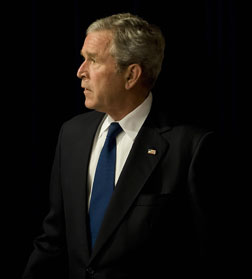
George W. Bush. Will the Bush tax cuts expire?Here are five things you need to know about the debate over extending the temporary tax cuts Congress passed almost a decade ago. (For those of you who haven't been paying attention in class, these are known as "the Bush tax cuts" because they were passed at the former president's urging, and if Congress does nothing, they will expire at the end of the year.)

1) All the representatives and senators who voted for the tax cuts in 2001 and 2003 also voted for their expiration. That's how they were designed.

2) The tax cuts could have been made permanent or extended at some point before now. Alternatively, the folks who ran fiscal policy from 2001 through 2008­the Republican White House and a Congress that was controlled for most of that period by Republicans­could have created the conditions that would have made it possible to extend the tax cuts or make them permanent. But they didn't. Instead of running balanced budgets, they appropriated hundreds of billions of dollars to fight two wars, created an expensive, open-ended entitlement without a funding mechanism (Medicare prescription drug coverage), and increased discretionary spending. Oh, and their failures of oversight, regulation, and management led to expensive, deficit-enhancing bailouts.

3) Many Republicans and some Democrats have spent much of the last year warning (falsely, it turns out) that the large deficits we face this year and in coming years would cause inflation, result in high interest rates, and turn us into indentured servants to China. Now, the same folks are arguing for … even-larger short-term deficits that somehow won't have all those ill effects. President Obama's proposal to extend the tax cuts for those making less than $250,000 per year will add $3.2 trillion to the debt. But as the Congressional Budget Office noted, extending them all will add $3.9 trillion in debt. Now, advocating tax cuts without specifying spending cuts (and, no, John Boehner, saying you want to roll back spending to 2008 levels doesn't count) means you're advocating a huge increase in new debt creation. It's sad to say, but it's nearly impossible to find a Democrat or Republican who can speak seriously about how we can align revenues with expenditures. (And, no, Rep. Paul Ryan, your much-discussed "road map" doesn't count, since it cuts taxes on the rich but doesn't lower deficits over the long term.)

4) The bold and confident assertions made about the links between tax rates and economic growth, market performance, and prosperity are almost certainly wrong. Turn on CNBC or look at the Wall Street Journal op-ed page these days, and you'll learn that we must keep tax rates on capital gains, dividends, and income precisely where they are because shifting them to different levels will retard economic growth. Keep this in mind: The people who designed the current, unsustainable tax system promised us that lower marginal rates, and lower taxes on capital and dividends, would boost the economy, promote investment, create jobs, spur market performance, and raise everybody's income. They were wrong. (It's no coincidence that these same people also warned us that raising taxes in 1993 would kill market returns and the economy. They were wrong then, too. They're pretty much always wrong.) As I've pointed out, the years under the current tax regime have been a lost decade. Pick your metric­median income, employment, stock market returns, economic growth­the low-tax '00s sucked. Yet proponents of keeping the tax cuts persist in making the argument: To avoid a repeat of the past decade, we must have the exact same tax policies as we did for the past decade.

5) Stopping all the tax cuts from expiring requires the passage of legislation. But the people who most want all the tax cuts extended­i.e., Republicans­don't have the ability to enact legislation. They don't control a majority in either legislative body, and for the past two years they've proved successful only at stopping or delaying legislation.

The upshot is this: If you're in the $250,000-per-year-and-up camp, even if you don't think you're rich, I'd start planning to pay higher taxes next year. But I wouldn't discount the scenario of all the tax cuts expiring. Look at what happened with the estate tax, another sop to the rich. In a bizarre turn of events, it was designed to decline throughout the decade, disappear entirely in 2010, and then return at a much higher level in 2011. Rather than compromise with Democrats on a permanent reduction that would leave lots of people better off but still require the richest of the rich to payer higher taxes, Republicans held out for a maximalist, all-or-nothing approach. They ended up with nothing. History may not repeat, but it sometimes rhymes.

Like Slate on Facebook. Follow us on Twitter.

Economics vs. Fakeonomics ANS

Here is an article on economic theory and how the whole country has been bamboozled by lies about how it works. 
Find it here:  http://www.huffingtonpost.com/ian-fletcher/economics-vs-fakeonomics_b_720327.html  
--Kim


Ian Fletcher

Ian Fletcher

Adjunct Fellow at the San Francisco office of the U.S. Business and Industry Council
Posted: September 16, 2010 07:45 PM

[]

 
Economics vs. Fakeonomics

We skeptics of free trade are used to being told, "You don't understand economics." In fact, one major reason I wrote the book Free Trade Doesn't Work was simply to expose, once and for all, that there do exist extremely serious and intellectually reputable arguments, within the confines of accepted mainstream economics, which question free trade. And indeed they exist.

But I've noticed something. We skeptics are often not really struggling against real economics at all. When I pick up a copy of the Wall Street Journal, or Forbes, or the New York Times, or turn on Fox TV or MSNBC, or read papers issued by the libertarian Cato Institute or the Peterson Institute for International Economics, I don't even find economic arguments. I find a mischievous substitute for economics we can call "fakeonomics."

What is fakeonomics? It sounds like economics to the uninitiated. It uses the same language, addresses the same issues and fills the same logical hole in the national policy discourse. Most people can't tell the difference. But fakeonomics is not the real thing.

How is fakeonomics fake? It tells a story that goes something like this...

• Free markets are always right, always and everywhere.

• Anyone who doesn't believe this is stupid. Smart people not only understand that free markets are best, they like free markets, because free markets mean opportunities to get rich.

• Or maybe they're corrupt. The opposite of free markets is government. Government is always incompetent. It never does anything right. Ever.

• Or maybe they're evil. Anyone who doesn't believe in perfectly free markets is a Marxist wannabe or a loser jealous of more-successful people.

• Free trade is just free markets applied internationally.

• Therefore all smart, good, successful people must believe in free trade.

Unfortunately, fakeonomics is at best a crude parody of economics. It is often larded with a thick layer of moral hectoring, courtesy of a certain variety of the American Right which seems to think that economics is its exclusive property, a stick given it by God to beat liberals with. There is even a whole class of people, known as "libertarians" who elevate fakeonomics to the level of an all-encompassing moral ideology. (Their fundamentalist sect is the old Ayn Rand cult, who call themselves "objectivists.")

So let's be clear about one thing: real economics does not support the idea that 100 percent pure free markets are best. Not domestically, not internationally. That's why the U.S. has, like every other developed nation, a mixed economy, with government amounting to about 35 percent (pre-2008; it's spiked since then) of our GDP and various laws, from child labor laws to environmental laws and the SEC, regulating much of the rest. It's easy to fulminate against this fact in beautiful after-dinner speeches about economic liberty, but the reality is that when in office, even conservative Republicans grasp the necessity of most of these policies -- whatever adjustments on the margin they may make.

Surveys indeed show that about 90 percent of economists support free trade. But, and this is crucial, only about 70 percent of them support it without reservation. Economists are, in fact, well aware of a number of problems with free trade, like:

• Free trade for America is one-sided, with most major foreign economies practicing managed trade of one kind or another.

• When free trade involves trade deficits, it may be optimal in the short run but is unsustainable over longer time horizons.

• Even if it increases GDP, it has even stronger effects on income distribution and can thus harm many, or even most, of the people in the economy.

• The adjustment costs of declining industries -- from unemployment checks to the rubble of Detroit -- are huge and ongoing.

• It brings us cheap goods today at the price of building up economic rivals who will take markets away from us tomorrow.

• It helps dirty industries move from environmentally-strict jurisdictions to environmentally-lax ones.

• Even if it is efficient in the short run, efficiency per se has little to do with long-term economic growth.

• The theory of comparative advantage -- which supposedly proves that free trade guarantees win-win outcomes -- doesn't hold in the presence of capital mobility between nations.

None of the above is especially new information, though these points are legitimately controversial like anything else. My point here is simply that economics does not grant free trade the blank check many people seem to think it does. Nonetheless, the juggernaut of fakeonomics, which doesn't understand this, rolls on.

The really scary thing about fakeonomics is that it is not just a vulgar version of economics, served up to amuse the audience of Bill O'Reilly's TV show. It is also believed in by people who should know better. Like it or not, fakeonomics is mistaken for real thinking by a disturbingly large number of people with top MBAs, graduate degrees in serious fields, congressional staffers, et cetera. (I know; my job obliges me to talk to these people all the time, and they tell me so.) Perhaps it's just laziness on their part, but people who should be taking their bearings from more serious sources -- people whose careers depend upon the idea that they have genuine expertise -- are drawing their ideas from fakeonomics. These are people who pride themselves on understanding the most sophisticated ideas when it comes to, say, corporate finance, but here they are, relying upon intellectual constructs of a chat-show level of sophistication.

Make no mistake: Fakeonomics matters. For one thing, it is the implied theoretical model of current U.S. trade policy. That is to say, if one looks at American trade policy and asks what picture of the economy one would have to hold in order to believe that these policies make sense, fakeonomics is that picture. So whatever sophisticated version of real economics someone like ex-Harvard professor Larry Summers may have tucked away in his head somewhere, when he acts as economic adviser to President Obama, fakeonomics is what he dishes out.

One can, of course, gin up rationalizations bridging the gap between real economics and fakeonomics on any given issue at will. So there's no point confronting people like Larry Summers with the gap between, say, their own theoretical writings and the policies they support in office. If they weren't bright enough to pull off a piece of minor casuistry like that, they wouldn't be where they are in the first place.

Why are the nominally sophisticated so misguided? Because fakeonomics tells them what they want to hear. At bottom, fakeonomics is the ultimate free lunch story. Its seductive message is that we can consume all we want, right now, and never worry about the consequences. "Free" trade translates as "don't worry about" trade. The market forgives all sins.

Unfortunately for this happy fantasy, fakeonomics can only maintain this fantasy vision by systematically ignoring half of economic reality. It is, for one thing, almost exclusively focused on consumption, ignoring the production side of the economy. So it has plenty to say about how cheap imports provide consumers lower prices, but blithely airbrushes out of the picture the way imports deplete our industrial base. Of course, in the long run, nobody can afford imports, however cheap, without the ability to produce something to exchange for them. But that, of course, is the long run, and fakeonomics is about instant gratification and letting the chickens come home to roost in the next administration.

What does all this mean? It means that there are really two targets, for those of us who would criticize free trade. There is economics per se, which tends to be pro-free trade, but is actually surprisingly well aware of the counterarguments and becoming slowly but inexorably more skeptical. And there is fakeonomics, which is dogmatically pro-free trade, proactively ignorant of the counterarguments, and determined to stick its head in the sand. Shooting at the first target does almost nothing, unfortunately, to hit the latter, which is arguably more important, at least in the short run, for determining real-world policy outcomes. As a result, the first question one must ask when querying some piece of economic reasoning offered as justification for policy is this: is it real?

Or is it fakeonomics?

Ian Fletcher is the author of the Free Trade Doesn't Work: What Should Replace It and Why (USBIC, 2010, $24.95) An Adjunct Fellow at the San Francisco office of the U.S. Business and Industry Council, a Washington think tank founded in 1933, he was previously an economist in private practice, mostly serving hedge funds and private equity firms. He may be contacted at ian.fletcher@usbic.net.

Top 5 Social Security Myths ANS

This is from MoveOn.org so you may have seen it before, but we can't say it enough to counter the lies from those on the right who want Cheap Labor and quiet servitude from you!
Find it here:  http://pol.moveon.org/ssmyths/index.html 
--Kim


Top 5 Social Security Myths

Rumors of Social Security's demise are greatly exaggerated. But some powerful people keep spreading lies about the program to scare people into accepting benefit cuts. Can you check out this list of Social Security myths and share it with your friends, family and coworkers?


Myth: Social Security is going broke.

Reality: There is no Social Security crisis. By 2023, Social Security will have a $4.3 trillion surplus (yes, trillion with a 'T'). It can pay out all scheduled benefits for the next quarter-century with no changes whatsoever.1 After 2037, it'll still be able to pay out 75% of scheduled benefits--and again, that's without any changes. The program started preparing for the Baby Boomers retirement decades ago.2 Anyone who insists Social Security is broke probably wants to break it themselves.

Myth: We have to raise the retirement age because people are living longer.

Reality: This is a red-herring to trick you into agreeing to benefit cuts. Retirees are living about the same amount of time as they were in the 1930s. The reason average life expectancy is higher is mostly because many fewer people die as children than did 70 years ago.3 What's more, what gains there have been are distributed very unevenly--since 1972, life expectancy increased by 6.5 years for workers in the top half of the income brackets, but by less than 2 years for those in the bottom half.4 But those intent on cutting Social Security love this argument because raising the retirement age is the same as an across-the-board benefit cut.

Myth: Benefit cuts are the only way to fix Social Security.

Reality: Social Security doesn't need to be fixed. But if we want to strengthen it, here's a better way: Make the rich pay their fair share. If the very rich paid taxes on all of their income, Social Security would be sustainable for decades to come.5 Right now, high earners only pay Social Security taxes on the first $106,000 of their income.6 But conservatives insist benefit cuts are the only way because they want to protect the super-rich from paying their fair share.

Myth: The Social Security Trust Fund has been raided and is full of IOUs

Reality: Not even close to true. The Social Security Trust Fund isn't full of IOUs, it's full of U.S. Treasury Bonds. And those bonds are backed by the full faith and credit of the United States.7 The reason Social Security holds only treasury bonds is the same reason many Americans do: The federal government has never missed a single interest payment on its debts. President Bush wanted to put Social Security funds in the stock market--which would have been disastrous--but luckily, he failed. So the trillions of dollars in the Social Security Trust Fund, which are separate from the regular budget, are as safe as can be.

Myth: Social Security adds to the deficit

Reality: It's not just wrong -- it's impossible! By law, Social Security funds are separate from the budget, and it must pay its own way. That means that Social Security can't add one penny to the deficit.1

Sources:

1."To Deficit Hawks: We the People Know Best on Social Security" New Deal 2.0, June 14, 2010
http://www.newdeal20.org/2010/06/14/to-defict-hawks-we-the-people-know-best-on-social-security-12290/

2. "The Straight Facts on Social Security" Economic Opportunity Institute, September 2009
http://www.eoionline.org/retirement_security/fact_sheets/StraightFactsSocialSecurity-Sep09.pdf

3. "Social Security and the Age of Retirement"Center for Economic and Policy Research, June 2010
http://www.cepr.net/index.php/publications/reports/social-security-and-the-age-of-retirement/

4. "More on raising the retirement age" Ezra Klein, Washington Post, July 8, 2010
http://voices.washingtonpost.com/ezra-klein/2010/07/more_on_raising_the_retirement.html

5. "Social Security is sustainable" Economic and Policy Institute, May 27, 2010
http://www.epi.org/analysis_and_opinion/entry/social_security_is_sustainable/

6. "Maximum wage contribution and the amount for a credit in 2010." Social Security Administration, April 23, 2010
http://ssa-custhelp.ssa.gov/app/answers/detail/a_id/240

7. "Trust Fund FAQs" Social Security Administration, February 18, 2010
http://www.ssa.gov/OACT/ProgData/fundFAQ.html

8. "To Deficit Hawks: We the People Know Best on Social Security" New Deal 2.0, June 14, 2010
http://www.newdeal20.org/2010/06/14/to-defict-hawks-we-the-people-know-best-on-social-security-12290/