Friday, March 22, 2024

ANS -- The Strongman Fantasy

Here's a really good article by Timothy Snyder (who wrote On Tyranny) on what it would be like with a "strongman" in charge.  Read it.  Share it. 
Find it here: The Strongman Fantasy


--Kim


The Strongman Fantasy

And Dictatorship in Real Life

MAR 17, 2024
2,003
179
372
Share

Quite a few Americans like the idea of strongman rule.  Why not a dictator who will get things done? 

I lived in eastern Europe when memories of communism were fresh.  I have visited regions in Ukraine where Russia imposed its occupation regime.  I have spent decades reading testimonies of people who lived under Nazi or Stalinist rule.  I have seen death pits, some old, some freshly dug. And I have friends who have lived under authoritarian regimes, including political prisoners and survivors of torture. Some of the people I trusted most have been assassinated.

So I think that there is an answer to this question. 

Strongman rule is a fantasy.  Essential to it is the idea that a strongman will be your strongman.  He won't.  In a democracy, elected representatives listen to constituents.  We take this for granted, and imagine that a dictator would owe us something. But the vote you cast for him affirms your irrelevance.  The whole point is that the strongman owes us nothing.  We get abused and we get used to it. 

Another pleasant illusion is that the strongman will unite the nation.  But an aspiring dictator will always claim that some belong and others don't.  He will define one group after another as the enemy.  This might feel good, so long as you feel that you are on the right side of the line.  But now fear is the essence of life.  The politics of us-and-them, once begun, never ends. 

We dream that a strongman will let us focus on America.  But dictatorship opens our country to the worst the world has to offer.  An American strongman will measure himself by the wealth and power of other dictators.  He will befriend them and compete with them.  From them he will learn new ways to oppress and to exploit his own people.

At least, the fantasy goes, the strongman will get things done.  But dictatorial power today is not about achieving anything positive.  It is about preventing anyone else from achieving anything.  The strongman is really the weak man: his secret is that he makes everyone else weaker. 

Unaccountable to the law and to voters, the dictator has no reason to consider anything beyond his own personal interests.  In the twenty-first century, those are simple: dying in bed as a billionaire.  To enrich himself and to stay out of prison, the strongman dismantles the justice system and replaces civil servants with loyalists. 

The new bureaucrats will have no sense of accountability.  Basic government functions will break down. Citizens who want access will learn to pay bribes.  Bureaucrats in office thanks to patronage will be corrupt, and citizens will be desperate.  Quickly the corruption becomes normal, even unquestioned. 

As the fantasy of strongman rule fades into everyday dictatorship, people realize that they need things like water or schools or Social Security checks.  Insofar as such goods are available under a dictatorship, they come with a moral as well as a financial price.  When you go to a government office, you will be expected to declare your personal loyalty to the strongman.   

If you have a complaint about these practices, too bad.  Americans are litigious people, and many of us assume that we can go to the police or sue.  But when you vote a strong man in, you vote out the rule of law.  In court, only loyalism and wealth will matter.  Americans who do not fear the police will learn to do so.  Those who wear the uniform must either resign or become the enforcers of the whims of one man.

man walking upstairs

Everybody (except the dictator and his family and friends) gets poorer.  The market system depends upon competition.  Under a strongman, there will be no such thing.  The strongman's clan will be favored by government.  Our wealth inequality, bad enough already, will get worse.  Anyone hoping for prosperity will have to seek the patronage of the official oligarchs. Running a small business will become impossible.  As soon as you achieve any sort of success, someone who wants your business denounces you. 

In the fantasy of the strongman, politics vanishes and all is clear and bright.  In fact, a dreary politics penetrates everything.  You can't run a business without the threat of denunciation.  You can't get basic services without humiliation.  You feel bad about yourself.  You think about what you say, since it can be used against you later.  What you do on the internet is recorded forever, and can land you in prison.

Public space closes down around you.  You cannot escape to the bar or the bowling alley, since everything you say is monitored.  The person on the next stool or in the next lane might not turn you in, but you have to assume they will.  If you have a t-shirt or a bumper sticker with a message, someone will report you.  Even if you just repeat the dictator's words, someone can lie about you and denounce you.  And then, if you voted for the strongman, you will be confused.  But you should not be.  This is what you voted for.

Denunciation becomes normal behavior.  Without law and voting, denouncing others helps people to feel safe.  Under strongman rule, you cannot trust your colleagues or your friends or even your family.  Political fear not only takes away all public space; it also corrupts all private relationships.  And soon it consumes your thoughts.  If you cannot say what you think, you lose track of what you believe.  You cease to be yourself.

If you have a heart attack and go to the hospital, you have to worry that your name is on a list.  Care of elderly parents is suddenly in jeopardy.  That hospital bed or place in a retirement home is no longer assured.  If you draw attention to yourself, aged relatives will be dumped in the street.  This is not how America works now, but it is how authoritarian regimes always work. 

In the strongman fantasy, no one thinks about children.  But fear around children is the essence of dictatorial power.  Even courageous people restrain themselves to protect their children.  Parents know that children can be singled out and beaten up.  If parents step out of line, children lose any chance of going to university, or lose their jobs.

Schools collapse anyway, since a dictator only wants myths that justify his power.  Children learn in school to denounce one another.  Each coming generation must be more tame and ignorant than the prior one.  Time with young children stresses parents.  Either your children repeat propaganda and tell you things you know are wrong, or you worry that they will find out what is right and get in trouble. 

In a dictatorship, parents no longer say what they think to their children, because they fear that their children will repeat it in public.  And once parents no longer speak their minds at home, they can no longer create a trusting family.  Even parents who give up on honesty have to fear that their children will one day learn the truth, take action, and get imprisoned. 

Once this process begins, it is hard to stop.  At the present stage of the strongman fantasy, people imagine an exciting experiment.  If they don't like strongman rule, they think, they can just elect someone else the next time.  This misses the point.  If you help a strongman come to power, you are eliminating democracy.  You burn that bridge behind you.  The strongman fantasy dissolves, and real dictatorship remains.

Most likely you won't be killed or be required to kill. But amid the dreariness of life under dictatorship is dark responsibility for others' death. By the time the killing starts, you will know that it is not about unity, or the nation, or getting things done. The best Americans, betrayed by you when you cast your vote, will be murdered at the whim and for the wealth of a dictator. Your tragedy will be living long enough to understand this.

The writing in this forum, my Substack "Thinking about..." is free.  You are welcome to pass it along to others.  In this particular case, I would urge you to share it with anyone in your life whom it might help.  Thank you.


Thursday, March 21, 2024

ANS -- Why the Trumpian Grotesquery is Happening Now to America

This is an interesting article about Trump being the God of Consumerism.  Remember Consumer Hedonism?  It think it fits in here.  
--Kim


Why the Trumpian Grotesquery is Happening Now to America

Consumerism and our outpouring of narcissism

Benjamin Cain
An Injustice!
·

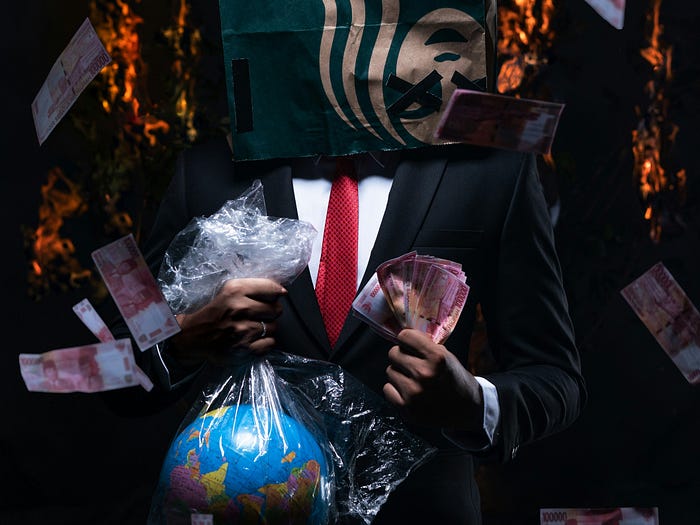
Crop of photo by fikry anshor on Unsplash

Why is the lurch towards Trumpian authoritarianism happening to the United States in the twenty-first century? What's the root of this grotesque affliction?

As with any social development, the causes are bound to be numerous and complex. For one thing, the Republican Party has been only nominally content with modern progressive norms since the civil rights revolution in the 1960s, and that resentment in turn is due to a split between northern and southern cultures in the US that led to the Civil War.

Moreover, the Democratic Party's retreat from progressive values in the 1990s, towards the political center of Clintonian triangulation forced the Republicans to distinguish their brand by driving themselves ever further rightward. The national unpopularity of conservatives' anti-modern policies, too, drove their representatives to cheat in elections (with gerrymandering, voter suppression, and the like), which means Republican politicians face few democratic tests of their merit, so they can indulge in explorations of conservative purity.

But there's also an underappreciated factor which has to do with Trump himself.

Consider some of the criteria the psychiatric DSM-5 uses to test for narcissistic personality disorder, criteria which obviously apply to Donald Trump:

  • A grandiose sense of self-importance
  • A preoccupation with fantasies of unlimited success, power, brilliance, beauty, or ideal love
  • A belief that he or she is special and unique and can only be understood by, or should associate with, other special or high-status people or institutions
  • A need for excessive admiration
  • A sense of entitlement
  • Interpersonally exploitive behavior
  • A lack of empathy

What's interesting here isn't that Trump suffers from this disorder. No, what's interesting is that Trump breaks this disorder's mold.

Consider the difference between your average narcissist and Trump. The average one may indeed have a grandiose sense of self-importance because he or she labours in obscurity. This narcissist may fantasize about being a rich, powerful celebrity, but few could boast that they're genuinely that important unless they've lost all touch with reality.

Trump's sense of his importance isn't inflated. He is rich and famous, and he was president of the United States.

What's the difference, then, between a deluded narcissist who exaggerates his or her specialness, and a narcissist who makes the fantasy a reality, who rules over millions in a political cult of personality?

We should be reminded here of the line from the Batman Begins movie: "If you make yourself more than just a man, if you devote yourself to an ideal, and if they can't stop you, then you become something else entirely…legend, Mr. Wayne."

Trump's a narcissist who's gone supernova. He's a narcissist who's succeeded in feeding his disorder the equivalent of ten thousand gallons of jet fuel. Trump's narcissism is fed by reality, not just by his fantasy. On the contrary, he's turned much of the world into his fantasy.

Trump, then, is a symbol, not just a man. Indeed, as a man, he's plainly a monster. But that's largely overlooked because of the relevance of Trump's symbolic content to the United States, and to the American-led global monoculture. After all, consumerism turns us all into petty narcissists.

Think of the myopia, for example, of the self-help movement. We want to help ourselves, which means we must think often about petty interests and problems. None of that's ethical or spiritually high-minded. The self-help movement, then, is the spillover from a flood of corporate marketing pitches, an astroturf culture that's good for big business. Capitalism thrives on greed and on the inflated sense of our importance as customers who deserve to satisfy all our desires.

Why do we buy so much stuff we don't need? It's not because we give it all to charity since if we thought so selflessly, we'd have repudiated runaway capitalism on moral and religious grounds. No, we keep the business world afloat with our conspicuous acts of consumption because we're proud of ourselves as individuals. After all, in the modern world that's powered by scientific skepticism and a secular humanistic ethos, we've solved many of our social problems and have progressed without any divine guidance.

We think humanistic pride is a virtue, not a sin. We aim to be self-confident because if we don't love ourselves, we think no one else should love us. And if we're proud of ourselves, we assume we deserve all that merchandise.

Even liberals and progressives who devour the self-help sophistry, or the ordinary consumers who focus on short-term gains rather than on the long-term environmental costs of the late-industrial way of life are implicitly drawn to the symbolic meaning of Trump's ascendancy.

Trump's the god of consumerism.

He's the epitome of capitalistic greed, the quintessence of consumerist myopia. We can pretend we're drawn to higher principles, but our actions speak louder than our words, and consumer society is well-represented by Trumpism.

That is why Trumpism is happening here and now to the US, and why similar authoritarian backlashes are happening across the neoliberal world, from Canada to Israel.

We want our consumer lifestyle to have spiritual merit, and Trump's a compelling figurehead for any such grandiose sense of entitlement. Even Trump's critics and enemies can't take their eyes off him because he's our raging unconscious come to dire life before our eyes. Our most self-destructive tendencies have materialized before us, the Jungian shadow of consumer greed and self-absorption darkening our doorstep.

Trump is us and we are Trump, Republicans and Democrats alike, Americans, Canadians, Australians, and Europeans — all who've made a Faustian bargain with capitalism.

Our yearnings for private gain are symbolized by Trump's dark miracle. We shine the cultural spotlight on the symbols that speak to our unconscious drivers, not just to our flimsy conceits. Trumpism is the mirror that reveals the decrepitude of consumer culture. He's the arch-narcissist that shows how far our petty collective narcissism can go.

I collect my Medium writings in paperback and eBook forms, and I put them up on Amazon. Check them out if you'd like to have them handy and to support my writing in that way. The newest one is Aristocrats in the Wild, and its 538 pages are filled with 89 recent articles of mine on religion and philosophy.


Sunday, March 10, 2024

ANS -- Biden’s Electrifying State of the Union, Why it Matters, Plus: Fascism vs Modernity

Here is umair haque's reaction to Biden's State of the Union speech last Thursday.  It is full of hope.  the comments on the site are a civilized and detailed discussion.  


--Kim


MAR 9, 2024  8 MIN READ

Biden's Electrifying State of the Union, Why it Matters, Plus: Fascism vs Modernity

Biden's Electrifying State of the Union, Why it Matters, Plus: Fascism vs Modernity

I'm Umair Haque, and this is The Issue: an independent, nonpartisan, subscriber-supported publication. Our job is to give you the freshest, deepest, no-holds-barred insight about the issues that matter most.

New here? Get the Issue in your inbox daily.


  1. The Oceans We Knew Are Already Gone (The Atlantic)


  2. Silencing of the girls (Aeon)


  3. Barcelona's rude awakening after years-long drought (Le Monde)


  4. I'm a climate scientist. If you knew what I know, you'd be terrified too. (CNN)

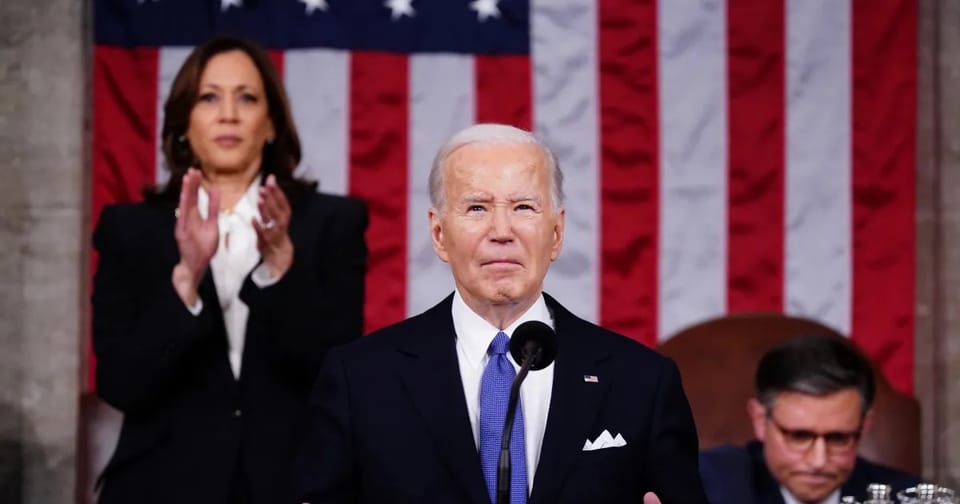
Let's not mince words. There are speeches and there are Capital S Speeches. Biden's sensational State of the Union was one of the latter. It was visionary, historic, and startling. I didn't know quite what to expect, and I doubt many did. Biden rose to the challenge of the moment—more on that in a second, and hit the ball out of the park.

By the way, if you didn't watch it, do so, just even the first few minutes, because…

This speech was a special moment for America. I don't know if Americans grasp that, but world leaders, starting this weekend, are going to be spending much of the year studying Biden's words, ideas, and vision—because it set out sort of a new direction for America, as leader of a troubled world again.

Let me explain, on three levels, why this speech mattered so much: stylistically, substantively, and politically.


Being a Leader Versus Becoming One, or, Is Biden Fit for Office?

Lately, it's become kind of cool to hate on Biden. I get that, though I don't join in it. Young people will accuse him of everything from indifference to genocide, while the GOP's attack line that he's too old and frail to hold office again has registered, amplified by media.

The Biden we saw yesterday answered those concerns decisively. He was witty, sharp as a razor, intelligent, spry. He ran rings around the Republicans, weaving webs around them to entrap them in, leaving them bewildered and spluttering. So much so that by the end of the night, this whole business of image manipulation had been turned on its head: the new attack line was that Biden was too energetic, angry, and talkative. The irony was lost on no one, really.

This Joe Biden delivered, as many said, a masterclass. And that masterclass was in large part about what politics, unfortunately, begins with: style, "impression management," "messaging." Biden got his message across, in giant blinking neon letters. He roasted the Republicans, while outmaneuvering them, out-thinking them, easily outdoing them, as if they were amateurs and wannabes—and so this Joe Biden electrified people. In the media business, we track a thing called "sentiment," which is how people talk about you on social media, and sentiment was off the charts. People were astonished, some, like the Republicans, overwhelmed, and the reaction was strikingly positive.

Those are all good things. Part of Biden's challenge, if the goal is to avoid another Trump era, and the consequent end of democracy, more or less, was just to convince people that Biden was still in the game. After this, while, sure, you can still have doubts, if you're fair, you're going to have fewer and smaller ones, on the issues of Biden's fitness and competence.

This Biden glowed, swaggered, and revelled, like a rock star.

Stylistically, the State of the Union was a devastating blow to the Republicans—think, again, how the erstwhile attack line had to flip from "he's got one foot in the grave" to "Jesus! Why won't he stop getting us!!" Funny—and telling.

We recently discussed the difference between occupying a leadership position—and being accepted as a leader. This Biden's been hid away by the Democratic machine, it seems. Those roaring, electrified masses? Those surging positivity ratings? That's a figure going from merely occupying the position, to being accepted as a leader.

That matters in a bigger way than you think, because…


What is America, Anymore?

But that was just the beginning of why this speech was so important, though it's what the chatter has focused on. Punditry is missing the real reason this speech was made of fireworks—why world leaders are going to be studying it frantically and intensely, beginning this weekend, if not already, and continue doing so the whole year.

Beneath the swagger, Biden quietly proposed something very much like a new America. A new American social contract. The ideas came so fast and furious that they were almost easy to miss, sandwiched between philosophy and persuasion.

I'll get to them, but first: most State of the Unions aren't like that. They're pretty boring, because Presidents tout their accomplishments. They're backwards looking things, in other words, sort of performance reviews, if you like. This one really was different—profoundly different.

Here are just a few of the Big Ideas in Biden's vision—and what their sort of link to the cutting edge of global thinking is.

—Taxing billionaires, which is part of a new movement, arising mostly in Europe, to reduce inequality, by having a global tax on the ultra-rich.
—Limiting executive compensation—this one in a soft way, not a hard one, salaries over $1 million no longer being tax deductible. This is linked, too, to recent moves by European nations to make economies more equal again.
—Giving home buyers tax credits. This is a first step towards fixing America's badly broken housing market. The world's is, in fact, and many European nations are trying to fix that through incentives like this.
—Lowering drug prices. One of Biden's most revolutionary policy ideas was to let the government negotiate for far more drugs—this is a big, big deal, because of course Americans are ripped off incredibly badly by their version of "healthcare." This is a way to modernize America and bring it in line with other Western nations.
—Freezing taxes on those earning than less $400K.

There were plenty more, in fact, than all this. The point isn't just the "policy ideas"—rather, it's the direction that Biden wants to go in, if you read between the lines a little bit. What is Biden really saying? He's recognizing how badly broken many aspects of the American social contract—healthcare, housing, inequality, salaries, taxes—and how all that adds up to an incredibly precarious life even at or above the median.

Biden seemed to be channeling the ghost of FDR—and the spirit of Truman. The FDR aspect: he appears to be reaching for something like a new deal, or at least as close to one as America's going to get in this tenuous situation. The spirit of Truman: he didn't say this nicely, he roasted the Republicans as he said it, driving home the point how little they actually care about people's lives, and simply rely on scapegoating, how empty of ideas their side really is.

This is a Big Deal. An American President doesn't not just say this stuff lightly—they never say it at all. Taxing billionaires? Not taxing everyone else? Making corporations pay their fair share? Expanding the role of government? Reducing the drivers of inequality, from overblown exec salaries to a crumbled housing ladder? That's…the stuff…much more aligned with…European social democracy…than American politics, which is usually anodyne variants of the same thing, aka, slightly different flavours of Coke versus Pepsi capitalism.

This isn't two slightly different variants of capitalism, and if you read between the lines, meaning that it's a first draft at setting out a vision, the end result will be even more radical. Taxing billionaires, limiting salaries, intervening in broken markets, giving people actual support—none of these are ideas we associate in the slightest with…American politics. They're the stuff of social democracy, and Biden's setting out a sort of lightweight-almost social democratic vision. It's not quite one fully, but what it does, at last, is begin to put America on the path to becoming one, like the rest of the Western world.


The Transformation of Politics From Anti-Modern to Modern

And all that draws a sharp distinction between the two parties, at long, long last. I've been sharply critical of the Democrats in recent times. Who are they? What do they stand for? What's the idea here? What's their sort of theory of the world, of a just society, of a good life?

Now we know. We know that it's something a lot more like lightweight European social democracy in nascent form—a good life comes from a just society, which is one that's socioeconomically equal, not just "equal opportunity," or what have you, yesterday's nostrums—than yesterday's tired neoliberalism. That said, of course, that a good life comes from being a survivor in a brutal game whose stakes are life or death.

But that's just what the other side said, too. So all this finally draws the difference between the two parties into sharp, stark relief. Sure, one's for democracy, and the other one's for fascism—but the truth is to win just that political contest, you can't just rely on that issue itself. You need to go deep into the issues people actually care about, which are always the economy, money, their property, stability, a sense of security, upwards mobility, etcetera.

Nobody ever really beat the fascists by saying: but we're offering you democracy!

This is a breakthrough, and it shouldn't be underestimated. For an American President to stand on the podium and say this stuff? The government should set prices, salaries for bigwigs are way too high, billionaires and corporations should be taxed—I scarcely thought I'd see that day happen, ever, period. America's been incredibly resistant to these ideas, on both sides of politics. The GOP, of course, built its political fortunes around defending capitalism and individualism, from Reaganomics on, and then Clintonomics was a sort of thinly disguised variant of much the same thing.

In more prosaic terms, this is the sort of stuff that Bernie and Liz have long pleaded for, argued vehemently for, demanded. Where does it come from? Again, from European social democracy, but now let's make that concrete. In France, the government negotiates everything from drug prices to waiter's salaries. Executive pay is sharply restrained by both norms and laws. One of the ways in which, for example, smarter parties, like Spain's socialists, stayed in power, was to give people more support precisely for basic necessities like housing.

So this is incredibly smart stuff—in the sense that we know it works. France is probably the world's most successful society, by a very long way, right about now, and Spain's not far behind. America, by contrast, is way behind. It needs to catch up to the rest of the Western world in basic political terms, and that's by having it's "sides' not just be predatory capitalism versus slightly less predatory capitalism, but modern oppositions, like conservative versus liberalism versus green in social democratic terms, which are completely different from America's. Nobody in Europe, for example, not even conservatives, would say that people deserve nothing, and government shouldn't exist—but of course America's do.

So this transforms America politically. It does something long, long overdue, and it does it in a clever way, which is that the people listening to it won't even know about it. They're not going to know that "oh, this idea comes from France, and this one from Spain, and this one from the EU itself." It doesn't matter, and of course, to make Americans, that'd make it a non-starter. It just puts these ideas front and center, and more importantly, the philosophies behind them.

Those theories of the world, of the good life, of the just society, and how they're linked. Now, at last, there's a variant of politics on offer that's not just "life should just be winners and losers, and winners should take it all, and losers should basically be left to perish." It's incredibly important that this happen, for any society, not just America, this evolution of politics to what we call a modern level, not just a sort of still-trapped-in-the 19th century one. In America, the State of the Union is the last place I expected it to, if it ever did.

There's plenty, plenty more to say, and we'll discuss it soon. I just wanted to share some quick thoughts with you. Color me impressed. Mightily so. Is it going to be enough to beat Trump—remember, just before this, the risk of a Trump landslide was rising swiftly? That's exactly what we'll delve into shortly. Thanks for reading—and let me know your thoughts in the comments!!