|

Democrats are Soft on Immigration, and Ice Cream Causes Murder
How a common logical fallacy explains a popular political one


Did you know that Democrats are for open borders? Of course you did. Everyone knows that.
How do they know? Because whenever a Democrat is president, the immigration rate goes up. Or at least that's what the trustworthy folks at Fox News tell us.
But seriously, in this case I have to admit the right-wing pundits have a point. Just take a look at the graph below. It shows the growth in the total foreign-born population — both documented and undocumented — per year from 1990 to 2022. The y-axis is in hundreds of thousands, so 10 = one million.
As you can see, during the 1990s, when Clinton was president, the foreign-born population grew by about 1.1 million per year. It was the largest absolute increase in America's foreign-born population ever.
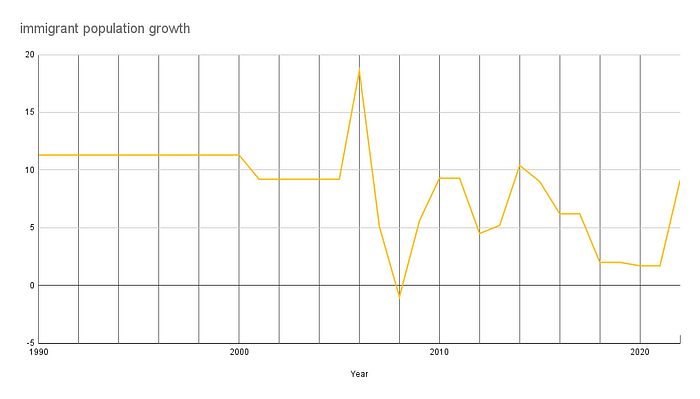
During, the Bush years, on the other hand, we see that the immigrant population grew less quickly, at about 900,000 people per year for his first term. There was a spike in 2006, but then a sharp drop at the end of his term.
In 2009 — Obama's first year — we actually see the total foreign-born population shrink. But for the rest of his term it we see it climb back up in fits and starts. Then it slows significantly under Trump, before jumping again under Biden.
So that settles it, right? Democrats really are soft on immigration. Unless… there's another explanation?
Correlation =/= Causation
For years, students in first-year statistics classes have confronted an odd coincidence. During the hot summer months ice cream sales spike, and so do murders. Does ice cream fill people with murderous rage? Or does the looming specter of a violent death make us hungry for one last ice cream?
Neither, actually. The two are correlated, but there's no causal relationship between them. Instead, each one is influenced by a third factor: hot weather. When it's hot outside we're more likely to want a cold treat. But we're also more likely to congregate in the kinds of social contexts where interactions might escalate to violence.
As criminology professor Steven Messner put it,
A prime reason murder peaks during this time has to do with the routines of people's lives…. Summer is when people get together. More specifically, casual drinkers and drug users are more likely to go to bars or parties on weekends and evenings, as opposed to a Tuesday morning. These people in the social mix, flooding the city's streets and neighborhood bars, feed the peak times for murder, experts say.
So maybe the relationship between Democratic presidents and growth in the immigrant population is like the relationship between ice cream and murder. But if that's the case, then what's the third factor that explains both?
Victims of their own success
In a word: growth. Since at least 1949, the U.S. economy has performed significantly better on a host of macroeconomic indicators whenever a Democrat has occupied the White House.
That trend has been slightly more pronounced in the period from 1981 to the present. There is a clear Democratic advantage in every one of the following categories of economic performance:
- Real GDP growth
- Real Net GDP growth per capita
- Total job growth
- Private sector job growth
- Unemployment rate
- Real wage growth
- Real business investment
- Real income excluding government transfers
- Inflation
- Federal interest rate
First, a couple of points. The word "real" here means adjusted for inflation, so it's not the case that people's wages grew more when Democrats were in office, but were swamped by inflation. They really grew more. Also, the idea that Democrats are bad for business is belied by the fact that private sector job growth and business investment both grew more when a Democrat was in power. Finally, the idea that incomes only grow more under Democrats because of welfare programs is refuted. Real income grew before accounting for government transfers.
Other statistics from the same study are equally interesting. The idea that Democrats are zero-sum egalitarians — tax and spend liberals who take from the rich and give to the poor — and that working class people who vote Republican just see themselves as "temporarily embarrassed millionaires," also doesn't hold up.
The fact is, whether we're looking at the top one percent, the bottom ten percent, or anywhere in between, every income level has seen their real incomes rise more when a Democrat occupies the Oval Office.
And guess what else happens when America's economy does so well. It's no surprise. People want to come here.
Let's look at the data on the foreign-born population again, but now let's add in two important economic indicators: the unemployment rate and GDP growth.
As you can see, in the '90s unemployment trended down, GDP growth trended up, and the immigrant population grew at a high, steady clip. It grew less quickly after the dot-com bubble burst, and fell again after the housing bubble burst, only to climb back following the passage of a massive stimulus bill that pulled the U.S. out of the Great Recession. Then it dipped again during COVID, bouncing back after another round of stimulus.
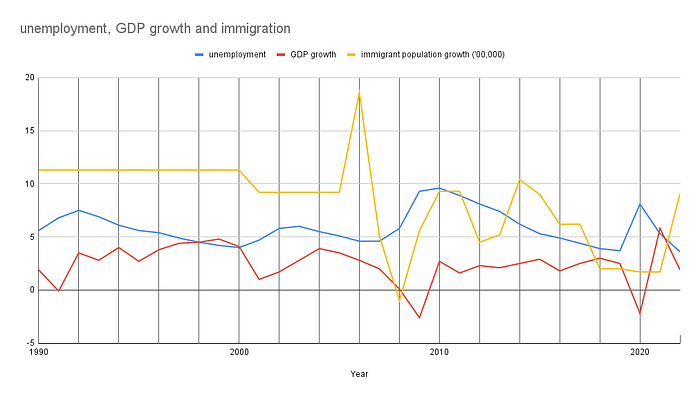
So maybe immigration doesn't grow because Democrats are soft on the border. Maybe immigration grows because Democratic policies grow the economy better than Republican ones, and a strong economy attracts people to our shores.
A virtuous circle
Some of you might be tempted to look at this data and see a worrying trend. You see foreigners coming here to take advantage of opportunities that ought to be reserved for American citizens.
But here's the truth: immigrants aren't just attracted to America's economic growth. They also contribute to it.
A 2023 study by economist Madeline Zavodny of the University of North Florida found that "Immigrants boost economic growth, employment growth and economic dynamism through their contributions to the workforce, entrepreneurial activities and purchases of goods and services."
The analysis in this study also finds that immigrants may slow the offshoring of manufacturing activity by U.S. businesses, indicating the importance of immigration to increasing U.S. domestic manufacturing production. Metro areas with a higher share of immigrants have more dynamic economies and experience faster growth in the number of jobs created and new business establishments. During 2010 to 2019, foreign-born workers accounted for up to one-quarter of employment growth and up to three-quarters of the growth in business establishments in the 248 metro areas examined.
That's quite a contrast with the claim that immigrants displace American workers. On the contrary, immigration and economic growth are part of a virtuous cycle, one that Democratic policies foster.
And how do Democrats foster growth? Not just by spending more than Republicans. The truth is both parties spend a lot. If anything, Democrats have been the more fiscally responsible party, with deficits growing more slowly during their tenures.
And Democrats tend to spend on things like infrastructure or programs that directly (food stamps, unemployment insurance) or indirectly (health care, education) produce higher fiscal multipliers. Republicans, on the other hand, spend more on the military or by cutting taxes on corporations and high income households, all of which have very low fiscal multipliers.
Conclusion
None of this is to say that immigration isn't an important issue, and that having a sound immigration policy isn't important. It obviously is. We've just seen how closely it's connected with things like economic growth. That connection will only become more important if birthrates continue to decline.
I suspect the real issue with immigration is a cultural one, centered on how immigration affects demography and identity. But when people start claiming that Democrats are throwing open the border because they want to effect that kind of cultural transformation for political reasons, they're overlooking the far more obvious reason why immigration grows when Democrats are in power.
It's easy to confuse correlation with causation, especially when doing so reinforces an idea we want to believe for other reasons. But in the Information Age, none of us has the right to claim ignorance when we persist in believing falsehoods.

Lawyer turned stay-at-home dad. I write about philosophy, culture, and law. Author of the book "Truth Evolves". Top writer in History, Culture, and Politics.



 Posts
Posts


