Saturday, September 09, 2023

ANS -- Our climate change debates are out of date Solar and batteries are going to win, and our thinking needs to adjust accordingly.

This article was recommended by Sara Robinson.  Read this if you think you can take some upbeat positive news, for a change.  (The comments at the site are trying to refute the article, but seem to have missed the point.) the point is, that we are making enough progress with solar and batteries, that the arguments should be changing instead of being stuck in 2010. 


--Kim


Our climate change debates are out of date

Solar and batteries are going to win, and our thinking needs to adjust accordingly.
SEP 7, 2023
330
288
Share

One thing that became apparent during Donald Trump's presidency was that Trump's outlook on the issues facing the nation was permanently stuck at around 1990. His paranoia over Japanese trade practices, for example, persisted long after Japanese companies no longer presented a competitive challenge. His attitudes on crime and immigration were also typical of the early 90s; by the time Trump took office, both had come way down. The world had changed, but Trump's worldview hadn't changed with it.

I get a little of this feeling when I watch Americans argue about climate change; the discussions seem stuck back in 2010, when solar power and electric vehicles were prohibitively expensive. For example, you still see tons of polls asking people whether they care more about economic growth or stopping climate change. For example, here's one from July 2023:
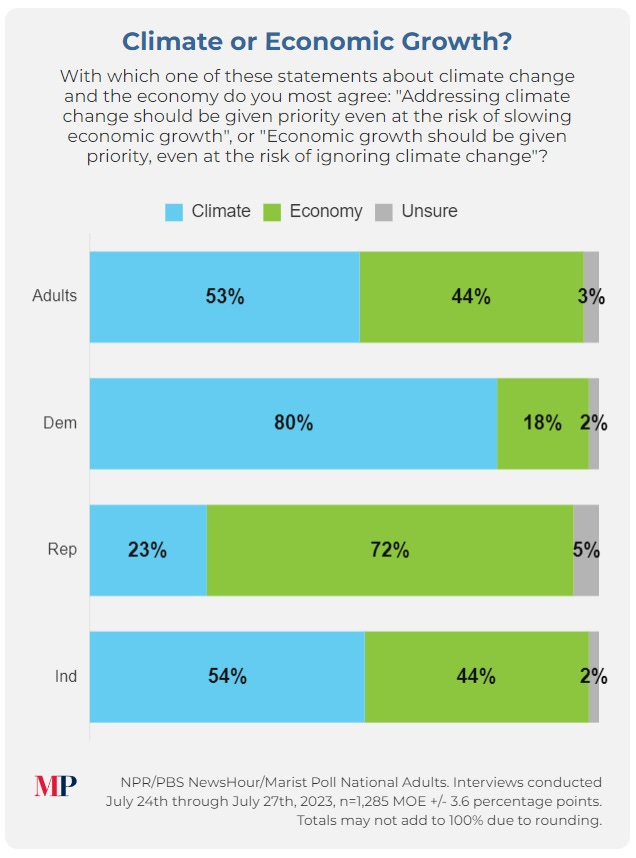
Source: Marist

In 2010, this poll would have made sense. In 2010, decarbonizing the global economy really would have required big cutbacks in our standard of living. But to ask this question in a poll in 2023 reflects a deep misunderstanding of how technology has changed since 2010. And this misunderstanding — this failure to update our sense of what is possible — is absolutely poisoning every aspect of the climate debate in America.

A number of things have changed regarding climate change over the last 13 years. On the negative side, annual emissions continued to increase slowly or maybe plateau, leading to continued warming. This has increased the risk of wildfires, extreme heat events, and floods, and it means that the dream of holding warming below 1.5C is now basically gone. On the positive side, better climate models have all but ruled out the more extreme "apocalypse" scenarios. And more Americans believe in the reality of climate change and are concerned about its impacts.

But the most important change, by far, is the advent of cheap renewable energy, particularly solar power and batteries.

Solar and batteries are a true technological revolution

I hate to post this chart yet again, and I understand if you're annoyed, but it might be the most important chart in the world:
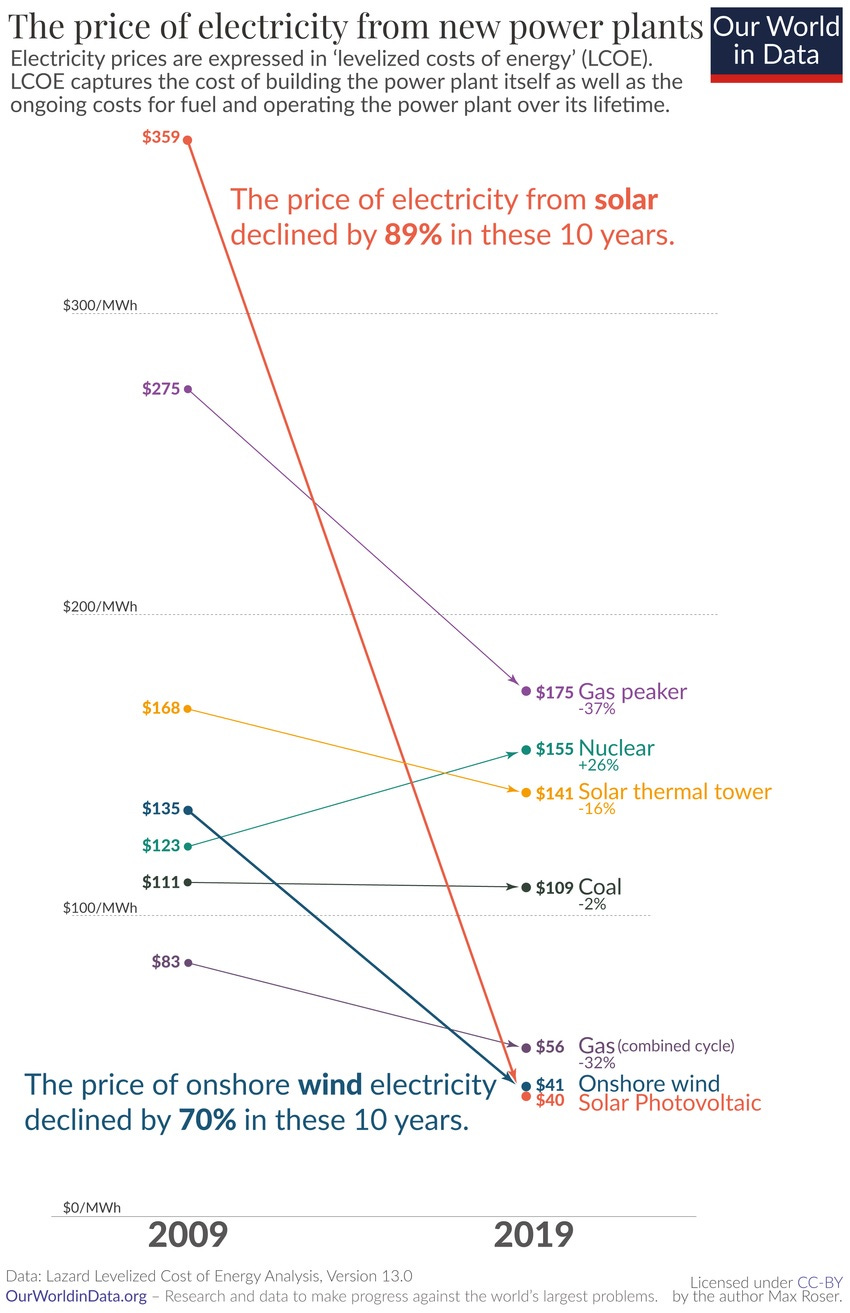
Source: OWID

Costs did slightly increase over the last year, due to inflation and supply chain issues, but that bump is already reversing as inflation comes down. Cheap solar is here to stay.

Lithium-ion batteries are on a similar trend; their costs plunged by eye-popping rates for decades, rose slightly in 2021-22, and are now declining again. Here's a recent chart:
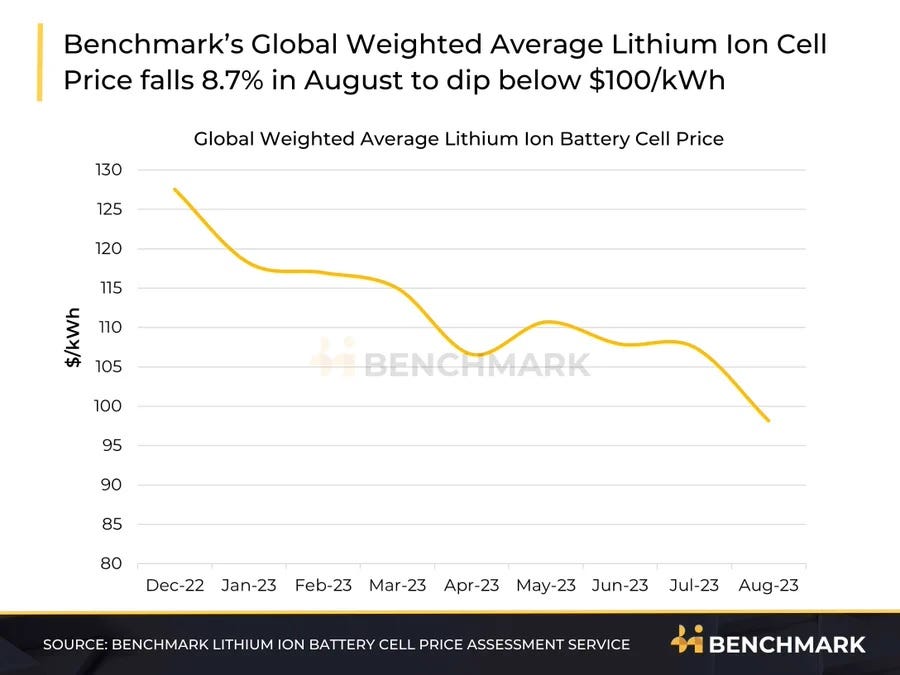
Together, cheap solar and cheap batteries mean that as of 2023, even without any subsidies, solar power is cheaper than most other ways of generating electricity — even when you factor in energy storage. Natural gas and wind are the only real competitors:
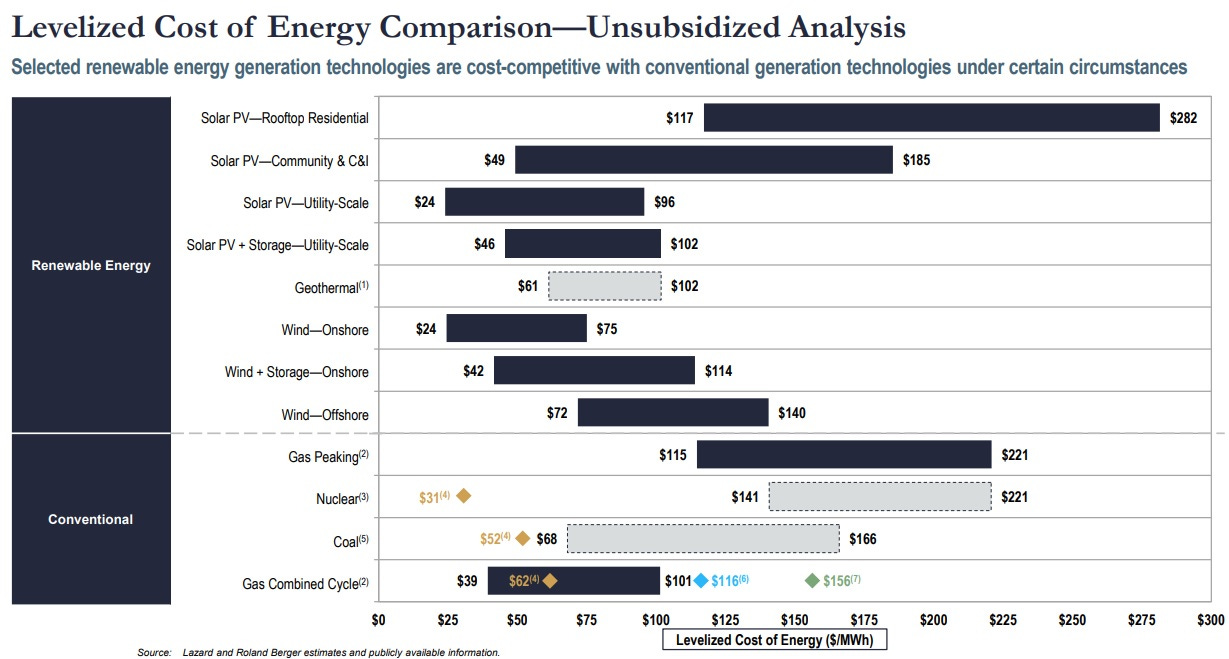
Source: Lazard

Now, levelized cost of energy isn't the only factor for power companies deciding how to produce electricity. Intermittency, reliability, and scalability all have to be taken into account.

First, let's talk about intermittency. Note that the chart above has a line for "Solar PV + Storage—Utility-Scale". Solar plus storage is not intermittent at the day-to-day frequency, and it's still pretty darn cheap, even without subsidies. Seasonality is a bigger problem; you can use batteries to store energy all year, but the amount needed is very large. The cheapest solution right now is probably just to build extra solar, but new kinds of battery chemistries are available that will make seasonal storage a lot more feasible.

Reliability is also important when you're considering how to source your electricity. Theory helps us less here, but fortunately, we have some natural experiments to draw on. Solar power with battery storage proved to be the most reliable source of power in Florida during Hurricane Ian last year:

Neighborhoods powered by solar panels with backup batteries weathered the direct onslaught of Hurricane Ian in Florida, utilities and developers said, keeping the lights on throughout the storm while millions of others lost power.

At least three solar-powered communities near Fort Myers and Tampa made it through Ian without losing electricity.

Meanwhile, Texas is increasingly relying on battery storage to harden its electrical grid against both heat waves and the occasional freak blizzard. Batteries have proven to be reliable backups when nuclear and coal plants went down. And solar is proving very reliable in heat waves.

Finally, there's the question of whether solar and batteries can scale up. If intermittency isn't a problem, the biggest challenge to scaling solar is land availability; NIMBYs try to block solar plants, just as they try to block basically any form of development, but because solar plants use a lot of land, they're more likely to run into NIMBYs than natural gas plants. For batteries, the constraint is mineral availability; though mining the minerals for batteries is far less environmentally destructive than mining fossil fuels, limited availability of lithium and we will probably have to switch to types of batteries that don't use lithium in order to get enough storage for the whole world.

These are real challenges, but I doubt they'll be prohibitive. NIMBYs are formidable in America but less so in most other countries. And if America doesn't figure out how to solve its NIMBY problem in general, our economy is in trouble from a lot more than climate change. Meanwhile, there's no reason to think that iron-air batteries or other types of batteries that rely on common minerals aren't subject to the same scaling effects as lithium-ion batteries were. So I think we'll get grid storage reasonably cheap and scalable as well.

Solar is happening right now

Now, you can choose to be a techno-pessimist about all this if you want. You can assume, if you like, that the learning curves of solar and batteries are about to hit a brick wall or go into reverse. You can assume that NIMBYs are invincible and that the lithium in lithium-ion batteries is utterly irreplaceable. You can tell yourself that other kinds of weather events (giant hail!) will be too much for solar plants to handle. You can choose to believe that humanity won't be able to build out a recycling industry to recycle massive amounts of solar panels after their 30-year lifespans. You can intone to yourself, like a protective mantra, that countries and companies and states only build solar because of politics. Yes, with enough mental effort, you can ignore a technological revolution in progress.

But ignoring a technological revolution in progress will accomplish nothing. You'll just sit in your room as the revolution goes on outside, undisturbed by your disbelief. And the solar/battery revolution is simply happening.

Solar and battery storage together will account for 71% of new U.S. generating capacity additions in 2023. Add other forms of green energy like wind and nuclear, and it's 86%:
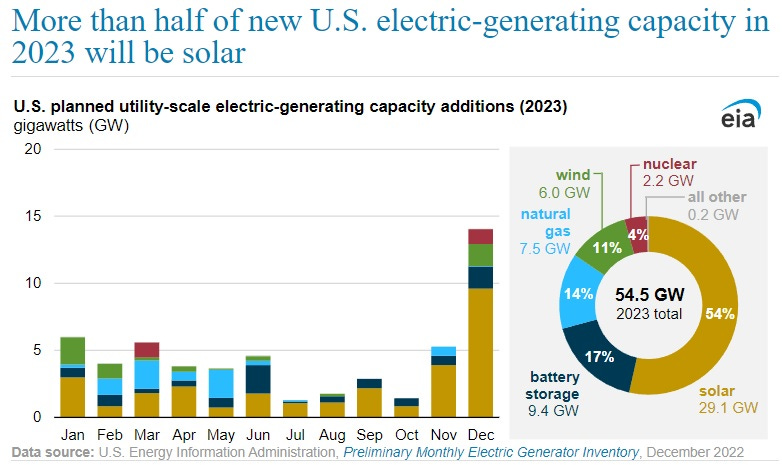
Source: EIA

Remember that capacity isn't the same as total generation, but this gives a clear idea of where things are headed — most of the new power we're building is solar and battery power.

Texas, as mentioned above, is emerging as a solar-power superstar, despite the anti-solar rhetoric of some of the state's politicians:
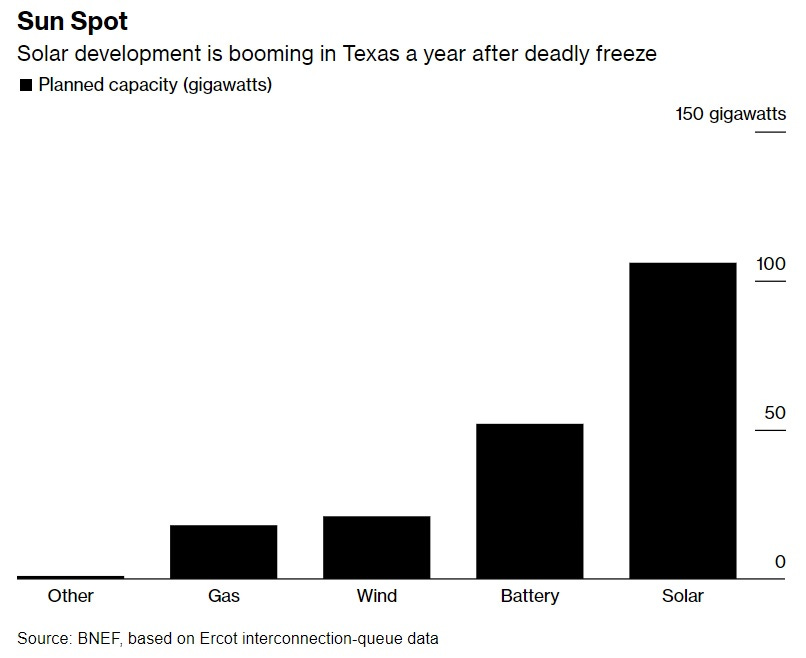
Source: Bloomberg

(If politics were behind the renewables revolution, do you really think Texas would have surged ahead of California in terms of total renewable generation? I don't think so!)

Meanwhile, beyond the U.S.' borders, the solar revolution is perhaps even more dramatic. Most EU countries are now expected to hit their 2030 solar targets years before 2030. And developing countries are racing to add solar as well:
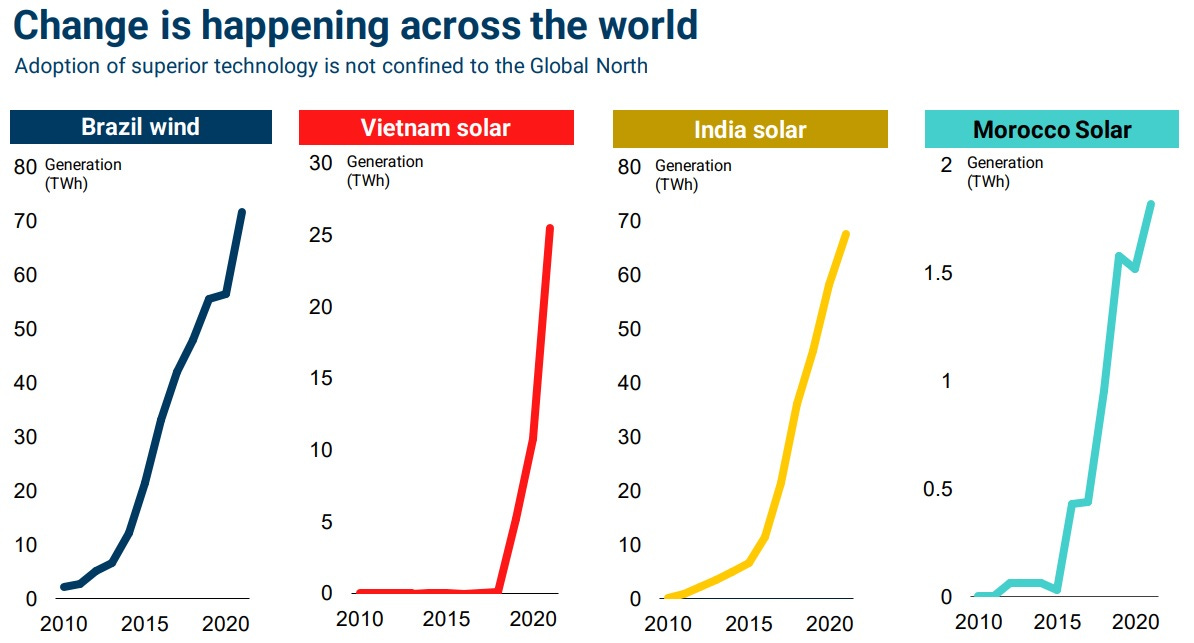
Source: RMI

Countries like India and Vietnam are not willing to jeopardize their economic development to placate the likes of Greta Thunberg. If they're going solar, it means it's because of one factor and one factor only: low cost.

And of course China is installing more solar than anybody.

As Stripe founder Patrick Collison pointed out, this is among the fastest deployments of a new technology in human history:
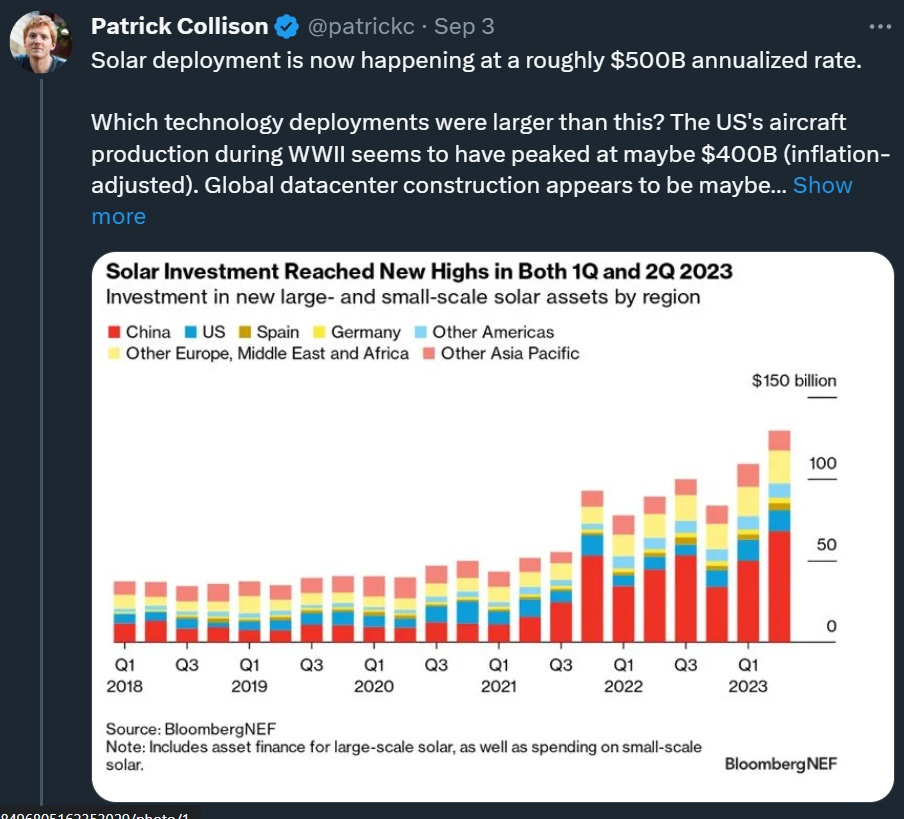
Of course, solar is still a small percentage of global energy generation — 4.5% by the IEA's latest reckoning. But a new energy source doesn't take over the entire global grid in just a couple of years. The IEA — whose predictions are famously conservative — now forecasts solar to provide a larger percent of global power capacity than either coal or natural gas in just four years:
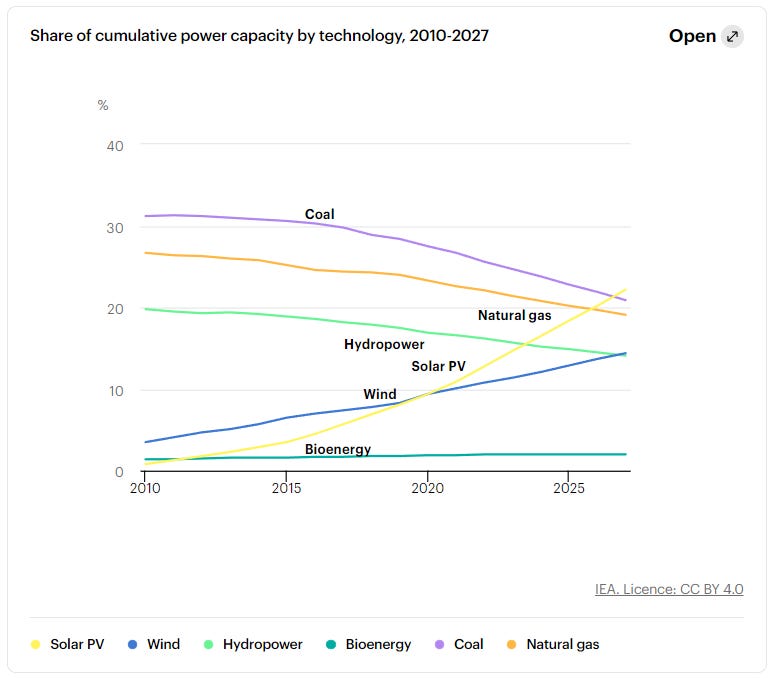
Source: IEA

(Of course, batteries will help transform that capacity into a similar percentage of total generation.)

In other words, you are looking at a true technological revolution in progress. It is no longer a question or a theory; it is a fact.

How the technological revolution should change our climate debates

The fact of the solar/battery revolution should change our climate debates in a number of ways.

First and foremost, it should serve as a counter to the unfortunate "doomer" trend that has taken hold in some lefty circles. Optimistic stories that highlight the positive developments I've laid out in this post, as well as other encouraging trends like falling emissions in rich countries, are starting to become more common in the media. That is good. Climate change isn't solved yet, but optimism is a strong long-term motivating force, and the solar/battery revolution gives us a fighting chance to hold the world under 2C of warming.

Climate scientists, too, ought to make sure to highlight the encouraging technological trends in their public communications. The world has already been warned very loudly about the dangers of climate change; those who still deny the threat will have to wait for heat waves and wildfires and floods to eventually convince them (and a few will go to their graves denying reality). What the world needs now is to be informed of the path out of the crisis — a path that didn't even exist back in 2010.

Next, the solar/battery revolution should make us decisively reject the idea of degrowth. Instead of forcing the human race to make sacrifices and tighten their belts, fighting climate change in the age of cheap solar and batteries will also mean creating cheap abundant energy for everyone, rich and poor alike. It will mean supercharging the development of poor countries in Africa and South Asia and elsewhere. And it'll allow people in rich countries to get even richer.

Notably, supporting renewables is Americans' preferred method of attacking climate change:
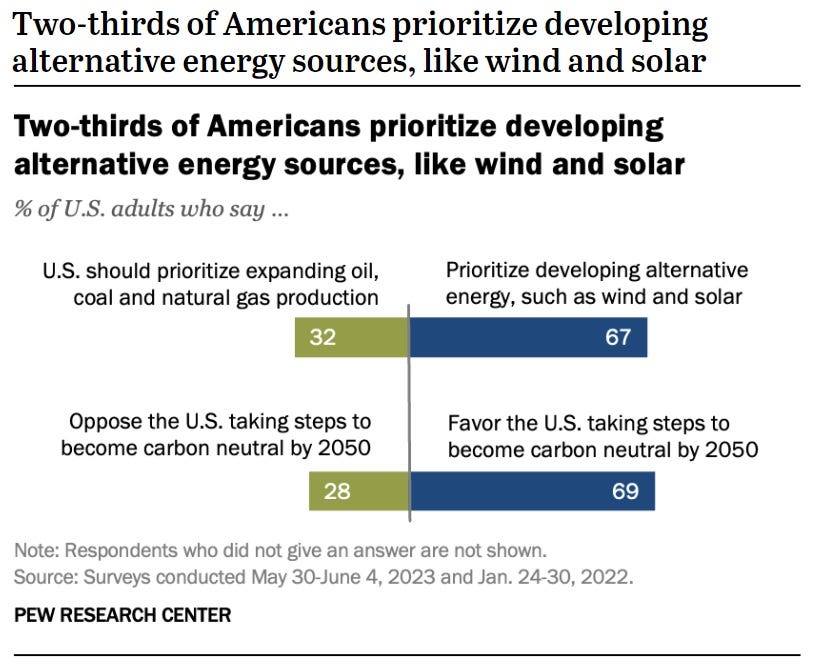
Source: Pew

Let's give the American people what they want!

The revolution in solar and batteries should also affect the debate over electric cars. Currently, one big objection to EVs is that as long as the electrical grid is still powered by fossil fuels, EVs burn carbon indirectly. But with a solar-and-battery-powered grid, this will no longer be true.

Economists, also, should shift their policy prescriptions in response to shifts in technology. A new paper by Armitage, Bakhtian, and Jaffe shows how promoting the scaling-up of green technologies is generally more effective than carbon taxes. The instincts of the Biden administration — to use industrial policy to scale up renewables — are correct, and the inherited intuition from the debates of 2010 is out of date.


To sum up, climate change is one problem where new technology has completely changed the game. That doesn't mean we can sit back and rest on our laurels and let the natural progress of technology take its course — we need to act to speed up the transition even more that we're currently doing. But it means that the idea that there's a tradeoff between the economy and the climate is now defunct.



Thursday, September 07, 2023

ANS -- Why some women still vote Republican and what can be done about it

This is a good article, a bit long, about trying not to get stuck in tribalism and see the other side as human beings.  It's about women-hating Republicans and why there are still Republican women.  Read it.


--Kim


Why some women still vote Republican and what can be done about it

Why some women still vote Republican and what can be done about it
Image via Crush Rush/Shutterstock.
How to reverse 'democracies being taken over by far-right ideologies and conspiracy thinking': author
September 06, 2023

Lists of crazy comments about women by Republican men have been an internet staple for years. If the party agenda were to alienate as many females as possible, they should be doing quite well.

Worse yet, from an impact standpoint, the policy priorities of Republican electeds match their expressed attitudes. Equal pay? Contraception? Abortion? Paid family leave? Childcare support? Forget it.

And then there's behavior.

POLL: Should Trump be allowed to hold office again?

As Leonard Pitts Jr. put it, here is where we stand:

After supporting senatorial candidate Roy Moore (a credibly accused child molester) President Donald Trump (a confessed perpetrator of sexual assault) nominated to the Supreme Court Brett Kavanaugh (a credibly accused attempted rapist) who would, if confirmed, serve alongside Clarence Thomas (a credibly accused sexual harasser).

The Grand Old Party isn't much of a party for women; it's more like a frat party—a power-drunk letch-fest. The Grand Old Boys Party.

One might think by now that Republican and woman would be a contradiction in terms. Granted, college-educated women are trickling away from the GOP; that should be no surprise. The head scratcher is that any stay. WTF. Before you decide that all female Republicans must be brainless or bad, and therefore hopeless, consider the following:

Dominance Hierarchies—Left-leaning activists often want to upend traditional power structures, but all of our nearest animal ancestors and many other social species are hierarchical—most often with dominant males at the top. Hierarchy is adaptive for them, and the preferences that create it are rooted deep in evolutionary biology. There's reason to believe that we humans carry some of the same instinctive social dynamics. That is not to say we have no alternatives, either as individuals or as societies. One of the awesome things about our capacity for higher-order reasoning is that we don't have to live according to instinct. But it should come as no surprise that some not-brainless women find traditional power structures efficient, familiar, comforting, or otherwise attractive.

Religion—There's a reason that devout religionists are fundamentally conservative. Religion takes instinct and transmogrifies it into immutable rules and rituals. What may have started out as a biologically-based inclination or simply a practical part of life at a given time and place (like gender roles in the Ancient Near East 2500 years ago) gets locked in as self-perpetuating, inflexible dogma.

Religious ideologies can arouse powerful moral emotions in believers so that protecting traditional religiously-sanctioned social structures feels good and righteous. For religious women, this can make ideas like gender equality and reproductive freedom feel wrong. As is clear from stories of those who have left conservative religious communities, no other force in our society so strongly organizes women against women. Even if you think that religions are mind viruses—essentially socially-transmitted infections, some worse than others—(as I do), one can still concede that bad kinds of infections can happen to people who are otherwise decent and healthy.

Tribal Identities—None of us are as independent in forming our political opinions as we like to think. Our sense of reality is socially constructed, and one of the most powerful forces shaping our beliefs is the kinds of reactions we get from people around us. Secularists point out that religious belief is geographically distributed—that most born-again Christians have simply acceded to the beliefs of their childhood communities and if they had been born in India would most likely be Hindu or Muslim. But once we belong to a tribe, no matter how we got there, the worldview of the tribe feels right and righteous.

The same is true of political tribes. About 7 in 10 teens say their political views are "about the same" as their parents. A similar percent say they follow the same religion as their parents. These two facts are not independent. As testimonies of former Christians show, when people change their religion, their politics often change too. Whether this is primarily because their internal world gets reconfigured or because their external world gets reconfigured, we don't yet know.

Information Silos—One of the ways that tribes maintain separate identities is by regulating information flow—by sanctioning some written texts but not others, elevating some authorities but not others, promoting some information channels (literally) and encouraging insiders to associate with insiders. The Christian New Testament puts it this way: "Do not be bound together with unbelievers; for what partnership have righteousness and lawlessness, or what fellowship has light with darkness?" But even without the encouragement, we tend to gravitate toward people who think like us and reinforce our existing biases and points of view.

The end result in an age that offers thousands of media channels, some of which adapt content to our individual likes and dislikes, is that Republican women on the whole are living in a very different narrative universe than the one Democratic women are living in. The Donald Trump they voted for is not the Donald Trump you voted against. The Brett Kavanaugh they think they support as a Supreme Court Justice is not the teenage sexual assailant or slippery ideologue you think should be no-where near the nation's high court.

Left-Wing Excesses—Republicans aren't the only ones who live in intellectually-gated communities. One of the accusations hurled against progressives is that we like every kind of diversity except diversity of thought. When we isolate ourselves from people who don't think like us, the stories we tell ourselves about class, race, gender, immigration, the environment—and hated Republican ideologues—become more and more streamlined, less nuanced, and—if we are honest—less reflective of the complicated realities that govern our lives. The robes of our heroes get bleached; those of our opponents get blackened—until we find ourselves in a satisfying world of saints and epic villains. Small wonder, with the narrative world split like this, that there are conservatives who play up our excesses, and middling folks who can't see past them.

Multifaceted Political Priorities—Even setting aside these factors, identity isn't as neat and clean as our intersectional grid of oppressed and oppressor identities would have us believe. Yes, women have been subject to men for millennia, with our subjugation sanctified by religion and culture. And yes, women who adhere to this worldview are disproportionately Republican. But even for women who have unshackled from conservative culture and religion—who prefer real gender equality—there is no reason to think that gender issues should dominate their political agenda.

I spend much of my time writing about how Abrahamic religion denigrates women, turning us into literal chattel. I feel so strongly about reproductive autonomy that I once wrote an article titled, "Why I'm pro-abortion and not just pro-choice." But I think that climate change is the core moral issue of our time; and if I had to choose between a political candidate who would do something about climate and one who would protect abortion rights, I would choose the former. I'm grateful that I haven't faced this choice. But we need to recognize that women who vote Republican may have to make equally tough choices when their values are in conflict. I need to grant them the same complicated individuality that I grant myself.

So, Simply Accept This Ridiculous State of Affairs?

No. That is not what I'm saying. The Republican Party has become a haven for sexists to the point that hostility toward women predicted Trump support better than authoritarianism and as well as racism. Some things need challenging, and this is one of them.

People do change, less than we previously thought—and we don't fully understand the process—but they do. Also, a meaningful shift in policy priorities or candidate preferences may not require much change at all. Because we all contain a myriad of values and priorities, sometimes it's just a matter of what grabs our emotions or is front of mind. Remember, it's not always a matter of winning someone over to your point of view or your tribe. Shifts in priorities within the Republican Party are consequential. So, it's worth doing what we can.

Be appealing. When you encounter a Republican woman online or in real life, imagine that you might end up neighbors or co-workers—or even (radical thought) friends. Comport yourself as if this were the case. Listen, be respectful of what there is to respect, show your own humanity, challenge selectively and carefully within a context of relatedness. You're never going to complicate the perspective of someone who you don't like and who doesn't like you, and a steady diet of disagreement is a formula for dislike. Marital therapists say that we need five positive points of contact for every negative. Even Evangelicals—who are bound by their religion to be constantly on the make—have figured this out and have cultivated expertise in what they call "relational apologetics" and "friendship missionaries." And who knows? Sometimes even missionaries learn a thing or two.

Challenge the power of religion in society. The gloves come off when it comes to institutions, and to my mind the corrosive power of religion in modern life signals that it's time to stop genuflecting and start fighting back. As the Catholic pedophilia cover-ups, the political "Moral Majority," and the emergence of ISIS demonstrate, religion doesn't deserve the free pass it has gotten for so long.

Because the Church claims to be a fount of truth and goodness, one of the most powerful ways to fight back is to expose the complicated realities that belie these claims. The Freedom from Religion Foundation has long published a "Black Collar Crime Blotter" as part of their monthly newsletter. They also fight in court to prevent aggressive religions from imposing their theologies on the rest of us.

The ACLU has dedicated staff working on the problem of Catholic hospitals, which are more than 90 percent funded by public dollars and patient fees but deny patients the full range of care based on religious theologies. Support their work. Advocate to end the tax-free status of religious institutions, which allows them to rely on public services they didn't help to fund. Support survivor groups and lawsuits against religious institutions and leaders that engage in bad behavior. The wealth of the Catholic Church, one of the world's richest real-estate owners, has given them particular undue political influence. Some of that wealth should be going as restitution to address the harms they have done.

Inoculate your children against fundamentalisms. Your children will be voting sooner than you think. More importantly, they are going to face the challenge of living well in our complicated world. But as they come of age conservative fundamentalists will be targeting them for conversion, offering a simplistic set of answers to life's big questions. (See Katherine Stewart's book, The Good News Club, or related articles.) To understand our world, your kids will need to understand how religion works and how science works and why only one of them helps us to understand and solve real world problems. Don't assume that raising them in a free-thinking or liberal religious mindset is enough. Even good people can fall for bad ideas—and for girls, traditional religious ideas can lead them to loathe their own curiosity and independence, or to support institutions that do.

Create space for flexible men. Right now the left is telling white males that there is no place for them in our aspirational future. You've had your turn on top, we say, as if one man were interchangeable with another—as if the son of an unemployed Appalachian coal miner were somehow one of a kind with the coal baron who employed his grandfather. As if he were, consequently, more privileged than the daughter of an Indian doctor with a Harvard degree, and more worthy of our compassion. Roles for men are changing and, yes, some have reacted by retrenching into contempt and arrogance and attempts to reassert old race, class, and gender privilege. But what alternative are we offering them? We've spent almost two generations now telling young women that they don't need to abide by traditional gender roles; that they can be anything they want. But young men haven't gotten the same message. A lot of young men are trapped in traditional roles, with the culture at large saying those roles are obsolete. Trapped animals fight to the death; those that have other options often take them.

What might it mean to invite both women and men into a flexible future in which they can picture themselves with dignity, respect, and opportunity?

Capture territory. The Right gained a lot of power in the last 30 years by being intractable and irrational, by acting as if the world were black and white. Anyone who's not for us is against us. At first, the Gingrich strategy of hyper-partisan obstructionism caught sensible people off guard. Think of Barack Obama patiently trying to court Republican support for what had been their own version of healthcare reform. Later, many of us on the Left decided we had to fight fire with fire. We amped up our own rhetoric and intransigence and built communications outlets that—even if they couldn't out-crazy Breitbart or Infowars or Fox—at least created a counterweight. But the middle couldn't hold, and that has left some people feeling politically homeless despite the fact that they consistently vote for—or even fund—one side of the aisle.

This leaves a lot of territory—policy priorities, constituencies, and rhetoric—wide open. Who, for example, puts the interests of the middle class above both rich and poor? Who speaks for people who both believe that capitalism improves lives and also believe in market failures—or that greed is destructive? How about those who believe that polities should manage immigration while also believing that our current system is cruel and unjust? How about those who value a social safety net and also worry about national debt? Our rhetoric has become so incendiary that someone espousing these positions is likely to be seen by each side as a member of the other. That's a problem. It's also an opportunity, because family-friendly, woman-friendly economic policies can cross the aisle.

Support bridge builders. If Republican women are going to walk away from fraternity island and settle in somewhere else, they need bridges to walk on, and that takes bridge builders. Some people are trying to play that role, and they need your support or engagement. Van Jones and his work at Rebuild the Dream comes to mind as a smart example. Several smaller start-ups are explicitly working on helping people figure out left-right communications (especially the listening part).

We can write off Republican women if we choose. We can walk away with an incredulous WTF, a shrug, or a sigh of hopelessness. I've done this many times. Persisting in an attempt to reach out, either collectively or individually, can be harder than fighting the good fight. It's viscerally less righteous, and it doesn't always work. The only thing guaranteed is that we can't make a difference if we don't try.

Valerie Tarico is a psychologist and writer in Seattle, Washington. She is the author of Trusting Doubt: A Former Evangelical Looks at Old Beliefs in a New Light and Deas and Other Imaginings, and the founder of www.WisdomCommons.org. Her articles about religion, reproductive health, and the role of women in society have been featured at sites including The Huffington Post, Salon, The Independent, Free Inquiry, The Humanist, AlterNet, Raw Story, Grist, Jezebel, and the Institute for Ethics and Emerging Technologies. Subscribe at ValerieTarico.com.