 The Weekly Sift
I am radicalizing against guns
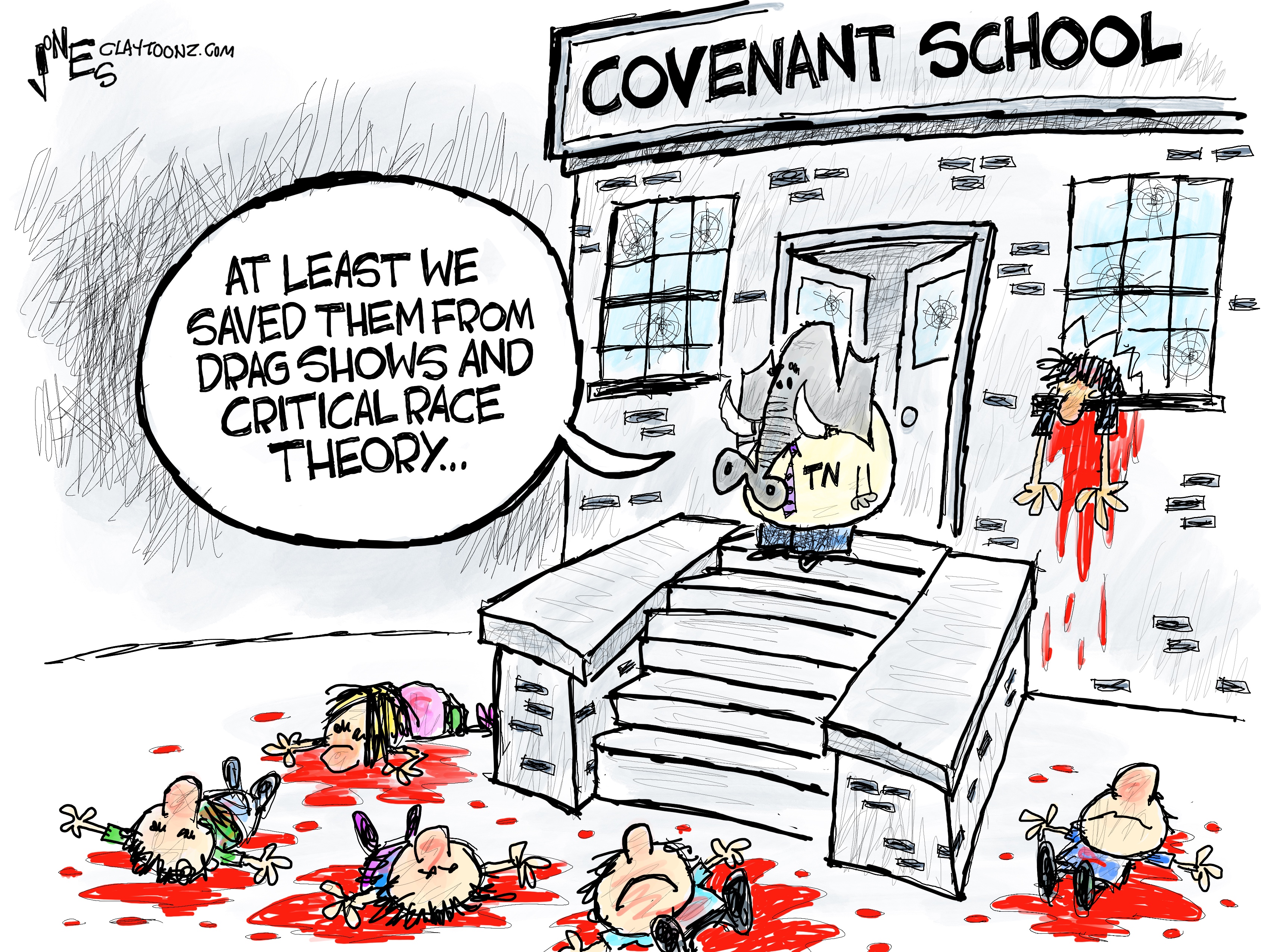
Anger is replacing sadness and hope.
Gun worship is American society's greatest sickness.
Guns don't preserve freedom, they threaten it.
And if the Second Amendment won't allow action, it has to go.
Last Monday, three students and three staff members of the Covenant School in Nashville were killed by a shooter. As you all know, this is not a new phenomenon in America. The Gun Violence Archive says it was the 130th mass shooting in the US in 2023. Gun violence has now replaced auto accidents as the #1 cause of death for children and teens.
But all the same, something about it felt different. At least to me.
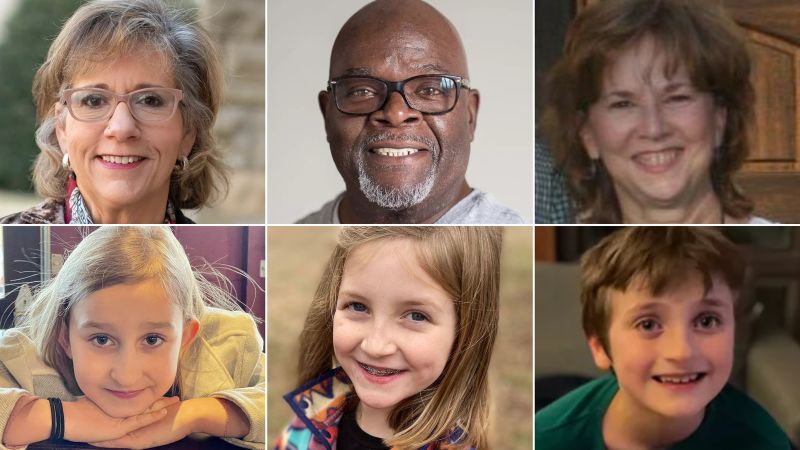 Covenant School shooting victims
Earlier school shootings, like Columbine or Sandy Hook or Parkland, left the nation with a sense of horror and sadness. But there was also a tinge of hopefulness: Maybe this would be as far as it goes. Maybe now, at long last, everyone would see that we had to do something about our gun problem.
That hopefulness is gone now. We've been through this so many times that the truth has become very clear: Some people will never see. They don't want to see.
So last Monday, I didn't feel any hopefulness in myself or see it in others. Instead, what I felt and saw was anger.
Post-Covenant rage. It started right away. Last Monday, Ashbey Beasley jumped in front of the cameras after Nashville police finished briefing the news media on the shooting, and ranted against our national inaction. Beasley and her son had been at the 4th of July parade in Highland Park last summer where a sniper killed seven people, and now she was on vacation in Nashville for another mass shooting.
How is this still happening? Why are our children still dying and why are we failing them? … These mass shootings will continue to happen until our lawmakers step up and pass gun safety legislation.
Rep. Jamaal Bowman of New York, a former middle school principal, was angry too. He stood outside the House chamber and railed at Republican congressman as they walked past.
They're all cowards! They won't do anything to save the lives of our children at all! Question them! Force them to respond to the question: "Why the hell won't you do anything to save America's children?" And let them explain that all the way up to election day in 2024.
When Kentucky's gun-worshiping Congressman Thomas Massie stopped to argue with him, saying that schools that arm teachers haven't had shootings, Bowman didn't back down.
More guns lead to more deaths. Look at the data. You're not looking at any data. … Have you ever worked in a school?
Both of these clips went viral as people responded to the justified outrage. Meanwhile, a Republican congressman was also going viral: Tim Burchett from Knoxville, who was fatalistic about gun violence. He acknowledged that the Nashville shooting was a "horrible, horrible situation", but then said:
We're not going to fix it. Criminals are going to be criminals. And my daddy fought in the Second World War, fought in the Pacific, fought the Japanese, and he told me, he said, "Buddy," he said, "if somebody wants to take you out and doesn't mind losing their life, there's not a whole heck of a lot you can do about it."
That caused Daily Show host John Leguizamo to respond with this:
That's the best you have to offer? You're a congressman. If you don't have any ideas for how to keep our kids safe, get the fuck out of the way and go work at a Pinkberry or some shit.
Hundreds, mostly young people, protested at the Tennessee Capitol Thursday.
Meanwhile, in the House, two Democratic lawmakers caused a temporary shutdown when they began yelling, "Power to the people" through a megaphone.
For so long, gun-control advocates have tried to be the soft voice of reason, and to project empathy for the strong feelings of gun advocates. Democratic politicians have treated the issue as a loser. The conventional wisdom said that pro-gun people would vote their convictions, while gun-control advocates wouldn't. And so politicians who aren't in the NRA's pocket have offered only small measures: "Can we at least have background checks on gun sales? Can we at least keep guns away from the mentally ill or people with restraining orders for domestic violence?"
And the answer has inevitably been No.
Republicans are pushing guns more than ever. As the American people have been moving in one direction, Republicans at the state level have been moving in the other.
Tennessee lawmakers have instead moved to make firearms even more accessible, proposing bills this year to arm more teachers and allow college students to carry weapons on campus, among other measures. … In Kentucky, Ohio, Nebraska, Texas and Virginia, Republicans have pushed this year to limit gun-free zones, remove background checks and roll back red-flag laws that seek to remove firearms from those who are a danger to themselves or others.
Even before the recent steps backward, Tennessee was already one of the worst states in the country when it comes to addressing gun violence, ranking 9th in gun deaths per capita. [1] Back in 2017, the minority leader of the Tennessee House, Rep. Mike Stewart, demonstrated just how ridiculous the state's gun laws were by offering an AK-47 for sale at a downtown lemonade stand. Private gun sales required no background checks then and still don't. He had bought the assault rifle in a parking lot with no background check and was proposing to sell it the same way.

The sickness of gun worship. But laws are not the whole problem. Arguably, our gun culture is worse. Guns in America are not just tools for self-defense or sport. They are symbols of identity and objects of cult veneration. They are, quite literally, worshiped.
Look at Andy Ogles, the congressman who represents the Covenant School neighborhood. He is not just pro-gun-rights. Here is his family Christmas card. Something well beyond simple second-amendment advocacy is going on here.

When asked whether he regretted that card after the Covenant School shooting, Ogles said: "Why would I regret a photograph with my family exercising my rights to bear arms?"
Let me answer that question for Rep. Ogles: You and your family are endorsing and propagating a deep sickness in our society.
The Ogles family doesn't just own guns, it chooses them to represent its identity and values. And the guns it highlights are not target pistols or duck-hunting shotguns, they are weapons of war, weapons that are often used to kill people in large numbers.
Apparently, those who hear from the Ogles once a year (on the birthday of the Prince of Peace, who told Peter "all who take the sword shall perish by the sword") need to know that the Ogles are a gun-toting family. The Ogles could send out a picture of the family volunteering at a soup kitchen, or touring the Grand Canyon, or sitting around the table for a Norman Rockwell Thanksgiving. But no: They are a family of guns. [2]
Ogles is not alone. Rep. Thomas Massie and Rep. Lauren Boebert also display the family arsenal on their Christmas cards. Several Republican members of Congress have been spotted wearing AR-15 pins. I mean, why wear a flag or a cross when you can show your fealty to an instrument of violence that regularly slaughters American children?
Yes, guns are everywhere in America. But our problem goes far beyond that. For a considerable segment of our society, guns have taken on totemic value. They have become idols. [3] Guns symbolize strength, they symbolize freedom. The bigger your gun, the more manly you are.
So it shouldn't surprise anyone that so many Americans who feel weak and helpless think they need to shoot somebody.
More guns, more death. When Rep. Bowmann told Rep. Massie "More guns lead to more deaths. Look at the data.", he had the facts on his side. Looking at all the world's richest countries, the number of guns correlates with the number of gun deaths — and the US is an outlier in both.
:format(webp):no_upscale()/cdn.vox-cdn.com/uploads/chorus_asset/file/18929874/8_5_Gun_Violence__1_.png)
Comparing US states yields a weaker correlation (probably because it's so easy to buy a gun in one state and use it in another), but the guns-lead-to-deaths relationship is still there.
:format(webp):no_upscale()/cdn.vox-cdn.com/uploads/chorus_asset/file/10259683/mother_jones_gun_deaths_by_state.png)
Guns don't protect freedom. One of the craziest recent statements came from the Michigan Republican Party. Two weeks ago, they tweeted a picture showing a box of wedding rings the Nazis had collected from Holocaust victims. "Before they collected all these wedding rings," said the meme, "they collected all the guns."
#History has shown us that the first thing a government does when it wants total control over its people is to disarm them. President Reagan once stated, "if we lose #freedom here, there is nowhere else to escape to. This is the last stand on Earth." #2A #GOP
When challenged on "trivializing the memory of millions murdered by the Nazis", the party leadership doubled down.
Considering the history of governments abusing their citizens, the only thing vile is that the Michigan Democratic party is incrementally seeking to disarm citizens. Our #2A rights shall not be infringed! Disarmed Citizens = Government Tyranny[.] #Defend2A.
Again, I'm thinking that the sane part of American society has been way too tolerant of this kind of nonsense. Posting something like this is like wearing a t-shirt that says: "I am stupid. I know nothing about history." This ought to be pointed out to them whenever they do it.
They don't seem to realize that the US is not the only country in the world with freedom and democracy. We're not even the most free or the most democratic. And the other free countries do not have anything like the number of guns we have.
In one recent ranking of countries by the quality of their democracy, the top five countries in the world were Denmark, Norway, Finland, Sweden, and Germany. The US ranked 36th. Another organization ranks countries by civil liberties. Their top five are Switzerland, New Zealand, Denmark, Estonia, and Ireland. The US is 15th.
Now let's look at the number of guns in civilian hands in those countries. Of the free and democratic countries listed above, Finland has the most guns: 32 per 100 civilians, compared to 120 in the US. Denmark, the only country that is top-five on both lists, has 10 guns per 100 civilians, and its gun laws are much stricter than US laws.
Denmark has one of the strictest – possibly the strictest – gun ownership laws in Europe. The only type of weapon that civilians may own without a licence are air rifles of a calibre of 4.5 mm or less. All other firearms, including gas pistols, alarm weapons and deactivated weapons, require a licence. In Denmark, self-defence is not a legitimate reason for acquiring a weapon, and civilians are never granted a firearm licence for self-defence reasons. The only two reasons for being granted a firearms licence are for sports shooting and hunting purposes. To gain an individual licence, sports shooters are required to have been active members of a sports shooting club for at least two years. Members without a firearms licence may practise their shooting at the firing range of the club to which they belong using the club's own licensed weapons, but they may not take any of these weapons home. Sport shooting clubs in Denmark currently have approximately 75,000 members; of these, about 20,000 members hold firearms licences. Dynamic sports shooting with semiautomatic rifles, as defined by the International Practical Shooting Confederation, is not allowed in Denmark. To have the right to hold a licence for hunting, individuals must pass an advanced hunting exam, which includes skills on how to handle weapons properly. Although Danish law accepts that hunters use semi-automatic rifles with a magazine capacity of more than two cartridges, hunters may never carry more than two cartridges in their semi-automatic rifles at one time.
So here's what I say to the Michigan GOP: When the Danish government starts herding its unarmed citizens into concentration camps, let me know. Until then just shut up about guns and tyranny, because you don't know anything. [4]
Guns threaten freedom. The most popular post in Weekly Sift history is "Not a Tea Party, a Confederate Party", which posted in 2014 and has over half a million page views. One of the observations I made in that post was that while the Tea Party attributed its ideology to the Founders, most of it actually came from the Confederacy. The true ancestor of the Tea Party wasn't Samuel Adams or Thomas Jefferson, it was John Calhoun.
Something similar is going on with guns. Today's gun worshipers fantasize about an armed populace overthrowing a tyrannical government, and they imagine themselves to be descendants of the colonial Minutemen. But that is all fantasy. The Minutemen and other colonial militias were organized openly by local governments, and they were not the primary force that defeated the British. The main force was the army authorized and funded by the Continental Congress and led by General Washington.
The revolution, in short, was a war fought between the army of a local government versus the army of a foreign government. Anti-government partisans played only a minor role.
However, there is an example in America history of armed partisans overthrowing an established government: The white supremacist Redeemer movement that overthrew the interracial democracy established in the South during Reconstruction and replaced it with the Whites-only government of Jim Crow.
Jim Crow didn't just happen. White Southerners used a campaign of organized terrorism to disrupt elections, kill politicians loyal to the United States, and prevent Black Americans from voting.
The roots of the current militia movement go back to that history, not to the Revolutionary War. Their true ancestor is Nathan Bedford Forrest, not George Washington.
Many gun-owning Americans have a Red Dawn fantasy, in which they take their guns into the hills when Communism overruns the US. The much more likely outcome is that they will be the instruments of tyranny, not its opponents. They will be the Brownshirts of American fascism, as the Oath Keepers and Proud Boys tried to be on January 6.
The Second Amendment. I think the Supreme Court has completely misinterpreted the Second Amendment in recent years, starting with Justice Scalia's Heller opinion in 2008 and continuing through Justice Thomas' last year in Bruen. I don't believe the amendment confers an individual right to bear arms, and I think the words "militia" and "well-regulated" appear in the amendment for a reason. That was the prevailing opinion on the US Supreme Court before 2008.
In short, the prevailing constitutional interpretation of gun rights is exactly what conservatives used to rail against: law created out of nothing by unelected judges.
And things are only getting worse. What Justice Thomas did in Bruen wasn't just to invalidate a century-old New York state law sharply limiting the concealed carry of handguns. Thomas initiated a whole new standard for evaluating restrictions on guns, and we still don't know what that standard will lead to. Recently a lower court used it to strike down a law taking guns away from domestic abusers.
One solution would be to reverse what the NRA did: elect sympathetic presidents who will appoint judges to undo the current court's ideological overreach. That means waiting for the Court's current majority to retire or die, which could take decades. A quicker option would be to expand the Court, allowing Biden or the next Democratic president to change the majority immediately. That's radical and sets a dangerous precedent, but the current court is so far out of line that it may be necessary. (As I've pointed out many times, the current Court majority has never been based on a popular majority. Trump's three appointees in particular were nominated by a president who lost the popular vote and were approved by a Republican Senate majority whose members represented far less than half the citizenry.)
But if we're going for a radical solution, I think there's a third option to consider: If the Second Amendment really does mean that the individual right to own and carry weapons is unlimited, and is not constrained by situations where it appears to conflict with other basic rights, then the Second Amendment needs to be repealed. I've already discussed how I would rewrite the amendment (a post that via Google caught the attention of pro-gun people and got me the most negative comments I've ever received). But I think it's time to stop tip-toeing around the irrational gun nuts in our midst: If the Second Amendment really is a suicide pact, and if the only way it can be interpreted forces us to keep watching children being slaughtered, then it has to go.
That may seem impossible today, but things can change quickly when the American people make up their minds about something. The majority will not stay in the box the radical minority has built for us.
Those who have a more reasonable interpretation of gun rights need to be put on notice. In the long run, if they can't constrain their lunatic fringe, they're going to lose all their gun rights. Because Americans will not put up with this forever.
[1] Except for New Mexico, the eight states with more gun deaths per capita also have Republican legislatures. The idea that blue states like New York or Illinois are more violent is just false.
[2] Except for the youngest, who seems to be holding a book rather than a gun. I saw one commenter on Twitter express sympathy for him. He looks like he belongs in a different family, one with sane values.
[3] If any Christian pastors are looking for a sermon topic, let me suggest that one.
[4] As for Hitler and Stalin controlling guns, Salon debunked this myth ten years ago.
Trackbacks
[…] week's featured post is "I am radicalizing against guns". A lot of people seem to be, and I suspect the prayers of pro-gun politicians like Blackburn […]
Leave a Reply
- Follow
|



 Posts
Posts


Comments
Wow, what a good essay — really puts it all together. I especially appreciated the footnote on the myth of Hitler controlling guns. Another great article today on another site was: "A Good Guy With A Dinosaur – by A.R. Moxon – The Reframe." And Mary Trump's article on the hypocrisy of the GOP. I've had a very good morning read. Thank you!
Apologies if I'm repeating myself… but the best way to improve gun control is to end gerrymandering in every state where that is possible. That is the ONLY reason Michigan is now taking big strides on gun control.
Thank you for this post. I agree 110% with everything you have written here. I go further than my friends and others who talk about "reasonable" use of firearms (hunting, self-defense) and I'm sorry, but I see absolutely no need for guns in the hands of civilians, period. Hunting is something people did for food 100 years ago and earlier. Now it is simply killing things for fun. People keeping guns around the house for self-defense are asking for a disaster – maybe their kids will find them, maybe one of the adults in the house will decide to end an argument REALLY decisively…
I live in big, bad NYC and I have NEVER felt the need for a gun. I have indeed felt the desire to be able to defend myself and my family if necessary, but I did this through study of martial arts.
I feel safe on the street, the buses, and on the subway, thanks to my training I've been able to de-escalate the occasional threatening situation through words and civilized actions, and I've never had to fight anyone. Confidence, training, and decisive and respectful action can do wonders. I shudder to think of what it would be like to have fearful people and random nutcases on our subways armed to the teeth.
I support repeal of the 2nd Amendment; it has been misinterpreted to allow practically anyone, anywhere, the right to brandish deadly military weapons in public; we need to repeal it and remove all ambiguity.
All it would take is for a future Supreme Court to decide that membership in a "well-regulated (i.e. government-controlled) militia" is necessary for gun ownership. I'm just not sure how successful this would be. Like abortion, guns are popular, and also like abortion, many Republican voters support gun regulations, same as they support abortion rights. However, since they're not single-issue voters, they aren't willing to vote for Democrats just to enact these policies. There's also the problem of enforcing bans against anything popular. The War on Drugs should have showed us how that doesn't work.
You're hopeful that the American people will eventually get tired of the carnage and demand change. I'm afraid that too many of us agree with Rep. Burchett – that there's nothing we can do, and these incidents are the price we pay for living here.
I agree with this sentiment completely.
I took a look at your earlier proposed Amendment (repeated below for convenience). I think it needs tightening up, especially #2 and #4. "Adequate means" is far too vague, and invites radical interpretation by, say, a rogue Federal Justice. And recent events have highlighted a fundamental weakness in the Constitution: it provides no limitations on the scope of State legislation. If Texas decides that an action by a "Texas citizen" (why not "resident"?) in California is subject to Texas law, unfettered state-by-state gun control becomes impossible.
From https://weeklysift.com/2019/08/19/how-should-we-rewrite-the-second-amendment/
1. The Second Amendment to this Constitution is hereby repealed.
2. Congress shall make no law preventing individuals from securing adequate means to defend their homes and persons, or preventing state or local governments from equipping police forces adequate to enforce their laws and ensure public safety.
3. Congress shall have the power to regulate the interstate transportation and sale of weapons, ammunition, and other weapon-related items.
4. States shall have the power to regulate the use, manufacture, ownership, and transfer of weapons within their borders, or to delegate such powers to local governments.
5. No federal expenditure or regulation shall be contingent on a state or local government using its power to regulate weapons in a manner specified by federal law.
Doug, I love it. Repeal the 2nd Amendment. #RF2A. American lost its right to keep and bear arms at Sandy Hook. Know Your Opposition and with that in mind I want to propose a new way of looking at people who own and carry guns: they are afraid; afraid to put them down. They cover-over their fear with labels of manliness and liberty and protecting democracy but underneath all that is a deep-seated fear. They will (unfortunately) not give up their guns quietly, and those of us who must insist that they do so are putting ourselves and our families in danger. But gun violence, not just mass shootings, happens around 100 times A DAY in America. Check the Gun Violence Archive. Our fear has driven us crazy. We have lost the right to keep and bear arms. Repeal the 2nd Amendment.
Thank you, thank you, thank you. Having just moved to Quincy with young children, and after some rough interactions with my neighbor, I'm pretty terrified to be very visib
The dependent clause is too weak. Should be "specifically designed and intended to easily kill people in large numbers."
May the people make up their minds soon enough that what they think still matters. The next Fascist-adjacent President might make the full leap, Reichstag Fire and all. The Supreme Court won't matter after that, but neither will elections. There will be better gun control after that, at least.
There are at least 6-12 countries around the world that we can learn from creating a gun control and ownership model that starts the process of changing our weird and paranoid gun culture.
Repealing and revising the 2nd amendment would be a critical part of that process.
The notion that "it'll never happen" is simply a defeatist self fulfilling/inflicted prophecy.
By the way, here in 2023 it's still legal to own a machine gun……it just requires a substantially more rigorous permitting and legal ownership process…..and lo and behold, because we have that process, machine guns are no longer the problem they were back in prohibition days.
Minimally, we just need the will to do something similar with the semi automatics and hand guns. We currently don't allow RPG's, rocket launchers, etc…….so I think we can expand the list.
Retired Marine Corps infantry officer here. Military-grade weapons belong in the hands of the military. Period. Any gun ownership should be regulated in accordance with the intent of the Constitution.
It is interesting that the "well-regulated" part of the 2nd Amendment is seldom mentioned by the … firearm enthusiasts.
Right. It's also been effaced in court rulings.
It is interesting to me that the "well regulated" phrase of the 2nd Amendment seldom gets mentioned by the … firearm enthusiasts.
Sadly, true – all of it. Well said!
The reason that there isn't any traction on the issue is that the supporters of the Republican party own the vast majority of the guns and those people are waiting for the coming Civil War which they believe that they will easily win with little destruction of the country.
I'm sad to say that I agree with Derek.
One of your finest essays. Thank you.
Perhaps a way to force a repeal/revision on the 2nd is to hit the main supporters where it hurts: the pocket. The reason they want guns unrestricted is to sell them. It all comes down to profit. So how about a lawsuit to make all arms free? Putting a price tag on a gun kinds infringes on someone's rights to get them. NOBODY thinks free guns is a good idea, but our current ways of going after the terrible reading of a poorly written amendment don't work. Make the NRA and gun manufacturers fear losing the cash cow. Fill people's heads with the idea that Republicans want homeless people with free AR-15's asking for a dollar & anybody who has a score to settle can just grab a free gun walking in a school (other than the "free" part it's close to the truth.)