Women have never built a dictatorship. Not once. Is sexism the reason? Or is there more to it?
Let’s explore the connection between performative masculinity and authoritarianism.

This piece grew out of a recent Existentialist Republic livestream conversation with comedian and author Michael Ian Black where we discussed whether performative masculinity and authoritarianism are causally linked. You can find his book A Better Man: A (Mostly Serious) Letter to My Son wherever books are sold, catch him on CNN’s Have I Got News For You, and you should definitely follow him on Substack.
“I love man as my fellow; but his scepter, real, or usurped, extends not to me, unless the reason of an individual demands my homage; and even then the submission is to reason, and not to man.” — Mary Wollstonecraft, A Vindication of the Rights of Woman (1792)
Women have never built a dictatorship. Not once. Is sexism the reason? Or is there more to it?
The sexism explanation deserves a full hearing before we go anywhere else, because it’s partially right and intellectual honesty requires we say so. Women have been locked out of political power for most of recorded history. Barred from military service, denied property rights, excluded from the ballot until embarrassingly recently. The thin historical record of female political leadership exists not because women lack the capacity for power, but because men spent centuries building systems specifically designed to prevent them from holding it.
Let’s start by exploring what happens when women inherit the halls of autocratic power.
Benazir Bhutto, twice elected Prime Minister of Pakistan and the first woman to lead a majority-Muslim nation, spent her career fighting for democratic institutions rather than dismantling them. She was assassinated for it. Corazon Aquino came to power in the Philippines specifically to remove dictator Ferdinand Marcos, did exactly that, then left when her term ended. Ellen Johnson Sirleaf, the first elected female head of state in African history, took charge of Liberia in the wreckage of a civil war, precisely the conditions that have handed men throughout history the justification to seize permanent control, and spent her presidency rebuilding rather than entrenching. Golda Meir, Prime Minister of Israel, led the country through the Yom Kippur War without using the national emergency to consolidate power beyond her constitutional authority.
We should also account honestly for the women who were genuinely brutal. Jiang Qing, wife of Mao Zedong, drove some of the Cultural Revolution’s most savage purges and wielded enormous power over China during Mao’s decline. Her power collapsed the day Mao died, because it was never independently hers; she was an instrument of a system a man had designed and built. Isabel Perón inherited the Argentine presidency from her husband Juan and presided over death squads that tortured and murdered hundreds of political opponents before a military coup removed her within two years. Ranavalona I of Madagascar was a genuinely independent autocrat who expelled Europeans, banned Christianity under penalty of death, and under whose reign Madagascar’s population fell by nearly half.¹
Look at what the full accounting reveals. Nearly every modern female authoritarian either derived her power through a husband or governed within a system of repression a man had built. Not one constructed an independent terror apparatus, a personality cult, or a system of mass political violence from scratch. Compare that to Stalin, Mao, Pol Pot, Kim Il-sung, each of whom built their machinery of control from nothing, and the contrast isn’t subtle.
Then there’s Indira Gandhi, Prime Minister of India and daughter of the country’s first post-independence leader Jawaharlal Nehru. She declared Emergency rule in 1975. She suspended civil liberties and imprisoned political opponents. She had the machinery in her hands and she used some of it. Then she called an election she expected to win, lost, and walked away. The woman who came the closest to crossing the line didn’t cross it. Let’s examine that.
Part of the answer is structural and measurable. The pathway to modern dictatorship runs almost exclusively through military command and the coup. From 1950 to 2010, researchers documented 457 coup attempts.² Every single one was led by men. Research published in 2025 found that societies which exclude women from public life tend to produce militaries that understand themselves as defenders of a social order built on male dominance, and that such militaries are more likely to seize power during political uprisings than to stand aside.³ The same structure that generates male dictators is the gate that blocks women from the path that produces them. Female heads of state are themselves more vulnerable to being removed by military coups in countries where armies are powerful enough to stage them.⁴
But the structural explanation still leaves something unexplained. Because even in the societies where women held genuine, centuries-old authority, something fundamentally different happened.
The Mosuo of southwestern China, a community of roughly 40,000 people, represent one of the world’s oldest continuing matriarchal societies, where mothers and grandmothers head households, women conduct business, and property passes down the female line.⁵ The Minangkabau of West Sumatra in Indonesia are the world’s largest matrilineal society, with a population of over five million, practicing female-centered governance for centuries while simultaneously maintaining their Islamic faith.⁶ The Khasi of northeastern India’s Meghalaya state give daughters inheritance rights, allow women to choose their own partners, and trace lineage through the maternal line. The Haudenosaunee Confederacy, the Six Nations of the Iroquois in what is now the northeastern United States and Canada, practiced matrilineal governance for centuries, and their model of distributed democratic authority, with women holding significant political power, is said to have influenced the framers of the United States Constitution.⁷
None of these societies produced a female Stalin. Not one, across four continents and centuries of female authority, generated a totalitarian state. Historian Riane Eisler’s framework explains what we’re seeing. She distinguishes between the dominator model and the partnership model of governance.⁸ The dominator model ranks humans in hierarchies and maintains those hierarchies through competition, control, and force. The partnership model links rather than ranks, built on equality, cooperation, and mutual respect. When women build power structures from scratch, without inheriting them from men and without operating inside systems men designed, they build something that looks like the second thing, not the first. They do this consistently, across cultures and centuries.
That’s where the biology becomes the explanation the evidence has been pointing toward all along.
Dominance hierarchies are ancient. They predate human civilization by hundreds of millions of years. Every social species that has organized itself has sorted individuals by status, and in most of those species, males compete for position through displays of dominance and the willingness to use force. Testosterone is the primary biological driver of that competition. It rises in response to winning, falls in response to losing, and drives status-seeking behavior in high-stakes hierarchical environments. Stanton and colleagues measured voters’ testosterone on the night of the 2008 presidential election and found that male voters responded to Obama’s victory with hormonal shifts that mirrored winning or losing a physical dominance competition, with Obama supporters’ testosterone rising and McCain supporters’ testosterone falling. Female voters showed no such pattern.⁹
Ruth Ben-Ghiat, Professor of History at New York University and author of Strongmen, the first systematic study to treat masculinity as a tool of autocratic rule, documented that virility isn’t the cultural packaging of dictatorship.¹⁰ It’s the engine. The strongman doesn’t perform masculine dominance because it’s expected. He performs it because it works on the specific psychological architecture of the people he needs to dominate and the people he needs to recruit. That architecture isn’t gender-neutral. It was shaped over an enormous stretch of evolutionary time by forces that had nothing to do with politics, and then patriarchy took it and amplified it far past anything biology alone would have produced.
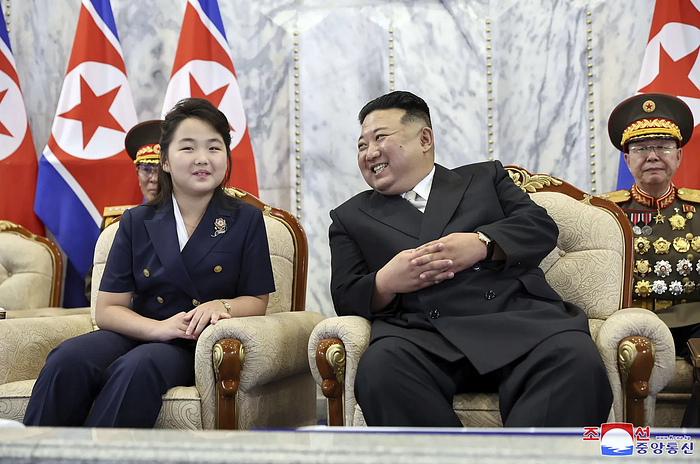
Which brings us to Kim Jong Un’s daughter, Kim Ju Ae, positioned to inherit one of the most militarized totalitarian states on earth, a nuclear-armed regime her grandfather Kim Il-sung built from scratch and her father has maintained through mass starvation and political imprisonment. She isn’t building anything. She’s being handed a machine, the same way Isabel Perón was handed Argentina and Jiang Qing was handed China’s cultural apparatus. Whether the military that has always been the real power in North Korea accepts her authority is genuinely unknown. The research suggests female leaders are more vulnerable to being removed by exactly that kind of institution.
The evidence points somewhere deeper than sexism, toward a specific combination of biology, social conditioning, and structural access that has been almost exclusively male for as long as humans have built states capable of organized terror. And when we look at what women actually build when given the chance, across cultures and centuries and every corner of the world where female authority has been the norm rather than the exception, we find something that looks nothing like what Stalin built, or Mao, or Kim Il-sung.
So what do you do next as one of The Existentialist Republic’s two to three million monthly readers. We have three full length books and a dozen booklets all available for free with download links below. You can also check out our four pieces of model legislation that are shared directly with legislators and activists. You can join the Discord community of nearly 1,000 organizers.
All of it runs on ten subscribers per article, about twenty cents per article for a subscriber.
You and I and 53,274 others have hit that minimum number of subscribers now for nine articles in a row after missing it for several weeks. That’s 9 of the 30 days we need this month to keep everything moving.
Don’t let this be the reason you miss rent or skip a meal. For everyone else, you can be one of the ten today and make sure the articles, books, legislation, and training keep coming for everyone.
Thanks for being here.
Conservatism: America’s Personality Disorder — physical copy / free download
Intro to Soft Secession — physical copy / free download
Oppositional Federalism and You — physical copy / free download
Toppling Tyrants: A Field Guide to Dismantling American Fascism — physical copy / free download
Grab Them By The E.A.R.R.: How to Get Politicians to Do What You Want — physical copy / free download
More Free downloads:
Soft Secession: 100 Policies That Pass
Being Dangerous: Go From Activist to Operative
Soft Secession: 100 Policies That Pass
All Four Completed Model Legislation Bills
The Opposition Guide to Tax Warfare
Six-Panel Soft Secession Brochure
Works Cited
¹ Campbell, G. (2005). An economic history of imperial Madagascar, 1750–1895. Cambridge University Press.
² Powell, J., & Thyne, C. (2011). Global instances of coups from 1950–2010: A new dataset. Journal of Peace Research, 48(2), 249–259.
³ Kingma Neu, K. (2025). Gender, militaries, and coups during nonviolent uprisings in nondemocracies. International Interactions, 52(1), 32–57.
⁴ Schroeder, T., & Powell, J. (2018). The right man for the job: Gender as a source of civil-military friction. Armed Forces & Society, 44(3), 460–475.
⁵ Unearthwomen.com. (2025). Matriarchal societies where women are in charge. Unearth Women.
⁶ The Conversation. (2022). Friday essay: Matrilineal societies exist around the world. The Conversation.
⁷ Untraveled.com. (2025). Matriarchal and matrilineal societies around the world. Untraveled.
⁸ Eisler, R. (1987). The chalice and the blade. Harper & Row.
⁹ Stanton, S. J., Beehner, J. M., Saini, E. K., Kuhn, C. M., & LaBar, K. S. (2009). Dominance, politics, and physiology: Voters’ testosterone changes on the night of the 2008 United States presidential election. PLOS One, 4(10), e7543.
¹⁰ Ben-Ghiat, R. (2020). Strongmen: Mussolini to the present. W.W. Norton & Company.

Written by Chris Armitage
Author, Former Law Enforcement, Policy Advisor. https://www.goodreads.com/chrisarmitage https://www.amazon.com/author/armitage TheExistentialistRepublic.com


 Posts
Posts


No comments:
Post a Comment