Saturday, September 07, 2024

ANS -- Why are ‘fact checks’ vouching for Trump's lies?

Here is an article about truth in public discourse.  It comes from the site owned by George Lakoff, Framelab.  Not sure who actually wrote it. 


--Kim


Election 2024

Why are 'fact checks' vouching for Trump's lies?

Losing the framing battle

Why are 'fact checks' vouching for Trump's lies?"Fact check" journalism appears to be broken. Can it be fixed? (photo via Shutterstock)
September 05 20245:05 AM4 min read

Let's hope 2024 will be the year that "both sides" fact-checking as a journalistic genre grows up. 

The comically bad "fact-checking" that came out of the Democratic National Convention should be a wake-up call for anyone who cares about the truth.

Example: Kamala Harris received a "Mostly False" when she said that, through Project 2025, Donald Trump "plans to create a national anti-abortion coordinator and force states to report on women's miscarriages and abortions." Politifact explained that "Project 2025 doesn't mention a 'national anti-abortion coordinator.' The document calls for a 'pro-life politically appointed Senior Coordinator of the Office of Women, Children, and Families.'"

That's like saying it's untrue to suggest a diner serves ketchup when it merely offers catsup.

Trump's Firehose of Falsehoods

These attempts to parse "tomato" from "tomah-to" might make some sense in a reality that didn't include Donald Trump, whose complete rejection of the truth thrives when the press falls into the trap of suggesting "both sides" as equally flawed. The perennial GOP nominee lies about everything from hurricane warnings to his historically bad jobs record. 

His lies – including his flood of falsehoods about the 2020 election that led to the end of America's tradition of a peaceful transfer of power – define him.

Get Full Access

Become a supporting subscriber and get all-access.

Upgrade

Even the idea that Trump can be fact-checked helps Trump. It falsely suggests there are times when he might be constrained by the truth when he, like all authoritarians, is "cognitively irresponsible," says rhetoric scholar Jennifer Mercieca. He uses his words almost solely to reject the idea that he's accountable to anyone or democracy itself.

The combination of Trump's firehose of falsehoods and the media's agenda to appear even-handed has always yielded toxic slop. But "fact checkers'" do accidentally reveal two truths:

  1. As Dr. George Lakoff has explained for years, accepting someone else's framing spreads that framing, even if you're debunking it.

The whole fact-check genre could be called "Don't Think of this Thing I Think is Wrong." Whether it's Richard Nixon saying, "I am not a crook," or the AP telling us that JD Vance didn't technically mate with furniture, the idea you're trying to dispel is spread far more than it can ever be debunked. A fact check tends to be the opposite of a truth sandwich, which Dr. Lakoff proposed to minimize the spread of blatant lies.

  1. The press still has no idea how to treat Trump, one of the worst liars in American history.

Many of the worst fact checks – like the suggestion Trump doesn't want to repeal Obamacare – rely on Trump's constant contradictions of himself, often in the same sentence. This loads in the presumption that Trump uses language the way typical politicians do instead of as a super salesman/demagogue. 

Lakoff categorized Trump's tweets to make it easier to analyze Trump's linguistic vandalism:
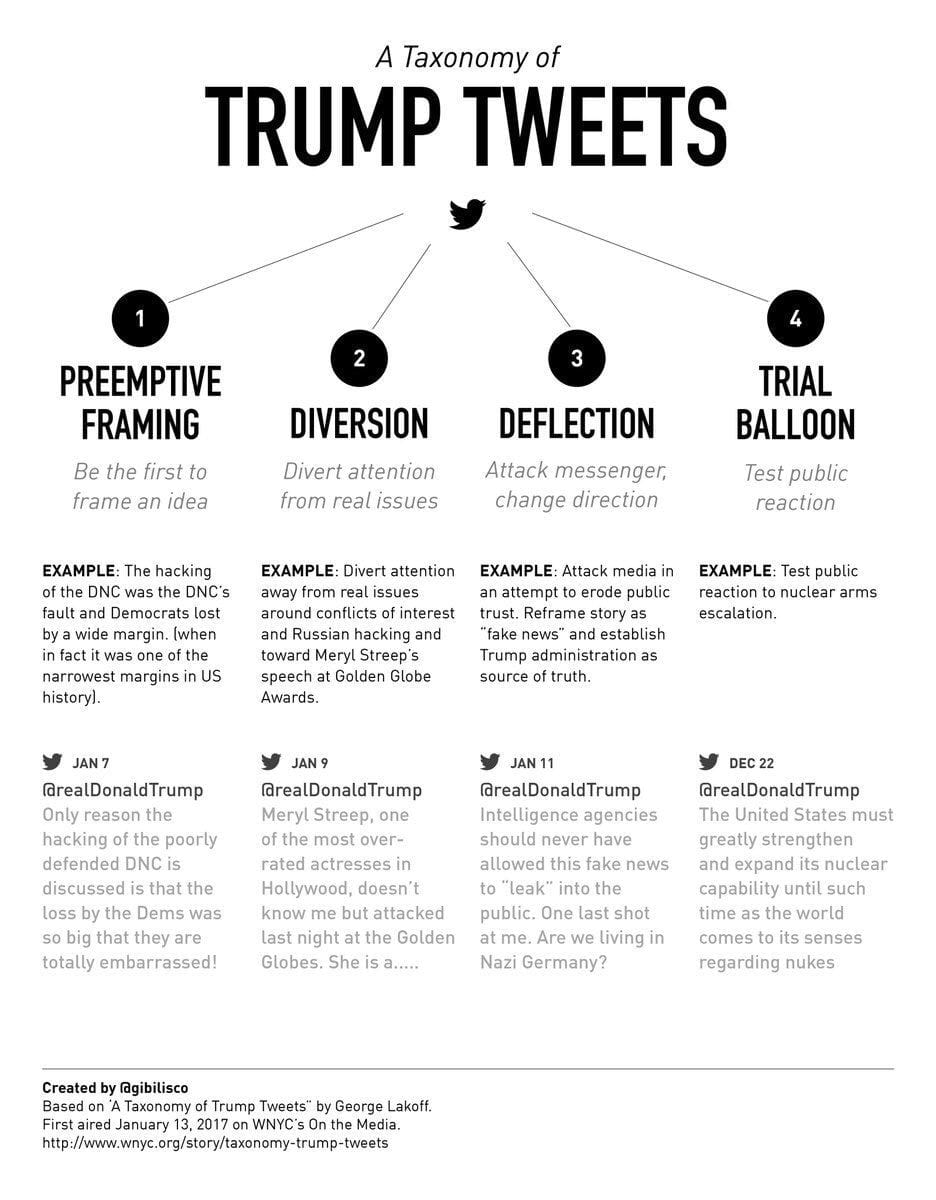
Trump is also an expert in paralipsis, which Mercieca describes as his way of asserting something without taking responsibility for saying it himself. It's his game of "I'm not saying/I'm just saying." He does this by retweeting particular noxious notions or images he's trying to spread or framing his assertions with "many people are saying." It's a repulsive hack that renders fact-checks useless.

Fact checks in the Trump era have begun to operate a bit like the "Community Notes" scam on Elon Musk's version of Twitter. Sure, you occasionally get a gem that exposes an obvious scam – like a faked Trump rally photo or a Republican bragging about an infrastructure program he opposed. But think about where those notes don't appear. They're never on Elon's tweets, which are saturated with right-wing propaganda, AI-generated disinformation, and neo-Nazi conspiracy theorizing. So, in essence, they're vouching for every lie he spreads.

Can Fact Checks be fixed?

Donald Trump depends on journalism's failed conventions to continue to normalize his unprecedented attack on American freedoms. That's why editors must pursue multiple strategies to ensure they don't mislead anyone into thinking Trump's dishonesty is comparable to his opponent's or any relevant American political figure. 

We need information to debunk lies, yet there should be a greater sense of responsibility when dealing with blatant untruths. That starts with recognizing that lies change brains, even when debunked. They are like toxic spilloff or nuclear waste that must be tracked, contained and cleaned up as much as possible. The best way to do that is to lead with the truth whenever possible, the exact thing Trump is trying to bury with his lies.

Readers also need a sense of Trump's lies' unprecedented scope, recurrence and purpose. One strategy is to annotate a typical rally speech with facts and reality checks. Then, compare it to a typical Harris speech. Another is to track his most-repeated lies. And, as Dr. Lakoff has suggested for decades, journalists should also analyze the rhetoric's frames to give voters a sense of the information war being waged for their brains. 

The problem with all of these strategies is that the press would be required to do something that they seem to do their best to avoid: Call out Trump's lies directly. The best we can hope for is a "falsely claims" in a headline or two, which is better than nothing. 

Fact checkers should stop pretending they are the be-all and end-all of determining a fact's value. Since their jobs do not seem to depend on their reputations or track records, they should bring in experts whose careers depend on accuracy to take on Trump's most repeated lies.

Publications that care about the truth need to show they understand the seriousness of this moment. Democracy and journalism face an unprecedented attack from Trump and MAGA that threatens the future of these two pillars of a free society.

Cowering to Trump will, at best, buy you more opportunities to cower to Trump, who will never be satisfied – not until he can imprison anyone who displeases him by suggesting he alone isn't in charge of deciding what is true. 


Wednesday, August 28, 2024

Fwd: green tidbit and NEW** MAGA ALERT!


---------- Forwarded message ---------
From: Joyce Segal <joyceck10@gmail.com>
Date: Wed, Aug 28, 2024 at 11:14 AM
Subject: green tidbit and NEW** MAGA ALERT!
To: Kim Cooper <kimc0240@gmail.com>


Republican officials in 24 states asked the Supreme Court on Tuesday to halt a Biden administration effort to reduce emissions of the planet-warming gas methane. Led by Oklahoma, the states are asking the high court to pause an EPA rule that went into effect earlier this year and that the agency estimates will slash methane emissions from oil and gas operations by nearly 80% through 2038. The latest filing is part of a broader campaign by the groups battling Biden administration environmental regulations, a push that has resonated with the court's conservative majority in recent years. The Supreme Court is likely to take several weeks, at least, to consider the request.
===================================== MAGA - ALERT! =======================
Robert F. Kennedy Jr. faces backlash over dead whale incident
An environmental group is calling for RFK Jr. to be investigated over a bizarre incident described by his daughter in which he beheaded a whale carcass.

Thursday, August 22, 2024

Fwd: fight


---------- Forwarded message ---------
From: Joyce Segal <joyceck10@gmail.com>
Date: Thu, Aug 22, 2024 at 9:33 AM
Subject: fight
To: Kim Cooper <kimc0240@gmail.com>


In Oakland, California students will ride to school on electric buses.
Joyce Cooper
CEO SunSmartPower
650-430-6243
SunSmartPower.com

Wednesday, August 14, 2024

Fw: August 13, 2024

Dear ANS group -- This edition of Heather Cox Richardson's posts is the history of Social Security.  Worth reading. 

----- Forwarded Message -----
From: Heather Cox Richardson from Letters from an American <heathercoxrichardson@substack.com>
To: "kimc0240@yahoo.com" <kimc0240@yahoo.com>
Sent: Tuesday, August 13, 2024 at 07:50:50 PM PDT
Subject: August 13, 2024

Forwarded this email? Subscribe here for more

On August 14, 1935, President Franklin Delano Roosevelt signed the Social Security Act into law. While he had already put in place new measures to regulate business and banking and had provided temporary work relief to combat the Depression, this law permanently changed the nature of the American government.

The Social Security Act established a federal system of old-age benefits; unemployment insurance; aid to homeless, dependent, and neglected children; funds to promote maternal and child welfare; and public health services. It was a sweeping reworking of the relationship of the government to its citizens, using the power of taxation to pool funds to provide a basic social safety net. 

The driving force behind the law was FDR's secretary of labor, Frances Perkins. She was the first woman to hold a position in the U.S. Cabinet and still holds the record for having the longest tenure in that job: she lasted from 1933 to 1945. 

Perkins brought to the position a vision of government very different from that of the Republicans who had run it in the 1920s. While men like President Herbert Hoover had embraced the idea of a "rugged individualism" in which men provided for their families on their own, Perkins recognized that the vision of a hardworking man supporting his wife and children was more myth than reality: her own husband suffered from bipolar disorder, making her the family's primary support. She understood that Americans had always supported each other. 

As a child, Perkins spent summers with her grandmother, with whom she was very close, in the small town of Newcastle, Maine, where she witnessed a supportive community. In college, at Mount Holyoke, she majored in chemistry and physics, but after a professor required students to tour a factory to observe working conditions, Perkins became committed to improving the lives of those trapped in industrial jobs. After college, Perkins became a social worker and, in 1910, earned a masters degree in economics and sociology from Columbia University. She became the head of the New York office of the National Consumers League, urging consumers to use their buying power to demand better conditions and wages for the workers who made the products they were buying. 

The next year, in 1911, she witnessed a fire at the Triangle Shirtwaist Factory in which 146 workers, mostly women and girls, died. They were trapped in the building when the fire broke out because the factory owner had ordered the doors to the stairwells and exits locked to make sure no one slipped outside for a break. Unable to escape the smoke and fire in the factory, the workers—some of them on fire—leaped from the 8th, 9th, and 10th floors of the building, dying on the pavement.

The Triangle Shirtwaist Fire proved to Perkins that voluntary organizations would never be enough to improve workers' lives. She turned toward using the government to adjust the harsh conditions of industrialization. She began to work with the Democratic politicians at Tammany Hall, who presided over communities in the city that mirrored rural towns and who exercised a form of social welfare for their voters, making sure they had jobs, food, and shelter and that wives and children had a support network if a husband and father died. In that system the voices of women like Perkins were valuable, for their work in the immigrant wards of the city meant that they were the ones who knew what working families needed to survive.

The overwhelming unemployment, hunger, and suffering during the Great Depression convinced Perkins that state governments alone could not adjust the conditions of the modern world to create a safe, supportive community for ordinary people. She came to believe, as she said: "The people are what matter to government, and a government should aim to give all the people under its jurisdiction the best possible life."

Perkins met FDR through her Tammany connections, and when he asked her to be his secretary of labor, she told him that she wanted the federal government to provide unemployment insurance, health insurance, and old-age insurance. She later recalled: "I remember he looked so startled, and he said, 'Well, do you think it can be done?'"

Creating federal unemployment insurance became her primary concern. Congressmen had little interest in passing such legislation, claiming that unemployment insurance and federal aid to dependent families would undermine a man's willingness to work. But Perkins recognized that the Depression had added pressure to the idea of social insurance by emphasizing the needs of older Americans. In Long Beach, California, Dr. Francis Townsend had looked out of his window one day to see elderly women rooting through garbage cans for food. Appalled, he came up with a plan to help the elderly and stimulate the economy at the same time. Townsend proposed that the government provide every retired person over 60 years old with $200 a month, on the condition that they spend it within 30 days, a condition designed to stimulate the economy. 

Townsend's plan was wildly popular. More than that, though, it sparked people across the country to start coming up with their own plans for protecting the elderly and the nation's social fabric.

It also spurred Congress to action. Perkins recalled that Townsend "startled the Congress of the United States because the aged have votes. The wandering boys didn't have any votes; the evicted women and their children had very few votes. If the unemployed didn't stay long enough in any one place, they didn't have a vote. But the aged people lived in one place and they had votes, so every Congressman had heard from the Townsend Plan people."

FDR put together a committee to come up with a plan, but committee members could not make up their minds how to move forward. Perkins continued to hammer on the idea they must come up with something, and finally locked the members of the committee in a room. As she recalled:  "Well, we locked the door and we had a lot of talk. I laid out a couple of bottles of something or other to cheer their lagging spirits. Anyhow, we stayed in session until about 2 a.m. We then voted finally, having taken our solemn oath that this was the end; we were never going to review it again."

By the time the bill came to a vote, it was hugely popular. The vote was 371 to 33 in the House and 77 to 6 in the Senate.

When asked to describe the origins of the Social Security Act, Perkins mused that its roots came from the very beginnings of the nation. When Alexis de Toqueville wrote Democracy in America in 1835, she noted, he thought Americans were uniquely "so generous, so kind, so charitably disposed." "Well, I don't know anything about the times in which De Tocqueville visited America," she said, but "I do know that at the time I came into the field of social work, these feelings were real."

With the Social Security Act, Perkins helped to write into our laws a longstanding political impulse in America that stood in dramatic contrast to the 1920s philosophy of rugged individualism. She recognized that the ideas of community values and pooling resources to keep the economic playing field level and take care of everyone are at least as deeply seated in our political philosophy as the idea of every man for himself. 

In a 1962 speech recalling the origins of the Social Security Act, Perkins reflected: "Of course, the Act had to be amended, and has been amended, and amended, and amended, and amended, until it has now grown into a large and important project, for which, by the way, I think the people of the United States are deeply thankful. One thing I know: Social Security is so firmly embedded in the American psychology today that no politician, no political party, no political group could possibly destroy this Act and still maintain our democratic system. It is safe. It is safe forever, and for the everlasting benefit of the people of the United States." In 2014, Perkins's Maine home was designated a National Historic Landmark.

But in 2024 it is no longer guaranteed that Social Security is "safe forever." The Republican Party has called repeatedly for cuts to the popular program. As recently as March 2024, the Republican Study Committee, which includes the Republican House leadership and about 80% of House Republicans, said it is "committed to protecting and strengthening" Social Security by raising the retirement age and cutting benefits for those who are not yet approaching retirement. The Heritage Foundation, the main organization behind Project 2025, said in June that the retirement age should be raised. 

There was such an outcry over that plan that Republicans backed away from it. By July, the Republicans promised in their 2024 platform to "FIGHT FOR AND PROTECT SOCIAL SECURITY…WITH NO CUTS, INCLUDING NO CHANGES TO THE RETIREMENT AGE," but offered no plan for making it solvent except further deregulation and tax cuts. Indeed, Trump's recent promise to end federal taxes on Social Security benefits for wealthier recipients could, according to the Committee for a Responsible Federal Budget, increase the budget deficit by $1.6  to $1.8 trillion by 2036, making the plan insolvent two years earlier than currently projected. 

As Minnesota governor, Vice President Kamala Harris's running mate Tim Walz expanded the state tax exemption for Social Security, eliminating it for most seniors but not affecting the program's solvency. One hundred and eighty-eight Democrats have cosponsored the Social Security 2100 Act, which expands Social Security benefits and raises payroll taxes on those who earn more than $400,000 a year to pay for it. 

—

Notes:

https://www.ssa.gov/history/35act.html

​​https://www.ourdocuments.gov/doc.php

https://www.ssa.gov/history/perkins5.html

https://francesperkinscenter.org/life-new/

https://www.whitehouse.gov/briefing-room/statements-releases/2024/03/21/fact-sheet-80-of-house-republicans-release-plan-targeting-medicare-social-security-and-the-affordable-care-act-raising-costs-and-cutting-taxes-for-the-wealthy/

https://www.heritage.org/social-security/commentary/should-the-social-security-retirement-age-be-raised-yes

https://www.cnbc.com/2024/08/09/trump-plan-cut-taxes-on-social-security-benefits.html

https://www.cnbc.com/2024/08/07/tim-walz-cut-social-security-taxes-its-different-from-trumps-plan.html

https://thehill.com/opinion/finance/4824705-populist-republicans-entitlements-reform/

https://www.presidency.ucsb.edu/documents/2024-republican-party-platform

https://www.congress.gov/bill/118th-congress/house-bill/4583/all-actions

https://www.nps.gov/places/frances-perkins-homestead.htm

Share

You're currently a free subscriber to Letters from an American. If you need help receiving Letters, changing your email address, or unsubscribing, please visit our Support FAQ. You can also submit a help request directly.

For the full experience, upgrade your subscription.

 
Like
Comment
Restack
 

Friday, August 09, 2024

Fwd: Look dems made the market crash.


---------- Forwarded message ---------
From: Joyce Segal <joyceck10@gmail.com>
Date: Wed, Aug 7, 2024 at 6:12 AM
Subject: Look dems made the market crash.
To: Kim Cooper <kimc0240@gmail.com>


for a day!

This is what it looks like now: 


--
Joyce Cooper
CEO SunSmartPower
650-430-6243
SunSmartPower.com