Here we are yet again.
Nine more Americans slaughtered by a raging madman with a gun and bad haircut.
Nine more innocents slaughtered because we absolutely, utterly, refuse to do anything to prevent it.
This time it was Charleston, but it could have been anywhere.
The place, the names, the blood and the hate, the insanity, they're all the same.
I waited a week to see what would happen. To see if it would be different this time.
But, of course, it's not.
It never is.
Oh, they'll haul down the Confederate Battle Flag, that stinking banner of treasonous bigotry, sure. Social media will raise a great cry of joy at the victory, but it won't end racism in America any more than outlawing the swastika in Germany got rid of the skinheads. It's a start, certainly, and one a hundred years overdue, but it won't do a damned thing to get at the real problem.
And it certainly won't stop the gun violence in America.
When US Congresswoman Gabby Giffords was shot in the head by a grinning nut with a gun, we watched six people including a little girl die. Eighteen people were wounded that day. I wrote about rights and responsibilities and about Second Amendment Solutions. We Americans, we talked about maybe doing something. Some demanded more laws. Some demanded more guns. Some blamed liberals. Some blamed conservatives. Some blamed mental health. Some blamed the victims. Everybody blamed Obama.
Predictably, nothing changed.
Then another lunatic with a gun slaughtered twelve people inside a movie theater and wounded seventy more.
I wrote The Seven Stages of Gun Violence. Over the last thirty-six months I've updated that piece numerous times with another, and another, and another, and another, and yet anothercase of armed madness and bloody mayhem.
I said then nothing will change, that nothing can change because we Americans will notchange it. We can't even have a civil conversation about it. Guns are an obsession in our country, a lunatic insanity, the mere mention of which makes us bang bang crazy.
I said that the slaughter will continue, and it has with terrible regularity.
I said liberals will blame conservatives, and they do.
I said conservatives will blame liberals, and they do.
I said the same old argument will continue. And so it has, repetitious and as predictable as clockwork, bang, bang, bang.
And nothing changed.
Fully half of Americans apparently believe gun violence can somehow be brought under control with the addition of yet more gun violence – which is a lot like saying drunk driving can be cured if we just put more drunk people behind the wheel. They might be right, in an evolutionary sense, but it's small comfort to those killed and maimed in the resulting blood bath.
The simple truth of the matter is that gun violence isn't the exception in America, it's who we are.
The president was right, you don't find this kind of gun violence in other First World countries.
What? What's that? Oh, of course, France. Charlie Hebdo. Fair enough. I'll give you Charlie Hebdo. Tell you what, I'll even spot you Anders Behring Breivik. Now, your turn, quick, name twenty more. Name ten more incidents of gun violence in France. Name ten more incidents of gun violence in Norway. No, no, don't Google it. If it's as common there as it is here, you should have no trouble naming five examples in either country right off the top of your head.
So go ahead, name them.
What's the matter? Can't do it?
Funny, you sure as shit can name that many incidents of gun violence, five, ten, twenty, right here in America, can't you? In the last three years.
Gun violence is who we are.
We're bang bang crazy.
We actually have "National Gun Appreciation Day" in America. All of our heroes are packing. Guns and violence solve all of our problems. Books, TV, movies, video games, law enforcement, foreign policy, we can't think of a solution that doesn't involve guns, or the threat of them. In the United States we believe gun ownership is a fundamental civil right, a Constitutional right … and access to food, clean water, education and healthcare are not.We proudly tell ourselves that an armed society is a polite society, a civil society, a law abiding society – even though that is patently and provably untrue in every example. We say that armed citizens, a good guy with a gun, stop crime, even though that is patently and provably untrue in large part. In America, "guns" and "religion" are commonly used in the same sentence. In America, it's now possible to print your own untraceable and undetectable gun with a 3D Assembler and a computer and won't that be fun? We have so many incidents of gun violence in this country that after a while they all just start to sound the same. In America, guns are so important to us that we demand even those with diagnosed psychological problems have access to guns. And when those same people go on a murderous killing spree, we say it was God's will and we say it was the victims who were at fault for not having guns of their own – which is exactly what was said at Sandy Hook and last week in Charleston.
Small wonder then that the nuts and disaffected and the simple-minded haters reach for that Second Amendment solution. Honestly, what other examples do we offer?
And so what do we do about it?
As a firearms expert and as a gun owner, and I am both, I'll say to you in all candor: moreguns are not the solution. Having people armed in schools and churches is not the solution. Carrying your mini-14 in a tactical harness to the grocery store isn't the solution. Living in an armed camp isn't the goddamned solution.
You can't fight drunk driving with more drunk drivers.
So what then? More laws?
Maybe, if they're the right laws.
The gun fetishists at the National Rifle Association often argue criminals and crazy people don't obey the law, so more laws won't stop them – new gun laws only punish "responsible" gun owners and take away their Constitutional rights.
There's a certain amount of truth to this.
Whenever this comes up, I always ask: what laws would have prevented this latest slaughter?
The response is usually some vague hand waving about more background checks. But background checks wouldn't have prevented Charleston. They wouldn't have prevented Columbine. They wouldn't have prevented Sandy Hook. They wouldn't have prevented Aurora. They wouldn't have prevented Fort Hood, twice. They wouldn't have kept Gabby Giffords from being shot in the head. They would not have stopped Christopher Dorner. Neither would banning assault weapons. Or high capacity magazines. Or mandating smart gun technology. Or more gun-free zones.
And in this, the NRA is provably correct.
But what both the anti-gun lobby and the pro-gun lobby get wrong is this: While it's often true laws don't stop criminals, that is not the law's purpose.
Laws don't stop crime. It would be nice if they did, but laws don't stop crime. Instead laws give society legal recourse when its members engage in antisocial behavior.
If there wasn't a law against theft, you couldn't prosecute somebody for stealing.
If there wasn't a law against murder, you couldn't imprison somebody for killing another.
Laws against theft and murder don't stop theft and murder, they give society legal options when theft and murder occur.
Saying new gun laws won't end gun violence is a non sequitur. Of course guns laws won't end gun violence.
Laws don't stop crime, however what well written laws do is to put responsibility where it belongs – on the criminal.
Well written laws are about pragmatism.
For example, we all know that laws against drinking and driving won't stop drunk driving, but they weren't intended to. We know it's going to happen. People are going to drink and drive and kill themselves and each other. We know we can't eliminate it completely. That's the pragmatism part.
Instead, drunk driving laws were intended to do two things, 1) give us legal recourse as a society, 2) make us responsible for our antisocial behavior – which in turn leads over time to a change in culture.
And that change significantly, measurably, reduced drinking and driving and provably saved lives and made American roads a safer place for all of us.
But, and this is important so pay attention, here's what those laws didn't do: they didn't keep those of us who take responsibility for our own actions from 1) drinking, or 2) driving (note the operative word here is or).
And that's the answer.
We need gun laws that give society legal recourse by making each gun owner/user personally accountable for their own actions.
Those laws should be designed to change our gun culture over time in order to make gun violence less likely. And, of course, those laws should not keep those of us who take responsibility for our own actions from exercising our Second Amendment rights.
Now, what exactly does such a law look like?
Well, it looks like the NRA.
I'll pause for a minute until you finish screaming.
Look, let's be honest.
More gun-free zones won't do a damned thing. The Emanuel African Methodist Episcopal Church was a gun-free zone.
More background checks won't do a damned thing – not unless we're willing to get serious about it, unless we standardize background checks across the nation to include a complete and thorough investigation like the kind used for federal security clearances. We're talking full national agency checks with interviews by certified investigators (what security clearance adjudicators call a NAC-I). Those cost about $100K and take four to six months. Such a system would require a complete disclosure of all financial, criminal (including juvenile records), and medical records (including mental health records), periodic updates, and a comprehensive database of all gun owners. It's possible, but I suspect neither affordable nor politically feasible. Anything less than that is a waste of time. Q.E.D.
Banning the future sales of assault weapons, certain types of ammo, and large capacity magazines won't do a damned thing. That horse is out of the barn.
So what would?
Well, we make the NRA's own rules federal law.
That's right.

On my range, on any range, military, law enforcement, or civilian, the first rule of gun safety is this:
Always assume the gun is loaded, unless you personally have verified that it is unloaded.
Everything depends from that anchor point.
Everything.
You always assume the gun is loaded. Always. Every time. Even if you just watched somebody else unload it. When you pick up a weapon or accept it from somebody else, you assume it is loaded until you, yourself, personally unload it or verify visually and physically that it is unloaded. Period. No exceptions.
Now, I doubt anybody would want to argue that rule.
Make it the law.
Every gun user is personally responsible for knowing the condition of their weapon. No exceptions.
Every year, hundreds of people are shot with unloaded guns. In the last year I've counted dozens of reports of "accidental" discharges, a number at gun shows by so-called experts. For example, last year in Medina, Ohio, a man was wounded at a gun show by a gun dealer, a gun dealer, who was checking out a semi-automatic handgun he had just bought. The dealer took the gun from the seller and accidentally pulled the trigger without clearing the weapon first. The gun's magazine had been removed from the firearm but one round remained in the chamber. Both the seller and the buyer should have been held criminally liable for failure to properly clear the weapon.
"I thought it was empty" is the single most common excuse when somebody "accidentally" discharges a weapon.
There are no accidents with guns.
There. Are. No. Accidents.
It's a killing machine. You're responsible. Period. No exceptions.
We start right there: anyone who picks up a gun is responsible for its condition. No excuses. Misdemeanor for failure to know the condition of your weapon if only property damage is involved, felony negligence if somebody is injured including yourself, manslaughter if somebody dies.
The next rule of safe gun handling is:
Always point the gun in a safe direction.
Every year hundreds of people are killed or injured by guns because the operator failed to keep the weapon pointed in a safe direction.
Last year, a pregnant woman, Katherine Lynn Bryan, was shot in the head by William DeHayes. DeHayes was showing Bryan and her husband some of his guns, including a .22-caliber revolver. He picked the gun up, didn't verify that it was unloaded, failed to maintain muzzle control in a safe direction, failed to keep his finger off the trigger, and inadvertently shot Bryan in the head. She died. So did her baby. The papers called it an "accident." The police called it an "accident." DeHayes called it an "accident."
There are no accidents with guns.
DeHayes didn't face any charges and he's still a gun owner.
Know how to use the gun safely.
Before handling a gun, learn how it operates. Know its basic parts, how to safely open and close the action and remove any ammunition from the gun or magazine. Remember, a gun's mechanical safety device is never foolproof. Nothing can ever replace safe gun handling.
Be sure the gun is safe to operate.
Just like other tools, guns need regular maintenance to remain operable. Regular cleaning and proper storage are a part of the gun's general upkeep. If there is any question concerning a gun's ability to function, a knowledgeable gunsmith should look at it.
Use only the correct ammunition for your gun.
Only BBs, pellets, cartridges or shells designed for a particular gun can be fired safely in that gun. Most guns have the ammunition type stamped on the barrel. Ammunition can be identified by information printed on the box and sometimes stamped on the cartridge. Do not shoot the gun unless you know you have the proper ammunition.
Cleaning
Regular cleaning is important in order for your gun to operate correctly and safely. Before cleaning your gun, make absolutely sure that it is unloaded.The gun's action should be open during the cleaning process. Also, be sure that no ammunition is present in the cleaning area.
A few months ago, right across the street from my house here in the Alaskan MatSu, a woman was getting her kids out of her car in a church parking lot. Her .357 fell out of its holster, hit the ground, discharged, and struck her 4 year old child in the leg directly above his knee. Give that some thought, gun people. A .357 magnum round dead center into the bone of a 4 year old child's leg at close quarters.
The police called it an accident.
There are no accidents with guns.
Always point the gun in a safe direction, that's rule #1 of the NRA's own guidelines.
Always keep your finger off the trigger until ready to shoot, that's NRA rule #2.
Always keep the gun unloaded until ready to use, that's NRA rule #3.
You're responsible for your weapon at all times. You're responsible for proper and secure carry. You're responsible for keeping the weapon in proper operating order. You're responsible for engaging the safety if the weapon is so equipped or for the use of other techniques if it is not. A properly maintained and carried weapon does not discharge when dropped, if it does, it's your responsibility. Period. No excuses.
Make it the law.
Misdemeanor for failure to point your weapon in a safe direction, for unintentional discharge, for failure to properly maintain and use safety systems if only property damage is involved. Felony negligence if somebody is injured including yourself. Felony manslaughter if somebody dies.
Know your target and what is beyond.
Be absolutely sure you have identified your target beyond any doubt. Equally important, be aware of the area beyond your target. This means observing your prospective area of fire before you shoot. Never fire in a direction in which there are people or any other potential for mishap. Think first. Shoot second.
Make it the law.
Just as you're responsible for keeping your weapon pointed in a safe direction at all times when not intending to shoot, any gun user should be lawfully accountable for correct target identification when shooting whether it's on a target range or in the grocery store in defense of an active shooter situation. Period. No excuses. No exceptions.
Misdemeanor for failure to discharge your weapon in a safe direction if only property damage is involved, felony negligence if somebody is injured including yourself, manslaughter if somebody dies.
There are no accidents with guns.
Think first. Shoot second. On or off the range. You're carrying a killing machine in public, it's your responsibility. Not anybody else's. Yours. Period. No excuses.
Never use alcohol or over-the-counter, prescription or other drugs before or while shooting.
Alcohol, as well as any other substance likely to impair normal mental or physical bodily functions, must not be used before or while handling or shooting guns.
We don't allow people to operate a car, a boat, an airplane when intoxicated. We don't let doctors to operate when drunk. We don't allow cops or military personnel to drink on duty.
But every year thousands of Americans are killed or injured by drunks with guns and even the NRA knows just how insane that is and they put it in writing.
Make it the law.
Just like drinking and driving, you're caught drinking with a gun, you take a breathalyzer or a blood test. We don't need any new standards, the ones for DUI will work just fine. You're intoxicated with a gun? You go to jail. And we impound your weapons. Somebody is injured? Aggravated assault. Somebody is killed? Negligent homicide. You're operating a killing machine, I don't think sobriety is too much to ask.
Store guns so they are not accessible to unauthorized persons.
Many factors must be considered when deciding where and how to store guns. A person's particular situation will be a major part of the consideration. Dozens of gun storage devices, as well as locking devices that attach directly to the gun, are available. However, mechanical locking devices, like the mechanical safeties built into guns, can fail and should not be used as a substitute for safe gun handling and the observance of all gun safety rules.
Every year hundreds of people are killed by guns in the hands of people not authorized to have them.
You own a gun, it's your responsibility. Period. No excuses. If Adam Lanza's idiot mother had properly secured her weapons, she and the innocents of Sandy Hook would still be alive. Hundreds of people are killed or injured every single year in the United States by unsecured weapons. Weapons are stolen and fall into the wrong hands, because they are not properly stored.
The NRA itself, by its own rules for safe gun handling, dictates that weapons must be stored so that they are not accessible to unauthorized persons. Note that the NRA doesn't dictate the method, only the requirement.
Make it the law.
Misdemeanor for failure to properly store your weapon. Felony negligence if somebody is injured including yourself. Negligent homicide if somebody dies. Children are able to access your weapon because you failed to properly secure it? Felony child endangerment. No excuses. No exceptions.
And finally, though it's not one of the NRA's rules, I'd add
Never provide a gun to someone not authorized to have it.
If you purchase or otherwise obtain a firearm for another who you know is not legally able to own/operate a gun, you are responsible for that person's resulting actions with that weapon.
If the people who buy weapons for those not authorized to have them were held to account for their actions, Charleston and Columbine wouldn't have happened – or at least the likelihood would be significantly reduced.
There are no accidents when it comes to guns.
Make that, that right there, the law. There are no accidents when it comes to guns. Period. No excuses.
Make responsible gun ownership and usage federal law, uniform across the United States.
Conviction on misdemeanor gun safety charges? You lose the privilege for a specified period. You engage in remedial action? You prove you've learned your lesson? You prove you'll be a responsible gun owner in the future? You get your guns back. Happens again, you lose the privilege forever. We don't give drunk drivers more than two strikes either.
Conviction on felony gun handling charges? You lose the privilege. Period. Your name goes in the federal database and you never own or operate a gun again, this includes cops and military.
You're caught with a gun after losing the privilege? You automatically go to prison, no plea deals, no excuses.
Don't want to lose the privilege? Then all you have to do is follow the NRA's own rules for responsible gun ownership.
Will this eliminate gun violence completely?
No, of course not.
Would implementation of this idea have prevented Charleston?
Maybe. Maybe not. But over time it would make such terrible events less likely and would hold those responsible for enabling the slaughter, such as Dylann Roof's father (the guy who gave him the gun even though he knew his son wasn't supposed to have it) to account right alongside the trigger-puller.
Over time, just like with the drunk driving laws, enforcing the NRA's own rules, the same basic common sense rules that are used in the military, in law enforcement, on civilian gun ranges, and were taught to most of us by our fathers, will change our culture from one of gun fetishists to one of responsible gun owners. And that will reduce gun violence, just as the same approach has significantly reduced drinking and driving.
More, it will provide opportunity for the free market to fill in the gaps. Want to own a gun, but you're afraid of running afoul of the law because you don't know the rules? Don't know how to properly shoot? Don't know how to maintain and secure your weapon? Plenty of room in there for somebody to teach classes, say even the NRA – should they decide to return to the original charter of their once venerable organization and stop pandering to the lunatics and the gun manufacturers.
Note that I didn't suggest that you had to take a class. States should decide that. Just like states decide how you'll get a driver's license, either by formal classroom or via a knowledgeable mentor. States can levy their own additional requirements. They want background checks, fine. They want waiting periods, fine. They want to limit certain weapons and ammo and specify gun-free zones, that's up to them.
But at the federal level, we set a basic standard for responsible gun ownership: the NRA's own rules.
There's no reason why any gun owner should be oppose this idea. There is no reason why the NRA should oppose this. There is no reason why gun manufactures should oppose this. The rules are ones they all claim to follow now. The only difference is they will be legally responsible for it.
What I'm talking about here is pragmatism.
What I'm talking about is responsible gun culture.
What I'm talking about is sanity.
Other articles on gun violence referenced in this essay are summed up here.
The Seven Stages of Gun Violence
The Bang Bang Crazy series:
Part 1, What we need, see, are more guns, big fucking guns
Part 2, Gun violence isn't the exception in America, it's who we are
Part 3, Sandy Hook, the NRA, and a gun in every school
Part 4, More dead kids and why we have laws
Part 5, Gun control and a polite society
Part 6, The Christopher Dorner rampage, they needed killin'
Part 7, Still more dead kids and let's print our own guns!
Part 8, Let's try blaming the victim, shall we?
Part 9, Armed soldiers on post, sure, nothing to go wrong there.
About me:
As noted elsewhere, I've been around guns my entire life. My dad taught me to shoot when I was a kid – in fact the very first gun I ever fired was my dad's prized black powder .75 caliber smooth bore Civil War trench piece when I was about four years old. I still own my very first gun, bought from Meyer's Thrifty Acres in Jenison, Michigan, for me by my dad when I was fourteen years old – a lever action Winchester 30-30. I got my first deer with that gun. I grew up shooting, at home, in the Boy Scouts, hunting, target shooting, plinking, with friends and with family. Thirty years ago I joined the military and spent my entire life there. I know more than a little about guns. I'm a graduate of the Smith & Wesson Rangemaster Academy, the nation's premier firearms instructor school. I'm a certified armorer and gunsmith. I've attended pretty much every boarding officer and gun school the military has. I hold both the Expert Pistol and Expert Rifle Medals. I've taught small arms and combat arms to both military and civilians for nearly thirty years now. I've fired damned near everything the US military owns, from the old .38 revolver to a US Navy Aegis Guided Missile Cruiser's 5" main battery – and everything in between. I can still field strip a Colt .45 M-1911 pistol and put it back together in under a minute, blindfolded – I happen to own several of them, along with numerous other semi-auto pistols and a number of revolvers. I used to shoot professionally and in competition. I helped to design, test, field, and fire in combat US Military weapons systems. I've spent my entire life in places where gun usage is extremely, extremely, common. I have a Concealed Carry Permit. I'm an Alaskan and I typically carry a gun in the wilds of Alaska on a regular basis. I am neither pro-gun nor anti-gun, a gun is a tool, nothing more. If you feel that I'm ignorant of guns, or that I'm anti-gun, or unAmerican, well, you're welcome to speak your piece – just so long as you can live with what comes after.


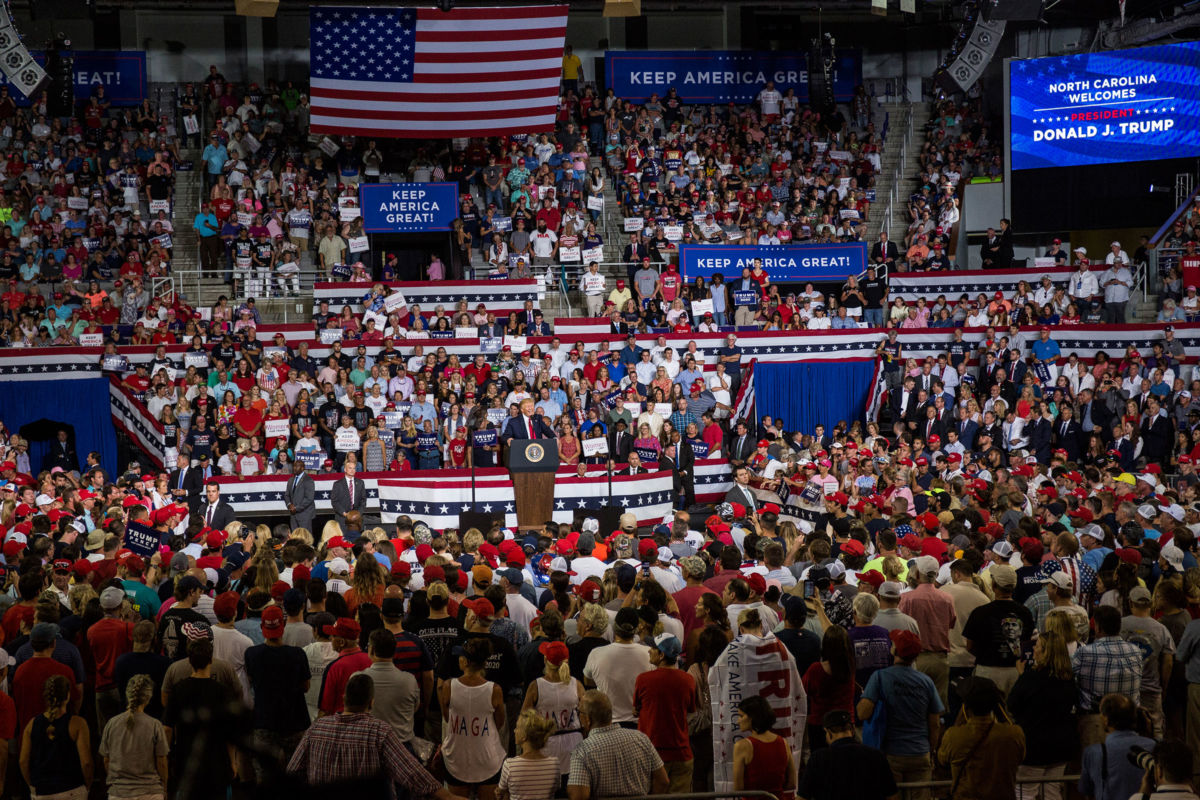 President Trump speaks during a Keep America Great rally on July 17, 2019, in Greenville, North Carolina.



 Posts
Posts


