I want to remind all of our readers to make sure you are registered to vote, and then make sure you vote. We need everyone to participate, to get rid of the toxic bunch in Washington, and local offices too.
This has some important ideas in it. Read it. If the short, confusing, video doesn't show up, go to the site. As he says, this is intended for his conservative readers.... It explains how the capitalist economy is what is destroying traditional values and relationships.
Migrants Don't Destroy Traditional Values–The Market Does
byBenjamin Studebaker
The other day I ran across a survey–apparently40% of British peoplefeel that "having a wide variety of backgrounds has undermined British culture". When people say that western culture has been undermined, they are implicitly saying that at one point in time western culture was better. Many socialists, liberals, and progressives don't agree with that–they think traditional values are wrong and moving past them is good. But today, instead of relitigating social issue debates about changing values, I want to make a case to our socially conservative friends on their own terms. To be clear, this doesn't mean I agree with traditional values. I merely want to show that the values social conservatives treasure are not threatened by migrants–they are instead threatened by the very markets many on the right so deeply prize.
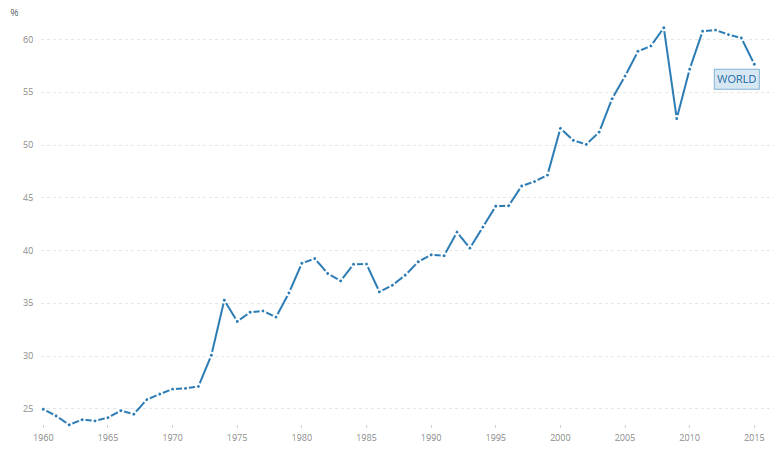
In the post-war period–the 50s and 60s, when ordinary people in western countries received large wage increases and saw their living standards skyrocket–they were largely insulated from the consequences of markets. In the halcyon days when we all knew that the man on television with the deep voice could be trusted implicitly, there were large trade barriers between countries. States didn't have to worry much about competing with each other to attract business, because for the most part business was immobile. German firms were German, British firms were British, American firms were American. When different countries don't worry so much about competing with each other, they can all do their own thing. They can develop a certain distinctiveness. But over the last half century, we got rid of much of the trade barriers we used to have, and the trade percentage of global GDPincreasedfrom less than 25% to more than 55%:
The more countries trade with each other, the more they must compete with each other to be economically successful. It's one thing when you're growing apples to sell to your own people–it's another thing when you are trying to sell apples to some third country. That third country doesn't have to buy your apples. It can grow its own, or buy them from someone else. Your apples have to be cheaper and better than everyone else's apples.
This is what many people like about markets. The competition forces us to become more efficient and more innovative, to improve the things we make and the services we render. The thing is, the same strategies for encouraging efficiency and innovation tend to work everywhere. In the academic literature, when people write about what facilitates prosperity, particularly in a competitive global marketplace, they tend to describe a suite of behaviours which all countries can pursue and sets of institutions which all countries can adopt. To stay competitive, countries have to become more similar to each other. The deviants lose ground. And weak, poor countries get abused by strong, rich countries.
This means that the distinctive, traditional "American" or "British" values which conflict with these imperatives have to be jettisoned. To make our economies competitive, we have to make our individual citizens competitive, and that means we have to make them into driven, highly educated, hard working people. It also means we have to avoid paying them more than we absolutely have to. The most successful countries will be the countries which develop the institutions and policies which produce people who adhere strictly to all of this. People who put their careers first. People who are willing to move anywhere to get ahead. People who will take on any amount of debt to get the degree they need.
These people are the people who reject the traditional, communitarian notion of happiness–they don't stay in the town they grew up in, get married in their early 20s, and raise a family in the same churches and schools they themselves grew up in. These are the people who go to the university far away, then move to the big city. They're the people who are too busy with their careers to get married until their 30s, if they get married at all.Statistically, if they do get married, more of them will also get divorced. They internalise the notion that self-actualisation is the most important thing, that the career is where you get it, and that spouses and children have to fit into that story if they want to stick around.
All these unmarried, work-first city people need to get their sex drives satisfied, so casual sex has to be invented and relentlessly promulgated, reinforced both by birth control technology and by the slow erosion of the laws and norms which once discouraged premarital sex, adultery, sodomy, and every other kind of sex which makes the economy more efficient rather than less efficient. To really compete, the economy can't make use of just half the workforce. Women have to enter the workforce, then they have to be socialised to put work first just like the men, and that means they'll need access to casual sex too. Discriminating against women is economically inefficient, so we have to knock that off and make them equal across the board. The same goes for racial and ethnic minority groups–an efficient economy won't waste their talents. To facilitate the end of discrimination on the basis of race or gender, we have to blow up the distinctions which give these categories meaning to people. Gender becomes a spectrum, race becomes a construct. Transgender and non-binary identities spring up into the collective consciousness. People begin having multiracial offspring. The traditional values have been rendered economically obsolete, so we obliterate them.
An efficient economy will happily poach workers from other countries. It will even take the poor and uneducated, knowing not only that even ordinary workers make rich countries richer but that their children and their grandchildren will contribute to GDP for generations to come. The right thinks the migrants change us–but we change them. To compete in western societies, the migrants and their descendants have to adopt western values. They have to go to the schools and universities where they are given the training to compete, and in these places they learn the market's values. Once upon a time white, Christian westerners lived traditional, communitarian lives. But market imperatives compelled them to abandon their values, to assimilate into a borg. The same thing happens to the migrants and their children. Islam is as readily effaced by the market as Christianity was, twisted in the western countries into an unrecognisable form. There's a reason the terrorist groupBoko Haramhas a name which roughly translates to "Western Education is Sacrilege". Its values cannot survive contact with the institutions and value-morphing mechanisms of western market states. All it can do is attempt to hide the people of developing countries from these forces, miring them in poverty in the process. The migrants are just like the rest of us–they come to the big western cities to survive and compete in the market's great, terrible game. And they must watch as they, or if not them then their children, surrender everything about themselves which was distinctive to win. The market is the melting pot, and melting burns.
What becomes of the work-first yuppies in the cities? Our expectations have been so heavily reshaped that we can never be satisfied by the traditional lives which satisfied our parents, but we will all too often find that the self-actualisation we were promised in our careers eludes us. We exhaust ourselves trying to find the career that completes us, and when we tire of that we plow our way into the mess that is the modern dating world, and when that goes south we make another run at finding occupational fulfilment. Back and forth we go–always trying very hard, always being productive and efficient, and accomplishing a great deal for our employers and very little for ourselves. And perhaps as time goes on we drink more booze, sip more coffee, whatever it takes to go on. But that's okay with the market. It needs us to work hard, it doesn't need us to be happy.
If we really get fed up, we can go looking for community. We can hole up in little enclaves with other people who are politically, religiously, ethnically, or sexually like us. But those enclaves make us weird and isolated from the rest of society, and the time we spend in them doesn't improve our CVs or help us get ahead. Some of us will go back to the suburbs and try to copy our parents, but it will never quite get us where it got them. The desperation and ennui that has long infected the suburbs will get us harder. We may not be able to live without community, but we also can't live with it anymore. We want more–we don't just want the distinctiveness that comes with being part of a group, we want the distinctiveness that comes with being a fully self-actualised individual. We are groping after god, now. A white picket fence just doesn't cut it.
What awaits us? Too many will become BoJack:
Of course, if we found a way to reign in the market, to restore space for inefficiency, some of us might find other ways to live. But why do that when free trade can help us score piles of plastic on the cheap?
Christians supporting this President are the most morally confused people I've ever met.They are profoundly spiritually disoriented.
Though their disorientation began much earlier in the Presidential campaign, as day after day they had to start selling off their souls in small parcels—it reached a tipping point in October of 2016, just a month before the Presidential election.
A video surfaced of the then-Presidential candidate saying the most explicitly vile things about women, about their genitalia, about leveraging power to use them, about his extramarital sexual advances—statements that would have disqualified him from employment in schools, businesses—and most certainly from the very churches these people worshipped in.
And in this unprecedented moral pivot point moment, millions of professed followers of Jesus, had to somehow find a way to make this man and these comments and this behavior, sufficiently decent enough to cast their votes for him.
They've never been the same since then, whether they know it or not. Their spirituality was compromised. Once you make a deal with that kind of devil, there is no moral path forward that makes sense anymore. There is no longer a script to follow because you've purposefully lost the plot.
You can see how confused these folks are in their duplicity, their inconsistency, their hypocrisy:
They claim they love Trump because he respects the Military, yet when he proceeded to posthumously give a middle finger to war hero John McCain, they respond by defending Trump and trashing the senator.
They've professed devotion to the President because they say he puts "America First"—and yet, have willingly tossed out the mountain of evidence that he is beholden to Russia and a pawn of Vladimir Putin; that he has polluted our elections and exposed our secrets.
After having screamed incessantly for years about what goes on in people's bedrooms and in public bathrooms—these "family values Christians" have had to ignore three marriages, serial adultery, porn star affairs, Playmate payoffs with campaign funds, and assault allegations.
They're forever claiming they support Trump because he is "pro-life," and yet say nothing while hundreds of children remain isolated from their parents, after becoming orphans by his Administration.
They want the Prince of Peace and the pussy-grabber President. They want "Love your neighbor as yourself"—and ICE raids and Muslim bans. They "marriage is between one man and one woman"—and an Olympic-level adulterer. They wantAmerica FirstandFor God so Loved the World. They want Jesus' compassionate humility and Trump's vile arrogance. They want to store up treasures in Heaven and tons of cash right now.
I can understand their disorientation.It must be dizzying to try and keep this cognitive dissonance up; an exhausting exercise to balance the moral inconsistencies and do the theological gymnastics required to not have it all collapse.
When you confront these people, you can tell that they can't make sense of it either.They double down and toss out random Bible verses, and they try to connect dots that simply cannot be connected.They may have chosen this haze, but they can't see out of it now.
The day they hitched their convictions to Donald Trump, they doomed themselves to moral confusion, but what's worse—they've confirmed the greatest fears that people outside of Christianity have about Christians. They've become a walking example of the hypocrites people fear, and the kind ironically, that Jesus warns about. They are giving millions of people sound reason to reject it all.I don't blame them one bit—though I hope they realize there are others.
I am a Christian and I am not morally confused. Many Christians I know aren't. We see with perfect clarity, that you can either align yourself with this President or with Jesus of Nazareth—but that emulating both is a moral impossibility.
I'm sad for the Christians who left the narrow road of Jesus to jump aboard the Trump Train, and who now can't find their way back—but I'm sadder still for a watching world who sees them and realizes how far they're drifted from their namesake, even when they cannot.
As Supreme Court nominee Brett Kavanaugh faces a sexual misconduct allegation, deputy editorial page editor Ruth Marcus asks, who's responsible for the burden of proof? (Gillian Brockell/The Washington Post)
"If somebody can be brought down by accusations like this, then you, me, every man certainly should be worried." — A lawyer close to the White House, speaking to Politico
Look, who among us?
If, apparently, a single alleged assault at a single party decades ago is to be frowned upon, then no man is safe, right?
What's next? You can't harass a colleague and serve on the Supreme Court? You can't pick up high schoolers outside custody hearings and serve in the Senate? You can't have a meat locker full of female femurs and expect to breeze through your confirmation as interior secretary?
How are we going to fill our offices if this is the new rule? I bet you will say I cannot shout at women as they pass on the street before dragging them to a concrete bunker and then still expect to become governor! What next? I'm supposed to make sure everyone I have sex with iswilling?
This isn't just my worry. This isn't just something horrible I am now revealing about myself. This is an every-man problem.
If suddenly, as a country, we decide that violently attempting to assault someone is, like, bad, then that knocks out 98, maybe 99 percent of men, just going off the locker-room talk I've heard.
Look, which of us is 100 percent certain all his sexual encounters are consensual? That isn't most people's baseline, surely? You're telling me I am supposed to encounter dozens, hundreds, thousands of women in my life, some drunk and some sober and some with really good legs and just … not assault any of them?
That sounds exhausting. A whole life of that would be excruciating. No, there ought to be some kind of punch card — say, if you treat 65 women with the respect and dignity you would accord any man, you are entitled to one freebie.
I mean, it's not as though they're people, are they? At the moment of conception, yes, but then they come out Daughters, not people! They grow into objects; some become Wives or Mothers, others Hags or Crones. Then they die! If they were people, we would not expect dominion over their bodies, surely; if they were people, we would not feel entitled to their smiles. If they were people, I could read a novel with a female protagonist and not be instantly confused and alarmed.
No. They are an unintelligible something else. They are to be put on pedestals, as John Kelly urges, or groped, as the president urges. They are impervious to cold, capable of wearing a bikini on the most frigid day to please us; they can run great distances in heels without discomfort; they were created for us from a rib and designed as our companion. If they have wants of their own, there is really no way of knowing. They say words people might say (You would be forgiven for thinking them people), but remember, they do not mean the words they say. If what they said was what they meant, then they have not wanted anything I have ever done to them!
It would just be too terrible if they were people. Then you could not harm them with impunity. Then if you made a mistake (Boys will be boys), you would have harmed aperson. Then something else would be at stake in additionto your career, and that cannot be.
Besides, if this is wrong, if you have to go through life inconveniently believing that the other half of the world is made of people, too, then what will boys do for innocent amusement? Who among us was not once 17 and partook in a little roughhousing? How were we to know there was — purportedly! — a person in there? Who cannot, in retrospect, be accused of something dreadful? This isn't just me, I hope.
No, if this is the rule, no man is safe. Not the man who shouts at you as you walk down the sidewalk, or grabs you, or puts something in your drink. As all men do, I think.
If assault renders a man unfit to serve on the Supreme Court, then how are we to discern the Founders' intent? I mean, Jefferson, hello? And what is going to become of the presidency? Who wants to live in that world?
Every man should be worried. If boys cannot be boys, then how can boys be men who rise to the highest offices in the land? If this stops being something you can get away with, then will anyone still be above the law?
Alexandra Petri is a Washington Post columnist offering a lighter take on the news and opinions of the day. She is the author of "A Field Guide to Awkward Silences."
This is a long article about the details of what is going on in the movement to change our world for the better. At the end, he says he suggested to a conference that they do some research as to what is actually working and what isn't, but it is not getting done.
Organizing the left is like herding cats -- getting organized is one thing the authoritarian right is much better at.
The Fearless Cities, North America Regional Municipalist Summit
"Getting woke is like beingin the Matrixandtaking the red pill. You get a sudden understanding ofwhat's reallygoing on and find out you were wrong about much of what you understood to be truth.I understandthe extraburdenit puts on you but I still feel everyone needs to getwoke."
"If the design of corporate capitalism is unable to sustain values of equality, genuine democracy, liberty and ecological sustainabilityas a matter of inherent systemic architecture, what systemic 'design' might ultimately achieve and sustain these values?"
– Gar Alperovitz,Principles of a Pluralist Commonwealth, Washington, D.C., The Democracy Collaborative, 2017.
Filling the Vacuum
Is the left today "woke," i.e. is it self-consciously learning from the limits of the path it has been on to design a new systemic architecture based on alternative, networked institutions to challenge the status quo? New institutions are needed because in the past farms, labor unions, progressive churches as well as universities provided the institutional base for powerful social movements. Today, each of these institutional spaces is severely challenged or has reduced in size. As Gar Alperovitz explains inPrinciples of a Pluralist Commonwealth"the small farm institutional substructure of populism has long since disappeared." Yet, "institutions matter" in part because they "provide a context, locally, which allows and nurtures the sustained development of an alternative political culture." Today, the foundations for such spaces can be found in "new cooperatives, neighborhood corporations, land trusts, municipally owned energy and broadband systems, hybrid forms of community and worker ownership, and many more" such institutions.
The Occupy Movement and Arab Spring imploded because of its failure to create durable, institutional alternatives to the concentrated media, economic, political and military/police power of the ruling elite. In the contemporary context, the global left, particularly innetworksextending from Europe to Turkey as well as North and South America are trying to create a new paradigm which has one foot in electoral politics and another in various spaces outside formal state power, from mobilizations which pressure politicians and inform political choices to cooperatives and measures to assess citizen preferences or even create regional or national networks.
On July 27-29 a consortia of groups organized the North American Municipalist Summit ofFearless Cities. This essay tries to capture some, but not all of the ideas of this summit. Kali Akuno, a speaker at the conference's only plenary session, argued that the right has out organized the left. The right has knocked on doors, canvassed extensively, and outpaced the left. The left has to mobilize the diverse forms of power in the diverse arenas now capitalized on by the right. He argued that we need to break up the dichotomy between politics and economics, with the "solidarity economy" rooted in various forms of economic cooperation being one important means to achieve this goal. Akuno is a leader inCooperation Jackson, a multifaceted social movement and institution-building effort centered in Jackson, Mississippi.
The Municipalist Moment
Fearless Cities is a political brand originating ina Barcelona conferencein June 2017. The goal of this initiative centers on a concept called "municipalism," whoseoriginsin the contemporary context seem to have one foot in the work of social ecologist Murray Bookchin, Henri Lefebvre's "Right to the City," and David Harvey's ideas about "Rebel Cities," and another foot in recent political developments within Spain, with any number of variants departing from these or other sources. What is municipalism? After the three day conference, a final wrap up session indicated that many were still confused by the term. Yet, numerous workshops provided a clue and various authors provide us with some departure points.
Kate Shea Bairdin June of last yeartried to define municipalism as a political mechanism to move beyond "a world stuck between neoliberal crisis and authoritarianism, a reinvigorated municipalist movement is proving a powerful tool to build emancipatory alternatives from the ground up." Baird writes: "The municipalist movement is made up of an ecosystem of organizations working within and beyond electoral politics at local level. It's a movement defined as much by how it does politics as by its goals, and it is this insistence on the need to do things differently that gives municipalism its unique strength in the current context." The focus is primarily "at the local scale," in initiatives that seek to construct "alternative forms of collective identity and citizenship based on residence and participation," in contrast to "xenophobic discourses that exclude people based on national or ethnic criteria."
Variants of municipalism can be found in what's been known as Rojava, three cantons in the predominantly Kurdish part of Syria now formally known as the Democratic Federation of Northern Syria. Debbie Bookchin, a radical scholar/activist and a central figure promoting municipalism, explains that "in these cantons, multi-ethnic neighborhood assemblies hold sway, and the prevailing ethos emphasizes an equal division of power between women and men, a non-hierarchical, non-sectarian, and distinctly ecological outlook, and a cooperative economy built on anticapitalist principles." Debbie Bookchinrecently explainedthe municipalist philosophy of her father, Murray Bookchin inUrbanization Without Citiesas follows. Large urban concentrations created opportunities for democratic engagement ranging from the Athenian polis to the Parris Commune. In these initiatives, the goal was to reclaim the city "as the locus of a new politics of assembly democracy." Murray Bookchin himself argued that "the city" should be "conceived as a new kind of ethical union, a humanly-scaled form of personal empowerment, a participatory, even ecological system of decision-making, and a distinctive source of civic culture." The elder Bookchin saw such urban mobilizations as a mechanism for creating a new democratic society within the framework of the existing order, by redirecting power from the centralized state.
Debbie Bookchin argues that these municipalist, or "Communalist", ideas have been put into practice in the Democratic Federation of Northern Syria. Here "an elaborate system of council democracy," begins at the level of settlements involving between thirty and four hundred families. These settlements or communes send "delegates to the neighborhood or village council, which in turn sends delegates to the district (or city) level and ultimately to the region-wide assemblies." Participants get to decide on basic issues through committees for defense, health, the economy, the environment, women, politics, ideology and justice.
Municipalism I: Spanish Developments, Mass Mobilization and Electoral Politics
Several factors have led important sections of the U.S. left to resist electoral politics. First, the U.S. New Left largely avoided involvement in electoral politics. InRevolution in the Air, Max Elbaum explains that "a particularly significant turning point" was in 1964 the Democratic Party refused to seat the anti-segregationist Mississippi Freedom Democratic Party (MFDP) delegation at the Atlantic City Convention. Prominent liberal stalwarts like Hubert Humphrey, the vice-presidential nominee, and Walter Reuther (head of the United Auto Workers union), "loyally carried out Lyndon Johnson's strategy and froze the MFDP out."
Second, the Democratic Party leadership came to be dominated by the Democratic Leadership Council, a neoliberal group dominated by loyalty to certain corporations, various forms of deregulation and privatization, and the military industrial complex. Hillary Clinton's victory over Bernie Sanders (and constraints within the Sanders campaign itself) have generated further arguments against electoral commitments. The weakening of trade unions, decline in the size of the industrial working class, and decline of various social movements help explain these trends.
New developments in Spain and the U.S. suggest a growing recognition of electoral possibilities. Vincente Rubio-Pueyo explains in "Municipalism in Spain: From Barcelona to Madrid, and Beyond," published in December 2017 by the Rosa Luxemburg Foundation that "during the May 2015 municipal elections, a series of new political forces had emerged that were aligned with neither of the two major parties in Spain." One of the drivers of Spanish developments has been municipalism.
At theFearless Cities Summit Yago Bermejo Abati, who works withMediaLab Prado, explained how such municipalism functions in Madrid. The basic premise of these efforts is that mainstream, representative democracy "is not working" and excludes actual citizen voice. The goal of municipalists is to turn "the will of the people into political action." The anti-austerity movement in Spain, known asMovimiento 15-Mor the Indignados movement, organized radical assemblies with 100 percent consensus. Yet, Bermejo explains that this movement disappeared because it lacked any political structure, something which led to frustration among participants.
A subsequent round of activism responded by creating new political parties where one enabling mechanism is based on creating or marshalling pre-existing symbolic power, i.e. the star or celebrity status of certain individuals which creates focal points for media attention. In contrast to the face-to-face, totally deliberative system made popular by Occupy's General Assemblies, the newer approach utilizes different levels of engagement. About 1% of those in the movement define structures, 9% help these key organizer/activists, and 90% follow, engaging in "softer" participation. Earlier electoral party formulations coming from up-from-below activism became displaced by Podemos, the popular left political party created by "traditional left intellectuals." These intellectuals recognized that in the age of the spectacle, where politics is dominated—if not colonized—by mass media, "we have to be on TV." In 2015, Podemos received 20.7% of the popular vote, becoming Spain's third largest political party. By 2016, the party remained the third largest. Facebook groups, Instagram, and Tumblr have built the larger movement. Rubio-Pueyo explains that "the use of social media alongside multiple informal (word-of-mouth) and familiar channels (for example, in the workplace), rapidly gave [supporting] campaigns a viral character."
The politics of personas is a key element in the Podemos phenomena. A 2015 article inThe Guardian explained: "Little more than a month before the European elections, Podemos's own polling revealed that only 8% of Spaniards had heard of them. However, 50% knew who Pablo Iglesias [the party's founder] was." In Madrid, Manuela Carmena was elected Mayor in 2015. She was the candidate ofAhora Madrid, a left-oriented party coalition which competed in municipal elections. One key component of this party was Ganemos Madrid, which was a citizen platform inspired by what is now known asBarcelona en Comúwhich governs in Barcelona. Manuela's victory was built in part on cultural power, defined by illustrations, songs, videos and other symbolic interventions that went "viral." In some cases supporters took images related to Manuela and projected them from their windows onto large, visible surfaces.
The Madrid movement, like initiatives in Spain, have dispensed with so-called "anarchist" precepts that there is no need for leaders. Yet, in one strain of thought promoted by Yago Bermejo, "leaders become facilitators and mediators for political action" in contrast to traditional representatives who are individuals backed by a committee of experts. Democracy is defined by everyone becoming agents of change, "not selecting who is in charge." Deliberative power and the "right to speak and know" becomes even more essential in the era of "fake news" and "fake knowledge."
In Madrid, municipalist engagement has been based on both face-to-face meetings as well as in Internet-based fora. The former involved decisions in small groups of thirty to sixty persons. The latter involve using social media, likeReddit, as an organizing tool to register citizen preferences. Over time, various computer programs likeCONSUL have been used as a way to promote participation through debates, voting, participatory budgeting, and "collaborative legislation" (where citizens can help identify and shape laws). Collaborative legislation provides a mechanism to communicate about legal developments outside of established lobbies giving citizen/participants the "right to collaborate and propose." While face-to-face deliberation can be considered deeper and internet fora "superficial," at one point the former had only 3,000 subscribers and the latter 300,000 participants.
The Madrid movement also promotes "the right to decide," taking some inspiration from Swiss referenda in which citizens get to vote on major policy proposals. A correction to exclusionary participation can come from quotas used to include groups, with representative samples of potentially excluded persons. In Ireland, the Citizens' Assembly has been a useful means of promoting popular support for women's abortion rights.
Recent U.S. initiatives linking dissatisfaction with incumbent politicians, mass mobilization, electoral and organizing capture part of the conjuncture represented by the Spanish movement. TheFearless Cities summit profiled organizers involved in the Jess King for Congress campaign in Lancaster, Pennsylvania and the Cynthia Nixon for Governor campaign in New York State. Regardless of what one thinks about the Democratic Party, the King effort led to a 2,000 person rally in a Red State area in a region with no visible left presence and weak Democratic Party infrastructure. Becca Rast, an organizer for King, explained that one way her candidate's campaign made inroads in this part of Trump Country was by linking pro-union organizing to advocacy of small business interests. Rast herself got involved in politics by organizing locally against the Iraq War. The victory of Alexandria Ocasio-Cortez over Rep. Joe Crowley in the Democratic Primary in New York's 14thcongressional district this June underscores the political openings in U.S. regions where progressive constituencies are already concentrated.
Municipalism II: Manhattan's Lower East Side and Reconstruction
At Fearless Cities Daniel Chodorkoff, Linda Cohen and Chino Garcia discussed how Latinos in Manhattan's Lower East Side (Loisaida) created a municipalist kind of engagement in the 1970s and 1980s. Chodorkoff is a long time social ecology activist and was a central collaborator with Murray Bookchin in the development of the social ecology movement. In this seminar, the conference provided an important sense of what a politics of the "totality," embracing diverse forms of power accumulation, might look like.
Chodorkoff explained the larger context of this project: "We have to be oppositional and confrontational," using direct action, but we also have to involve ourselves "practically in reconstruction." A group of activists tried to rebuild the Lower East Side as a neighborhood blighted by disinvestment and a real estate capital strike. This bottom up planning process, complemented by organizers and activists using a social ecology approach, involved deploying new technologies and the localized resource base.
The strategy for reconstruction involved several key components. First, self-reliance built upon resources within the neighborhood that were identified. These activities involved skills assessment and training.
Second, technological innovations were deployed to promote autonomy. Solar panels and a windmill were placed on residential buildings in one of the first such experiments in the United States. The windmill at 519 East 11thStreet was 37 feet tall and became a symbol of self-help. The solar system was built to save the residents money as it provided them with 75% of their hot water. The windmill was installed because Con Ed had shut down the local residents' electricity. There were also fish farms and window box greenhouses. These efforts were unique because they were among the first such interventions promoted by an activist community.
Third, new institutions were created including a tenants' housing cooperative, a tool lending library, food cooperatives, an oil purchasing corporation, and a recycling center (the Charas Recycling Center which also engaged in boat repair). The Lower East Side Joint Planning Council emerged as a counterforce to established community development. Town meetings were held four times a year. Key actors included the Institute for Social Ecology, Pete Seger and the Clearwater organization, and City Arts. La Plaza Cultural, a cultural space, was built on a big lot in the neighborhood. This became a meeting space for dialogue and arts performances. Chodorkoff argued that public space was necessary for developing a "public sphere," to promote "face-to-face relations." Community gardens appeared throughout the Lower East Side, maintained under the Parks Department's supervision. Hundreds, if not thousands, of such gardens were created. Byone estimate, 39 remain. The El Sol Brillante Garden, spread over four parcels of land, was owned by a land trust incorporated in 1978 as explained by Mark Francis, Lisa Cashdan, and Lynn Paxson inCommunity Open Spaces: Greening Neighborhoods Through Community Action and Land Conservation.
These processes helped convert even gun totting gang members and drug dealers into reflective community citizens. Linda Cohen argued that one of the first steps to support community gardens was winning over both public school teachers and gang members. This social base need not be written off to structural forces and dispensed with. In contrast, the community's "three biggest enemies" were bankers, bureaucrats and landlords. Gentrification came to overwhelm part of the neighborhood reclamation efforts leading the community to the slogan, "Speculators Keep Out: This is Our Land." Cohen argued that professionals were key to defending the community: engineers, architects and lawyers were essential to fighting the big three enemies and helped to preserve community development for local residents. Where an earlier panel at Fearless Cities included audience members suspicious of all "intellectuals," this session clearly understood the upside of building strategic alliances with politically, committed professionals, i.e. "intellectuals."
These community development efforts helped make the Lower East Side attractive, indirectly paving the way for gentrification and displacement. Efforts to socialize and control land for local residents came up against the leading power brokers in the City's real estate elite. In sum, even a very sophisticated effort to mobilize residents tied to marshalling diverse forms of power is insufficient if ownership is not more widely socialized. Partially a result, the municipalist agenda has come to increasingly involve a discussion of economic democracy and cooperatives.
Municipalism III: The Cooperative Economy
About three panels at the Summit were dedicated to exploring the role that can be played by cooperatives in advancing a progressive agenda. Cooperatives can be used not simply to create jobs and generate economic activity, but also to fight racism, sexism and social exclusion. Sometimes these notions are linked to the idea of a "solidarity economy," a definition whichsometimes takes its inspirationfrom the discourse about "the commons." In practical terms, many cooperatives in New York City have as their average worker a women who is an immigrant, African American or Latino.
Within New York City, the Cooperative Economic Alliance of New York City (CEANYC) is now an institutionalized presence for democratizing firms. In CEANYC'sNew York City Co-op&Solidarity Economy Directory, published last year, the solidarity economy is defined as "a diverse economy that meets human needs through economic activities—like the production and exchange of goods and services—that reinforces values of social justice, ecological sustainability, cooperation, mutualism, and democracy." CEANYC's vision involves four key arenas: consumption or use, "surplus allocation," production, and exchange/transfer of goods.
The first arena, consumption/use, is manifested in consumer and housing cooperatives, ethical purchasing, collective houses, collective ownership of land, and land trusts. Here consumption power comes into focus. Reflective citizens can use their consumption power to change the way markets related to work, housing, and corporate decision-making operate.
The second arena, "surplus allocation," involves diverse activities like credit unions, composting, recycling, cooperative banks and credit unions, rotating savings and credit associations and community financing. These spaces try to socialize finance or indicate how expended capital can be allocated to serve public interests.
A third arena, production, involves a different kind of cooperative—one centered in production cooperatives, community gardens, do-it-yourself initiatives, and other spaces that directly organize what could be called productive or wealth-generating activities.
A final area focuses on economic activities related to exchange or transfer such as barter clubs, time banks (where different individuals invest time or exchange services), fair trade, purchasing agreements and other activities.
Esteban Kelly moderated and led a later panel discussion about cooperatives emerging role at the national and international scale. Kelly works at the U.S. Federation of Workers Cooperatives in Philadelphia. The panel pointed out that various mechanisms could help promote cooperative developments. Among these were: cooperative education (from pre-school to higher education), strong government support, support from strong labor unions, and cross-sector relationships.
Cooperatives can create a platform for organizing jobs and contribute to a new kind of political space, independent from transnational corporate control. Kelly and others argued that broader awareness about a "solidarity economy" has led activists and some government advocates to shift their priorities from generic "business development" to "community empowerment." Trade associations of cooperatives can focus on capacity development within their membership and lobby to increase government support programs.
Alvaro Porro, who works in Barcelona, explained what happens when a progressive movement takes over the administration of a city. Porro noted that "we won the election" and "are running Barcelona." Yet, he also argued that a left takeover of the local state is not in itself a recipe for success. He explained that only seven percent of his city's public procurement involves the local social economy in his city. At the same time, social economy development efforts were supported by a quickly put together and artificial system of engagement, creating a weak infrastructure resulting in little real advancement.
A central question is the ability of the cooperative movement to reach a certain scale, particularly in the United States. The Democracy at Work Institute, associated with the US Federation of Worker Cooperatives, explains that within the United States there are 357 worker cooperatives and democratic workplaces, having an estimated workforce of 6,833, with an estimated total gross revenue of $428,188,895 (based on 2016 data).
Scale can also be defined in terms of the relationship between the core and periphery of the economy. For example, the Institute says that 25% of cooperatives are in manufacturing, transportation and warehousing. This is somewhat important, but we can readily see that only a tiny fraction of all U.S. workers areemployed by cooperatives. Nevertheless, inPrinciples of a Pluralist Commonwealth, Alperovitz explains that the consumer and credit-based cooperatives are far more extensive: "Between 100 and 110 million Americans are members of co-opts, mostly through co-op credit unions, and around the world there are at least 800 million people who are co-op members." In Spain, Mondragon "has grown to encompass 257 companies—in the finance, manufacturing, retail, and knowledge industries—that together employ more than 74,000 people." At the global level, the Interncontinental network for the promotion of social solidarity economy, RIPESS, has organizedthe World Social Forum of convergence of Transformative Economies. This initiative is centered in Barcelona, Spain, and involves a wide variety of actors concerned with democratizing the economy.
The Limits toFearless Cities
The implicit change model forFearless Cities seems to incorporate electoral politics tied to citizen deliberation in mass movements, the creation of local institutions which organize various cultural, economic and political assets, and the development of various kinds of cooperatives and social economic organizations. The pursuit of multiple avenues for accumulating power is a very positive development. With not much advanced planning and a limited budget, the conference organizers pulled off a very interesting conference with a wide variety of speakers and helped push the left agenda past its often narrow confines. This movement, however, is associated with several limitations which should be debated among activists.
First,the movement is not very reflective about the role of ideology as both a limiter and enabler of politics. While the conference (and associated literature) revealed that Spanish movements have been very savvy about media power, they strangely don't systematically analyze how public opinion is formed outside of a social movement context. The strength of recent Spanish developments is that they move beyond old-fashioned identity politics, but this strength may be associated with future, potential weaknesses when such developments attempt to transcend "ideology." Rubio-Pueyo writes: "the profound novelty of the confluences [the movement efforts beginning outside the state] as political initiatives and a big part of their appeal was precisely that they went beyond established political identities and limits." Will this transcendence of what has been end up throwing the baby out with the bath water? InAnti-Politics: On the Demonization of Ideology, Authority and the State, Eliane Glaser argues that the left's postmodern preoccupations shies away from the notion that there is a hierarchy of ideas.
While the new Spanish left would have leaders become "facilitators," one might ask about the potential role of intellectuals as committed individuals who champion unpopular causes, informed by academic knowledge or social science research. Deliberation and participation don't take place in a hegemonic vacuum. In other words, both activists and citizens or the mass of persons mobilized by the Internet are influenced by concentrated sources of information which often have the elites' fingerprints on them. Can there simply be a division of labor between facilitators and such intellectuals? Yago Bermejo says"politics has been made by men" who confront power and fight whereas the Madrid movement argues that politics has to be "feminized," e.g. where this can mean a premium is put on facilitation. Rubio-Pueyo suggests another interpretation: "the feminization of politics does not reject confrontation, but rather stresses the centrality of the political subject to be built—including its capacities, knowledge, and constructive potential." He explains "the feminization of politics" means that female candidates have appeal not because they are women, "but in their insistence on ideas of dialogue, tolerance, empathy, and capacity for listening." This is contrasted with "the culture too often built by macho political figures" where the alternative is the leader functioning "like a screen onto which collective values and desires can be projected." Some of these arguments strike me as a bit essentialist in their claims about men and feminism. We know that feminism can be coopted by elite forces, like the Hillary Clinton campaign backed by the National Organization for Women and sections of the military-industrial complex, and that even some feminist scholars have had to back track in creating new categories to explain male sexist behavior of some subset of men, e.g. so-called "hypermasculinity."
A second problem concerns the role of activists and intellectuals. It's not clear to me that this movement has not over-emphasized grassroots participation at the expense of intellectual engagement, even if such participation is a necessary condition for social change. These two processes, participation and intellectual engagement, are logically not in conflict. They often can be, however, because of the role played by elite or incumbent forces (associated for example with foundations and in the ways in which new generations of activists sometimes blindly recycle the tropes that defined earlier waves of activism) in steering social movements. InParticipation: The New Tyranny?, editors Bill Cooke and Uma Kothari, show how foundations and NGOs have supported participation as a mechanism that displaces various challenges to established authority.
InIdeology: An Introduction, Terry Eagleton argues that the structures of peoples' jobs, the way they organize their time, and a whole range of media and culture institutions can influence peoples' thoughts. This means that political change must not simply marshal what people already think or come to think after being exposed to organized social activity. What people think is not a neutral space that should always be granted a special "aura" or status. In the language of the older left, political consciousness may be undeveloped and would have to be "raised." Feminists used to talk about "consciousness raising." Now, "feminized politics," tied to a potentially anti-ideological kind of politics, risks being defined as a post-confrontational validation of what the localized majority thinks. Majorities can tolerate petroleum-based economies, arms exports, and large numbers of alienating jobs.
Debunking macho organizers does not lead us to understand the intellectual figures who might help us inform designs for a future society. These figures represent parts of intellectual traditions, deceased individuals, the accumulated knowledge in libraries, cultural trajectories seen in the classical architecture, and other forms of knowledge which one does not generate automatically by talking to someone else in a "democratic fora." Suspicions about the intellectual as a frontman for the professional managerial class easily becomes a recipe for the philistinism that erodes the value of the Social Democratic parties, social movements and non-governmental organizations. At the conference, one activist complained that intellectuals did not understand the needs of the poor, where the word "intellectual" seems to be used as a code word for elitist "managers." Hillary Clinton's campaign was rather sophisticated in marshalling identity politics to win over large swaths of the public by making progressive ideas seem elitist.
Parts of the Spanish left have recognized an implicit ideology as when they try to generate hierarchies of behavior, however. Rubio-Pueyo explains one essential contribution of the Spanish developments was "the participatory elaboration of a code of ethics, which later had to be signed by all the actors involved. This code encompassed a number of principles and practices concerning the democratization of public services, the need for listening to citizens' demands and for accountability" (which has been compared to the Zapatista movement's approach in Mexico). This code by promoting certain choices and stands, must be involved in ideological describable preferences.
A third problem with theFearless Cities approach is that its profiling of electoral possibilities was not matched by an analysis of electoral pitfalls. InPrinciples of a Pluralist Commonwealth, Alperovitz warns "simply electing one group of politicians to replace another is unlikely to alter the long-term trends and decaying patterns." This limit to electoral politics points to the need for other kinds of interventions. These were amply addressed at the conference, with examples of various forms of non-electoral organizing in the Lower East Side as well as other social economy and social movement examples. Yet, the problem with presenting a pluralistic survey of approaches is that one does not automatically learn what might be appropriate where, when and how. If people could simply figure that out by analyzing their local context, then they would not need to go to an organizing conference.
A fourth problem in theFearless Cities approach concerns its financing/social inclusion model. On the one hand, a number of participants complained that the conference did not include a sufficient representation of people of color and some may have discussed representation of poor persons. On the other hand, the conference relied on foundation support and a sliding scale in which the attendance fees ranged from $75 to $175. More inclusion potentially means raising the conference fees such that only organization-affiliated groups or the higher paid strata of the professional managerial class will participate, alongside less affluent individuals. A number of persons did not attend the conference simply because of the hefty entrance fee. Those in organizations can often get their organizations to pay for conference fees, travel and lodging costs. Yet, what happens when organizations are in thenon-profit industrial complex, which some conference participants acknowledged as a problematic issue? One way around that constraint is to get activist organizers as speakers who can get fees waved and by sharing lodging with locals (which was one practice). The problem then becomes whether this subgroup (the incumbent members of groups with budgets or activists who conference organizers know) is itself representative. Livestreaming and use of social media may include more, but the included might be reduced to spectators.
Another solution is to rely even more on foundation support, so that foundations subsidize participation and also help set conference agendas. The limitation of this approach is that foundations often have limited agendas, e.g. they are often seem averse to taking on the military-industrial complex, militarism, and the non-profit industrial complex itself. Of course, conference organizers try their best to address a social inclusion problem which is not of their making. On the other hand, the Trump campaign managed to include a number of working class people who the left does not include orviews as enemies, with the result that the left often loses or remains oblivious to its own exclusionary frameworks.
A fifth problem concerns how the conference addressed (or failed to address) the problem of militarism. When municipalism becomeslocalism it faces limits defined by how state, repressive power can be wielded, particularly military power. The previously cited manifesto has three references to military power, pointing to the example of the Palestinian resistance. Yet, despite the ability of this resistance to organize somewhat autonomous power, Palestinians have failed to limit the managerial and militarist extension of power ensconced in the Israeli Behemoth. Likewise, in analyzing Syrian developments, Debbie Bookchin explains that the Rojava experiment is threatened by Turkish leader Recep Erdoğan's willingness to invade Kurdish areas of Syria with the U.S. government's complicit backing. This seems a case where international realities at the transnational scale threaten to limit, if not obliterate, municipalist power.
Onemight argue that these realities are remote from the concerns of Madrid's citizens or those organizing for social change in the U.S. or the "pragmatic" agenda of organizers who have to address homelessness, unemployment and all the rest. Nevertheless, the Summit did not offer a comprehensive vision of how to demilitarize the U.S.'s $1 trillion dollar plus war economy which has largely sanctionedtheft from citiesin the U.S.,drained budgetsand supported its militarist partners overseas. Nevertheless, one conference participant and activist from Black Socialists of America I spoke with was fully conversant with efforts by both Martin Luther King and Ron Dellums to oppose militarism and the military's economic impact on urban communities. When local activists are operating at the scale of hundreds, thousands, and sometimes millions of dollars, the Pentagon and allied security agencies manipulate hundreds of billions of dollars. Militarist economic patronage of cities at the regional scale certain provides a potential constraint upon municipalism.
A sixth problem concerns how the movement's social composition influences its ability to frame problems. A basic problem in social economy circles is that various persons coming out of an "activist" or "organizing" background predominate. These individuals tend to view cooperatives as tools to fight racism, social exclusion and unemployment (which are virtuous goals), but are rather weak in advancing a strategy to move cooperatives up the economic food chain into large scale manufacturing products that often lead to the ultimate political power in society. For example, some of the world's largest banks are now in China because China has raised capital by advancing manufacturing. Manufacturing firms can make the alternative vehicles, windmills and solar panels necessary to delink regions from oil dependency and elite energy companies. These companies can employ tens of thousands of persons, helping to move the left beyond the cosmetic job creation which often fascinates organizers.
Inanarchist Spainand the revolutionary movement in Chile centered on Salvador Allende's presidency, grassroots workers directly organized production, transportation, and various service delivery functions. Manufacturing was a central element to this movement, which did not simply occupy streets or establish cooperatives in areas peripheral to the commanding heights of the economy. In contrast, contemporary organizers often believe that some kind of localist process will somehow provide access to core economic functions and activities from which such activists and even the "rank-and-file" are far removed.
A final problem concerns how the question of how to systematically accumulate economic power was addressed. The development of cooperatives and economic democracy is clearly a complement to the limitations of electoral organizing, community organizing and gentrification. Yet, the four categories used to analyze cooperatives (described above) seem to relate to different ideal types of activities which often are manifested in distinct organizations according to a specialized division of labor. I did not hear much discussion at the conference regarding how such processes might be brought together into a set of mutually reinforcing processes. The Cooperation Jackson model, however, has sought to leverage social movement engagements that reproduce and exchange power through mechanisms that relate to such processes. Yet, that initiative—while on the minds of many activists in attendance at the summit—was not used reflectively to assess different practices or social movement investments. Curiously,the Cleveland Model, which also embraces systemic change models, was largely—if not completely—ignored.
The strengths and weaknesses ofFearless Citiescan be seen in one cross cutting initiative calledSymbiosisaims "to create a confederation of radical, directly democratic local assemblies and projects in North America." Theirrecently published manifestolays out their vision in detail. Key influences on this network are Detroit-based organizing, Hannah Arendt, Naomi Klein, and networking among different municipalist projects. This analysis explains how geographically dispersed initiatives can support each other in the fashion which Kropotkin advocated a century ago.
In general, the Symbiosis approach is a rather sophisticated one, but at the same time seems to mirror some of the larger problems of theFearless City approach. There is a very strong danger that cooperatives will simply become voluntarist replacements for a shrinking welfare state and lower tier replacements for organizing work as global corporations promote investments outside the U.S. One way to avoid this fate is for cooperatives to put a premium on innovation, manufacturing moving towards advanced sectors and alternative banking systems linked to these. Using this document as a departure point, I searched for various key words. The words/phrases "engineer," "manufacturing" and "innovation" only appears once in the Symbiosis manifesto, "Community, Democracy, and Mutual Aid: Toward Dual Power and Beyond." In contrast, the word "federation" appears six times, "municipal" sixteen times, and "organizing" forty-nine times. When a leading leftist scholar asked one panelist inFearless Citiesabout "production" (meaning manufacture or industry) his question was twisted into an analysis of software development.
Mondragon reached its enormous scaleby first establishing a technical school and cultivating various engineering and manufacturing capacities. Mondragon did not move up in scale by simply organizing persons or networking localities. The Occupy Movement was initially brilliant in networking diverse spaces, but all these spaces were based in part in fetishizing the most peripheral economic real estate when it comes to economic accumulation, i.e. park land. TheFearless Cities movement goes far beyond such preoccupations, but may not be cognizant of the larger limits tosocial movement-driven social change. Should blame be put on innovators, engineers, business persons and managers for not attending progressive conferences and explaining how to enter and control the advanced sectors of the economy? One strategic problem is that persons who enter engineering, business and management schools usually are not taught by professors or administrations embracing economic democracy as a core principle. Do people on the left think that they will simply lobby or "resist" the organizers of the advanced sectors of the capitalist class that disagree with them? How will a federation of low-on-the-economic-food-chain cities defeat the power elite dominated by large, hegemonic institutions?
Could the federation of local projects organized by municipalist networks provide a solid institutional foundation to secure advanced innovative and manufacturing resources as well as challenge militarism itself? Probably and most certainly. Yet, the intersectional language used by the conference did not encompass any coherent understanding of militarism or the hierarchical ordering of power relations within the economic system itself.
It is certainly true that certain academic discourses related to structures may have become scholastic perversions that involve a do-nothing attitude that might co-opt activists into becoming navel gazers. On the other hand,critical understandings of how economic power is accumulated on a systemic basis is essential to understanding the Trump phenomena, the dangers of fascism from the right, and even the growth dynamics of the Mondragon model itself. Activists at progressive conferences can't be expected to easily promote entry into the more advanced sectors of the economy as they often lack the necessary resources. Yet, it's not clear that the activist community is always as economically conversant as it should be. At the end of the conference, I suggested that one way to be reflective of where we are heading would be to compare: a) what groups are doing, b) structural barriers we face, and c) what seems to work or not. This suggestion was never really followed up on, perhaps because of end of conference burnout or simple indifference.



 ADVERTISE WITH US

 Posts
Posts


