Monday, January 11, 2016

Fwd: [SEJC-of-BUF] Uncertainty and Solidarity: Reflections on Shutting it Down with Black Lives Matter

I am forwarding this to you all because I just wanted to make sure you all read it.  Because when one speaks quietly and calmly, no one listens.  
--Kim


---------- Forwarded message ----------
From: Deborah J. Cruz <dwcruz@comcast.net>
Date: Fri, Jan 1, 2016 at 4:53 PM
Subject: [SEJC-of-BUF] Uncertainty and Solidarity: Reflections on Shutting it Down with Black Lives Matter
To: Social Justice Justice <socialjusticecommittee@buf.org>


From: "Arif Mamdani, Standing on the Side of Love" <love@uua.org>
Subject: Uncertainty and Solidarity: Reflections on Shutting it Down with Black Lives Matter
Date: December 31, 2015 11:31:09 AM PST
Reply-To: love@uua.org


View this email online. Share:

This reflection was initially shared at First Unitarian Society of Minneapolis as part of the assembly on Sunday, December 27th, 2015 and published on the Quest for Meaning website here.

Dear Deborah J.,

I was there last Wednesday, at the Black Lives Matter protests at the Mall of America, at the airport, and on the light rail.

I was there last Wednesday with my 12 and 7-year-old daughters.

I was there because we were there a year ago—our first visit to the mall with 3,000 of our closest friends. As my older daughter pointed out when I was wavering on my decision to go, "It's our holiday tradition, Dad! On Thanksgiving we protest Walmart. At Christmas, we go to the mall with Black Lives Matter!"

And, I was there because in this season of Christmas, I believe that there is almost nothing that is more in the spirit of the man whose birth Christmas celebrates, than standing for justice with people at the margins who are fighting for their freedom.

It was the most Christian thing I could think to do and I'm not even Christian (though as a seminary student, I'm spending a lot of time with the teachings of Jesus and find them to be deeply inspirational).

So in the wake of those protests at the mall, at the airport, at the light rail, and not just here in the Twin Cities, but in 6-7 other cities around the country I've seen and heard that folks have some responses, some feelings about the tactics and the like.

This is what happens when Black Lives Matter shuts something down—a road, a state fair, a precinct, a highway, a city hall, a mall, an airport. People have feelings.

I share this reflection with you, because on Wednesday I found myself sitting in a number of different places physically and metaphorically. I had some feelings myself.

This concern about tactics is not unfamiliar to me.

You see, when I showed up at the mall on Wednesday with my kids I did not know what we were going to do—what we would be asked to do, and there were moments during the action on Wednesday when I felt uncomfortable and uncertain and uneasy. Particularly when we were doing things that were directly confronting the authorities and power.

I felt uncomfortable when we confronted the police officers blocking us from walking up from the light rail station into airport. I felt uncomfortable when we took over the intersection across the light rail lines, when it became clear that we were going to occupy that intersection, and prevent trains from running. I felt uncomfortable, uncertain, and uneasy because what we were doing was very clearly confronting authority, and my tendency is to not confront authority. Confronting state power is sometimes scary for me.

Those feelings of discomfort and tension in confrontation were all telling me at a visceral level that what we were doing was wrong, and dangerous, and that I needed to stop.

But I didn't stop. I stayed in there, and stood with Black Lives Matter and the hundreds of other people who were there with us—it is always easier to stand with when you are not standing alone.

Later that evening, a friend reminded me of Dr. Martin Luther King Jr's words from "Letter from a Birmingham Jail, April 16, 1963":

I have almost reached the regrettable conclusion that the Negro's great stumbling block in his stride toward freedom is not the White Citizen's Counciler or the Ku Klux Klanner, but the white moderate, who is more devoted to "order" than to justice; who prefers a negative peace which is the absence of tension to a positive peace which is the presence of justice; who constantly says: "I agree with you in the goal you seek, but I cannot agree with your methods of direct action"; who paternalistically believes he can set the timetable for another man's freedom; who lives by a mythical concept of time and who constantly advises the Negro to wait for a "more convenient season." Shallow understanding from people of good will is more frustrating than absolute misunderstanding from people of ill will. Lukewarm acceptance is much more bewildering than outright rejection.

I returned to those words Wednesday evening and felt convicted.

I felt convicted because in his writing I saw aspects of myself. In my discomfort and my dis-ease, in my tension, I saw my capacity, tendency even, to paternalistically believe that I could set the timetable or the tactics for another person's freedom. Earlier that day, when it became clear to me what we were going to do, there was a part of me that felt "not today, don't disrupt traffic today." A part of me wished for a more convenient season.

It isn't easy for me to share this. But I do because I believe it's important that we think about where we stand. I certainly am. Some of you may be as well.

I am not black. I cannot know what it is to live as a black person in this society. But my brownness has taught me enough to know that the racism that I experience—heightened right now in the climate of anti-immigrant, anti-Muslim sentiment, (thank you very much Donald Trump), the racism that I experience is minor compared to the racism experienced by black folks in this country.

As such I know that my understanding is woefully inadequate and incomplete. Any criticism I may have about tactics is more my own internalized racism and fear than it is about anything else. As King notes, I cannot and must not set the timetable for another person's freedom. It is simply not something that I can do.

I also know that solidarity is our only hope for creating the world I want my kids and grandkids to live in; solidarity with each other, with this planet, with the whole beautiful catastrophe.

What that means for me is that when Black Lives Matter, or any other group that is self directing its efforts toward liberation, puts out a call for support—a call to stand with them, to put my time and energy to work to work of freedom—I show up, I stand with, and I follow directions; uncomfortable, uncertain, and uneasy as I may be in the moment.

Those opportunities are opportunities for me to feel the practices that we've been taught to live out—the stories of "this isn't my fight, I'm not involved" or "this isn't the right way," or "wait for a better time," "use nicer tactics," "don't get in the way."

I've internalized all those stories. Those practices are a part of me. And, what I've been reflecting on since Wednesday is how the tension and unease that I felt in those moments of confrontation was a small price to pay for what we did on Wednesday, which was to take one more step toward freedom.

Arif Mamdani is pursuing his Master of Divinity Degree at United Theological Seminary of the Twin Cities. He is also an Associate Director at the Kaleo Center for Faith, Justice & Social Transformation. Arif serves on the boards of the the Church of the Larger Fellowship (clfuu.org), and the Movement Strategy Center (movementstrategy.org). He lives in St. Paul, MN, with his wife, two daughters, and two cats.

Facebook Twitter

You are subscribed to this list as dwcruz@comcast.net. Click here to unsubscribe

empowered by Salsa


_______________________________________________
Social&Environmental Justice Committee mailing list
SocialJusticeCommittee@buf.org
http://mail.buf.org/mailman/listinfo/socialjusticecommittee_buf.org


Wednesday, January 06, 2016

ANS -- Inattention to Detail

Here is a comment on the current Bundy standoff in Oregon, it's from Sara Robinson's new blog!!!!
Yes, Sara is writing again! As always, her ideas are pretty clear and helpful.  
--Kim


Future Imperfect

We must first let go of the things that will not save us. Then we must reach out for the things that can. — Forrest Church

Inattention to Detail

Posted by Sara Robinson

dt.common.streams.StreamServer.cls

Photo: Bend Bulletin

A dozen "Patriots" are holed up in a federal wildlife refuge outside of Burns, OR this morning. I hope no one is genuinely surprised by this — at least, not anyone who remembers what happened at the Bundy Ranch in Nevada last year. Because make no mistake: it was federal inattention in the aftermath of that one that led, very directly, to the scenes coming out of Oregon today.

Let me be clear. The Feds did a smart thing in standing down at Bundy Ranch. With 150 armed men pointing guns at their officers, tensions rising, rhetoric becoming ever more belligerent, and the media making a national spectacle out of it all, the whole thing was a hot, fast-rising updraft spiraling toward a violent Waco-style storm of violence and terror. The site commanders, having learned some hard lessons from past standoffs, recognized the path they were on and wisely took the right steps to get off of it.  In a situation pushing everyone toward hardline behavior, they retained some capacity for nuance, kept their eyes on the long-term goals, and saved a lot of people from getting unnecessarily hurt. All in all: well done.

The failure was in the follow-up, as it became clear that what looked at first like a temporary tactical retreat was, in actuality, a complete and utter surrender. As anyone who's gotten on the wrong side of the IRS knows, our government has an endless array of innovative ways to put pressure on people that don't involve agents with guns. De-escalating the situation was a way, I thought, of increasing the range of options, and giving them room and time for more subtle maneuvers. For months after, I expected to hear any day that they'd finally arrested Bundy and his co-conspirators, coercing him to surrender out of the public eye through some kind of creative deployment of the law.

But that arrest never happened. Instead, the feds seem to have lost interest about as quickly as the cameras disappeared. Most of the gun-toting seditionists were allowed to go home and resume their lives (though not all of them got away with it). But it's the lessons their movement as a whole took away with them that led us directly to this moment, and we need to understand where that mistake happened.

With the rise of the militias and other hate groups in the early 90s, a certain canon developed among law enforcement and community groups about how you deal with right-wing insurrection. Devin Burghart at the Center for Community Change  developed a set of principles, ultimately used by scores if not hundreds of communities, that rested on some central understandings of how right-wing hate groups begin, grow, and metastasize.

Among these understandings was that you cannot let even small things slide. Within a community, right-wing violence often starts small, typically with someone tagging a mosque or synagogue, or perhaps putting racist graffiti in a very public place. Also typically, the police will tend to ignore these first events: it's just kids, or it will make the town look bad if we make a big deal out of it, or we have more important things to do.

What they don't factor into this is that the perpetrators are watching for just this reaction. Almost always, they're motivated by the idea that they're simply acting on widely-shared community values. "Other people have been silenced by the political correctness police; I and I alone have the courage to say out loud what everyone else is really thinking. And in daring to do this, I'll be hailed as a hero — as the one who finally stands up for the truth." Wherever you see right-wing violence in action, it's a pretty safe assumption that some version of this dramatic, heroic vision is playing in the actor's head. You can bet this is what they're telling each other right now  in that little building in Malheur.

Letting them get away with their first actions provides strong confirmation for this story. In their minds, they got away with it because the cops and city leaders must agree with them, and are on their side. They really are speaking for the community! So they keep at it, escalating both the magnitude of their crimes and their ability to evade capture as they gain skill and experience. More people join them. They get brazen, and may start acquiring arms. What was once mere tagging is now arson, robbery, beatings, or bombings. And before too long, the cops who once looked the other way find that they're facing down a skilled, tough gang of self-styled Aryan warriors or Patriots or militiamen who are now fully convinced that their crusade has been blessed by the community as a righteous one. After all: nobody's done anything yet to stop us.

The Center for Community Change's recommended strategy for nipping emergent racial and right-wing violence in the bud had several prongs, but there are two that matter here. First, the community needs to respond to the very first broken window or tagged wall by expressing the community's actual values in one unanimous, full-throated voice. The perpetrators need to know, beyond a doubt, that they are not speaking for everyone. (This often comes as a genuine shock to the perps, who have completely convinced themselves otherwise.) Government, service groups, congregations, and the local media all have roles to play. Events and vigils, window signs, school assemblies, op-eds in the media — the message needs to be ubiquitous and inescapable. Hate will not be tolerated. Violence will be prosecuted. You don't speak for us.

Second, law enforcement also needs to know it can't blow off the little stuff without risking much bigger problems down the road.  Their choice is to quietly bust a few people now, or risk a much bigger stand-off with a far larger and more sophisticated crew somewhere in the future. In the end, their failure to make early arrests — and make them stick — is the one factor that will ensure the worst possible future outcomes.

That's the mistake the Feds made in Nevada. They let the crowd at the Bundy Ranch go home thinking that they'd scored one on Obama. They already had a raw, bone-deep contempt for the federal government, which for years has been too weak to keep them from using and abusing public lands however they saw fit. Authoritarians despise weakness, and have no compunction about taking full advantage of it. So to them, it was pretty laughable when the Feds finally decided to come after Bundy. (Now you think you're gonna do something about it? Let's just see about that.)

When that motley militia of Minutemen, Oathkeepers, and self-styled Patriots succeeded in driving federal agents off the land, it absolutely confirmed and amplified everything they and their fellow Middle American Radicals thought they knew. The Federal government is weak, and deserves their even more scathing contempt than they might have imagined. The public — represented by all that national media — is indeed with them. They are heroes, at least to a large number of FOX-watchers. And, most importantly of all: they totally got away with it. All of it. They made Obama blink.

After a victory like that, there was zero chance that they wouldn't come back again — bigger, badder, with more overheated "I'm gonna die a patriot" rhetoric, higher ambitions, greater contempt for American norms, and general bad attitude. High on their own supply, they've been eagerly scouting the rural West for other places to stage their traveling seditionist circus. And given the parlous state of rural white America today (something I'll write about another time), they won't find any shortage of those.

Malheur is the next episode  — but if the federal response this time is anywhere as feckless as it was last time, it almost certainly won't be the last. The FBI needs to learn what countless city law enforcement and local policy folks already know: while it's wise not to let these things turn into high-noon confrontations that end in bombs and bullets, ending the siege is only half the work. The job's not done until you've also made sure that law and order have been restored to their full authority, and that would-be seditionists achieve full understanding of the steep price to be paid for rebellion, and that their disgrace is every bit as fully public as their crimes were.

To fail here is to open the door to full-on armed insurrection. They cannot be allowed to succeed again.

Friday, January 01, 2016

ANS -- JUDGE HANDS DEMOCRATS A HUGE WIN IN FLORIDA JUST IN TIME FOR ELECTIONS

Here's an encouraging article about some solid blows to gerrymandering.  It's pretty short.  
--Kim
Written by Rika Christensen on December 31, 2015

The GOP in Florida has lost a major battle they should never have had a chance at winning in the first place. A judge for the Leon Circuithas ruled in favor of district maps drawn up by voters' groups, and not the GOP-controlled legislature. These maps give Democrats a new chance at capturing the state's Senate in upcoming elections by making districts competitive again.

The House is another story, because Republicans dominate Florida's House by a huge margin. Right now, they hold the Senate by a 26-14 margin, despite the fact that registered Democratic voters outnumber registered Republican voters in the state. Judge George Reynolds rejected the state Senate's maps as partisan, saying:

"While the Senate maintains that the selection of Senate Map 1 was without partisan intent and that all safeguards were taken to insulate staff from outside political influence, it is difficult to infer anything other than impermissible partisan intent in the selection of Senate Map 1 based on its political performance."

Gerrymandering has been losing a lot of ground around the nation, particularly in the wake of a little-known Supreme Court decisionearlier this summer that upheld Arizona's citizen redistricting commission. Arizona's legislature sued in federal court after the commission drew Arizona's new districts, claiming the Constitution doesn't give them that authority. It was a 5-4 decision, but the Court sided with the independent commission, which paved the way for other states to create their own independent commissions to combat the scourge of gerrymandering.

"Safe districts" are a major problem for voters and the population because they give one party a distinct advantage over the other for years at a time. States end up with disproportionate representation in their legislatures and in the federal government. Florida is a prime example of this, with more Democratic voters than Republican voters, but far more Republicans controlling the state.

Safe districts can cause two massive problems that seem contradictory: The first is to make legislators lazy, because they don't have to fear serious challenges from the opposition. However, it can also make them more extreme politically, because they fear primary challenges from their lunatic fringes. This is part of how the GOP's lunatic fringe, a.k.a. the Tea Party, took over. Republicans screwed themselves with their gerrymandering efforts, because they created hyperpartisan districts for themselves, some of which were way too far right. When you create entire districts for your lunatic fringe, your lunatic fringe takes over.

Florida's new maps—one for the House and one for the Senate—will be drawn by the League of Women Voters of Florida and Common Cause Florida. These two groups spearheaded the four-year long war against the Republicans' own redistricting plans. The court rejected those plans as illegal under a voter-approved ban on gerrymandering.

State Sen. Joe Negron, of Stuart, seems to think that the Senate should cut its losses with this, although others are reviewing the judge's decision and seeing if there might be a way to appeal to the state Supreme Court. Negron thinks that the people of Florida will continue to elect "principled" Republicans in spite of the new maps.

Florida's Supreme Court has struck blows to nearly every one of the legislature's redistricting challenges, so if they do appeal, they can probably expect to be shot down yet again. Negron might actually be a voice of reason for the GOP on this. It's time for them to give it up and find real, honest ways to reach voters.

That requires real work on the party, though, which is too difficult for them.

Earlier in December, Florida's Supreme Court approved the independently-drawn Congressional district map, which was also far less gerrymandered than previous maps. It will hurt some Republicans and also some Democrats, but helps to end the "safe district" problem at the federal level, too.

Other states with independent redistricting commissions include California, Arizona, Alaska, Idaho, Montana and Washington. These commissions do not include lawmakers as a general rule, which is necessary to create the fairest map possible.

Ohio voters approved a ballot measure earlier this year to reform the redistricting process in their state. With that, the Supreme Court ruling on Arizona's commission, and this latest ruling in Florida, we're seeing a slow, agonizing death to the gerrymandering process, which will help voters get their voices back and prevent politicians from languishing in their seats, and catering to their fringe elements, because they come from safe, hyperpartisan districts.


Image by Second Judicial Circuit Guardian ad Litem Program. Licensed under CC BY 2.0 via Flickr

Saturday, December 26, 2015

ANS -- The Christmas story is all about God divesting Himself of power

Here is an interesting philosophical / theological article for those of you who indulge.  The comments are closed and there are over 1100 of them, but you can imagine the tones exhibited....
--Kim


The Christmas story is all about God divesting Himself of power

Giles Fraser
At the centre of the drama is a helpless baby. But how many people would be prepared to follow a powerless God?
New born baby
 'A religion of the baby, one that has foresworn hard power, can no longer be a warrior religion. This is not a religion that can support Trident. Nor can it have any need of seats in the House of Lords.' Photograph: Tanya Little/Getty

Friday 19 December 201409.36 ESTLast modified on Friday 19 December 201419.08 EST

When the American theologian Thomas JJ Altizer first published his work on Christian atheism back in the 1960s, he received an avalanche of hostility, including death threats. But most people were just plain puzzled. Christians believe in some big God up in the sky. Atheists don't. There is no middle path. Surely it's that simple. So Altizer's big idea that the project of the Christian God was progressively to work himself out of existence, found few friends on either side of the God argument.

The fancy footwork of Hegelian dialectics – refusing to accept the simple binary of God existing/not existing – just did not cut it in an age where God's existence had become such a raw issue politically. Nonetheless, Altizer's account of the Christian God being in a gradual process of divesting himself of His God-ness is a pretty good way of recapturing some of the puzzlement and shock value of the original Christmas story. "He emptied Himself, taking the form of a servant," is how St Paul described the incarnation in a letter to new Christians at Philippi. This word "emptied" – kenosis in Greek – has been argued about by scholars ever since. To some it implied that, in becoming human, God was almost giving up divinity, or at least giving up something of the power that we often associate with it. From here on in, God would cry, bleed, and (horror of horrors) defecate. No longer omnipotent nor omniscient, He would be vulnerable to the constituent conditions of humanity. And all this seemed a bit too much like the beginnings of atheism. Like a prince becoming a pauper, or Prospero throwing away his magic.

Yet the astonishing assertion of the Christmas story is that the God who comes as a pathetic child is all the more God-like for the total evacuation of power. It's a birth story at one with what would become the central message of His teaching: the first will be last and the last first. It sounds like a phrase from the French revolution, with the mighty being pulled off their thrones and the weak being held up high. But it's the buried message of Christianity, extravagantly heralded in the festival we know as Christmas. At Christmas, God becomes a child. Power is divested. Might and right no longer nestle comfortably together. But how many people would follow this new God if He were no longer able to smite enemies or call down a plague of frogs? For what the Gospel drama goes on to demonstrate is that if might (in this case, the Romans) and right (in this case, Jesus) point in different directions, many haven't the guts to follow what is right.

Advertisement

Of course, none of this is in the slightest bit acceptable to an institutional church that has looked to the state for comfort, protection and kudos. No Christian coronation service is going to proclaim the first being last, or the mighty being pulled off their thrones. No state is going to hold up banners to a powerless poverty-stricken God screaming in a dirty shed. Indeed the whole reason Christianity came to have official status with European political leaders is because the Emperor Constantine superstitiously believed it helped him win battles. Talk about getting the wrong end of the stick. The Christianity of Christmas is not the religion of a warrior like David – despite the irony that He was born in David's city. A religion of the baby, one that has forsworn hard power, can no longer be a warrior religion. This is not a religion that can support Trident. Nor can it have any need of seats in the House of Lords.

I know, this is a Christmas column and you might have been expecting carols and community. But this sentimental stuff is such a massive distraction from the earth-shatteringly radical nature of the Christmas story which tells us to forget about the God of power. That's not what God looks like. No, when thinking of God, imagine a tiny child, unable even to look after itself. Still, 2,000 years later, the full theological and political consequences of this astonishing about-turn continue to be lost, forgotten, betrayed, ignored and denied – and I'm talking about by us religious people.

@giles_fraser

ANS -- The General Election Electoral Vote Map: Hillary vs. Bernie

Here is one person's picture of what is likely to happen at teh 2016 election.  Read it.  It's important.  Find it here:   http://rightwingstories.blogspot.com/2015/12/the-general-election-electoral-vote-map.html?m=1    --Kim

Saturday, December 19, 2015

The General Election Electoral Vote Map: Hillary vs. Bernie

All elections are decided by turnout, but given how closely divided the American electorate is, the 2016 Presidential election is even more sensitive than the norm to turnout. 2016 will be decided by which party has the candidate that can accomplish three things: generate enthusiasm from their own base, add new members to that base, and doesn't inspire the other side's base to turn out in opposition.

In my view, who the Republicans nominate will have minimal effect on turnout; all of their candidates are roughly equal in motivating both bases and independents. The real variable will be who the Democrats nominate: Bernie Sanders or Hillary Clinton. I am not the world's leading expert on elections but I do study politics for a living and I have followed US politics very closely for over 30 years. Based on what I have learned from past election results and applying that to the trends in this election cycle, here are the two possible electoral maps.

If Democrats Nominate Hillary Clinton:


Extreme? No. A Hillary nomination moves the General into Mondale or Dukakis territory. Polls consistently show Hillary's Unfavorable rating exceeding 50% and she is seen as dishonest and untrustworthy by 61% of Americans--that's greater than Trump, Hillary starts the race from behind, name-recognition her only asset, and with undecideds on her in single-digits, she has no path to victory.

But why the near landslide loss? It's a perfect storm, led by the nation's mood. Over two-thirds think we are on the wrong track. People want change. Hillary is The Establishment politics-as-usual candidate in an election cycle where a significant portion of the American electorate is demanding change. Hillary turns off every American wanting change which includes significant portions of the Democratic base. If Hillary is the nominee, there will be record low turnout from traditional Democratic constituencies like students, labor unions, and minorities. She will get little support from Progressives many of whom will, if they vote at all, vote Green. Among independents, Hillary is viewed unfavorably by a large majority (net -27 in the latest poll), and she strongly motivates the Republican base to vote to defeat her--Conservatives hate her even more than they hate Obama. A Hillary nomination guarantees Republican victory.

My only real doubt on this map is Illinois--Hillary could lose that state also if Chicago turnout is low enough to be overcome by downstate Republican votes. Some will express surprise that I predict Pennsylvania would go Republican but that state is far more in play than some pundits realize. Outside of Pittsburgh and Philadelphia, the state is solidly Conservative and therefore, a large turnout in the large cities is needed to overcome that. If the Democratic nominee cannot inspire a large turnout from the base and attract independents, Democrats cannot win. Similar arguments back my predictions about Virginia, North Carolina. Minnesota, and Colorado--states that would easily go Democratic if there is a candidate who motivates above average turnout from the Left. The balance is so on edge that Democratic turnout losing even 5% turns a comfortable victory into a huge defeat. Which leads us to the other possible electoral map.

If Democrats Nominate Bernie Sanders:

Does Bernie really make that much difference? Yes, because even a 5% swing of turnout means that many states flip from one column to the other. Bernie is the only candidate offering change and whether you like his Progressive ideas or not, Bernie is clearlynot an Establishment, status quo candidate. Arguably, even a smaller change in turnout could make this dramatic of a shift. Bernie excites the Democratic base far more than Hillary does, and he brings new voters into the Party who would sit out if Hillary is the nominee. Bernie polls better against Republicans with independents and rather than call Republicans to the barricades in opposition like Hillary does, Bernie actually attracts some Republican votes. Unions will find it much easier to motivate their members to turn out for pro-worker Bernie than for Corporatist Hillary and that swings Ohio, Michigan, and Pennsylvania into the Democratic side.  My one doubt on this map is Wisconsin, which bizarrely thinks Scott Walker is acceptable. But even if Bernie can't carry Wisconsin and even Virginia and North Carolina, he still wins.

Mostly, it comes down to Ohio and Florida. These are states that slightly lean to Republicans, particularly on Conservative hot button social issues. so the question is whether the Democrats can offer a populist pro-working class message to overcome that. Hillary does not offer that; Bernie does.


Sunday, December 06, 2015

ANS -- The Second Amendment Check Boycott List

Here is a post by the NRA listing companies they think are bad (and want you to boycott) because they don't allow guns in their sites.  It has been recommended we use this boycott list in reverse and patronize these companies BECAUSE they don't want guns in their places of business.  For what it's worth:
--Kim


Share Button

The Second Amendment Check Boycott List

All companies we boycott have received a 2ACheck rating of "F" for their lack of respect for the rights of gun owners.  Your experience with some of these companies will vary based on location, however, the boycott is based on the corporate policy toward responsible gun owners.

We believe guns in the hands of good people make everyone safer.  We encourage freedom loving Americans to boycott anti-gun companies until they improve their policy.  Please share this page.

We also strongly recommend everyone know the firearms laws applicable in their own state, and states they travel through.  We recommend something like the Traveler's Guide to Firearms Laws.

Print this image and post it publicly for all to see, take it with you, give it to friends, etc.

 Boycott List 2014.09.22

We are attempting to provide detailed rationale for the entries on this list.  Some, but not all have been provided.  We are working to get the rest updated ASAP.  Click on the name of a company below to learn valuable information about the company, its policy and other brands under the same corporate umbrella.

We provide you with contact information for every company on the list. We encourage you to contact them for the following reasons:

1) Verify for yourself that we have accurately described their behavior

2) Inform the company that they have lost your business

3) Encourage them to change their policy to be more respectful of the rights of gun owners if they want to earn your business.  Our long-term goal should be to try to influence them to respect our rights.  Never be rude.  Always be polite.


  1. A & P
  2. AMC Theatres
  3. BB&T Bank
  4. Bloomin' Brands (Outback Steakhouse, Carrabba's Italian Grill and others)
  5. Brinker International (Chili's and Maggiano's)
  6. Buffalo Wild Wings
  7. California Pizza Kitchen
  8. Carmike Cinemas
  9. CBL & Associates Properties (Shopping Malls)
  10. CBS
  11. Chuck E. Cheese's
  12. Cinemark Theatres
  13. CNN/Time Warner
  14. Comcast/NBC Universal
  15. Costco
  16. Forest City Enterprises (Shopping Malls)
  17. General Growth Properties (Shopping Malls)
  18. Goodyear
  19. Groupon
  20. hhgregg
  21. Hooters
  22. Howard Hughes Corporation (Shopping Malls)
  23. IKEA
  24. Jack in the Box / Qdoba Mexican Grill
  25. Jo-Ann Stores
  26. Macerich (Shopping Malls)
  27. Modell's Sporting Goods
  28. Paragon Theaters
  29. Peet's Coffee and Tea
  30. Regal Cinemas
  31. Simon (Shopping Malls)
  32. Southern Theatres
  33. Sprouts Farmers Market
  34. Square
  35. Sterling Jewelers (Kay, Jared, Shaw & others)
  36. T.G.I. Friday's (and all Carlson Companies)
  37. The New York Times Company
  38. Toy's R Us / Babies R Us
  39. US Bank
  40. Value City Furniture
  41. Waffle House
  42. Walgreens
  43. Whole Foods Market

Thursday, December 03, 2015

ANS -- Former CEO found guilty of conspiracy in West Virginia mine explosion

Here is a small article about something finally going the way of justice.  
Just out of curiosity, did you hear about this anywhere else?
Sorry about the rough formatting -- it wouldn't cooperate.  
--Kim


Former CEO found guilty of conspiracy in West Virginia mine explosion

Jury finds former coal executive Don Blankenship guilty of a conspiracy to commit safety violations that resulted in an April 2010 explosion that killed 29

Massey Energy mine explosion West Virginia Don Blankenship
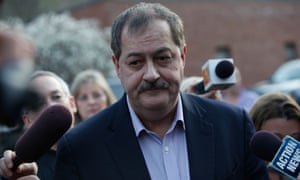
 The Massey Energy Co CEO, Don Blankenship, speaks to reporters in Montcoal, West Virginia, in 2010. Photograph: Haraz N Ghanbari/AP

Thursday 3 December 2015 14.13 ESTLast modified on Thursday 3 December 201517.31 EST


Don Blankenship, the "outlaw" former coal executive and enemy of environmentalists, has been found guilty of a conspiracy over events that led to a deadly mine explosion in West Virginia.

Nine days of jury deliberation, which was put on hold over the Thanksgiving, have resulted in Blankenship being found guilty of a conspiracy to commit safety violations at the mine. But he has been acquitted of charges that he made false statements and committed securities fraud.

An explosion at the Upper Big Branch mine in April 2010 killed 29 miners. A jury deliberated over the fate of Blankenship for six weeks, hearing testimony from 27 witnesses and sifting through more than 500 pieces of evidence.

Blankenship, 65, is the former chief executive of Massey Energy, a coal company that was acquired by Alpha Natural Resources in 2011.

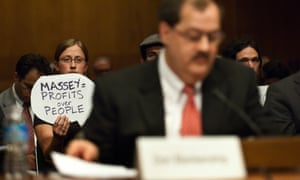
A protester holds a sign behind Don L Blankenship during a Senate hearing on mine safety 20 May 2010 in Washington, DC.
 A protester holds a sign behind Don L Blankenship during a Senate hearing on mine safety in 2010. Photograph: Scott J Ferrell/CQ-Roll Call,Inc

He was charged with three criminal counts over his role in dodging federal mine safety laws at the Upper Big Branch mine in Raleigh County. He was also accused of committing fraud through a statement sent to shareholders following the mine explosion. He denied all of the charges from the outset.

Federal regulators said a series of unsafe practices led to the explosion, with US attorney Booth Goodwin telling court that "Don Blankenship ran a massive criminal conspiracy". Goodwin said an internal memo shows that Blankenship was aware of measures to make the mines safe but chose to not do so. Blankenship, according to Goodwin, was an "outlaw" who pushed miners to continue extracting coal in hazardous conditions.

Bill Taylor, Blankenship's defence attorney, said the federal government had provided "no witnesses, no proof" to back up its charges. Taylor had moved for a mistrial, arguing that the long distance travel required of jurors and the looming Thanksgiving holiday increased the likelihood of a rushed decision. Judge Irene Berger rejected the request.

Democratic senator for West Virginia Joe Manchin said he was pleased with the verdict.

"With this verdict, the state of West Virginia has set precedents and signaled that we will not allow the prioritization of production and profits over the safety of our workers," he said.

"While nothing can ever bring back the 29 beloved souls who we lost on that tragic day, I hope that today brings some closure and peace to the families of the miners."

The makers of Blood on the Mountain, a new documentary about environmental and economic injustice in West Virginia, also welcomed the outcome.

"This verdict has finally held a coal company executive criminally responsible for his crimes against his own workers for his own greed," said Mari-Lynn Evans, the film's director and producer.

"This guilty verdict affirms our faith in justice, and it will have a tremendous a tremendous and lasting impact on how the coal industry does business. For West Virginians, this verdict affirms that the lives of our coal miners is more important than the cost of a mule."