|

Next stop, Twatt! My tour of Britain's fantastically filthy placenames
The UK is full of extremely rude-sounding towns and villages. But what's it like to live in them? Some locals can't wait to change the names, while others embrace the quirk – even selling signpost souvenirs

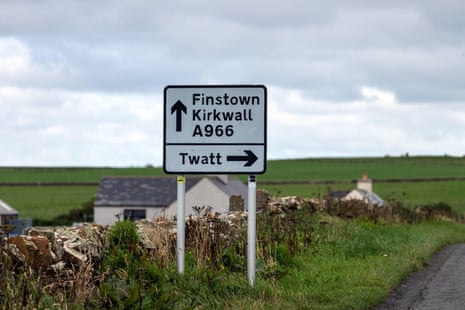
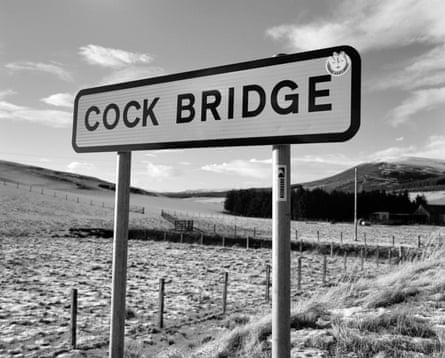
On the road to Twatt, a message arrives from a resident there. Am I making the pilgrimage up through Scotland to this hamlet on the island of Orkney only to admire its notorious, unwittingly rude road sign? If so, don't bother. "Our council was so frustrated by that sign being stolen, they have now not replaced it," says Judith Glue, who runs a gift shop selling pictures of the old Twatt sign to tourists who might otherwise leave the region disappointed. Grateful for her warning, I thank Glue and read over a list I've made of those other dwelling places in the UK that through some quirk of linguistic evolution have found themselves with fantastic, filthy-sounding names. At Cock Bridge, in Aberdeenshire, they have the same trouble as in Twatt. "Our sign is constantly being pinched," says Geva Blackett, a councillor for the region. "People have been taking them away as mementoes. Why do they do it?"
It's an early lesson from my road trip around these towns, villages, parishes, hamlets and farms, many of which are irresistible to Insta-tourists and sign thieves – always phone ahead. One autumn day, I drive for over an hour to visit an Ass Hill in Dorset, just to find it's an unremarkable and uninhabited lane between hedgerows. The village of Shitterton, about 20 miles away, is much more interesting. Residents here are quite accustomed to hobby-horse types like me wandering through to have a nose around and ask questions. Most are proud, even defiant about this startling name of theirs, which derives from the fact that about 1,000 years ago the site was an open sewer.
One local, Peter Gordon, tells me he always makes sure to include Shitterton on his driving licence, because it's a reliable conversation starter if he's ever asked to show ID. Gordon directs my attention to an enterprising local plumber who has gone all-in on a branding opportunity, renaming his premises Pooh Corner. Not every local person takes quite such pleasure in their geographic distinction however. One of Gordon's neighbours, Ian Ventham, tells me about a quarrel he used to have with his late mother-in-law. She always swore that the "h" in Shitterton was silent. "There are still adherents to the 'Sitterton' variant today," sighs Ventham.
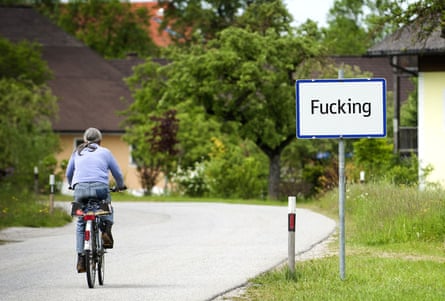
I first became curious about these places – what it was like to live in them, what the benefits were, what were the frictions and frustrations for locals – when I read about the put-upon citizens of Fucking in Austria. This remote, socially conservative village had suffered from decades of unwanted attention, ever since the second world war when British and American soldiers passed through and took home word about a truly unforgettable little place. (The name is thought to stem from a centuries-old landowner.) By 2005, Fucking was so routinely overrun by backpackers and bucket‑listers, all of them chasing selfies or keepsakes, that CCTV cameras had to be pointed at every Fucking sign in town. Even this wasn't enough to deter people, and in 2020 the local mayor, Andrea Holzner, oversaw a change of name to Fugging. Holzner did not respond to my requests to be interviewed, and no wonder, having told reporters in 2020: "We've had enough."
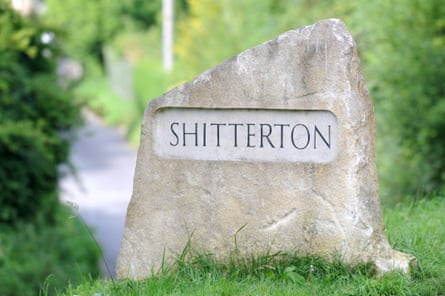
When I chat to Shittertonians about the plight of the Fuckingites, though, they're sympathetic, having adopted their own special measure against sign thieves in 2010. Instead of a standard aluminium sign, too easily dug up and thrown in the boot of a car, residents invested in a great big lump of limestone, about the size of a fridge and surely heavier. It would require some sort of mobile crane to spirit away this engraved rock as a memento. After I've admired it for a while, I give councillor Blackett in Scotland a call. You should see this thing, I say to her! It's the answer to Cock Bridge's problems. She promises she will look it up online.
Browsing on Google images becomes a risky business should you ever undertake to research such a trip. Internet queries about Three Cocks, a village in Powys, or Three Holes, a hamlet in Norfolk, can go wrong, quickly. It's no fault of the places themselves. The etymologies of these names trace back hundreds of years. Pare away a millennium of British history, says John Baker, associate professor of name-studies at the University of Nottingham, and most of our towns and villages were named for features of the landscape, or a landowner, or an agricultural quirk. "The names tended to reflect immediate local circumstances," says Baker. "A particular hill. The condition of the soil."
Many such meanings have been obscured or eliminated by time. Languages evolve. Different citizenries come and go. Suddenly you find yourself learning about a place called Clench in Wiltshire, and instead of that name summoning the idea of a hill in the vicinity, as it would have done in the 1200s, the modern ear hears only something lavatorial. (Or mine does.) A Viking settlement comes to be known in Old Norse as Hill of Sekk, or Sekkshaughr, and 1,000 years later we have the wonderful enigma that is the Yorkshire parish of Sexhow. There are actually two Twatts in the UK, one in Orkney and another in Shetland. We might have ended up with more, says Tom Birkett, a linguist from University College Cork, only the Old Norse word for "meadow" evolved somewhat more innocuously south of the Scottish-English border, becoming Thwaite. Residents of Haithwaite in Buckinghamshire might want to breathe a sigh of relief.
Baker makes the point that we are hardly the first people in history to find ourselves snorting with amusement, or blushing with embarrassment, as placenames become unmoored from their meanings. There is an Ugley in Essex that for decades in the 19th century was primly rebranded as Oakley. "Locals didn't want the association," says Baker, who tells me about a district of Leicester, now known as Belgrave, that was once down in the records as Merdegrave. Norman conquerors, arriving in the 11th century, didn't like the sound of that merde. Why not make the place sound less shitty and call it something beautiful, or belle, instead?
Knowing all this, I start to feel more impressed by those places that have stuck fast to their filthy names, despite the pressures of genteel bowdlerisation. In the late 00s, there was a decision made by the ruling council in Castleford in Yorkshire to alter the name of a thoroughfare in the middle of town. Tickle Cock Bridge became Tittle Cott Bridge, albeit briefly, because locals were so irritated by the prudish switch that they campaigned for a reversal. Tickle Cock Bridge endures. When I drive to Sandy Balls in Hampshire one day, it's a surprise to find that this ancient place – once a sandy, bumpy field, thus the name – has been turned into a modern holiday park. There's now a boules court on site, and a Segway garage. When I pass through, some children are being introduced to a domesticated alpaca. The name Sandy Balls is up in lights, everywhere, no squeamishness whatsoever.
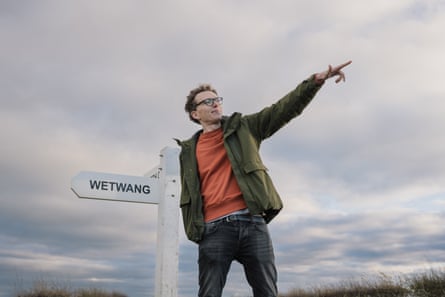
I get the same impression when I visit the village of Wetwang in east Yorkshire. Here, notoriety has been embraced, even greedily courted. Since the late 1990s, the people of Wetwang have taken it upon themselves to invite minor celebrities to serve as honorary figureheads. The tradition started when the TV presenter Richard Whiteley, then the host of Countdown, made a few fond mentions of the village (it once meant "wet field") on air. He was invited to be mayor, and agreed, holding that title for years until his death in 2005. "When Richard died, they wanted him replaced," says Paul Hudson, a weather presenter at the BBC. "For God knows what reason, I won an election in the village."
Hudson, like Whiteley before him, had never so much as visited. But he had mentioned the village on TV a few times, during some lighthearted weather segments, and he was installed as Wetwang's second mayor in 2006. "I help choose the best vegetables at the summer fair," Hudson says. "I judge the annual scarecrow competition. I do it for fun, I'm not even paid mileage … I get the feeling the residents just like it that they're different. They're small. But they're on the map for something. I suppose it's quite a British thing."
In the village of Penistone, 70 miles south-west of Wetwang, I meet photographer Dominic Greyer. After many hours spent driving, and bleary from travel, I'm quite star-struck to meet Greyer in person. This 50-year-old must have put in more miles than anyone alive in his pursuit of obscure and obscene British placenames, establishing himself as the Indiana Jones of his field. Sure, every few years some well-intentioned hiker or cyclist takes it upon themselves to tour the notorious sites, starting at one of the two Twatts and working south, fundraising for charity. But these men and women are amateurs, mere hobbyists, compared with Greyer, who has made a career out of a niche of all niches. "I've done 20 years at the coalface of great British placenames," he says, when we're sitting down together for lunch.
He says he first got interested when he was a student in the 1990s, doing data entry for a transport consultancy firm in York. The firm had a large collection of maps, and Greyer started poring over them, noting down the tiny-lettered names of any farms, footpaths, fields or thoroughfares that caught his eye. High Back Side near Pickering? He'd have to go there one day. Long Fallas Crescent in Brighouse? He added it to his list. In 2004, Greyer published the first of three photobooks that presented his more abstract discoveries (Seething in Norfolk, Tiptoe in Northumberland, Fryup in Yorkshire, Minions in Cornwall) with those placenames that had a bit more tang, including Penistone itself, which derives from the older, more innocent-sounding Peningston, or "farm on a hill".
After years spent running a magnifying glass over Ordnance Survey maps and truckers' atlases, and trudging with his camera over farmland, ditches, clifftops, Greyer has been mistaken for an animal-rights campaigner and a drains inspector. He's also been quizzed at least once by police officers about his intentions while lingering to take photos in places such as Dancing Dicks Lane in Essex or Busty View in Durham. Once he realised there was money to be made from those pictures in his archive that got people laughing, Greyer founded a company called Lesser Spotted Images and started manufacturing Penistone mugs and Sandy Balls greetings cards, as well as all the Twatt merch that Glue has been selling for years from her shop in Orkney.
Greyer once got into an argument, he says, at a Women's Institute fair in Harrogate, when a male security guard made him cover up his Titty Ho tea towels. (It's a junction of roads in Northamptonshire.) On another occasion, he was laying out his wares at a fair in the village of Muff in County Donegal in Ireland – he sells Muff products, too – when a local person looked over his photos from Happy Bottom in Dorset and Slack Bottom in Yorkshire, and asked why Greyer didn't take photos of something nice instead, like flowers.
Why don't you take photos of something nice instead, like flowers, I ask? "If it's there, I want to see it," is all Greyer can say to explain his lifelong compulsion to catalogue these places. He points out that his work has been recognised by the art world, and that Grayson Perry invited him to exhibit at a Royal Academy show in 2018. Greyer remembers stewing over what to submit. A photograph of No 2 Passage in Manchester? He settled on one of Cumcum Hill in Hertfordshire, instead.
Sign up to Inside Saturday
The only way to get a look behind the scenes of our brand new magazine, Saturday. Sign up to get the inside story from our top writers as well as all the must-read articles and columns, delivered to your inbox every weekend.
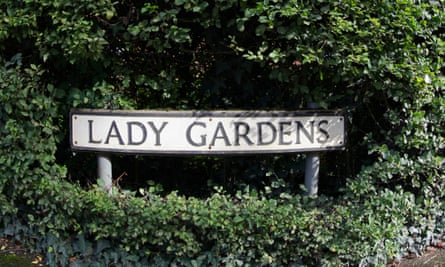
As we're talking, a passing hiker notices one of Greyer's photographs on the table between us. He comes over to inspect it (Lady Gardens, Herefordshire) and introduces himself. Turns out this hiker has a similar eye for placenames. He and Greyer briskly compare notes, as if they are butterfly hunters or birdwatchers meeting in the field. Greyer asks: "Have you ever been over to Scarborough, and those cliffs called Randy Bell End?"
"No. But we do live close to Upperthong," says the hiker.
"I have a photo of the sign at Netherthong," says Greyer, "not Upper."
"I prefer Upper."
"I think Nether is better."
"Have you ever heard of Fanny Moor Crescent in Huddersfield?"
"Trumped," says Greyer, "by Fanny Hands Lane in Ludford."
Ileave them to it, driving south out of Penistone into wilder country. Earlier that day, on the roads around Wetwang, I passed evidence of a traffic accident. Tyre tracks left the road towards a ditch – exactly where Wetwang's big welcome sign loomed, as though a passing driver had seen the name, been distracted by mirth or disbelief, and lost control. Leaving Penistone, I almost get into similar grief. The landscape is stunning here, rolling hills of green and brown, moss-covered walls, brooks. When I pass a craggy rock that's engraved with directions to the nearest village, I have to hit the brakes, and come to a screeching halt. It's a marker for Penistone, forged from actual stone. It has been scratched all over by long-gone vandals, some of their faded carvings surely meant to be penises.
I sit beside the stone for a bit, feeling unusually in tune with my compatriots. There is so much that divides us and makes us frustrated with each other, politically, economically, tonally. But we do share these ridiculous islands, with our Twatts, our Clench, our churches named after a saint called Sexburga. I find something comforting and levelling about it, whenever I hear of a new one. Assington in Suffolk. Cuckoo's Knob in Wiltshire. Out of pride or perversity, sometimes because of the conservation efforts of unsung heroes, we've stuck by these names. When a petition was launched in Rowley Regis in the West Midlands, to try to alter the name of a local road that was felt by some to be bad for house prices, a counterpetition was launched: Save our beloved Bell End! I like what these campaigns say about us, stubborn little weirdo nation that we are.
Ever since the start of my trip, I've been trying to get in touch with Linda George, the woman who stood up for Bell End (which probably referred to a bell pit in a bygone mine), successfully petitioning for its protection in 2018. When we finally speak my travels are almost done. I ask her, why go to battle for Bell End?
"I lived there with my grandmother as a baby," George explains. "She was a great storyteller about her village. There used to be a coaching house dating to the 1700s. There used to be Georgian pubs. By the time I was an adult, almost all of this was gone. It had been demolished for modern buildings. Even the church has been rebuilt several times. My kids fall about laughing whenever I talk about Bell End and protecting it – but it's an ancient name. It's one of the few things the village has left in terms of its history. In a way, if we lose Bell End, we lose everything."
I wish George luck, and she does the same, asking me where I'm heading next on my road trip. I tell her I'm not sure. I have my eye on Butts Wynd in Fife. Or maybe Pant in Shropshire. We'll have to see.
Next stop, Twatt! My tour of Britain's fantastically filthy placenames
The UK is full of extremely rude-sounding towns and villages. But what's it like to live in them? Some locals can't wait to change the names, while others embrace the quirk – even selling signpost souvenirs
On the road to Twatt, a message arrives from a resident there. Am I making the pilgrimage up through Scotland to this hamlet on the island of Orkney only to admire its notorious, unwittingly rude road sign? If so, don't bother. "Our council was so frustrated by that sign being stolen, they have now not replaced it," says Judith Glue, who runs a gift shop selling pictures of the old Twatt sign to tourists who might otherwise leave the region disappointed. Grateful for her warning, I thank Glue and read over a list I've made of those other dwelling places in the UK that through some quirk of linguistic evolution have found themselves with fantastic, filthy-sounding names. At Cock Bridge, in Aberdeenshire, they have the same trouble as in Twatt. "Our sign is constantly being pinched," says Geva Blackett, a councillor for the region. "People have been taking them away as mementoes. Why do they do it?"
It's an early lesson from my road trip around these towns, villages, parishes, hamlets and farms, many of which are irresistible to Insta-tourists and sign thieves – always phone ahead. One autumn day, I drive for over an hour to visit an Ass Hill in Dorset, just to find it's an unremarkable and uninhabited lane between hedgerows. The village of Shitterton, about 20 miles away, is much more interesting. Residents here are quite accustomed to hobby-horse types like me wandering through to have a nose around and ask questions. Most are proud, even defiant about this startling name of theirs, which derives from the fact that about 1,000 years ago the site was an open sewer.
One local, Peter Gordon, tells me he always makes sure to include Shitterton on his driving licence, because it's a reliable conversation starter if he's ever asked to show ID. Gordon directs my attention to an enterprising local plumber who has gone all-in on a branding opportunity, renaming his premises Pooh Corner. Not every local person takes quite such pleasure in their geographic distinction however. One of Gordon's neighbours, Ian Ventham, tells me about a quarrel he used to have with his late mother-in-law. She always swore that the "h" in Shitterton was silent. "There are still adherents to the 'Sitterton' variant today," sighs Ventham.
I first became curious about these places – what it was like to live in them, what the benefits were, what were the frictions and frustrations for locals – when I read about the put-upon citizens of Fucking in Austria. This remote, socially conservative village had suffered from decades of unwanted attention, ever since the second world war when British and American soldiers passed through and took home word about a truly unforgettable little place. (The name is thought to stem from a centuries-old landowner.) By 2005, Fucking was so routinely overrun by backpackers and bucket‑listers, all of them chasing selfies or keepsakes, that CCTV cameras had to be pointed at every Fucking sign in town. Even this wasn't enough to deter people, and in 2020 the local mayor, Andrea Holzner, oversaw a change of name to Fugging. Holzner did not respond to my requests to be interviewed, and no wonder, having told reporters in 2020: "We've had enough."
When I chat to Shittertonians about the plight of the Fuckingites, though, they're sympathetic, having adopted their own special measure against sign thieves in 2010. Instead of a standard aluminium sign, too easily dug up and thrown in the boot of a car, residents invested in a great big lump of limestone, about the size of a fridge and surely heavier. It would require some sort of mobile crane to spirit away this engraved rock as a memento. After I've admired it for a while, I give councillor Blackett in Scotland a call. You should see this thing, I say to her! It's the answer to Cock Bridge's problems. She promises she will look it up online.
Browsing on Google images becomes a risky business should you ever undertake to research such a trip. Internet queries about Three Cocks, a village in Powys, or Three Holes, a hamlet in Norfolk, can go wrong, quickly. It's no fault of the places themselves. The etymologies of these names trace back hundreds of years. Pare away a millennium of British history, says John Baker, associate professor of name-studies at the University of Nottingham, and most of our towns and villages were named for features of the landscape, or a landowner, or an agricultural quirk. "The names tended to reflect immediate local circumstances," says Baker. "A particular hill. The condition of the soil."
Many such meanings have been obscured or eliminated by time. Languages evolve. Different citizenries come and go. Suddenly you find yourself learning about a place called Clench in Wiltshire, and instead of that name summoning the idea of a hill in the vicinity, as it would have done in the 1200s, the modern ear hears only something lavatorial. (Or mine does.) A Viking settlement comes to be known in Old Norse as Hill of Sekk, or Sekkshaughr, and 1,000 years later we have the wonderful enigma that is the Yorkshire parish of Sexhow. There are actually two Twatts in the UK, one in Orkney and another in Shetland. We might have ended up with more, says Tom Birkett, a linguist from University College Cork, only the Old Norse word for "meadow" evolved somewhat more innocuously south of the Scottish-English border, becoming Thwaite. Residents of Haithwaite in Buckinghamshire might want to breathe a sigh of relief.
Baker makes the point that we are hardly the first people in history to find ourselves snorting with amusement, or blushing with embarrassment, as placenames become unmoored from their meanings. There is an Ugley in Essex that for decades in the 19th century was primly rebranded as Oakley. "Locals didn't want the association," says Baker, who tells me about a district of Leicester, now known as Belgrave, that was once down in the records as Merdegrave. Norman conquerors, arriving in the 11th century, didn't like the sound of that merde. Why not make the place sound less shitty and call it something beautiful, or belle, instead?
Knowing all this, I start to feel more impressed by those places that have stuck fast to their filthy names, despite the pressures of genteel bowdlerisation. In the late 00s, there was a decision made by the ruling council in Castleford in Yorkshire to alter the name of a thoroughfare in the middle of town. Tickle Cock Bridge became Tittle Cott Bridge, albeit briefly, because locals were so irritated by the prudish switch that they campaigned for a reversal. Tickle Cock Bridge endures. When I drive to Sandy Balls in Hampshire one day, it's a surprise to find that this ancient place – once a sandy, bumpy field, thus the name – has been turned into a modern holiday park. There's now a boules court on site, and a Segway garage. When I pass through, some children are being introduced to a domesticated alpaca. The name Sandy Balls is up in lights, everywhere, no squeamishness whatsoever.
I get the same impression when I visit the village of Wetwang in east Yorkshire. Here, notoriety has been embraced, even greedily courted. Since the late 1990s, the people of Wetwang have taken it upon themselves to invite minor celebrities to serve as honorary figureheads. The tradition started when the TV presenter Richard Whiteley, then the host of Countdown, made a few fond mentions of the village (it once meant "wet field") on air. He was invited to be mayor, and agreed, holding that title for years until his death in 2005. "When Richard died, they wanted him replaced," says Paul Hudson, a weather presenter at the BBC. "For God knows what reason, I won an election in the village."
Hudson, like Whiteley before him, had never so much as visited. But he had mentioned the village on TV a few times, during some lighthearted weather segments, and he was installed as Wetwang's second mayor in 2006. "I help choose the best vegetables at the summer fair," Hudson says. "I judge the annual scarecrow competition. I do it for fun, I'm not even paid mileage … I get the feeling the residents just like it that they're different. They're small. But they're on the map for something. I suppose it's quite a British thing."
In the village of Penistone, 70 miles south-west of Wetwang, I meet photographer Dominic Greyer. After many hours spent driving, and bleary from travel, I'm quite star-struck to meet Greyer in person. This 50-year-old must have put in more miles than anyone alive in his pursuit of obscure and obscene British placenames, establishing himself as the Indiana Jones of his field. Sure, every few years some well-intentioned hiker or cyclist takes it upon themselves to tour the notorious sites, starting at one of the two Twatts and working south, fundraising for charity. But these men and women are amateurs, mere hobbyists, compared with Greyer, who has made a career out of a niche of all niches. "I've done 20 years at the coalface of great British placenames," he says, when we're sitting down together for lunch.
He says he first got interested when he was a student in the 1990s, doing data entry for a transport consultancy firm in York. The firm had a large collection of maps, and Greyer started poring over them, noting down the tiny-lettered names of any farms, footpaths, fields or thoroughfares that caught his eye. High Back Side near Pickering? He'd have to go there one day. Long Fallas Crescent in Brighouse? He added it to his list. In 2004, Greyer published the first of three photobooks that presented his more abstract discoveries (Seething in Norfolk, Tiptoe in Northumberland, Fryup in Yorkshire, Minions in Cornwall) with those placenames that had a bit more tang, including Penistone itself, which derives from the older, more innocent-sounding Peningston, or "farm on a hill".
After years spent running a magnifying glass over Ordnance Survey maps and truckers' atlases, and trudging with his camera over farmland, ditches, clifftops, Greyer has been mistaken for an animal-rights campaigner and a drains inspector. He's also been quizzed at least once by police officers about his intentions while lingering to take photos in places such as Dancing Dicks Lane in Essex or Busty View in Durham. Once he realised there was money to be made from those pictures in his archive that got people laughing, Greyer founded a company called Lesser Spotted Images and started manufacturing Penistone mugs and Sandy Balls greetings cards, as well as all the Twatt merch that Glue has been selling for years from her shop in Orkney.
Greyer once got into an argument, he says, at a Women's Institute fair in Harrogate, when a male security guard made him cover up his Titty Ho tea towels. (It's a junction of roads in Northamptonshire.) On another occasion, he was laying out his wares at a fair in the village of Muff in County Donegal in Ireland – he sells Muff products, too – when a local person looked over his photos from Happy Bottom in Dorset and Slack Bottom in Yorkshire, and asked why Greyer didn't take photos of something nice instead, like flowers.
Why don't you take photos of something nice instead, like flowers, I ask? "If it's there, I want to see it," is all Greyer can say to explain his lifelong compulsion to catalogue these places. He points out that his work has been recognised by the art world, and that Grayson Perry invited him to exhibit at a Royal Academy show in 2018. Greyer remembers stewing over what to submit. A photograph of No 2 Passage in Manchester? He settled on one of Cumcum Hill in Hertfordshire, instead.
Sign up to Inside Saturday
The only way to get a look behind the scenes of our brand new magazine, Saturday. Sign up to get the inside story from our top writers as well as all the must-read articles and columns, delivered to your inbox every weekend.
As we're talking, a passing hiker notices one of Greyer's photographs on the table between us. He comes over to inspect it (Lady Gardens, Herefordshire) and introduces himself. Turns out this hiker has a similar eye for placenames. He and Greyer briskly compare notes, as if they are butterfly hunters or birdwatchers meeting in the field. Greyer asks: "Have you ever been over to Scarborough, and those cliffs called Randy Bell End?"
"No. But we do live close to Upperthong," says the hiker.
"I have a photo of the sign at Netherthong," says Greyer, "not Upper."
"I prefer Upper."
"I think Nether is better."
"Have you ever heard of Fanny Moor Crescent in Huddersfield?"
"Trumped," says Greyer, "by Fanny Hands Lane in Ludford."
Ileave them to it, driving south out of Penistone into wilder country. Earlier that day, on the roads around Wetwang, I passed evidence of a traffic accident. Tyre tracks left the road towards a ditch – exactly where Wetwang's big welcome sign loomed, as though a passing driver had seen the name, been distracted by mirth or disbelief, and lost control. Leaving Penistone, I almost get into similar grief. The landscape is stunning here, rolling hills of green and brown, moss-covered walls, brooks. When I pass a craggy rock that's engraved with directions to the nearest village, I have to hit the brakes, and come to a screeching halt. It's a marker for Penistone, forged from actual stone. It has been scratched all over by long-gone vandals, some of their faded carvings surely meant to be penises.
I sit beside the stone for a bit, feeling unusually in tune with my compatriots. There is so much that divides us and makes us frustrated with each other, politically, economically, tonally. But we do share these ridiculous islands, with our Twatts, our Clench, our churches named after a saint called Sexburga. I find something comforting and levelling about it, whenever I hear of a new one. Assington in Suffolk. Cuckoo's Knob in Wiltshire. Out of pride or perversity, sometimes because of the conservation efforts of unsung heroes, we've stuck by these names. When a petition was launched in Rowley Regis in the West Midlands, to try to alter the name of a local road that was felt by some to be bad for house prices, a counterpetition was launched: Save our beloved Bell End! I like what these campaigns say about us, stubborn little weirdo nation that we are.
Ever since the start of my trip, I've been trying to get in touch with Linda George, the woman who stood up for Bell End (which probably referred to a bell pit in a bygone mine), successfully petitioning for its protection in 2018. When we finally speak my travels are almost done. I ask her, why go to battle for Bell End?
"I lived there with my grandmother as a baby," George explains. "She was a great storyteller about her village. There used to be a coaching house dating to the 1700s. There used to be Georgian pubs. By the time I was an adult, almost all of this was gone. It had been demolished for modern buildings. Even the church has been rebuilt several times. My kids fall about laughing whenever I talk about Bell End and protecting it – but it's an ancient name. It's one of the few things the village has left in terms of its history. In a way, if we lose Bell End, we lose everything."
Next stop, Twatt! My tour of Britain's fantastically filthy placenames
The UK is full of extremely rude-sounding towns and villages. But what's it like to live in them? Some locals can't wait to change the names, while others embrace the quirk – even selling signpost souvenirs
On the road to Twatt, a message arrives from a resident there. Am I making the pilgrimage up through Scotland to this hamlet on the island of Orkney only to admire its notorious, unwittingly rude road sign? If so, don't bother. "Our council was so frustrated by that sign being stolen, they have now not replaced it," says Judith Glue, who runs a gift shop selling pictures of the old Twatt sign to tourists who might otherwise leave the region disappointed. Grateful for her warning, I thank Glue and read over a list I've made of those other dwelling places in the UK that through some quirk of linguistic evolution have found themselves with fantastic, filthy-sounding names. At Cock Bridge, in Aberdeenshire, they have the same trouble as in Twatt. "Our sign is constantly being pinched," says Geva Blackett, a councillor for the region. "People have been taking them away as mementoes. Why do they do it?"
It's an early lesson from my road trip around these towns, villages, parishes, hamlets and farms, many of which are irresistible to Insta-tourists and sign thieves – always phone ahead. One autumn day, I drive for over an hour to visit an Ass Hill in Dorset, just to find it's an unremarkable and uninhabited lane between hedgerows. The village of Shitterton, about 20 miles away, is much more interesting. Residents here are quite accustomed to hobby-horse types like me wandering through to have a nose around and ask questions. Most are proud, even defiant about this startling name of theirs, which derives from the fact that about 1,000 years ago the site was an open sewer.
One local, Peter Gordon, tells me he always makes sure to include Shitterton on his driving licence, because it's a reliable conversation starter if he's ever asked to show ID. Gordon directs my attention to an enterprising local plumber who has gone all-in on a branding opportunity, renaming his premises Pooh Corner. Not every local person takes quite such pleasure in their geographic distinction however. One of Gordon's neighbours, Ian Ventham, tells me about a quarrel he used to have with his late mother-in-law. She always swore that the "h" in Shitterton was silent. "There are still adherents to the 'Sitterton' variant today," sighs Ventham.
I first became curious about these places – what it was like to live in them, what the benefits were, what were the frictions and frustrations for locals – when I read about the put-upon citizens of Fucking in Austria. This remote, socially conservative village had suffered from decades of unwanted attention, ever since the second world war when British and American soldiers passed through and took home word about a truly unforgettable little place. (The name is thought to stem from a centuries-old landowner.) By 2005, Fucking was so routinely overrun by backpackers and bucket‑listers, all of them chasing selfies or keepsakes, that CCTV cameras had to be pointed at every Fucking sign in town. Even this wasn't enough to deter people, and in 2020 the local mayor, Andrea Holzner, oversaw a change of name to Fugging. Holzner did not respond to my requests to be interviewed, and no wonder, having told reporters in 2020: "We've had enough."
When I chat to Shittertonians about the plight of the Fuckingites, though, they're sympathetic, having adopted their own special measure against sign thieves in 2010. Instead of a standard aluminium sign, too easily dug up and thrown in the boot of a car, residents invested in a great big lump of limestone, about the size of a fridge and surely heavier. It would require some sort of mobile crane to spirit away this engraved rock as a memento. After I've admired it for a while, I give councillor Blackett in Scotland a call. You should see this thing, I say to her! It's the answer to Cock Bridge's problems. She promises she will look it up online.
Browsing on Google images becomes a risky business should you ever undertake to research such a trip. Internet queries about Three Cocks, a village in Powys, or Three Holes, a hamlet in Norfolk, can go wrong, quickly. It's no fault of the places themselves. The etymologies of these names trace back hundreds of years. Pare away a millennium of British history, says John Baker, associate professor of name-studies at the University of Nottingham, and most of our towns and villages were named for features of the landscape, or a landowner, or an agricultural quirk. "The names tended to reflect immediate local circumstances," says Baker. "A particular hill. The condition of the soil."
Many such meanings have been obscured or eliminated by time. Languages evolve. Different citizenries come and go. Suddenly you find yourself learning about a place called Clench in Wiltshire, and instead of that name summoning the idea of a hill in the vicinity, as it would have done in the 1200s, the modern ear hears only something lavatorial. (Or mine does.) A Viking settlement comes to be known in Old Norse as Hill of Sekk, or Sekkshaughr, and 1,000 years later we have the wonderful enigma that is the Yorkshire parish of Sexhow. There are actually two Twatts in the UK, one in Orkney and another in Shetland. We might have ended up with more, says Tom Birkett, a linguist from University College Cork, only the Old Norse word for "meadow" evolved somewhat more innocuously south of the Scottish-English border, becoming Thwaite. Residents of Haithwaite in Buckinghamshire might want to breathe a sigh of relief.
Baker makes the point that we are hardly the first people in history to find ourselves snorting with amusement, or blushing with embarrassment, as placenames become unmoored from their meanings. There is an Ugley in Essex that for decades in the 19th century was primly rebranded as Oakley. "Locals didn't want the association," says Baker, who tells me about a district of Leicester, now known as Belgrave, that was once down in the records as Merdegrave. Norman conquerors, arriving in the 11th century, didn't like the sound of that merde. Why not make the place sound less shitty and call it something beautiful, or belle, instead?
Knowing all this, I start to feel more impressed by those places that have stuck fast to their filthy names, despite the pressures of genteel bowdlerisation. In the late 00s, there was a decision made by the ruling council in Castleford in Yorkshire to alter the name of a thoroughfare in the middle of town. Tickle Cock Bridge became Tittle Cott Bridge, albeit briefly, because locals were so irritated by the prudish switch that they campaigned for a reversal. Tickle Cock Bridge endures. When I drive to Sandy Balls in Hampshire one day, it's a surprise to find that this ancient place – once a sandy, bumpy field, thus the name – has been turned into a modern holiday park. There's now a boules court on site, and a Segway garage. When I pass through, some children are being introduced to a domesticated alpaca. The name Sandy Balls is up in lights, everywhere, no squeamishness whatsoever.
I get the same impression when I visit the village of Wetwang in east Yorkshire. Here, notoriety has been embraced, even greedily courted. Since the late 1990s, the people of Wetwang have taken it upon themselves to invite minor celebrities to serve as honorary figureheads. The tradition started when the TV presenter Richard Whiteley, then the host of Countdown, made a few fond mentions of the village (it once meant "wet field") on air. He was invited to be mayor, and agreed, holding that title for years until his death in 2005. "When Richard died, they wanted him replaced," says Paul Hudson, a weather presenter at the BBC. "For God knows what reason, I won an election in the village."
Hudson, like Whiteley before him, had never so much as visited. But he had mentioned the village on TV a few times, during some lighthearted weather segments, and he was installed as Wetwang's second mayor in 2006. "I help choose the best vegetables at the summer fair," Hudson says. "I judge the annual scarecrow competition. I do it for fun, I'm not even paid mileage … I get the feeling the residents just like it that they're different. They're small. But they're on the map for something. I suppose it's quite a British thing."
In the village of Penistone, 70 miles south-west of Wetwang, I meet photographer Dominic Greyer. After many hours spent driving, and bleary from travel, I'm quite star-struck to meet Greyer in person. This 50-year-old must have put in more miles than anyone alive in his pursuit of obscure and obscene British placenames, establishing himself as the Indiana Jones of his field. Sure, every few years some well-intentioned hiker or cyclist takes it upon themselves to tour the notorious sites, starting at one of the two Twatts and working south, fundraising for charity. But these men and women are amateurs, mere hobbyists, compared with Greyer, who has made a career out of a niche of all niches. "I've done 20 years at the coalface of great British placenames," he says, when we're sitting down together for lunch.
He says he first got interested when he was a student in the 1990s, doing data entry for a transport consultancy firm in York. The firm had a large collection of maps, and Greyer started poring over them, noting down the tiny-lettered names of any farms, footpaths, fields or thoroughfares that caught his eye. High Back Side near Pickering? He'd have to go there one day. Long Fallas Crescent in Brighouse? He added it to his list. In 2004, Greyer published the first of three photobooks that presented his more abstract discoveries (Seething in Norfolk, Tiptoe in Northumberland, Fryup in Yorkshire, Minions in Cornwall) with those placenames that had a bit more tang, including Penistone itself, which derives from the older, more innocent-sounding Peningston, or "farm on a hill".
After years spent running a magnifying glass over Ordnance Survey maps and truckers' atlases, and trudging with his camera over farmland, ditches, clifftops, Greyer has been mistaken for an animal-rights campaigner and a drains inspector. He's also been quizzed at least once by police officers about his intentions while lingering to take photos in places such as Dancing Dicks Lane in Essex or Busty View in Durham. Once he realised there was money to be made from those pictures in his archive that got people laughing, Greyer founded a company called Lesser Spotted Images and started manufacturing Penistone mugs and Sandy Balls greetings cards, as well as all the Twatt merch that Glue has been selling for years from her shop in Orkney.
Greyer once got into an argument, he says, at a Women's Institute fair in Harrogate, when a male security guard made him cover up his Titty Ho tea towels. (It's a junction of roads in Northamptonshire.) On another occasion, he was laying out his wares at a fair in the village of Muff in County Donegal in Ireland – he sells Muff products, too – when a local person looked over his photos from Happy Bottom in Dorset and Slack Bottom in Yorkshire, and asked why Greyer didn't take photos of something nice instead, like flowers.
Why don't you take photos of something nice instead, like flowers, I ask? "If it's there, I want to see it," is all Greyer can say to explain his lifelong compulsion to catalogue these places. He points out that his work has been recognised by the art world, and that Grayson Perry invited him to exhibit at a Royal Academy show in 2018. Greyer remembers stewing over what to submit. A photograph of No 2 Passage in Manchester? He settled on one of Cumcum Hill in Hertfordshire, instead.
Sign up to Inside Saturday
The only way to get a look behind the scenes of our brand new magazine, Saturday. Sign up to get the inside story from our top writers as well as all the must-read articles and columns, delivered to your inbox every weekend.
As we're talking, a passing hiker notices one of Greyer's photographs on the table between us. He comes over to inspect it (Lady Gardens, Herefordshire) and introduces himself. Turns out this hiker has a similar eye for placenames. He and Greyer briskly compare notes, as if they are butterfly hunters or birdwatchers meeting in the field. Greyer asks: "Have you ever been over to Scarborough, and those cliffs called Randy Bell End?"
"No. But we do live close to Upperthong," says the hiker.
"I have a photo of the sign at Netherthong," says Greyer, "not Upper."
"I prefer Upper."
"I think Nether is better."
"Have you ever heard of Fanny Moor Crescent in Huddersfield?"
"Trumped," says Greyer, "by Fanny Hands Lane in Ludford."
Ileave them to it, driving south out of Penistone into wilder country. Earlier that day, on the roads around Wetwang, I passed evidence of a traffic accident. Tyre tracks left the road towards a ditch – exactly where Wetwang's big welcome sign loomed, as though a passing driver had seen the name, been distracted by mirth or disbelief, and lost control. Leaving Penistone, I almost get into similar grief. The landscape is stunning here, rolling hills of green and brown, moss-covered walls, brooks. When I pass a craggy rock that's engraved with directions to the nearest village, I have to hit the brakes, and come to a screeching halt. It's a marker for Penistone, forged from actual stone. It has been scratched all over by long-gone vandals, some of their faded carvings surely meant to be penises.
I sit beside the stone for a bit, feeling unusually in tune with my compatriots. There is so much that divides us and makes us frustrated with each other, politically, economically, tonally. But we do share these ridiculous islands, with our Twatts, our Clench, our churches named after a saint called Sexburga. I find something comforting and levelling about it, whenever I hear of a new one. Assington in Suffolk. Cuckoo's Knob in Wiltshire. Out of pride or perversity, sometimes because of the conservation efforts of unsung heroes, we've stuck by these names. When a petition was launched in Rowley Regis in the West Midlands, to try to alter the name of a local road that was felt by some to be bad for house prices, a counterpetition was launched: Save our beloved Bell End! I like what these campaigns say about us, stubborn little weirdo nation that we are.
|
Ever since the start of my trip, I've been trying to get in touch with Linda George, the woman who stood up for Bell End (which probably referred to a bell pit in a bygone mine), successfully petitioning for its protection in 2018. When we finally speak my travels are almost done. I ask her, why go to battle for Bell End?
"I lived there with my grandmother as a baby," George explains. "She was a great storyteller about her village. There used to be a coaching house dating to the 1700s. There used to be Georgian pubs. By the time I was an adult, almost all of this was gone. It had been demolished for modern buildings. Even the church has been rebuilt several times. My kids fall about laughing whenever I talk about Bell End and protecting it – but it's an ancient name. It's one of the few things the village has left in terms of its history. In a way, if we lose Bell End, we lose everything."
I wish George luck, and she does the same, asking me where I'm heading next on my road trip. I tell her I'm not sure. I have my eye on Butts Wynd in Fife. Or maybe Pant in Shropshire. We'll have to see.


 Submarine volcanic activity along a section of the Kolumbo crater on the seafloor, observed with SANTORY monitoring equipment. Credit: SANTORY
 Data-misfit across iterations. (a) Objective function defined as L

 Posts


