Thursday, May 12, 2016

ANS -- Bernie Sanders Could Still Win the Democratic Nomination — No, Seriously

Read this article.  It shows a scenario, plausible, possible, in which Bernie could win the nomination.  Really.  
--Kim


Bernie Sanders Could Still Win the Democratic Nomination — No, Seriously

 05/11/2016 09:37 am ET | Updated 17 hours ago
4.9 K
  • Seth AbramsonAssistant Professor of English at University of New Hampshire; Series Co-Editor, Best American Experimental Writing
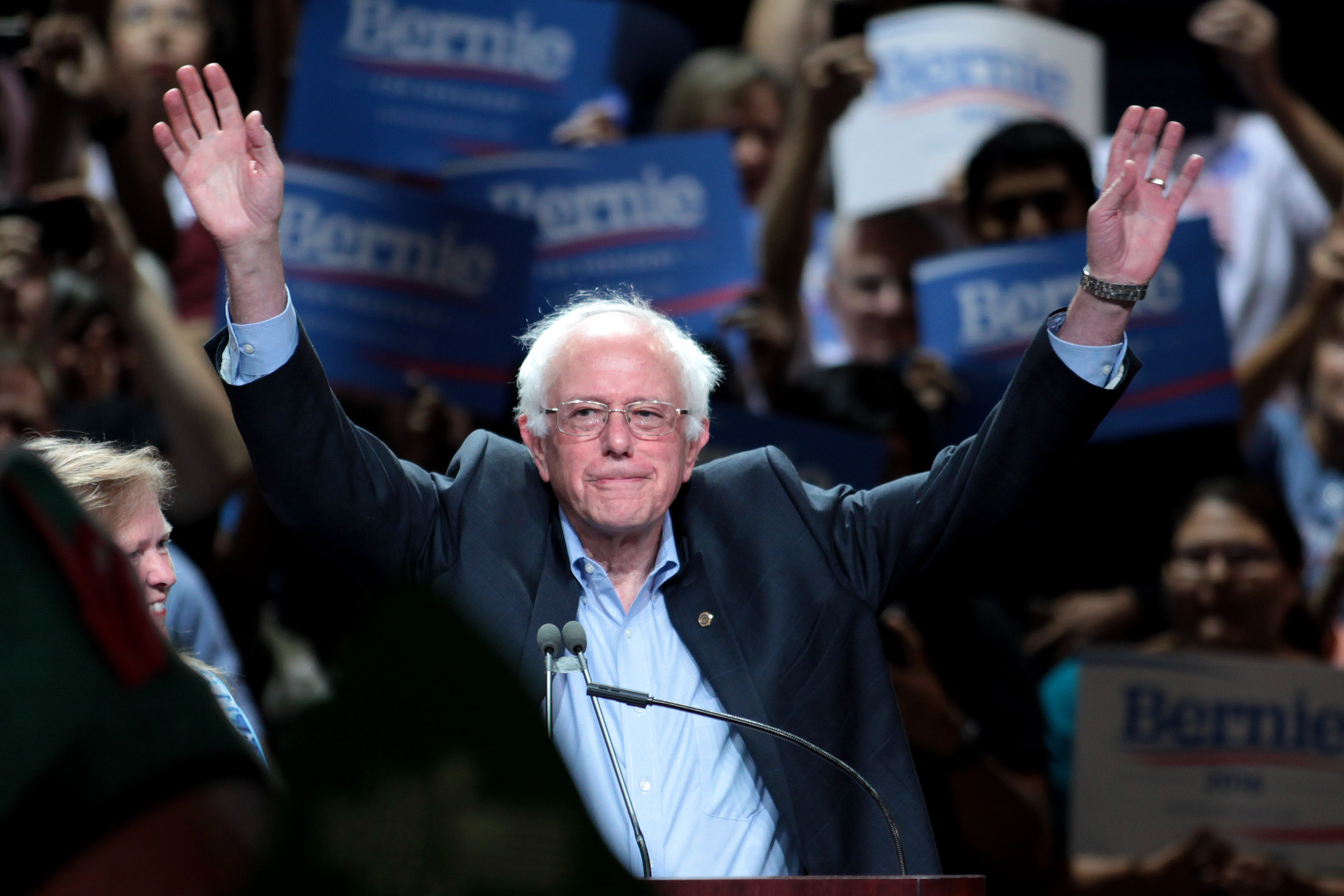
2016-05-11-1462938425-838385-Bernie_Sanders.jpg

Last night on CNN, while discussing Bernie Sanders' landslide victory over Hillary Clinton in West Virginia — which followed a 5-point Sanders win in Indiana last week — Michael Smerconish said that "Democratic super-delegates might have to rethink" their support of Hillary Clinton given how dramatically better Sanders fares in head-to-head match-ups against Donald Trump.

After Clinton's Indiana loss, John King had told CNN viewers that "if Sanders were to win nine out of ten of the remaining contests, there's no doubt that some of the super-delegates would panic. There's no doubt some of them would switch to Sanders. What he has to do is win the bulk of the remaining contests. Would that send jitters, if not panic, through the Democratic Party? Yes. Yes it would."

So what gives? Isn't this thing over?

Almost, but not quite.

What Smerconish (and Wolf Blitzer) were discussing last night, and John King was discussing last week, is a very simple theory — call it "run-the-table" — which is easy enough to understand if you simply know the history of Democratic super-delegates and what's happened in the 2016 Democratic primary since Super Tuesday.

So here it is — both a brief history of the "super-delegate" and an explanation of the "run-the-table" scenario that increasingly is making it into the mainstream media.

In 1984, the Democratic Party created "super-delegates" — Party officials with a vote at the Democrats' nominating convention. The hope was that super-delegates would rarely if ever be needed. There was reason to be hopeful on this score: first, because any Democratic nominee able to win even 59 percent of the "pledged" (primary and caucus) delegates would clinch the Democratic nomination before even a single super-delegate had voted; second, because even if a weak front-runner were unable to clinch the Democratic nomination without super-delegates, the candidate behind in the "pledged" delegate count would almost certainly concede before any super-delegates were forced to weigh in.

For 32 years, the Democrats' decision to create super-delegates looked pretty smart. Other than the current primary season — a single-digit race (54 percent to 45 percent) that's the second-closest Democratic primary of the last 32 years — only one of the Democrats' primaries, the one in 2008, was ultimately close enough for super-delegates to matter. In that case the losing candidate, Hillary Clinton, decided to concede after the final votes were cast in June. Clinton's concession made the super-delegate question a moot one.

Clinton conceded in 2008 for a number of reasons: her opponent, now-President Obama, agreed to retire her massive campaign debt; she believed (correctly) that Obama would name her either Vice President or Secretary of State, the latter the second-most powerful position in Washington; and finally and most importantly, Obama had kicked the hell out of her in the latter half of the election season, winning 16 of the final 25 states. In other words, there was no reasonable argument for Clinton to make to super-delegates that they should step in to change the primary result.

While Clinton permitted a roll call vote in Denver — with more than 1,000 convention delegates officially casting their first-ballot vote for her rather than then-Senator Obama — she thereafter called for Obama to become the nominee by acclamation. Having made a public statement regarding her own base of support within the Democratic Party — it's highly unusual, indeed almost unheard of, for a roll call vote to occur when one of the two candidates has conceded — Clinton receded into the background. By which I mean that she became, within just a few months, arguably the second most-powerful person in America: the Secretary of State.

But Clinton had seriously considered staying in the race past June 7th of 2008. The reason she almost did — she was barely talked out of it by her aides — is the very reason Bernie Sanders could still win the Democratic nomination in 2016.

That reason?

Super-delegates exist for only one purpose: to overturn, if necessary, the popular-vote and delegate-count results.

Super-delegates would be meaningless if their only purpose were to validate the primary and caucus results, which is why that consideration had absolutely nothing to do with their creation. When super-delegates were created in 1984, it was in fact to avoid a repeat of what had almost happened in 1980: a candidate with no shot at winning the general election almost becoming the popular-vote and pledged-delegate winner. It may seem counter-intuitive to some now, but the Democratic Party in 1984 wanted a mechanism available to vote down the Party's prospective nominee — the popular-vote and pledged-delegate winner — if that person couldn't be elected in the November general election. So when Howard Dean, former presidential candidate and Democratic National Committee Chair, said several months ago that he would cast his super-delegate vote without regard for the popular vote or pledged-delegate race, he was only stating what has been true about super-delegates for 32 years now: their role in the process is only "activated" either (a) to validate a historically weak front-runner who isn't able to clinch the nomination via pledged delegates alone (in which case the super-delegates are "active," and yet things would be no different if they didn't exist), or, more profoundly, (b) to preclude the nomination of someone who can't win the general election.

Fast-forward to 2016.

John King of CNN, and others, have made crystal-clear the scenario under which Bernie Sanders could become the Democratic nominee for President: he runs the table on the remaining primaries and caucuses.

If Sanders runs the table in 2016, it will mean the following has (by June 7th) happened:

  • Sanders has won 19 of the final 25 state primaries and caucuses (not a typo);
  • Sanders is within a few hundred thousand votes of Clinton in the popular vote;
  • Sanders has won 54 percent of the pledged delegates since Super Tuesday; and
  • Sanders is in a dead heat with Clinton in national polling.

The above alone — while absolutely stunning; Sanders running significantly better than Obama for the entire second half of the primary season is a major eye-opener — wouldn't be enough to trigger the second scenario in which super-delegates are suddenly meaningful (as noted above, a front-runner so weak he or she is unlikely to win the general election). What makes 2016 very different from 2008 is that the following items are presently true:

  • Sanders has dramatically higher favorable ratings than Clinton, despite months of attacks from his Democratic opponent and Trump and GOP super-PACs generally laying off both Sanders and Clinton;
  • Sanders beats Donald Trump nationally by much more than does Clinton (12 points, as opposed to 6 for Clinton, in an average of all national polls);
  • Sanders beats Donald Trump in every battleground state by more than does Clinton; and
  • Sanders beats Trump by 22 points among independents, while Clinton loses independents to Trump by 2 points.

As we sit here today, the Clinton-Trump match-up in the three biggest battleground states — Ohio, Florida, and Pennsylvania, the loss of all three of which would lose the Democrats the general election — is a dead heat.

This is one reason why so many Sanders supporters honestly and fervently believe a Hillary Clinton candidacy means a Donald Trump presidency.

The idea that Clinton is in a dead heat with Trump in the three most important battleground states at a time when Trump is the most unpopular major-party candidate in American history is horrifying to Democrats. How horrifying it is cannot be overstated; along with recent polling showing Clinton tied nationally with Trump, and the fact that Hillary's unfavorables are already rising while Trump's are already falling, and the fact that the Republican Party is uniting dramatically behind Trump precisely because Clinton looks to be the likely Democratic nominee, the fact that Hillary is already struggling in Ohio, Florida, and Pennsylvania against an absolute buffoon of an opponent is causing Democrats to worry that she actually can't win.

And they may well be right.

Certainly, much of the available data says they are.

Now imagine that all of the above is true, and Hillary Clinton has just lost the State of California to Bernie Sanders.

In that scenario, Sanders and his supporters believe that the super-delegates — placed in a situation which, to be clear, they have never encountered before — would switch en masse to vote for Sanders in late July.

Anyone reading the above who thinks that eventuality is an impossibility has not done the simple thought experiment that John King's reasoning requires.

So let's do it now.

Imagine — I mean really imagine — that you're watching CNN on June 7th and Hillary has just lost California, New Jersey, New Mexico, Montana, North Dakota, and South Dakota. This comes on the heels of losses in Indiana, West Virginia, Kentucky, and Oregon. Clinton hasn't won a state since April; she's behind Donald Trump in national polling; she's tied with or behind Donald Trump in all of the battleground states; she's lost the pledged-delegate battle to Bernie Sanders 53 percent to 47 percent since March 1st; she's lost 19 of the final 25 state primaries and caucuses; her unfavorables are the highest of any Democrat the Party has considered running since World War II; she's losing independent voters to Donald Trump; she's still under investigation by the FBI, and an international criminal is claiming (credibly) that he successfully hacked her basement server and stole classified and top-secret data; 40 percent of Sanders supporters are saying they won't vote for her; and she's come to look exactly like two other Democratic losers — unlikable policy wonks Al Gore and John Kerry — rather than the movement candidate Bernie Sanders is and Barack Obama was.

The Clinton camp is betting that Hillary loses zero super-delegates in this situation because — well, just because.

The Sanders camp is betting that the Democratic Party cares more about winning in November than gamely running a terrible dynasty candidate against a beatable Republican foe.

In the hypothetical John King has imagined, that bet doesn't seem so unreasonable.

Every non-partisan in the national media who's actually looked at the above scenario has concluded that super-delegates would switch to Sanders in the situation described here — the only question is how many. And if you've actuallyimagined the scenario described above — if you actually imagined the rank panic that would be running through the Democratic Party should Hillary lose the largest state in the country to Bernie Sanders at a time when all the hard-data and environmental indicators are suggesting she's a possible loser in the fall — you're thinking, as I am, that the answer to the question, "How many supers would jump ship in that scenario?" is the same answer I got from John King when I asked him this question directly after the Indiana primary: "Lots."

To get to that point, Sanders has to win Indiana — which he's already done. And he has to win West Virginia, which he now has. Now he's looking ahead to Kentucky and Oregon next week, and Oregon looks like a safe win while Kentucky an eminently possible one. Should he sweep Clinton for the third Tuesday in a row, he'll be looking forward to just one final test: June 7th. Sanders is a plausible winner on that date in California, Montana, North Dakota, South Dakota, and New Mexico; his longest odds are in New Jersey, a state where he nevertheless polled within single digits of Clinton in the second-to-last poll taken in the state (the most recent poll is far less favorable, but also, given the political make-up of the state and the fact that Trump's lack of competitors on the GOP side will drive up interest and turnout on the Democratic side, less plausible). More importantly, perhaps, King's scenario doesn't even require that Sanders win New Jersey — merely that he take nine of the final ten contests, and therefore a still-staggering 18 of the last 25. This isn't just doable — it's entirely possible, given the momentum, demographics, and polling in the upcoming states.

Still, no one knows what will happen next week — though the odds of Sanders continuing his current winning streak seem high. And if Sanders does win Kentucky and Oregon, John King's "run-the-table" scenario will be just one day of voting from becoming a reality. It's on those grounds that we can say — whatever we might hear from Clinton partisans — that the Democratic primary is, indeed, far from over.

Seth Abramson is the Series Editor for Best American Experimental Writing (Wesleyan University) and the author, most recently, of DATA (BlazeVOX, 2016).

Follow Seth Abramson on Twitter: www.twitter.com/sethabramson

ANS -- Is universal basic income the answer to automation?

This one is just a link, because it's an info-graphic.  Have a look.  
--Kim

Tuesday, May 10, 2016

ANS -- THE FOUNTAINHEAD OF SATANISM

Here's a shorter article; about the popularity of Anton LaVey's Satanic Bible.  I think it's from a few years ago.  
--Kim


  1. THE FOUNTAINHEAD OF SATANISM

    6 . 8 . 11

Over the past few years, Anton LaVey and his book The Satanic Bible has grown increasingly popular, selling thousands of new copies. His impact has been especially pronounced in our nation's capital. One U.S. senator has publicly confessed to being a fan of the The Satanic Bible while another calls it his "foundation book." On the other side of Congress, a representative speaks highly of LaVey and recommends that his staffers read the book. 

A leading radio host called LaVey "brilliant" and quotations from theThe Satanic Bible can be glimpsed on placards at political rallies. More recently, a respected theologian dared to criticize the founder of the Church of Satan in the pages of a religious and cultural journal and was roundly criticized by dozens of fellow Christians. 

Surprisingly little concern, much less outrage, has erupted over this phenomenon. Shouldn't we be appalled by the ascendancy of this evangelist of anti-Christian philosophy? Shouldn't we all"especially we Christians"be mobilizing to counter the malevolent force of this man on our culture and politics? 

As you've probably guessed by this point, I'm not really talking about LaVey but about his mentor, Ayn Rand. The ascendency of LaVey and his embrace by "conservative" leaders would indeed cause paroxysms of indignation. Yet, while the two figures' philosophies are nearly identical, Rand appears to have received a pass. Why is that? 

Perhaps most are unaware of the connection, though LaVey wasn't shy about admitting his debt to his inspiration. "I give people Ayn Rand with trappings," he once told the Washington Post . On another occasion he acknowledged that his brand of Satanism was "just Ayn Rand's philosophy with ceremony and ritual added." Indeed, the influence is so apparent that LaVey has been accused of plagiarizing part of his "Nine Satanic Statements" from the John Galt speech in Rand's Atlas Shrugged 

Devotees of Rand may object to my outlining the association between the two. They will say I am proposing "guilt by association," a form of the ad hominem fallacy . But I am not attacking Rand for the overlap of her views with LaVey's; I am saying that, at their core, they are the same philosophy . LaVey was able to recognize what many conservatives fail to see: Rand's doctrines are satanic. 

I realize that even to invoke that infernal word conjures images of black masses, human sacrifices, and record needles broken trying to play "Stairway to Heaven" backwards. But satanism is more banal and more attractive than the parody created by LeVay. Real satanism has been around since the beginning of history, selling an appealing message: Your eyes will be opened, and you will be like God. 

You can replace the pentagrams of LeVayian Satanism with the dollar sign of the Objectivists without changing much of the substance separating the two. The ideas are largely the same, though the movements' aesthetics are different. One appeals to, we might say, the Young Libertarians, and the other attracts the Future Wiccans of America. 

What is harder to understand is why both ideologies appeal to Christians and conservatives. My guess is that these groups are committing what I'd call the fallacy of personal compatibility. This fallacy occurs when a person thinks that because one subscribes to both "Belief X" and "Belief Y," the two beliefs must therefore be compatible. For example, a person may claim that "life has meaning" and that "everything that exists is made of matter" even though the two claims are not compatible (unless "meaning" is made of matter). This take on the fallacy has long been committed by atheists. Now it appears to be growing in popularity among conservatives and Christians as well. 

But to be a follower of both Rand and Christ is not possible. The original Objectivist was a type of self-professed anti-Christ who hated Christianity and the self-sacrificial love of its founder. She recognized that those Christians who claimed to share her views didn't seem to understand what she was saying. 

Many conservatives admire Rand because she was anti-collectivist. But that is like admiring Stalin because he opposed Nazism. Stalin was against the Nazis because he wanted to make the world safe for Communism. Likewise, Rand stands against collectivism because she wants the freedom to abolish Judeo-Christian morality. Conservative Christians who embrace her as the "enemy-of-my-enemy" seem to forget that she considered us the enemy. 

Even if this were not the case, though, what would warrant the current influence of her thought within the conservative movement? Rand was a third-rate writer who was too arrogant to recognize her own ignorance (she believed she was the third greatest philosopher in history, behind only Aristotle and Aquinas). She misunderstood almost every concept she engaged with"from capitalism to freedom"and wrote nothing that had not been treated before by better thinkers. We don't need her any more than we need LeVay. 

Few conservatives will fall completely under Rand's diabolic sway. But we are sustaining a climate in which not a few gullible souls believe she is worth taking seriously. Are we willing to be held responsible for pushing them to adopt an anti-Christian worldview? If so, perhaps instead of recommending Atlas Shrugged , we should simply hand out copies of The Satanic Bible . If they're going to align with a satanic cult, they might as well join the one that has the better holidays. 


Joe Carter is Web Editor of First Things and the co-author of How to Argue Like Jesus: Learning Persuasion from History's Greatest Communicator His previous articles for "On the Square" can befound here .

RESOURCES 

David Bentley Hart , The Trouble with Ayn Rand 
Joe Carter, The Fountainhead of Bedford Falls 
LaVeyan Satanism 

Mark Silk, Guilt by Ayn Rand Association

ANS -- They're Still Not Telling the Real Story: Donald Trump, Bernie Sanders and the Analysis You Won't Hear on Cable News

Here is a fairly long article about the new trends in politics, and a rather intellectual, but important, analysis of what the establishments are missing about what is going on in politics.  It has several intriguing ideas in it.  At least read the last three paragraphs.  
--Kim


ELECTION 2016

They're Still Not Telling the Real Story: Donald Trump, Bernie Sanders and the Analysis You Won't Hear on Cable News

From Fox News to MSNBC, the pundits are too obsessed with this very second to notice the massive changes underfoot.
May 8, 2016

Photo Credit: Wikipedia

After every presidential primary, we were treated to a new round of conventional wisdom about what things mean for both parties going forward. Yet, there's every reason to be deeply skeptical of these discussions among people who never saw either Donald Trump or Bernie Sanders coming. They represent a chattering class that both expected and normalized a "war of dynasties" between Bushes and the Clintons, then marveled at the "depth" of the Republican bench, and spent months obsessing over whether Joe Biden would run, as if he were a figure of mythic proportions.

You can laugh, if you want, but the out-of-touch nature of these treasured campaign narratives now lives on in a new form: an obsessive focus on this election cycle, when, if anything, the one thing it has to tell us is that much larger, long-range changes are afoot, and have been creeping up on us, below the radar, for quite some time. If you're going to cover politics almost exclusively as a horse race, it makes perfect sense, of course. But that narrow-minded focus is an integral part of the very system that voters are furiously struggling to reject.

More than ever, we have to ask, why should the conventions or the elections be the framework for all we think? Even if Trump's presidential run ends ruinously in November, Trumpism will remain, along with the GOP's profound vulnerability to the forces Trump has unleashed. Similarly, even if Sanders fails to overtake Clinton's delegate lead, his voters clearly represent the future of the Democratic Party, and Stan Greenberg, pollster for both Bill Clinton and Al Gore, seems justified in his warning last October that it's a mistake for Democrats to run for Obama's "third term." "That's not what the country wants. It's not what the base of the Democratic Party wants. The Democratic Party is waiting for a president who will articulate the scale of the problems we face and challenge them to address it," he said.  

So party leaders on both sides—as well as bipartisan media figures—are simply whistling past the graveyard, perhaps with a slightly different tune just now, but still deeply devoted to reporting, analyzing and discussing things in a way that avoids as long as possible the profound changes that are clearly under way, and the equally profound changes that people are hungry for.   

If past looming disasters we've ignored can teach us anything, it's that this is exactly what we shouldn't be doing. We need to be thinking as clearly and explicitly as we possibly can about the change process under way in our political system—including the objective realities driving it, as well as the deep socio-cultural and psychological forces at work, forces so deep that they are even reshaping how we think of terms like liberalism and conservatism.

At the satellite overview level, theoretical-biologist-turned-human-history-data-analyst Peter Turchin told Salon last November about long-term cycles of increased competition pushing civilizations to peaks of instability, followed by swings back toward greater cooperation. "When the elite are prosocial, when they're cooperative, the society is governed well; and when the elite eventually become less prosocial, that's when all kinds of troubles happen," Turchin said. "In the United States, 50-year instability spikes occurred around 1870, 1920 and 1970, so another could be due around 2020," he added.

Societies run on cooperation, but that means that the question of who counts as a member can be crucial, which helps explain the stakes in the very different politics of Bernie Sanders and Donald Trump. Sanders' call for a broadly cooperative turn is unambiguous—the more so as he's expanded his platform to include a strong social justice platform in response to early Black Lives Matter protests. His support for immigration reform and respect for Islam—even Palestinian rights—are further reflections of his inclusive universalism. 

But Trump's cooperative argument is complicated by the central concern of conservatives down through the ages—the question of group privilege. This includes the full range of sub-questions: who calls the shots, who's included in the social compact, how it's policed and who is excluded, even demonized. While Trump may cross a lot of lines drawn by today's tottering conservative elite establishment, he is undeniably focused on these underlying core conservative concerns, and as Corey Robin has pointed out, redefining what conservatism means at moments of high stress is a typically conservative move.

Thus, the question on the left is can Clintonian incrementalism possibly deliver the kind of sweeping reorientation that Turchin's study of history sees coming, while the question on the right is what's driving Trump's redefinition of conservatism, and what chance is there for different sorts of resolution to the tensions fueling that redefinition. Whatever happens this election cycle can only raise these questions, not answer them.

We got an early taste of the forces behind Trump from political scientist Richard M. Skinner last September. He wrote a post at the Brookings Institute's FixGov blog looking at five long-term factors contributing to Trump's emergence, and I interviewed him for a story here exploring them at greater length. The factors were: authoritarianism, ethnocentrism, lack of ideology, distrust and negative partisanship. While there's been some scattered mention of other factors, the most focused attention has  been on the role of authoritarianism, epitomized by Amanda Taub's superb article "The rise of American authoritarianism," which places Trump's emergence into an historical context of long-term worldview evolution and partisan polarization (as described in the book "Authoritarianism and Polarization in American Politics" by political scientists Marc Hetherington and Jonathan Weiler), and combines that dynamic view with a detailed snapshot via a Morning Consult poll on the subject.  As Taub described Hetherington and Weiler's findings:

Much of the polarization dividing American politics was fueled not just by gerrymandering or money in politics or the other oft-cited variables, but by an unnoticed but surprisingly large electoral group — authoritarians.

Their book concluded that the GOP, by positioning itself as the party of traditional values and law and order, had unknowingly attracted what would turn out to be a vast and previously bipartisan population of Americans with authoritarian tendencies.

In their book, they describe authoritarianism as a worldview capable of organizing and orienting a variety of different issues:

By worldview, we mean a set of connected beliefs animated by some fundamental, underlying value orientation that is itself connected to a visceral sense of right and wrong. Politics cleaved by a worldview has the potential for fiery disagreements because considerations about the correct way to lead a good life lie in the balance. Specifically, we demonstrate that American public opinion is increasingly divided along a cleavage that things like parenting styles and "manliness" map onto. We will call that cleavage authoritarianism.

And in a 2009 discussion forum on their book, they described how its influence as a worldview spread across issue domains over time:

That evolution started with race and 'law and order' in the 1960s, continued with the emergence of feminism and differing approaches to the Soviet Union in the 1970s and 1980s, and hardened following the rise of gay rights, terrorism, and immigration as high-profile issues in the 1990s and 2000s.

In the end, Taub suggests, "the rise of authoritarianism as a force within American politics means we may now have a de facto three-party system: the Democrats, the GOP establishment, and the GOP authoritarians." In her final paragraph, she writes:

For decades, the Republican Party has been winning over authoritarians by implicitly promising to stand firm against the tide of social change, and to be the party of force and power rather than the party of negotiation and compromise. But now it may be discovering that its strategy has worked too well — and threatens to tear the party apart.

I believe this is a real possibility, but I don't believe it's due to authoritarianism alone. The other factors Skinner pointed to are implicated as well. First, there's a close relationship between authoritarianism and ethnocentrism, which has been observed statistically for decades. In my article discussing Skinner's analysis, I wrote:

[E]thnocentric voters oppose spending on means-tested programs such as welfare and food stamps, which they (mistakenly) perceive as primarily benefiting minorities not like them [chart], while supporting spending on Social Security and Medicare, which are seen quite differently as benefiting a truly deserving white middle class [chart].

Trump appeals to such voters in ways that "true conservatives," scheming to end Social Security and Medicare, obviously cannot, even as he is much more forceful than they are in castigating Muslims and immigrants.

Second, there's a similar synergy with a long-term dynamic of declining trust, the subject of another book by Hetherington, "Why Trust Matters: Declining Political Trust and the Demise of American Liberalism." As the publisher's description explains:

As people lost faith in the federal government, the delivery system for most progressive policies, they supported progressive ideas much less….

Growing distrust feeds into a more threatening worldview, which in turn feeds into authoritarianism. They are distinct, but clearly related phenomena, and declining trust fits snugly into Turchin schema. "Cooperation is unraveling at several multiple levels," he told Salon in November. "First of all there is much less willingness to cooperate between the rulers, and the ruled, you can see that expressed in the declining measures of the public trust, for government, and similar things." Turchin also saw it reflected in higher levels of elite anti-social behavior, and here Trump has been pushing the envelope in both respects, turning distrust onto everyone standing in his way—Fox News, Pope Francis, whoever—even as he claims to be a unifier. But again, he's only advancing a logic that's been growing in force for decades.

Third, there's the dynamic of negative partisanship—another phenomena reflecting increased elite competition in Turchin's framework. Skinner cited Trump's identification with birtherism, and his attacks on Obama as "other" as a key to establishing his Republican identity, regardless of his past affiliations and transgressions. "Today, the issues all the fall on the same divide, you see major cultural divisions in society fall along the same divide, race, religion, and so on," Skinner told me. "And that seems to be accentuating the sense of the other party being not just mistaken, but really just alien."

However, there's another consideration influencing how negative partisanship works: the asymmetry between conservatives/Republicans and liberals/Democrats described by political scientists Matt Grossman and David Hopkins, which has other significant impacts on the race as well.. As Grossman explained, "[T]he Republican Party is based on an ideological movement, around conservatism, as a set of broad ideas and principles, and the Democratic Party is much more a coalition of social groups that have specific concerns, and usually have particular policy goals that they want to try to achieve." Hence, pragmatic compromise is second nature to Democrats, while refusing to budge on principle is second nature to Republicans. This, in turn, fuels profound misunderstanding, as Ezra Klein put it:

Democrats tend to project their preference for policymaking onto the Republican Party — and then respond with anger and confusion when Republicans don't seem interested in making a deal. Republicans tend to assume the Democratic Party is more ideological than it is, and so see various policy initiatives as part of an ideological effort to remake America along more socialistic lines.

Ever since Bill Clinton's election in 1992, Democrats have been touting their pragmatism and eagerness to work across the aisle with Republicans and those aligned with them, patterning their market-oriented neoliberalism more along the lines of Ronald Reagan than any Democratic predecessor, only to be relentlessly attacked by Republicans in return. Negative partisanship inhibits any Republican gestures toward compromise, rewards intransigence, and helps move the GOP to the right. But, over the long run, negative partisanship moves Democrats right as well, inhibiting criticism from the left on the ground that it "helps Republicans." The fighting spirit critics exemplify is perceived as Republican-friendly as well.  Such arguments preempt serious consideration of the substantive criticisms being made, further consolidating the Democrat's rightward drift. We're seeing this dynamic once again in how Sanders' criticisms of Clinton are being dismissed, not just by her campaign, but by the broader establishment she represents. Thus, negative partisanship has helped shift the entire political spectrum to the right, while increasing the importance of fighting over that of actually governing effectively.

But negative partisanship has also brought us to a crisis point, as the GOP's ideological grounding in conservatism has brought it to a crisis point of near collapse. Social conservatism has failed to return us to the 1950s, as gay marriage so forcefully underscores, while economic and foreign policy conservatism brought us the signature failures of the Bush administration: 9/11, the Iraq War and the Great Recession. Denial has risen sharply as the failures have mounted, but it can only hold out for so long. Conservatism desperately needs reinvention, as does the GOP, since it's so much of a conservative party.

This brings us to the last factor Skinner pointed to, which he described as "lack of ideology," but which actually turns out to be something far more subtle. Skinner pointed to the classic work of Philip Converse, who found that only a very small fraction of voters (about 3 percent) reasoned about political issues in ideological terms—terms that serve to organize the political world in terms of what goes with what. Trump appeals to the large mass of less politically sophisticated voters for whom the rules of ideology are virtually unknown, and do not apply—or so I thought, when I wrote that piece.

Since then, however, I've come across the work of Stanford sociologist Amir Goldberg (here and here), who used 20 years of polling data from the American National Election Survey to study how people's opinions aligned. Goldberg used a sophisticated technique, relational class analysis, which revealed three distinctly different patterns of how people organize issue orientations:

[T]he American public is composed of three groups, each characterized by a different structure of beliefs: ideologues [33 percent of the population], whose organization of political attitudes on all issue domains is consistent with the prevalent liberal-conservative polarity; alternatives [40 percent of the population], who dissociate between moral and economic conservatism by adopting what are normally considered liberal views on moral issues and conservative views on economic and civil rights issues, or vice versa; and agnostics [27 percent of the population], whose political beliefs are only weakly associated with one another. This division has been consistent throughout the 20-year period under investigation.

 Goldberg's approach disentangles questions of how people intuitively see the world from questions of political sophistication.  There are plenty of ideologues who are not that sophisticated—10 times more than the 3 percent identified by Converse. That's not to say that education more broadly is irrelevant; it's just one of a range of demographic variables Goldberg uses to explore the distribution of these views. His approach reveals that a much more nuanced view of public opinion is called for. Libertarians, who are socially liberal and economically conservative, are precisely the opposite of Trump's prime targets, ethnocentrics who are socially conservative and economically liberal, but both groups structure their beliefs according to the same "alternative" logic. That logic is less tightly interconnected than the standard logic, but it is systematically coherent on its own terms. GOP elites are predominately conservative—both socially and economically—but they do include a significant libertarian minority. Trump's voter base has nothing in common with them. For him to reshape the party it would mean a massive replacement—or else conversion—of the party's existing elite, which would have far-reaching ramifications.

So what would that outcome look like?

Long-time Salon contributor Michael Lind recently penned a piece for the New York Times looking ahead to a possible political realignment, "Trumpism and Clintonism are the Future," which has some interesting thoughts on the subject but is notably not a response to what's been happening this election cycle. In fact, his analysis is basically unchanged from his earlier views on realignment, here in 2014, for example. In that analysis, he began with the observation that younger millennial voters were far more socially liberal than earlier generations, and predicted the eventual withering away of social conservatism, leading to "a dramatic realignment in American politics… likely to reshape the two major parties" based on "public philosophies or political worldviews."

With social conservatism dropping out of the picture, Lind argues, there wouldn't be any significant number of today's conservatives, or what he calls "populists"—economically liberal social conservatives. Only liberals and libertarians would remain, but Lind gives them new labels, "populiberals" and "liberaltarians," and attaches associations that suggest something more going on, particularly when he argues for a partisan-ID reversing geographic/demographic fit: Populiberals (whom he identifies with support for universalist programs like Social Security and Medicare) fit well with "Republican-leaning red suburbs, exurbs, and rural regions," he argues, while liberaltarians (whom he identifies with means-tested programs like Food Stamps and welfare) fit more naturally with "Democratic-leaning blue urban areas." It could happen, I suppose. After all, today's Democratic "blue states" represent the GOP's original 1860s strongholds, while today's GOP has the stronger claim on the once-Democratic "Solid South." But Lind accomplishes the switcheroo far too easily, without even acknowledging that something a bit unusual is going on.

Lind's New York Times piece goes a bit further: Donald Trump fills the role of populiberal avatar, while Hillary Clinton is the liberaltarian champion.  It's easy to see why he gives gives Bernie Sanders short shrift: he's devised a new political typology where Sanders doesn't fit, even though the initial logic seems to point straight at him—he's certainly more of social and economic liberal than Donald Trump ever dreamed of being.

While I applaud Lind's willingness to think in such large-scale terms, two major flaws jump out immediately. The first is his confusion about the nature of "social conservatism."  He sees it in terms of a specific package of issues, which genuinely do seem to be in decline with younger voters. But the essence of conservatism, as I mentioned above, is how  it deals with questions of group privilege—who calls the shots, who's included in the social compact, how it's policed and who is excluded, even demonized. "Social conservatism" is a huge slice of  all this, and it's not going away overnight just because some of the specific lines of who's in and out have to be redrawn, along with some new explanations of why. That's what Donald Trump is doing right now, in a manner that aligns with decades of authoritarian evolution, as well as the other factors previously cited—ethnocentrism, distrust, and negative partisanship. So long as structures of social privilege, who's in and who's out, are being defended social conservatism is still very much alive.

The second problem with Lind's analysis is more subtle. It rests on a failure to recognize Amir Goldberg's category of "alternatives," who operate on a logic that puts libertarians at one pole and ethnocentrics (culturally conservative economic liberals) at the other. Among ideologues, it might make sense to simply lop off one category, reducing the more complex category of conservatives to simply being libertarians. But among alternatives it simply won't work. The categories are fundamentally dyadic/oppositional: you get rid of one and you get rid of its opposite as well. We may not yet have a very good understanding of the "alternatives," but the simple fact of their existence is a warning sign that we need to be much more careful in characterizing how different people think.

Still, whatever problems Lind's analysis may have, it is certainly the kind of thinking we need to have much more of. He's absolutely right that the weakening of the social conservative agenda among younger voters is a foretaste of likely major changes yet to come. But we're only just beginning to gain an understanding of the full range of cross-cutting forces at work. Trump has begun trying to redraw the lines for what social conservatism may look like, and it remains to be seen if others will step up to try to draw lines differently.

Meanwhile, on the Democratic side—as I've noted repeatedly, hereherehereand here—Sanders represents a revitalized New Deal-style social democratic vision, characterized by universalist programs like free public education, Medicare and Social Security, in which the fruits of a successful economy are broadly and equitably shared by all. It represents the kind of fundamental shift in logic to a broadly cooperative social order that's exactly what we need to reverse our current trend toward social instability, even crisis.

In contrast, Clinton argues for updating 1980s "New Democrat"-style improvements within a capitalist meritocratic system, expanding opportunities for the most successful individuals of formerly excluded groups, but leaving the underlying logic of selective individual success in place, with narrowly-tailored means-tested programs purported to serve those left furthest behind. The game of musical chairs can be improved significantly, Clinton argues, if only everyone is allowed to play and "compete equally," but Sanders points out that the game is rigged: a shortage of chairs is the whole point of the game.

Horse-race coverage has reinforced Clinton's repeated efforts to blur the differences between their different visions. A shift to a more extended framework would serve to help sharpen public understanding of the profound differences involved, so don't expect to see it any time soon. Within the political establishment today, it's not in anyone's short-term interest to look out for the public good. That's what a rigged system is all about. Which is why Sanders' campaign could be perfectly justified in writing its own rules. They are waging a battle for the soul of the party and the country. Anyone who thinks it will end in a few weeks or months is missing the big picture. Which is just what the establishment is hoping for… still.


Paul H. Rosenberg is senior editor at Random Lengths News, a biweekly serving the Los Angeles harbor area. 

Tuesday, May 03, 2016

ANS -- The First Neoliberals -- How free-market disciples and union busters became the prophets of American liberalism.

for those of you who ask, "Why don't the Democrats support the Unions better?" and questions like that, this history of Neoliberalism will answer the question.  It has some very interesting ideas in it, and does help explain what happened, but it's not the best written article ever.  
--Kim


The First Neoliberals

How free-market disciples and union busters became the prophets of American liberalism.

Marty Peretz reading the New Republic in 1974. Arthur Grace

Marty Peretz reading the New Republic in 1974. Arthur Grace

  • 2.22k

Our new issue, "Between the Risings," is out now. To celebrate its release, international subscriptions are $25 off, and limited prints of our Easter 1916 cover are available.

On Tuesday, New York magazine's Jonathan Chaittweeted, "What if every use of 'neoliberal' was replaced with, simply, 'liberal'? Would any non-propagandistic meaning be lost?"

It was an odd tweet.

On the one hand, Chait was probably just voicing his disgruntlement with an epithet that leftists and Sanders liberals often hurl against Clinton liberals like Chait.

On the other hand, there was a time, not so long ago, when journalists like Chait would have proudly owned the term neoliberal as an apt description of their beliefs. It was the New Republic, after all, the magazine where Chait made his name, that, along with the Washington Monthly, first provided neoliberalism with a home and a face.

Now, neoliberalism, of course, can mean a great many things, many of them associated with the Right. But one of its meanings — arguably, in the United States, the most historically accurate — is the name that a small group of journalists, intellectuals, and politicians on the Left gave to themselves in the late 1970s in order to register their distance from the traditional liberalism of the New Deal and the Great Society.

The original neoliberals included, among others, Michael Kinsley, Charles Peters, James Fallows, Nicholas Lemann, Bill Bradley, Bruce Babbitt, Gary Hart, and Paul Tsongas. Sometimes called "Atari Democrats," these were the men — and they were almost all men — who helped to remake American liberalism into neoliberalism, culminating in the election of Bill Clinton in 1992.

These were the men who made Jonathan Chait what he is today. Chait, after all, would recoil in horror at the policies and programs of mid-century liberals like Walter Reuther or John Kenneth Galbraith or even Arthur Schlesinger, who claimed that "class conflict is essential if freedom is to be preserved, because it is the only barrier against class domination." We know this because he so resolutely opposes the more tepid versions of that liberalism that we see in the Sanders campaign.

It's precisely the distance between that lost world of twentieth century American labor-liberalism and contemporary liberals like Chait that the phrase "neoliberalism" is meant, in part, to register.

We can see that distance first declared, and declared most clearly, in Charles Peters's famous "A Neoliberal's Manifesto," which Tim Barker reminded me of last night. Peters was the founder and editor of the Washington Monthly, and in many ways the éminence grise of the neoliberal movement.

In re-reading Peters's manifesto — I remember reading it in high school; that was the kind of thing a certain kind of nerdy liberal-ish sophomore might do — I'm struck by how much it sets out the lineaments of Chait-style thinking today.

The basic orientation is announced in the opening paragraph:

We still believe in liberty and justice for all, in mercy for the afflicted and help for the down and out. But we no longer automatically favor unions and big government or oppose the military and big business. Indeed, in our search for solutions that work, we have to distrust all automatic responses, liberal or conservative.

Note the disavowal of all conventional ideologies and beliefs, the affirmation of an open-minded pragmatism guided solely by a bracing commitment to what works. It's a leitmotif of the entire manifesto: everyone else is blinded by their emotional attachments to the ideas of the past.

We, the heroic few, are willing to look upon reality as it is, to take up solutions from any side of the political spectrum, to disavow anything that smacks of ideological rigidity or partisan tribalism.

That Peters wound up embracing solutions in the piece that put him comfortably within the camp of GOP conservatism (he even makes a sop to school prayer) never seemed to disturb his serenity as a self-identified iconoclast. That was part of the neoliberal esprit de corps: a self-styled philosophical promiscuity married to a fairly conventional ideological fidelity.

Listen to how former New Republic owner Marty Peretz described that ethos in his look-back on the New Republic of the 1970s and 1980s:

My then-wife and I bought the New Republic in 1974. I was at the time a junior faculty member at Harvard, and I installed a former student, Michael Kinsley, as its editor. We put out a magazine that was intellectually daring, I like to think, and politically controversial.

We were for the Contras in Nicaragua; wary of affirmative action; for military intervention in Bosnia, Rwanda and Darfur; alarmed about the decline of the family. The New Republic was also an early proponent of gay rights. We were neoliberals. We were also Zionists, and it was our defense of the Jewish state that put us outside the comfort zone of modern progressive politics.

Except for gay rights and one or two items in that grab bag of foreign interventions, what is Peretz saying here beyond the fact that his politics consisted mainly of supporting various planks from the Republican Party platform? That was the intellectual daring, apparently.

Returning to that first paragraph of Peters's piece, we find the basic positions of the neoliberal persuasion: opposition to unions and big government, support for the military and big business.

Above all, neoliberals loathed unions, especially teachers unions. They still do, except insofar as they're useful funding devices for the contemporary Democratic Party.

But reading Peters, it's clear that unions were, from the very beginning, the main target. The problems with unions were many: they protected their members' interests (no mention of how important unions were to getting and protecting Social Security and Medicare); they drove up costs, both in the private and the public sector; they defended lazy, incompetent workers ("we want a government that can fire people who can't or won't do the job").

Against unions, or conventional unions, Peters held out the promise of employee stock-ownership plans (ESOPs), where workers would forgo higher wages and benefits in return for stock options and ownership. He happily pointed to the example of Weirton Steel:

. . . where the workers accepted a 32 percent wage cut to keep their company alive. They will not be suckers because they will own the plant and share in the future profits their sacrifice makes possible. It's better for a worker to keep a job by accepting $12 an hour than to lose it by insisting on $19.

(Sadly, within two decades, Weirton Steel was dead, and with it, those future profits and wages for which those workers had sacrificed in the early 1980s.)

But above all, Peters and other neoliberals saw unions as the instruments of the most vile subjugation of the most downtrodden members of society:

A poor black child might have a better chance of escaping the ghetto if we fired his incompetent middle-class teacher . . .

The urban public schools have in fact become the principal instrument of class oppression in America, keeping the lower orders in their place while the upper class sends its children to private schools.

And here we see how in utero how the neoliberal argument works its magic on the Left.

On the one hand, Peters showed how much the neoliberal was indebted to the Great Society ethos of the 1960s. That ethos was a departure from the New Deal insofar as it proclaimed its solidarity with the most desperate and the most needy.

Michael Harrington's The Other America, for example, treated the poor not as a central part of the political economy, as the New Deal did. The poor were superfluous to that economy: there was America, which was middle-class and mainstream; there was the "other," which was poor and marginal. The Great Society declared a War on Poverty, which was thought to be a project different from managing and regulating the economy.

On the other hand, Peters showed how potent, and potently disabling, that kind of thinking could be. In the hands of neoliberalism, it became fashionable to pit the interests of the poor not against the power of the wealthy but against the unionized working class.

(We still see that kind of talk among today's Democrats, particularly in debates around free trade, where it is always the unionized worker — never the well-paid journalist or economist or corporate CEO — who is expected to make sacrifices on behalf of the global poor. Or among Hillary Clinton supporters, who leverage the interests of African American voters against the interests of white working-class voters, but never against the interests of capital.)

Teachers unions in the inner cities were ground zero of the neoliberal obsession. But it wasn't just teachers unions. It was all unions:

In both the public and private sector, unions were seeking and getting wage increases that had the effect of reducing or eliminating employment opportunities for people who were trying to get a foot on the first run of the ladder.

And it wasn't just unions that were a problem. It was big-government liberalism as a whole:

Too many liberals . . . refused to criticize their friends in the industrial unions and the civil service who were pulling up the ladder. Thus liberalism was becoming a movement of those who had arrived, who cared more about preserving and expanding their own gains than about helping those in need.

That government jobs are critical for women and African Americans — as Annie Lowrey shows in an excellent recent piece — has long been known in traditional liberal and labor circles.

That it is only recently registered among journalists — who, even when they take the long view, focus almost exclusively, as Lowrey does, on the role of GOP governors in the aughts rather than on these long-term shifts in Democratic Party thinking — tells us something about the break between liberalism and neoliberalism that Chait believes is so fanciful.

Oddly, as soon as Peters was done attacking unions and civil-service jobs for doling out benefits to the few — ignoring all the women and people of color who were increasingly reliant on these instruments for their own advance — he turned around and attacked programs like Social Security and Medicare for doing precisely the opposite: protecting everyone.

Take Social Security. The original purpose was to protect the elderly from need. But, in order to secure and maintain the widest possible support, benefits were paid to rich and poor alike. The catch, of course, is that a lot of money is wasted on people who don't need it . . .

Another way the practical and the idealistic merge in neoliberal thinking in is our attitude toward income maintenance programs like Social Security, welfare, veterans' pensions, and unemployment compensation. We want to eliminate duplication and apply a means test to these programs. They would all become one insurance program against need.

As a practical matter, the country can't afford to spend money on people who don't need it — my aunt who uses her Social Security check to go to Europe or your brother-in-law who uses his unemployment compensation to finance a trip to Florida. And as liberal idealists, we don't think the well-off should be getting money from these programs anyway — every cent we can afford should go to helping those really in need.

Kind of like Hillary Clinton criticizing Bernie Sanders for supporting free college education for all on the grounds that Donald Trump's kids shouldn't get their education paid for? (And let's not forget that as recently as the last presidential campaign, the Democratic candidate was more than willing to trumpet his credentials as a cutter of Social Security and Medicare, though thankfully he never entertained the idea of turning them into means-tested programs.)

It's difficult to make sense of what truly drives this contradiction, whereby one liberalism is criticized for supporting only one segment of the population while another liberalism is criticized for supporting all segments, including the poor.

It could be as simple as the belief that government should work on behalf of only the truly disadvantaged, leaving everyone else to the hands of the market. That that turned out to be a disaster for the truly disadvantaged — with no one besides themselves to speak up on behalf of anti-poverty programs, those programs proved all too easy to eliminate, not by a Republican but by a Democrat — seems not to have much troubled the sleep of neoliberalism.

Indeed, in the current election, it is Hillary Clinton's support for the 1994 crime bill rather than the 1996 welfare reform bill that has gotten the most attention, even though she proudly stated in her memoir that she not only supported the 1996 bill but rounded up votes for it.

Or perhaps it's that neoliberals of the Left, like their counterparts on the Right, simply came to believe that the market was for winners, government for losers. Only the poor needed government; everyone else was made for capitalism.

"Risk is indeed the essence of the movement," declared Peters of his merry band of neoliberal men, and though he had something different in mind when he said that, it's clear from the rest of his manifesto that the risk-taking entrepreneur really was what made his and his friends' hearts beat fastest.

Our hero is the risk-taking entrepreneur who creates new jobs and better products. "Americans," says Bill Bradley, "have to begin to treat risk more as an opportunity and not as a threat."

Whatever the explanation for this attitude toward government and the poor, it's clear that we're still living in the world the neoliberals made.

When Clinton's main line of attack against Sanders is that his proposals would increase the size of the federal government by 40 percent, when her hawkishness remains an unapologetic part of her campaign, when unions barely register except as an ATM for the Democratic Party, and Wall Street firmly declares itself to be in her camp, we can hear that opening call of Peters — "But we no longer automatically favor unions and big government or oppose the military and big business" — shorn of all awkward hesitation and convoluted formulations, articulated instead in the forthright syntax of common sense and everyday truth.

Perhaps that is why Jonathan Chait cannot tell the difference between liberalism and neoliberalism.