Wednesday, September 09, 2015

ANS -- We’re getting Kim Davis all wrong: What she reveals about the right’s true motivations

This is a really good perspective on what the Right is really about.  It reveals their real agenda.  
--Kim


SATURDAY, SEP 5, 2015 06:30 AM PDT

We're getting Kim Davis all wrong: What she reveals about the right's true motivations

Her 15 minutes of fame may be nearly over, but the county clerk's defiance reveals an enduring truth

  Follow

We're getting Kim Davis all wrong: What she reveals about the right's true motivations(Credit: AP/Timothy D. Easley)

After a lengthy, dramatic and utterly pointless stand-off-cum-media circus, the story of Kim Davis, the Kentucky county clerk who refuses to issue marriage licenses to gay couples, finally reached its inevitable conclusion earlier this week. Having ignored orders from authorities as high as the Supreme Court and rejected appeals to let her subordinates grant licenses in her stead, Davis on Thursday was hauled off to jail. And as of this writing, that is where she remains — "God's authority" notwithstanding.

Fairness requires we take the thrice-divorced Davis at her word and interpret her act of civil disobedience as a consequence of her faith. But if Davis ultimately follows the route Dan Savage forecasts and parlays her 15 minutes of fame into a career as a martyr for the Christian right, she'll have a receptive audience. Movement heroes like Gov. Mike Huckabee and Sen. Ted Cruz are already defending her, citing her ordeal as proof of not only "judicial lawlessness" but "the criminalization of Christianity," too.

For some observers, seeing conservative leaders so exuberantly align themselves with this self-proclaimed instrument of the Lord's will has been disorienting. Conservatives are supposed to be the guardians of law and order; yet here they are, defending someone who quite explicitly claims to be above "man's law." What's more, conservatives are supposed to loathe despotic government bureaucrats; yet here they are, defending an official who is using state power to further her own agenda.

If we apply our traditional understanding of conservatism, it doesn't seem to add up. And it's enough to compel some right-wingers to insinuate that Davis is no friend to conservatism, not really. But the problem isn't that Davis' innumerable conservative supporters don't know what they really believe. The contradiction cannot be waved away with a right-wing variation of the "no true Scotsman" fallacy. Because it's not Davis who's mistaken; it's our understanding of conservatism itself.

Let's treat this incident, then, as an opportunity to redefine our terms. Instead of holding fast to the traditional understanding of conservatism as an ideology that promotes stability, gradualism, order and restraint — none of which can be found in the Davis case — let's see if we can find a lens that doesn't require us to squint. Rather than throw up our hands when conservatives don't behave like they're "supposed" to, let's assume that it's the actions of practitioners (and not the words of intellectuals) that truly count.

So here's what I think is a much better definition, one that explains both the populist and the elite strains of conservatism. It comes from Corey Robin, a professor at Brooklyn College and the CUNY Graduate Center, author of "The Reactionary Mind: Conservatism from Edmund Burke to Sarah Palin," and regular contributor to Salon. Conservatism, Robin says, is "a reactionary movement, a defense of power and privilege against democratic challenges from below, particularly in the private spheres of the family and the workplace."

On first blush, that definition might seem broad. But I'd argue that's to its credit. After all, American conservatism is a big tent, with room enough to fit people as dissimilar as Kim Davis on the one hand and David Koch on the other. It's hard to imagine that the GOP mega-donor and the registered Democrat (in Kentucky, mind you) share much in common. Indeed, Koch says he's a social liberal who supports same-sex marriage, and I doubt scrapping the Export-Import Bank is high on Davis' "to-do" list.

When it comes to defending their "power and privilege," however, the two see eye-to-eye. For Koch, the stakes are obvious; he's a billionaire oil and gas magnate with clear material interests in slashing the regulatory state and lowering high-end taxes. Any government attempt to fend-off catastrophic climate change is a threat to his business' bottom-line. And any government attempt to combat wealth inequality threatens not only his checkbook but puts his considerable philanthropy in a less-flattering light.


As a county clerk in small-town Kentucky, Davis' power is negligible. But her privilege — specifically, the privilege of being able to marry (again and again and again and again) — isn't. Gay marriage, which is representative of the full acceptance of gay and lesbian people into the mainstream, severely challenges the version of Christianity she's embraced. Her (highly selective) Biblical literalism can't allow it; and if that crumbles, her vision of herself as "saved," as one of God's elect, goes down with it.

To be clear, the point is not that all conservatives are the same. They're not. But just as a socialist and a liberal can differ on many things but still share a fundamental belief in the legitimacy of redistribution, so too can conservatives find common ground in the "defense of power and privilege." As Davis and her Republican champions show us, if there's one organizing principle to conservatism, that — and not law, order, gradualism or liberty — is it.

Elias Isquith
Elias Isquith is a staff writer at Salon, focusing on politics. Follow him on Twitter at @eliasisquith.MORE ELIAS ISQUITH.

ANS -- The three wonders of the ancient world solving modern water problems

This is an interesting article, in three parts, about reviving ancient ways of managing water to grow food.  Ancient people often knew how to do stuff.
--Kim


The three wonders of the ancient world solving modern water problems

In Peru, Kenya and India, NGOs are helping communities overcome water scarcity using wisdom from the past

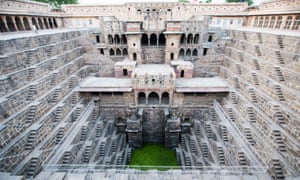
 Chand Baoli (stepwell), Abaneri, Rajasthan, India
 The Chand baoli near Jaipur extends almost 100ft into the ground, making it one of the deepest and largest stepwells in India. Photograph: dbimages/Alamy

Sponsored by:

About this content

Nivedita Khandekar in Delhi, Geoffrey Kamadi in Nairobi, and  in Puno

Wednesday 19 August 2015 08.24 EDTLast modified on Sunday 23 August 201502.20 EDT

India

Across large swaths of the Thar desert in western India, traditional techniques for harvesting the little amount of rain that falls has helped people survive the powerful effects of the sun for centuries.

The most beautiful of these are step wells – known as baolis in Hindi – large, stone structures built to provide water for drinking and agriculture. Baolis have existed for at least 1,000 years and were constructed in towns and alongside serais (travellers' inns), across the desert and into Delhi.

Baolis exist in all shapes and sizes and are essentially reservoirs built into the earth. Groundwater is pulled up from a circular well at the bottom and rainwater is collected from above. A set of steps – on one or more sides of the structure – lead down to the water level, which fluctuates depending on the amount of rain. More recently, electric pumps have been installed in many baolis to help retrieve the water.

"Step wells are etched into people's collective memory so deeply, they are now part of their DNA, passed on from one generation to another," says Farhad Contractor of the Sambhaav Trust, an ecological conservation group.

Today, many baolis have fallen prey to rapid urbanisation and neglect. In Delhi only around 15 survive but local groups are fighting to protect and preserve them. While 700mm of rain falls on Delhi every year, half of the city has been declared a dark zone – where the groundwater level has depleted so much that the rate of recharge is less than the rate of withdrawal – by the groundwater authority. Rainwater harvesting, therefore, is key to a secure water supply for India's second-biggest city.

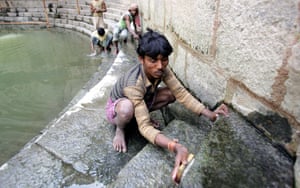
Workers carry out conservation work at Hazrat Nizamuddin Auliyas baoli in New Delhi.
 Workers carry out conservation work at Hazrat Nizamuddin Auliyasbaoli in New Delhi. Photograph: Anindito Mukherjee/EPA

One such baoli restored by the Aga Khan Trust for Culture(AKTC) was built in the 14th century in Hazrat Nizamuddin Basti, a medieval village in Delhi named after Sufi saint, Hazrat Nizamuddin Auliya. In 2008, parts of the baoli walls collapsed due to sewage water seeping into the structure and the local residents using it as a rubbish dump. The pool was drained and the rubbish, garbage and sludge that had accumulated over the past 700 years was removed to reach the foundation of the baoli some 80 feet below ground level. While the water in the baoli is still not potable, it can be used for cleaning and agriculture.

Experts say the baoli model can be replicated anywhere in the world with similar climatic conditions and physiological features. Contractor has been invited to Morocco where he is working on a project to build baolis and smaller wells, known as beris in Hindi.

Join the Guardian Global Development Professionals Network

Join up to access commentary and insight from development experts across the world.

Click here

But large baolis need large catchment areas, and in Delhi space is an issue. While the majority of the physical structures of baolis are protected – some by being sited inside historic monuments – urban development in Delhi has had a greater impact on their water levels; storm drains divert rain away from baoli catchment areas.

Diwan Singh, an activist with non-profit Natural Heritage First, says that even though many baolisin Delhi are surrounded by buildings, the wells can still be recharged. "Catchment area management is the key. In the small areas of land between the baolis and buildings, rainwater harvesting pits could be built to divert rainwater away from the storm drains," he says. "Once in the pit, water will percolate through the soil and recharge the nearby baoli, allowing modern development and ancient structures to co-exist side by side."

Nivedita Khandekar

Kenya

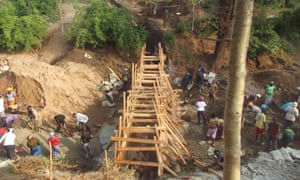
construction sand dam kenya
 The construction of a sand dam involves building a concrete barrier or wall across a seasonal river. Photograph: Geoffrey Kamadi

Makueni County – just over 100 miles south of Nairobi – has one of the most inhospitable environments in the country.

The region's sandy loam soil supports little else besides the thorny, stunted shrubs that stretch for miles, interspersed only by gigantic baobab trees or some species of the hardy acacia. The only food crops cultivated here are sorghum, cassava and pigeon peas – drought-tolerant crops. With an average annual rainfall of just 600mm, meaningful agriculture is nearly impossible.

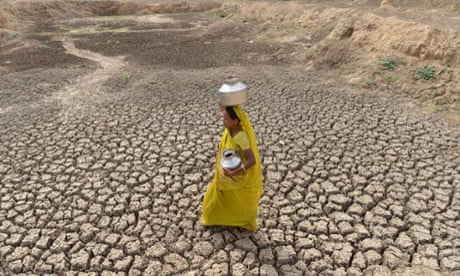
Water access is a big problem. In Kenya, 63% of the population use an improved source of drinking water and 46% live below the poverty line. Women and girls in sub-Saharan Africa spend up to four hours a day fetching water, according to the One campaign.

But things are changing for the better, thanks to an ancient water harvesting technique being used in the dry regions. Sand dams, which were invented by the Romans in 400BC, have become an important source of water for domestic and agricultural needs.

Sand dams are constructed by building a concrete barrier or wall across a seasonal river with a firm bedrock. As the river flows, sand in the water is deposited behind the wall. Over time, layers of sand build into a reservoir for water, which remains stored in the sand once the river level drops. Evaporation is virtually impossible below a metre of sand – no matter how intense the sun – and the water is clean and safe for immediate drinking as the sand acts like a filter.

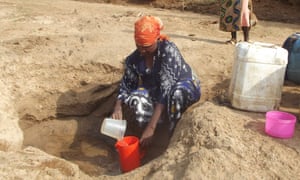
woman sand dam kenya
 A woman collects water stored beneath the sand. Photograph: Geoffrey Kamadi

The Africa Sand Dam Foundation (ASDF) has been facilitating the construction of the dams alongside Excellent Development (ED), a UK-based NGO that has enabled the construction of 838 sand dams in rural dry lands across eight countries. The work of ED has improved access to clean water for more than 800,000 people, according to Jonny McKay, the NGO's communications manager.

Not only have the sand dams improved water security for local communities. Villagers are also coming together to form self-help groups to construct the dams with assistance from the NGOs, and to initiate agro-based economic schemes.

Advertisement

"We are able to practise agribusiness now that we have water available for irrigation," says Elizabeth Ndungune, the chairwoman of the Star Thange self-help women's group in Ulilinzi. Using water from the sand dam built on the nearby River Thange, the group can now grow kale, tomatoes, beans and other crops. They sell whatever they harvest and pool the proceeds, which help families pay for school fees.

While sand dams are a cheap and simple solution to some complex problems, they can fail if they are not applied in a way that meets the users' needs. "The biggest challenge is ensuring that the technology is applied to specific local conditions and people's needs, rather than simply being replicated from one place and situation to another," says McKay.

But the initiative is gaining momentum and expanding not only to other parts of the country, but to Tanzania, Chad, Zimbabwe, Mozambique and even to India.

Geoffrey Kamadi

Peru

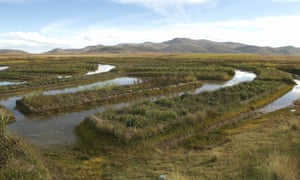
suqakollo peru
 Resembling an ornate garden maze from above, suqakollos are a patterned system of raised cropland and water-filled trenches. Photograph: Ronald Reategui

On the hardscrabble, treeless highland plain that joins Peru with Bolivia, farmers have eked out an existence for thousands of years amid bitter winters and the harsh sun, at 4,000 metres above sea level and higher.

As scientists predict climate change will make the Altiplano's weather even more inclement and unpredictable, today's farmers are reviving an ancestral system of cultivation and irrigation using what looks like an intricate piece of land sculpture.

Resembling an ornate garden maze from above, suqakollos – or waru-warus – are a patterned system of raised cropland and water-filled trenches.

 
Read more

Alipio Canahua, an agronomist working with the Food and Agriculture Organisation (FAO), says that the ancient agricultural system, which could date back 3,000 years, actually creates its own microclimate.

"It captures water when there are droughts and drains away water when there's too much rain, meaning that it irrigates the crops all year round," he says. "When it comes to temperature, we've measured a rise of three degrees centigrade in the immediate environment around it – this can save a significant percentage of the crops from being killed in frosts."

A suqakollo can also be a small oasis in the scorching daytime sun, which yellows even the coarse highland grass, known as ichu – the main fodder for the alpacas and llamas herded by the local Aymara people.

Canahua has been leading the resurgence of this ancient farming system with local communities, restoring old suqakollos and building new ones.

Sonia Ticona, a local indigenous Aymara leader who has been working with Canahua, says that in her village, the women work harder than the men to dig the trenches which are filled with water.

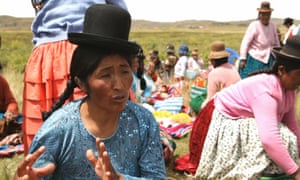
Sonia Ticona, local indigenous Aymara leader
 Sonia Ticona, a local indigenous Aymara leader, explains that her community are reviving techniques used by their great-great-grandfathers. Photograph: Ronald Reategui

"Our great-great-grandfathers used the suqakollo system then at some point, and we don't know why, they stopped. Now we are restarting it and bringing it up to date – men and women working together."

Potatoes have been sown this season – next year it will be quinoa – in a carefully planned crop rotation, explains Canahua. While the yields are smaller than cultivating in larger fields, beating the plummeting winter temperatures, which can reach -20C, can prevent devastating crop losses.

The suqakollos project is one of several globally important agricultural heritage systems (GIAHS) funded by the Global Environment Facility (GEF), which is working with the regional governments of Cusco and Puno. Along with Peru's agricultural ministry, the FAO is promoting family farming with the GIAHS methodology.

Canahua's only frustration is that it's not possible to make the suqakollos as big as Puno's pre-hispanic people did. Archaeologists say that people have lived on the Altiplano – on the shores of the highest navigable lake, Lake Titicaca – for some 8,000 years, and traces of the ancient canals still mark the high plain. Roads and boundaries between communal lands, however, have limited the space available.

John Preissing, the FAO's representative in Peru, says the pilot project has produced more than double the normal crop yields.

"We can't isolate just the fact that we're using suqakollos but we can say that between the water management, the soil management and the fertiliser management, we are reaching double the harvest numbers." 

Figures for 2013-14 indicate that suqakollo's crop yields for quinoa are 3.2 tonnes per hectare, more than double the average of 1.3 tonnes per hectare for the same crop grown on the plain.

Ancestral crops like quinoa, and its kiwicha and kaniwa varieties, could make this labour-intensive, complex farming system worthwhile; international demand for the superfoods has multiplied the price, bringing in extra income for these smallholder farmers.

Dan Collyns

  • This article was amended on 19 August to correct a sentence stating that women and girls in Kenya spend between six and 12 hours a day collecting water. It should have said that women and girls in sub-Saharan Africa spend up to four hours a day collecting water.

Join our community of development professionals and humanitarians. Follow@GuardianGDP on Twitter, and have your say on issues around water in development using #H2Oideas.

Saturday, September 05, 2015

ANS -- A CARTOON STORY EXPLAINING SYRIA

I am just going to link to this because of the wonderful watercolor illustrations, but it's a story explaining how climate change is behind what's happening in Syria.
--Kim


Tuesday, September 01, 2015

ANS -- Hawaii marks two milestones on road to clean marine power

This URL was sent to me by one of our readers.  It's good news in the energy department.  Short article.
--Kim


Hawaii marks two milestones on road to clean marine power

Makai's OTEC plant was inauguarated in a ceremony at Natural Energy Laboratory of Hawaii Authority (NELHA)Makai's OTEC plant was inauguarated in a ceremony at Natural Energy Laboratory of Hawaii Authority (NELHA)

AUGUST 31, 2015 — Hawaii this month marked two significant milestones on the path to clean power.

Makai Ocean Engineering celebrated the completion of the world's largest operational Ocean Thermal Energy Conversion (OTEC) power plant, while Foss Maritime subsidiary Young Brothers hosted a ceremony at the Port of Honolulu to inaugurate a Sandia National Laboratories led project to test a hydrogen-fuel-cell-powered generator as an alternative to conventional diesel generators.

Back in June, Hawaii Governor David Ige signed into law legislation directing the state's utilities to generate 100 percent of their electricity sales from renewable energy resources by 2045.

"As the most oil dependent state in the nation, Hawaii spends roughly $5 billion a year on foreign oil to meet its energy needs," said Governor Ige. "Making the transition to renewable, indigenous resources for power generation will allow us to keep more of that money at home, thereby improving our economy, environment and energy security."

OTEC cycle 1516x1190 THERMAL ENERGY

Governor Ige was among those attending an August 21 dedication ceremony for Makai's OTEC power plant at the Natural Energy Laboratory of Hawaii Authority (NELHA).

The OTEC power plant uses the temperature difference between the ocean's cold deep water and warm surface water to generate clean, renewable electricity that is available 24 hours a day, 365 days a year. The NELHA-sited plant will generate 100 kilowatts of sustainable, continuous electricity—enough to power 120 Hawaii homes annually. It is the first true closed-cycle OTEC plant to be connected to a U.S. electrical grid.

"Today marks the launch of the world's largest operational ocean thermal power plant," said Governor David Ige. "This plant provides a much-needed test bed to commercialize ocean thermal energy conversion technology and bolster innovation, and it serves as a stepping stone to larger plants that will provide meaningful amounts of stable, clean power to Hawaii and other locations in Asia Pacific such as Okinawa in the near future."

The research and development at the plant was funded by the Office of Naval Research (ONR) through the Hawaii Natural Energy Institute (HNEI), and the infrastructure was funded by Naval Facilities Engineering Command (NAVFAC).

Accrued electricity revenues from this power plant will sustain further research and development of OTEC technology.

A potential next phase for OTEC development at NELHA is being considered by an international consortium under a recently signed clean energy agreement between Hawaii and Osaka, Japan.

MarFC HongHYDROGEN FUEL CELL

Inaugurated at a ceremony this past Friday, the Port of Honolulu fuel cell unit is built into a standard 20 ft shipping container. It is already providing power to refrigerated containers on shore. Soon it will begin powering the same refrigerated containers on Young Brothers' barges operatin in the Hawaii inter island trade.

Young Brothers President Glenn Hong

"Young Brothers will be testing and demonstrating this technology on our on-shore and ocean environments over the next six months," said Young Brothers President Glenn Hong. "We are very pleased to have been selected to participate in this project with our many national and international partners in expanding this clean technology into new applications."

During the six-month deployment period, performance feedback and data will be recorded to determine the environmental, energy, and cost savings from the hydrogen fuel cell unit. Upon completion of testing, Sandia National Laboratories will analyze the operational, safety, and cost performance data to develop a business case for using hydrogen fuel cells for marine use.

The U.S. Department of Energy's (DOE) Fuel Cell Technologies Office and the U.S. Department of Transportation's Maritime Administration are funding the six-month deployment of the hydrogen-fuel-cell-powered generator.

"At the point of use, hydrogen fuel cells produce nothing but water — zero pollutant emissions and no greenhouse gases," said Joe Pratt, Sandia's project lead. "This technology could enable major commercial ports and marine vessels to lessen their environmental impacts."

An analysis by Sandia and DOE showed that due to fluctuating loads in maritime auxiliary power applications, a hydrogen fuel cell, which only supplies power when it is needed, is more energy efficient than a diesel engine.

Hydrogenics Corp designed and built the hydrogen fuel cell generator unit, comprised of four 30-kilowatt fuel cells, a hydrogen storage system and power-conversion equipment, all packaged in a 20-foot shipping container. With 75 kg of on-board hydrogen storage, the generator has enough energy to power 10 refrigerated containers for 20 continuous hours of operation.

Hickam Air Force Base in Honolulu is supplying the hydrogen to power the fuel cell. The hydrogen is produced by electrolysis, the process of splitting water into hydrogen and oxygen, using electricity supplied by Hickam's solar-powered electrical grid.

Following the six-month test of the fuel cell unit, the project team will analyze the project's successes and challenges, including the operating and cost parameters needed to make a business case at other ports.

ANS -- Are Coddled College Students the New Book Censors?

Here is an article that starts out to be about students objecting to a book on religious grounds, and turns into a piece about the impact of books.  At least read the last few paragraphs.  
--Kim


EDUCATION

Are Coddled College Students the New Book Censors?

Aggrieved students find books dangerous; neoliberal administrators say they're useless. I'd take the former any day.
August 30, 2015

No one knows the power of literature better than the censor. That's why he burns books: to fight fire with fire, to stop them from setting the world aflame. Or becomes an editor: Stalin, we now know, excised words from texts with about as much energy and attention as he excised men and women from the world. As Bertolt Brecht archly noted of the East German regime's efforts to control what he wrote: "Where else in the world can you find a government that shows such interest and pays such attention to artists?"

This week, as I head back to the classroom amid controversy — from Columbia to Berkeley to Duke — over what college students will or will not read, I'm mindful of Brecht's observation. Could it be that the men and women who most appreciate what we, professors of the humanities and social sciences, have to offer are the students who've been vilified as coddled and cosseted, demanding trigger warnings on syllabi or simply refusing to read the books we've assigned them because those books make them uncomfortable? Could it be that they, like the censor, are the ones who truly understand the power of the books we teach?

The latest bomb in the campus wars was set off by Duke University freshman David Grasso's announcement on Facebook that he would not read Alison Bechdel's "Fun Home," which the university had recommended incoming students read over the summer. Bechdel's graphic memoir narrates her relationship with her closeted gay father; she, too, is gay. The book visually depicts a scene in which the narrator masturbates and another in which she gives oral sex to another woman. Grasso thinks the book is pornographic; reading it, he says, would violate his Christian beliefs. 

Though much of Grasso's argument hangs on the specifics of his religious beliefs and the distinction he draws between words and images, his objection fits with a larger pattern of complaint we've heard in the last couple of years. Indeed, as this Vox explainer explains, that may be the only reason Grasso's announcement has gotten so much traction. While he speaks for barely a handful of students, the structure of his complaint has become all too common on today's campus. That complaint goes like this: This book — class, professor, speaker — threatens my identity and beliefs. It's unsettling, discomfiting, triggering. It makes me feel small and unsafe, as if my world, my very self, is under attack. It wants to annihilate me. Keep it away.

Critics of these students — on the left and the right — think they're privileged and precious. Yet how different is their account of what a book might do to them from the view of this privileged, coddled and precious twenty-something from a century ago?

Altogether, I think we ought to read only books that bite and sting us. If the book we are reading doesn't shake us awake like a blow on the skull, why bother reading it in the first place? So that it can make us happy, as you put it? Good God, we'd be just as happy if we had no books at all; books that make us happy we could, at a pinch, also write ourselves. What we need are books that hit us like a most painful misfortune, like the death of someone we loved more than we love ourselves, that make us feel as though we had been banished to the woods, far from any human presence, like a suicide. A book must be the axe for the frozen sea within us. That is what I believe.

The difference, of course, is that Kafka didn't hide from such books; he sought them out. Underlying that difference, however, is a shared recognition that books can shred your nervous system.

That's why I'm less bothered than some of my colleagues are by today's students. I see in their fear a premonition of what a book — and an education — can do. We live in an age, we're often told, where reading has become rote or has simply disappeared. Half our students don't do the reading; the other half submit dutiful book reports, barely registering the effect of what they've read.

Yet here are students who seem to understand, however faintly and problematically, what the literary critic Alfred Kazin called "the raw hurting power that a book could have over me." They seem like throwbacks, these students: not to the Midwestern evangelism of Elmer Gantry but to the urban hothouse of the New York Intellectuals, those anxious and oversexed minds of mid-century for whom a Henry James novel or Walt Whitman poem was a holy fire. "Writing Was Everything": that's how Kazin titled one of his memoirs. In their refusal to read a book, in their insistence that professors warn them of the trauma it may contain, that is what students are running away from: writing that consumes them, writing that's everything.

Instead of sneering at their fear or concern, why not see it as revelation of literary truth, as Brecht does in his poem "The Burning of Books"?

When the Regime commanded that books with harmful knowledge

Should be publicly burned and on all sides

Oxen were forced to drag cartloads of books

To the bonfires, a banished 

Writer, one of the best, scanning the list of the

Burned, was shocked to find that his 

Books had been passed over. He rushed to his desk

On wings of wrath, and wrote a letter to those in power

Burn me! He wrote with flying pen, burn me! Haven't my books

Always reported the truth? And here you are

Treating me like a liar! I command you:

Burn me!

I don't want to get romantic about these refuseniks. As Justice Brandeis once said, "Men feared witches and burned women." People who fear literature can do it great damage. I teach on a campus that was embroiled in controversy five years ago, when students — and, more important, alumni — objected to the assignment of my friend Moustafa Bayoumi's book "How Does It Feel to Be a Problem?" as the required "common reader" for incoming students. They claimed it — or Moustafa, it was never clear — was pro-Palestinian, anti-Israel and anti-American. Since then, Brooklyn College has been the site of repeated attempts to shut down the conversation about Israel and Palestine, all for the sake of protecting student identities and beliefs. 

There's something to be said for indifference on a campus, particularly when the only alternative is a holy war that breaks out every time someone utters a heterodox word. Education, even the kind that destabilizes identities and jars belief, requires some sense of ongoing calm and commonality, some sort of agreement that we'll do the reading, come prepared to talk about it in class and then, whatever happens, move on. If every text — or speaker — ignites a controversy consuming the campus in flames, there'd be nothing left but ashes. 

Even so, there's a greater threat to reading and readers, to education itself, than trigger warnings or students objecting to a text. And that is the downsizing administrator, the economizing politician, who refuses to believe there's any value in reading a difficult text at all. While the media debates Mr. Grasso's refusal, I, as chair of my department, anxiously scrutinize our daily enrollment reports, knowing I have to defend courses with 12 students from administrative economizers — simply because the intimacy, attention and focus of a senior seminar doesn't register as a value to men who can only see value when it is expressed as a number on a spreadsheet. Given the choice of defending a book to an aggrieved student or a course to a phlegmatic accountant, I'll take the student any day: at least she and I agree that the book in question has power, and the experience of reading it, reality.

In this age of the neoliberal university, these students may be our best allies, for they seem to be among the few who understand that what we do matters. The administrator and the politician, the trustee and the pundit, think that we professors are worse than subversive; we're useless. These students, by contrast, think we're dangerous. Rather than dismissing them, maybe we should say: Thank you, we thought no one was listening, we thought no one cared. And then turn around and figure out how to use this as, ahem, a teachable moment — about the radioactivity of books and the fact that radiation has its uses.


Corey Robin teaches political science at Brooklyn College and the CUNY Graduate Center. He is the author of The Reactionary Mind: Conservatism from Edmund Burke to Sarah Palin and Fear: The History of a Political Idea.