Monday, June 16, 2014

ANS -- 11 Ways Our Society Treats Us Like Caged Rats: Do Our Addictions Stem from that Trapped Feeling?

This bears repeating, because not enough people have heard it or taken it in.  Addictions are from being trapped or hopeless.  His conclusion, though, goes farther than that.
Find it here:  http://www.alternet.org/drugs/11-ways-our-society-treats-us-caged-rats-do-our-addictions-stem-trapped-feeling?paging=off&current_page=1#bookmark   
--Kim


  Drugs  
The Fix / By Charles Eisenstein
comments_image   92 COMMENTS

11 Ways Our Society Treats Us Like Caged Rats: Do Our Addictions Stem from that Trapped Feeling?

Instead of a moral failing or physiological malfunction, is addiction an adaptive response to circumstances?
92 COMMENTS 92 COMMENTS


[]

Photo Credit: Amanda Tromley / Shutterstock.com
June 12, 2014 |  


The following article first appeared in The Fix. Also on TheFix.com: Why I'm More Sober Than You!; The Spirituality of Recovery; Are Athletes More Susceptible to Eating Disorders?

You've probably heard about those addiction studies with caged lab rats, in which the rats compulsively press the heroin dispensing lever again and again, even to the point of choosing it over food and starving themselves to death. These studies seemed to imply some pretty disheartening things about human nature. Our basic biology is not to be trusted; the seeking of pleasure leads to disaster; one must therefore overcome biological desires through reason, education, and the inculcation of morals; those whose willpower or morals are weak must be controlled and corrected.

The rat addiction studies also seem to validate the main features of the War on Drugs. First is interdiction: prevent the rats from getting a taste of drugs to begin with. Second is "education" – conditioning the rats into not pressing the lever in the first place. Third is punishment: make the consequences of taking drugs so scary and unpleasant that the rats will overcome their desire to press the lever. You see, some rats just have a stronger moral fiber than others. For those with a strong moral fiber, education suffices. The weak ones need to be deterred with punishments.

Alexander found that when you take rats out of tiny separate cages and put them in a spacious "rat park" with ample exercise, food, and social interaction, they no longer choose drugs; indeed, already-addicted rats will wean themselves off drugs after they are transferred from cages to the rat park.All of these features of the drug war are forms of control, and therefore sit comfortably within the broader narrative of technological civilization: the domination of nature, the rising above the primitive state, conquering animal desire with the mind and the base impulses with morality, and so forth. That is, perhaps, why Bruce Alexander's devastating challenge to the caged rat experiments was ignored and suppressed for so many years. It wasn't only the drug war that his studies called into question, but also deeper paradigms about human nature and our relationship to the world.

The implication is that drug addiction is not a moral failing or physiological malfunction, but an adaptive response to circumstances. It would be the height of cruelty to put rats in cages and then, when they start using drugs, to punish them for it. That would be like suppressing the symptoms of a disease while maintaining the necessary conditions for the disease itself. Alexander's studies, if not a contributing factor in the drug war's slow unraveling, are certainly aligned with it in metaphor.

Are we like rats in cages? Are we putting human beings into intolerable conditions and then punishing them for their efforts to alleviate the anguish? If so, then the War on Drugs is based on false premises and can never succeed. And if we are like caged rats, then what is the nature of these cages, and what would a society look like that was a "rat park" for human beings?

Here are some ways to put a human being in a cage:

­Remove as much as possible all opportunities for meaningful self-expression and service. Instead, coerce people into dead-end labor just to pay the bills and service the debts. Seduce others into living off such labor of others.

­Cut people off from nature and from place. At most let nature be a spectacle or venue for recreation, but remove any real intimacy with the land. Source food and medicine from thousands of miles away.

­Move life – especially children's lives – indoors. Let as many sounds as possible be manufactured sounds, and as many sights be virtual sights.

­Destroy community bonds by casting people into a society of strangers, in which you don't rely on and needn't even know by name the people living around you.

­Create constant survival anxiety by making survival depend on money, and then making money artificially scarce. Administer a money system in which there is always more debt than there is money.

­Divide the world up into property, and confine people to spaces that they own or pay to occupy.

­Replace the infinite variety of the natural and artisanal world, where every object is unique, with the sameness of commodity goods.

­Reduce the intimate realm of social interaction to the nuclear family and put that family in a box. Destroy the tribe, the village, the clan, and the extended family as a functioning social unit.

­Make children stay indoors in age-segregated classrooms in a competitive environment where they are conditioned to perform tasks that they don't really care about or want to do, for the sake of external rewards.

­Destroy the local stories and relationships that build identity, and replace them with celebrity news, sports team identification, brand identification, and world views imposed by authority.

­Delegitimize or illegalize folk knowledge of how to heal and care for one another, and replace it with the paradigm of the "patient" dependent on medical authorities for health.

It is no wonder that people in our society compulsively press the lever, be it the drug lever or the consumerism lever or the pornography lever or the gambling lever or the overeating lever. We respond with a million palliatives to circumstances in which real human needs for intimacy, connection, community, beauty, fulfillment, and meaning go mostly unmet. Granted, these cages depend in large part on our own individual acquiescence, but this doesn't mean that a single moment of illumination or a lifetime of effort can liberate us fully. The habits of confinement are deeply programmed. Nor can we escape by destroying our jailers: unlike in the rat experiments, and contrary to conspiracy theories, our elites are just as much prisoner as the rest of us. Empty and addictive compensations for their unmet needs seduce them into doing their part to maintain the status quo.

The cages suffer no easy escape. Confinement is not incidental to modern society, but woven deeply into its systems, its ideologies, and our own selves. At bottom are the deep narratives of separation, domination, and control. And now, as we approach a great turning, a shift in consciousness, we sense that these narratives are unraveling, even as their outward expressions – the surveillance state, the walls and the fences, the ecological devastation – reach unprecedented extremes. Yet their ideological core is beginning to hollow out; their foundation is cracking. I think that the lifting (still by no means assured) of the War on Drugs is an early signal that these superstructures are beginning to crack too.

A cynic might say that the end of the drug war would signal no such thing: that drugs make life in a cage more tolerable and absorb energy that might otherwise go toward social change. The opiate of the masses, in other words, is opiates! The cynic dismisses cannabis legalization in particular as a small, barely significant counter-eddy in an onrushing tide of imperialism and ecocide, an innocuous victory that does nothing to slow the onward march of capitalism.

This view is mistaken. Generally speaking, drugs do not make us into more effective cage-dwellers: better workers and consumers. The most notable exception is caffeine – significantly, virtually unregulated – which helps people wake up to a schedule they don't want to live and focus on tasks they don't care about. (I'm not saying that's all caffeine does, and in no way do I want to demean sacred plants like tea and coffee, which are among the only herbal infusions or decoctions still taken in modern society.) Another partial exception is alcohol, which as a stress reliever indeed makes life in our society more bearable. Certain other drugs – stimulants and opiates – also may serve these functions, but are ultimately so debilitating that the guardians of capitalism recognize them as a threat.

Yet other drugs, such as cannabis and the psychedelics, can directly induce nonconformity, weaken consumer values, and make the prescribed normal life seem less tolerable, not more. Consider for example the kind of behavior associated with marijuana smoking. The stoner is not on time for work. He sits around in the grass playing his guitar. He is not competitive. This is not to say that pot smokers don't contribute to society; some of the wealthiest Information Age entrepreneurs are reputedly smokers. In general though, the reputation of cannabis and the psychedelics to be disruptive of the established order is not without foundation.

The halting but substantial steps in several states and countries toward cannabis legalization is significant for several reasons beyond the well-known benefits regarding crime, imprisonment, medicine, and industrial hemp. First, it implies a release of the mentality of control: interdiction, punishment, and psychological conditioning. Second, as I just discussed, the object of control – cannabis – is corrosive to the cages we have lived in. Third, it is part of a deep shift in consciousness away from separation and toward compassion.

The mentality of control is predicated on the question of whom or what is to be controlled. Drug War thinking blamed the individual drug user for making poor moral choices, a view grounded in the theory that social psychologists call dispositionism – that human beings make free-willed choices based on a stable character and preferences. While dispositionism acknowledges the influence of environment, it says essentially that people make good choices because they are good people, bad choices because they are bad people. Deterrence, education, and interdiction spring naturally from that philosophy, as does our criminal justice system at large. Judgment and paternalism, inherent in the whole concept of "corrections," are built into it, because it says, "If I were in your situation, I would have done differently than you." In other words, it is an assertion of separation: I am different from (and if you are a drug addict, better than) you.

Note as well that the same belief motivates the War on Terror and, well, the war on pretty much anything. But there is a competing philosophy called situationism that says that people make choices from the totality of their situation, internal and external. In other words, if I were in your situation, including your entire life history, I would do as you do. It is a statement of nonseparation, of compassion. It understands, as Bruce Alexander shows us, that self-destructive or antisocial behavior is a response to circumstances and not a dispositional weakness or moral failing. Situationism motivates healing rather than war, because it seeks to understand and redress the circumstances that give rise to terrorism, drug addiction, germs, weeds, greed, evil, or any other symptom we go to war against. Instead of punishing drug use, it asks, From what circumstances does it spring? Instead of eradicating weeds with pesticides, it asks, What conditions of soil or agronomy are causing them to grow? Instead of applying extreme antiseptic hygiene and broad-spectrum antibiotics, it asks, What "climate of the body" has made it a salubrious environment for germs? That is not to say we never should use antibiotics or lock up a violent criminal who is harming others. But we cannot then say, "Problem solved! Evil has been conquered."

Here we see how drug legalization is consistent with the reversal of a millennia-long paradigm I call the War on Evil. As old as civilization itself, it was originally associated with the conquest of chaos and the taming of the wild. Through history, it came to incinerate whole populations and nearly the planet itself. Now, perhaps, we are entering a gentler era. It is fitting that something from nature, a plant, should be a hinge for such a turning.

The growing movement to end the drug war might reflect a paradigm shift away from judgment, blame, war, and control towards compassion and healing. Cannabis is a natural starting point, because its widespread use makes the caricature of the morally weak abuser insupportable. "If I were in the totality of your circumstances, I would smoke too – in fact I have!" 

Marijuana has long been vilified as a "gateway drug," the argument being that even if it isn't so dangerous itself, it ushers a person into the culture and habits of drug use. That canard is easily debunked, but perhaps marijuana is a gateway of another sort – a gateway to broader drug decriminalization, and beyond that, toward a compassionate and humble justice system not based on punishment. More broadly still, it may offer us a gateway away from machine values toward organic values, a symbiotic world, an ecological world, and not an arena of separate and competing others against whom one must protect oneself, conquer, and control. Perhaps the conservatives were right. Perhaps drug legalization would mean the end of society as we have known it.

For a weekly roundup of news and developments in the drug reform movement and the injustices stemming from prohibition,  sign up to receive  AlterNet's Drugs Newsletter. Make sure to scroll down to "Drugs" and subscribe.

Charles Eisenstein is an essayist and author of the books Sacred Economics and The Ascent of Humanity.

Sunday, June 15, 2014

ANS -- The Difference Between Republican and Democratic Brains

Here's a short little article that no one in the comments agrees with.  It's about how people think, and why liberals have trouble getting stuff done and why conservatives are surprised when they don't win. 
Find it here:   http://www.nationaljournal.com/politics/the-difference-between-republican-and-democratic-brains-20131121   
--Kim


Politics


The Difference Between Republican and Democratic Brains


The good, the bad, and the ugly from new research that suggests the way political parties perceive who's behind them and who's not can affect entire political movements.

[]  [picture here]

An actual human brain displayed inside a glass box.(MAURICIO LIMA/AFP/Getty Images)

By Marina Koren

November 21, 2013

What Democrats and Republicans don't have in common goes far beyond the ballot box. Their personalities, like their core beliefs and policy ideas, are fundamentally different.

Liberals are creative and curious, and tend to be more open to new experiences, while conservatives are more anxious, dislike change, and appreciate order in their lives. Scientists don't know if political interests shape temperament, or vice versa, but new research suggests lawmakers' personality traits play an important role in political causes­like forcing a government shutdown­and may even determine if those causes survive.

In a study published this week in the journal Psychological Science, researchers asked 300 people in an online survey whether they agreed or disagreed with both political ("In general, I support labor unions") and nonpolitical statements ("I enjoy coffee"). They also asked participants to indicate how much others who shared their political views would support their attitudes.
"" style="border: 0px none; vertical-align: bottom;" marginheight="0" marginwidth="0" scrolling="no" name="google_ads_iframe_/1594/nationaljournalonline/politics_content_2" id="google_ads_iframe_/1594/nationaljournalonline/politics_content_2" frameborder="0" height="250" width="300">

The results showed that liberals underestimated their levels of partisan support; that is, they thought their beliefs were different from their liberal peers, when they actually were not. Conservatives and moderates, on the other hand, thought their beliefs were more similar to those of other members of their political group than they actually were, overstating partisan agreement. These patterns of thinking held for topics unrelated to politics, like personal preference for coffee.
Share This Story

Real-world politics, however, is where it gets interesting. Democrats, thinking they lack support, struggle to find solidarity, the researchers conclude. Republicans, sticking together because of a perceived abundance of support, get mobilized­and effect change­more quickly.

This party distinction in judgment stems from yet another fundamental difference between liberals and conservatives: the need to feel unique. In the study, liberals reported a stronger desire for uniqueness than did conservatives and moderates­a strange finding for the party that champions social programs, as well as Republicans who stand for an Ayn Rand individualism.

That thinking, says study coauthor Chadly Stern, a psychological scientist at New York University, can undermine progress. Conformity, at face value, works better. Conservatives, by banding together under one leader, don't waste time agreeing with each other, Stern says. One prime example? The tea party, led by Sen. Ted Cruz, R-Texas.

Democrats, meanwhile, are slow to mobilize. Stern cites the fractured Occupy Wall Street movement as one example, the 2010 repeal of the "don't ask, don't tell" policy as another, which the researcher says " flew through" Congress despite Democrats' concern it wasn't going to make it. The current splintering of the Democratic Party in the face the flawed rollout of the Affordable Care Act is evidence of the liberal tendency to dislike stereotypes, Stern says. Democrats lack a leader that could, hypothetically, keep them on message like conservative figures do for their group.

But Republicans' collective thinking can, in some cases, backfire. Take last year's presidential election. "There was this tendency to think, among Republicans, that there was a lot of support for [Mitt] Romney, but then the night of the election, that illusory consensus was shattered," Stern says. Perhaps there is no better example of that than what happened immediately after Fox News called Ohio­and subsequently, the election­for President Obama. Republican political consultant Karl Rove, convinced Romney would win, refused to accept the results, repeating voting numbers he'd crunched that indicated the election was too early to call. Eventually, a baffled Megyn Kelly asked a rambling Rove, "Is this just math that you do as a Republican to make yourself feel better, or is this real?"

By overestimating support, Republicans may get things done, but they can trap themselves in an ideological bubble, further inflating the popularity of conservative views. That environment, as evidenced by the Rove incident, can come crashing down when their perception of support is wrong.

As for moderates, Stern says they tend to conform unless they feel strongly motivated to deviate from the middle on a given issue. They believe there are lots more moderates like themselves out there, tending to overestimate the commonality of their beliefs.

When it comes to legislating, consensus is crucial for social change. Reaching it, however, doesn't always mean things will go as planned.

Saturday, June 14, 2014

ANS -- Billionaire Gets 4 MONTHS For Sexually Assaulting 12-Year-Old Because He’s ‘Productive’

Here is a report on the state of "justice" in the present day U.S. of A.   Sad, sad.  This was recommended by Brad Hicks, I am otherwise unfamiliar with the source.
Find it here:   http://www.addictinginfo.org/2014/06/07/billionaire-gets-off/    
--Kim


Billionaire Gets 4 MONTHS For Sexually Assaulting 12-Year-Old Because He's 'Productive'

Author: Ryan Denson June 7, 2014 7:12 pm
[]   []

MJS Johnson_Curt.jpg

In the United States, it doesn't matter who you are; if you're rich, you receive special treatment in our "justice" system.

SC Johnson, the "family" company's billionaire heir, Samuel Curtis Johnson III, who confessed to repeatedly sexually assaulting his teenage stepdaughter has received an outrageous prison sentence of only four months because the judge, Circuit Justice Eugene Gasiorkiewicz, feels that Johnson's importance to the community is valued much higher than the dignity of his abused step-daughter.

You read that right. Affluenza, as it has been dubbed, has struck again. This billionaire has officially plead guilty to mere misdemeanor charges of fourth-degree sexual assault and disorderly conduct instead of receiving the maximum which is felony sexual assault on a minor child. These charges originally stem from 2011. Think Progress reported Johnson's stepdaughter "initially told police Johnson was 'a sex addict' and touched her inappropriately 15 to 20 times starting when she was 12 years old. She told her mother about the abuse in order to protect her younger sister, and Johnson confessed when the mother confronted him." Because Johnson's victim was unwilling to testify in the case, the prosecutors had to make a plea deal with Johnson and his legal team.

Johnson's attorney, Michael F. Hart argued to Judge Gasiorkiewicz that the maximum prison term for his client was not fair and that is should be reserved for "maximum defendants," people unlike his client (aka not billionaires with a prestigious name), who has no prior record and who leads a "productive life." Again, the billionaire status and famous name apply to that "productive life." He's an heir, so remember folks, he's inheriting this empire and inheriting this money. Very productive.

Add insult to injury, the judge made his decision based on other cases in which he has rarely gives first time offenders the maximum sentence. So instead the judge gave Johnson, a billionaire, a fine of $6,000. The judge ruled that he must serve at least 60 days of the sentence before he will be eligible for release.

Billionaire rapes an underage child, gets a sentence that a teenager gets for shoplifting. That's what some people like to call the "invisible hand" in economics.

Affluenza is spreading, and it is spreading fast. Just last year, a Washington state judge failed to sentence Shaun Goodman, arrested for his 7th DUI (who, while going over 100 mph, crash into both a parked car and house), to any jail time. The reason? He was a local businessman, a rich businessman, and giving him jail time even after his 7th DUI "wouldn't be fair for him," as per the words of Judge James Dixon. Dixon brazenly violated the sentencing guidelines for DUI offenders, but that doesn't matter when the person facing the crime is of an upper class and owns a business.

Now who could forget the smug little punk Ethan Couch, the Texas teen who killed four people in a drunk driving accident who got only 10 years' probation? Because of his rich, elite status, his attorney argued that because he was raised in such affluent circumstances, he failed to grasp the concept of his negative actions and thus couldn't be held responsible for his actions. Never mind that he plowed his car into four people and savagely murdered them. Never mind that after he realized what had happened he ran and left the scene. All that doesn't matter. In the eyes of Texas District Judge Jean Boyd, this teen never faced jail time. Instead, he was given the luxury to attend a very expensive, very prestigious rehab center. Guess who is picking up the bulk of that rehab cost? Not his rich parents. Thanks to the taxpayers of the great state of Texas, Couch's rehab bill has been dropped from $438,000 annually to only $13,870. Congrats, Taxpayers, you picked up 68% of the cost for a rich teen who got out of manslaughter charges simply because he was rich. America!

And, how about one to really make your blood boil. A trust fund baby, Robert H. Richards IV, who owns, among other things, a $1.8 million dollar mansion near the Winterthur Museum, Garden and Library, had his sentence of 8 years in prison for raping his daughter repeatedly between the ages of 3 and 5 as well as molesting his son starting at the age of 19 months, reduced. The reason? Superior Court Judge Jan Jurden didn't think the rapist would not "fare well in a level 5 prison." Well that's the point. It will let them learn from their mistakes while they sit and think about what it is they have done.

Remember their names:
  • Circuit Justice Eugene Gasiorkiewicz
  • Judge James Dixon
  • Texas District Judge Jean Boyd
  • Superior Court Judge Jan Jurden

These are the judges, among a multitude, who have let justice slip through the cracks because the men facing them happened to rich and elite. Maybe they should have their bank accounts investigated. Personally, now I will never buy from SC Johnson again. I suggest some of you take the same route. Boycott SC Johnson, and boycott activist judges who let the rich get away with rape, murder, and sexual assault.

ANS -- The Three Biggest Right-Wing Lies About Poverty

Here's a short article by Robert Reich about right wing lies about the economy and jobs.  Simple to understand, so read it.  I've included the comments thus far, for no particular reason. 
Find it here:  http://readersupportednews.org/opinion2/277-75/24228-the-three-biggest-right-wing-lies-about-poverty  
--Kim


The Three Biggest Right-Wing Lies About Poverty

By Robert Reich, Robert Reich's Blog

14 June 14


[] ather than confront poverty by extending jobless benefits to the long-term unemployed, endorsing a higher minimum wage, or supporting jobs programs, conservative Republicans are taking a different tack.

They're peddling three big lies about poverty. To wit:

Lie #1: Economic growth reduces poverty.

"The best anti-poverty program," wrote Paul Ryan, the House Budget Committee chairman, in the Wall Street Journal, "is economic growth."

Wrong. Since the late 1970s, the economy has grown 147 percent per capita but almost nothing has trickled down. The typical American worker is earning just about what he or she earned three decades ago, adjusted for inflation.

Meanwhile, the share of Americans in poverty remains around 15 percent. That's even higher than it was in the early 1970s.

How can the economy have grown so much while most people's wages go nowhere and the poor remain poor? Because almost all the gains have gone to the top.

Research by Immanuel Saez and Thomas Piketty shows that forty years ago the richest 1 percent of Americans got 9 percent of total income. Today they get over 20 percent.

It's true that redistributing income to the needy is politically easier in a growing economy than in a stagnant one. One reason so many in today's middle class are reluctant to pay taxes to help the poor is their own incomes are dropping.

But the lesson we should have learned from the past three decades is economic growth by itself doesn't reduce poverty.

Lie #2: Jobs reduce poverty.

Senator Marco Rubio said poverty is best addressed not by raising the minimum wage or giving the poor more assistance but with "reforms that encourage and reward work."

This has been the standard Republican line ever since Ronald Reagan declared that the best social program is a job. A number of Democrats have adopted it as well. But it's wrong.

Surely it's better to be poor and working than to be poor and unemployed. Evidence suggests jobs are crucial not only to economic well-being but also to self-esteem. Long-term unemployment can even shorten life expectancy.

But simply having a job is no bulwark against poverty. In fact, across America the ranks of the working poor have been growing. Around one-fourth of all American workers are now in jobs paying below what a full-time, full-year worker needs in order to live above the federally defined poverty line for a family of four.

Why are more people working but still poor? First of all, more jobs pay lousy wages.

While low-paying industries such as retail and fast food accounted for 22 percent of the jobs lost in the Great Recession, they've generated 44 percent of the jobs added since then, according to a recent report from the National Employment Law Project.

Second, the real value of the minimum wage continues to drop. This has affected female workers more than men because more women are at the minimum wage.

Third, government assistance now typically requires recipients to be working. This hasn't meant fewer poor people. It's just meant more poor people have jobs.

Bill Clinton's welfare reform of 1996 pushed the poor into jobs, but they've been mostly low-wage jobs without ladders into the middle class. The Earned Income Tax Credit, a wage subsidy, has been expanded, but you have to be working in order to qualify.

Work requirements haven't reduced the number or percent of Americans in poverty. They've merely increased the number of working poor ­ a term that should be an oxymoron.

Lie #3: Ambition cures poverty.

Most Republicans, unlike Democrats and independents, believe people are poor mainly because of a lack of effort, according to a Pew Research Center/USA Today survey. It's a standard riff of the right: If the poor were more ambitious they wouldn't be poor.

Obviously, personal responsibility is important. But there's no evidence that people who are poor are less ambitious than anyone else. In fact, many work long hours at backbreaking jobs.

What they really lack is opportunity. It begins with lousy schools.

America is one of only three advanced countries that spends less on the education of poorer children than richer ones, according to a study by the Organization for Economic Cooperation and Development.

Among the 34 O.E.C.D. nations, only in the United States, Israel and Turkey do schools serving poor neighborhoods have fewer teachers and crowd students into larger classrooms than do schools serving more privileged students. In most countries, it's just the reverse: Poor neighborhoods get more teachers per student.

And unlike most OECD countries, America doesn't put better teachers in poorly performing schools,

So why do so many right-wing Republicans tell these three lies? Because they make it almost impossible to focus on what the poor really need – good-paying jobs, adequate safety nets, and excellent schools.

These things cost money. Lies are cheaper.


Chancellor's Professor of Public Policy at the University of California at Berkeley and Senior Fellow at the Blum Center for Developing Economies, was Secretary of Labor in the Clinton administration. Time Magazine named him one of the ten most effective cabinet secretaries of the twentieth century. He has written thirteen books, including the best sellers "Aftershock" and "The Work of Nations." His latest, "Beyond Outrage," is now out in paperback. He is also a founding editor of the American Prospect magazine and chairman of Common Cause. His new film, "Inequality for All," is available on Netflix, iTunes, DVD, and On Demand.
 

Comments

We are concerned about a recent drift towards vitriol in the RSN Reader comments section. There is a fine line between moderation and censorship. No one likes a harsh or confrontational forum atmosphere. At the same time everyone wants to be able to express themselves freely. We'll start by encouraging good judgment. If that doesn't work we'll have to ramp up the moderation.

General guidelines: Avoid personal attacks on other forum members; Avoid remarks that are ethnically derogatory; Do not advocate violence, or any illegal activity.

Remember that making the world better begins with responsible action.

- The RSN Team
 
[]
+37 # tswhiskers 2014-06-14 07:26
Only in America can a political party get away with telling bold-faced lies and even be re-elected for them. The first 2 lies are (or should be) blatantly obvious. It has been self-evident at least since the crash of 2008 that economic growth produces economic growth for the few at the top who MAY OR MAY NOT pass some of that largesse on to their employees. Lie no. 2 is a lie because of Lie no. 1. Unless we could increase the number of hours in the day so people could work 4/5 jobs a day instead of 2/3 employment by itself will not provide a liveable wage. (Hey! There's a new line for Reps.! The earth has recently been shown to rotate on its own axis every 26 hours.) Lie no. 3 says that ambition alone will solve our economic problems. A wealthy old fart actually said to my face that I surely went out of business because I didn't work hard enough. The fact was that he and others didn't SPEND enough for me to stay in business. The fact is that you need money or access to it to develop an idea or start a business and more money and help to keep it running. Then you need customers who will pay enough to keep you going. Since 2001 it's been very difficult for many businesses to get and keep all 3. Yes, the Reps. are pro-business FOR BIG BUSINESS and to **** with all other businesses.
Reply | Reply with quote | Quote | Report to administrator
 
 
[]
+27 # reiverpacific 2014-06-14 07:58
I'm pretty thick when it comes to economics. I read my daughter's school books on the subject and they seemed to me to be simplistic, broad-brushed and pretty shallow in socio-economic content.
I once asked Dr Richard Wolff (Capitalism Hits the Fan) at a talk he gave in Portland Oregon, if the language of economics is deliberately obscure and he answered "Absolutely", so go figure that into an equation for dictation of terms by a few!
The word "Growth" keeps popping up also but that to me translates, by current standards and lack of creative imagination, especially on the Right, into more extractive plunder of the earth's finite resources, the gradual obliteration of many species and even our own kind.
The term "Inflation" is easily explained but still hard for me to understand: maybe I'm just dim or blocked in some way.
I haven't spent my life pursuing money, rank or a "career" in the accepted sense but have done what I love and used my education and abilities to travel, see, live and experience other cultures and morés.
Ergo, from a simple minded perspective, the Right Wing's limited, blinkered morés are based on a kind of pyramid structure but with weak foundations, where the wider the structure gets, the less it is able to bear the concentrated weight at the top, so it will eventually all come crashing down (as an Architect with a strong structural engineering side, I at least understand THAT)!
Mr Reich also left out Universal Healthcare as an crucial element.
Reply | Reply with quote | Quote | Report to administrator
 
 
[]
+1 # Malcolm 2014-06-14 15:07
Well said, reiverpacific! You've got as good a grasp as anyone else, I'd say.

Yor comment on the pyramid structure is so true (I'm only an unlicensed architect and engineer, but I've a lot of experience in designing and constructing both residential and industrial structures)

Back in the hazy, lazy, hippy days, we had a saying about the fact that growth is a pyramid scheme: "GROW" is a four-letter word.

I think that's even clearer now than it was then. Back then, the limits to growth were a bit more abstract, at least in this country.
Reply | Reply with quote | Quote | Report to administrator
 
 
[]
-26 # Hammy 2014-06-14 08:09
I have ministered in low economic areas and in prisons for many years. It is obvious to anyone familiar to these contexts that the primary cause of poverty in the U.S. is the breakdown of the family and the resulting consequences of single-parentho od.
Reply | Reply with quote | Quote | Report to administrator
 
 
[]
+19 # reiverpacific 2014-06-14 08:45
Quoting Hammy:
I have ministered in low economic areas and in prisons for many years. It is obvious to anyone familiar to these contexts that the primary cause of poverty in the U.S. is the breakdown of the family and the resulting consequences of single-parenthood.


Would this perhaps be -just to link it to the subject matter- because the "Lousy (Minimum or less) wages" Reich mentions in which two parents -and sometimes the teens too- have to work to sustain a family at ongoing inflationary costs, all competing for fewer and fewer jobs as living wage (single-earner) jobs have been sent overseas to Sweatshop economies.
BTW, the Latino-a population where I live have a tendency to pool their resources and keep both a sense of family and community together, at times buying up failed businesses, supporting the tax base and even hiring local help.
But I also know single-parent families who are better, more dedicated parents just by virtue of the struggle, than many of those in classic "Family" structures that the Tea-Thuglicans keep beating the US population over the head with, whilst working to make this impracticable.
In fact I have a friend who is an executive director in an international sports Corporation, who has given his "Corporate" wife (a former student of mine) and daughter every material advantage, has three houses in prime neighborhood, coastal and resort locations -and they are falling apart.
I could go on but it's never just that easy.
Reply | Reply with quote | Quote | Report to administrator
 
 
[]
+10 # hd70642 2014-06-14 09:40
Excuse me but about the breakdown when jobs are shipped over seas ? My family was neither the worst or the greatest but the economy has continued to plummet since the lack luster administration of Gerald Ford who left the economy in worst condition than the current GM vehicles being produced !!
Reply | Reply with quote | Quote | Report to administrator
 
 
[]
+8 # Tigre1 2014-06-14 13:05
Which comes first, Hammy? like the chicken and the egg...and YOU have it backwards.

Another person of the cloth who blithely has no clue. I forgive you, sort of, because you "know not what you do".

But if I were in your line of work I'd either get out of it or work very hard on getting "right" with my God and His Son, especially the words Jesus is reported to have said in the New Testament...
Reply | Reply with quote | Quote | Report to administrator
 
 
[]
# Kimc 2014-06-14 18:42
Some of the breakdown of the family was deliberately engineered by big corporations in the 1950s. They wanted workers (executives especially) to be completely dedicated to the company, so they made them move away from their extended families so they would be isolated and dependent on the company.
Reply | Reply with quote | Quote | Report to administrator


[]
+17 # Carol R 2014-06-14 08:12
"And unlike most OECD countries, America doesn't put better teachers in poorly performing schools."

I agree with what Reich says except he is off on the idea that good teachers aren't working in poverty level schools. It is the culture of poverty that prevents kids from learning. Stop beating up on teachers. it is also true that many poverty level schools don't have decent updated materials. I subbed in poverty schools in Chicago and some school physical facilities were in really bad shape with floors having holes, outdated text books and desks that didn't even fit the size of the kids. Class sizes in these schools were way too big.

I seriously doubt that any rich schools in high income neighborhoods have anything that bad. Money does make a difference but what politician really cares about poor people?
Reply | Reply with quote | Quote | Report to administrator
 
 
[]
0 # chasashmore 2014-06-14 18:03
[quote name="Carol R"]"And unlike most OECD countries, America doesn't put better teachers in poorly performing schools."

[Quote from Carrol:] "I agree with what Reich says except he is off on the idea that good teachers aren't working in poverty level schools. It is the culture of poverty that prevents kids from learning. Stop beating up on teachers."[end quote from Carol]

Robert Reich isn't beating up on teachers, nor, I'm sure, would he sent that there are some excellent and dedicated teachers in pour schools. He's simply making a statement of fact. There's NO CONCERTED EFFORT to direct good teachers toward poor schools as there is in many countries. Poor schools suffer from lack of resources and from neglect, and both lack of resources and general neglect affect the overall quality of staff as well. We should be able to see the difference between a statement of fact like that and an attack on teachers. Such hyper sensitivity serves no one.
Reply | Reply with quote | Quote | Report to administrator
 
 
[]
+11 # kalpal 2014-06-14 08:47
But, but, if you don't punish the poor how will they ever become rich? Withholding support from the poor is the RW metodology of forcing the poor to forget about food and shelter and spending their meager funds to earn a PhD.

I have heard all too often ignorant excuses from the right about how schools are bad because teachers insist on earning a living wage rather than living frugally so that the parents of their students pay fewer taxes and even less attention to their progeny.
Reply | Reply with quote | Quote | Report to administrator
 
 
[]
-3 # dick 2014-06-14 08:53
Reich, bless his humane heart, has one foot stuck in a time warp and the other stuck in misguided loyalty to the Party (ies) that made him LabSec. I wish Bob would focus his many skills on Living Wage, tax billionaires, re-structure student loans, and
RADICAL restructuring of education for the poor. Dysfunctional families, dysfunctional communities, uninterested law enforcement, poorly focuses churches, anti-learning culture, etc., create a monuMENTAL challenge for education. We need hundreds, perhaps thousands, of protective CAMPUSES that promote useful learning from 6:00am to 10:00pm. But we must ADMIT that dysfunctional families, communities, other world obsessed churches WILL NOT get the job done. Homework trumps prayer; the Santa Claus in the sky CANNOT really deliver.
Reply | Reply with quote | Quote | Report to administrator
 
 
[]
+14 # jojo5056 2014-06-14 09:15
Here is a sure fix for America's ills. Mandatory that everyone's tax returns be made public. Most folks who make over $200K per year pay zip in taxes.
Question for you all--how is it that most politicians after 1 1/2 terms in office become millionair$ on a $180,000 salary?
The one that really bothers me the most--invest in stocks--max 15% tax on profits and still these investors at the end pay no taxes.
Time to put term limits on all politicians 2 x 4. Clean house in no time :^(
Reply | Reply with quote | Quote | Report to administrator
 
 
[]
+3 # fredboy 2014-06-14 13:28
You nailed it.
Reply | Reply with quote | Quote | Report to administrator
 
 
[]
+1 # karenvista 2014-06-14 16:57
Quoting jojo5056:
Question for you all--how is it that most politicians after 1 1/2 terms in office become millionair$ on a $180,000 salary?
The one that really bothers me the most--invest in stocks--max 15% tax on profits and still these investors at the end pay no taxes.
Time to put term limits on all politicians 2 x 4. Clean house in no time :^(


I'm not for term limits. It just creates more lobbyists, which is what out-of-work politicians become.

Politicians get their family members or other associated people to trade on the inside information they get from being in government. That's since it recently became illegal for them to do it themselves.

It's just like Goldman Sachs - their execs move back and forth between the government and the bank so they always have inside information and also have the ability to write or influence the laws that pertain to them and protect their frauds and wealth.
Reply | Reply with quote | Quote | Report to administrator
 
 
[]
# Kimc 2014-06-14 18:46
How do you know this? Since the tax returns aren't public now, where do you get your info? I'm not disagreeing with the concept, I just want to know the authority.
Reply | Reply with quote | Quote | Report to administrator


[]
-1 # robcarter.vn 2014-06-14 16:18
Robert of course you are right in the US context. But, "Lie #1: Economic growth reduces poverty." but it would be true if the growth was not in unemployment caused by fossil fuel eating mchines scking real consumers, and destroying disposable incomes at large.
Lie #2: Jobs reduce poverty. That two would be true if they weren't paid lower than machine alternatives, and if there were enough jobs to make supply demand fair prices from the employer, again machines cost less and complain less.
Lie #3: Ambition cures poverty. "its only true if there is a sufficient employee demand to satiate the available supply of at least the ambitious, but in USA the Automation makes certain there are less jobs each year as a ratio to growth in working aged unemployed. USA only SALVATION IS in the Un-industrial revolution that must come as in 1700's Europe when workers removed their wooden shoes, the clogs (Sabots) and threw them into the machines that stole their jobs. Thus clog-ging the works in the sabot-age or age of the sabot = sabotage clogging automation to re-employ humans.
Reply | Reply with quote | Quote | Report to administrator
 
 
[]
# Kimc 2014-06-14 18:50
You can't just sabotage the current system -- you have to have an alternate system to offer that is different and works. We propose worker-owned, democratically run businesses, where the aim of the business is to produce good jobs with living wages. To do that, you need the business to be profitable, but it doesn't have to have accelerating percentage of profit if it stays away from selling stock.
Reply | Reply with quote | Quote | Report to administrator

ANS -- 5 Over-the-Counter Meds You Likely Use That Just Don't Work

Here's a fluff article about the effectiveness of over-the-counter remedies.  I was interested to see what they said was ineffective. 
Find it here:  http://www.alternet.org/5-over-counter-meds-you-likely-use-just-dont-work?src=newsletter1002736&paging=off&current_page=1#bookmark   
--Kim


AlterNet / By Larry Schwartz
comments_image   102 COMMENTS

5 Over-the-Counter Meds You Likely Use That Just Don't Work

Save your money and try these common sense treatments instead.
102 COMMENTS 102 COMMENTS
 
  Email
Print
[]

Photo Credit: Shutterstock.com
June 12, 2014 |  
 

Pharmaceutical companies rank right up there with Big Oil, Congress, and Cable companies when it comes to trust and popularity.  We don't trust or like Big Pharma, which we suspect puts profits before all else. Big Pharma haters would even accuse them of preferring to treat disease rather than cure it, and get us addicted to the treatments.  After all, where's the money once a disease is cured?

Curiously, though, Americans, in droves, seem to trust over-the-counter medicines. According to the Consumer Healthcare Products Association, sales figures for over-the-counter medicines in 2013 topped $33 billion.  Should we trust them, though? Maybe not.  While the medical establishment is quick to dismiss many "natural" remedies for illness, the truth is that many mainstream OTC meds just don't work, and some can even pose a health danger.  Here are five common over-the-counter meds that deserve skepticism:

Cough Medicines

Americans spend billions of dollars every year combatting the dreaded tickle in the throat that keeps us up all night long.  Cough medicines are the go-to remedy when colds strike, and yet studies have indicated that cough medicines don't do any good.  "The best studies that we have to date would suggest there's not a lot of justification for using these medications because they haven't been shown to work," says Dr. Richard Irwin, a professor of medicine at the University of Massachusetts Medical School in Worcester, Massachusetts, and chairman of the cough guidelines committee for the American College of Chest Physicians (ACCP).  The problem with the OTC syrups is that the doses of the most commonly used and effective cough suppressants (codeine or dextromethorphan) are too low to be effective.

Besides cough suppressants, there are other cough medicines that are available over-the-counter.  Expectorants work by thinning the mucus that lines the throat and chest.  The ACCP does not recommend them, as their effectiveness against coughs varied.  Decongestants can help in the short term but can cause side effects. Antihistamines have been shown to be effective against coughs, but many cough medicines do not contain them (for that reason, the ACCP recommends buying an allergy medication instead of a cough medication to treat your cough, regardless of the cough's cause).

What you can try instead of cough medicine: the aforementioned allergy medication, lots of fluids (water, teas) or a tablespoon of honey mixed with lemon juice. Lozenges can help to keep your throat lubricated.

Children's Cold Medicines

When your child has a cold, which often seems to be all winter long, you reach for anything that can alleviate the symptoms.  Nothing you do, however, is going to change the course of a cold, a virus that typically lasts from one to three weeks.  In 2012, the Cochrane Collaboration, an international non-profit health organization, reviewed many studies on the effectiveness of OTC cold meds.  What they found was that while some of the medicines provided some limited relief to adults and teens, "there is no evidence of effectiveness in young children."  (Also, the side effects on adults and teens from the remedies, including heart racing, drowsiness, dizziness, and upset stomach should give pause when compared to the limited relief the medications provide).  An earlier review by Cochrane found that mucus thinners/expectorants had mixed results on adults and no evidence of effectiveness on children.

What you can try instead of children's cold medicine: lots of fluids (especially water), chicken soup, but only because children tend to like it and it is a hot fluid, a tablespoon of honey mixed with lemon juice, nasal saline sprays, steam, vaporizer

Insect Bite Remedies

When pesky mosquitoes bite, their saliva is injected into your skin causing an allergic reaction­itching, redness, minor pain. We will do anything (anything!) to alleviate the itching.  While topical antihistamines are widely recommended for bites, according to the British journal "Drugs and Therapeutics Bulletin" there is no evidence that they are particularly effective. Various insect bite medicines are "only marginally effective and occasionally cause sensitization," the Bulletin says, "There is little evidence for the efficacy of treatments for simple insect bites."  How about those clip-on devices?  Sorry.  Consumer Reports tells us that the active ingredient in many of them, metofluthrin, actually is risky to the nervous system. Besides that, they also found they didn't work well anyway, so not worth the risk.

What you can try instead of insect bite remedies:  Not a whole lot… There is some evidence that diluted ammonium solution can help.  Otherwise, prevention is the best remedy: long sleeves, long pants, repellants with DEET (no higher than 30%, better to keep it around 10%) or Picardin.  If you are just hanging out on your deck, a fan can drive them away, as skeeters are ineffective flyers.  Put away the perfume-y soaps and shampoos for the season. Bugs like the smell just as much as you do…

Sleep medications

Sleep is a big deal, especially when you are not getting enough of it.  Numerous studies have shown that sleep deprivation can be injurious to your health.  Those who habitually get less than 6 hours of sleep a night are actually 12% likelier to die prematurely. (Sleepers, don't be smug though…those who get more than 9 hours a night are similarly at risk.)  However, don't go reaching for those OTC sleep meds when you are battling insomnia.  Even though Americans spend hundreds of millions of dollars a year on Tylenol PM, Excedrin PM, and the like, The Food and Drug Administration tells us they do not offer any significant benefit.  To be fair, even the prescription drugs, according to a study by the National Institutes of Health, only get people to sleep faster on average by 13 minutes compared to a dummy pill.  Not exactly knock out drops… Worse, many OTC sleep aids contain acetaminophen, which is the number one cause of liver failure in the U.S.

What you can try instead of sleep medications:  If your problem is chronic and health-threatening, see a therapist. Cognitive Behavioral Therapy has been shown to be much more effective than drugs. For the occasional sleepless night, try chamomile tea (or any relaxing non-caffeinated warm beverage).  Meditation can also relax you and send you to dreamland faster. Above all, don't panic about it.  That will just keep you up longer.

Weight Loss Medications

Being overweight can be a problem.  In addition to body image issues, obesity is a leading cause of many of the chronic diseases that beset modern humankind.  However, OTC weight loss medicines have not been shown to be effective, and, according to the Mayo Clinic, can be dangerous:

These medications are not overly regulated and can be sold in a store near you with limited proof that they are safe or effective.

What you can try instead of weight loss medications:  You know what I am going to say, right?  Exercise and diet.  Yeah.  It's harder than popping a pill.  But it works.


Larry Schwartz is a Brooklyn-based freelance writer with an avid interest in health, science and nutrition. He works at Scholastic Inc. in their classroom magazine division on Superscience and Science World

Friday, June 13, 2014

ANS -- Thomas Piketty terrifies Paul Ryan: Behind the right’s desperate, laughable need to destroy an economist

Watch Elizabeth Warren.  She may save us yet.  We don't have Piketty's book yet, but we intend to get it and read it.  Consider it yourself.


Find it here:  http://www.salon.com/writer/paul_rosenberg/ 
--Kim


Thomas Piketty terrifies Paul Ryan: Behind the right's desperate, laughable need to destroy an economist


Five years post-collapse, Piketty and Elizabeth Warren offer a way ahead. That's why the right must destroy them

Paul Rosenberg
Topics: Books, Elizabeth Warren, Thomas Piketty, capital, Chris Hayes, Income inequality, Editor's Picks, Business News, News, Politics News
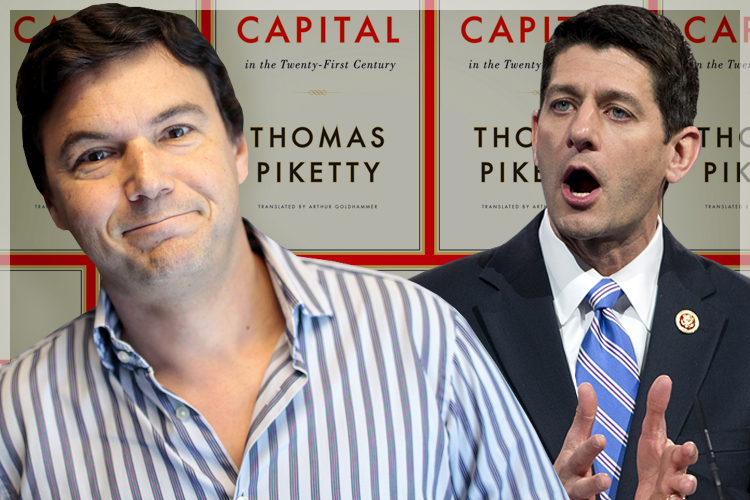
Thomas Piketty terrifies Paul Ryan: Behind the right's desperat Thomas Piketty, Paul Ryan (Credit: Reuters/Charles Platiau/AP/Manuel Balce Ceneta/Salon)

Thomas Piketty's "Capital in the 21st Century" hit No. 1 at Amazon, right around the time that Elizabeth Warren released her book "A Fighting Chance." Far from being the only figures addressing the failure of unregulated market capitalism to produce fair outcomes and broad prosperity, they embody two key facets of that criticism: the intellectual/academic and pragmatic/political. But there are a host of other figures criticizing the workings of actually existing capitalism and the increasingly destructive inequalities of wealth we see it producing all around us.

It may have taken more than five years since the financial crisis hit in late 2008, but are we finally seeing signs of a coherent response coming together? A number of recent developments suggest that we are. Just in the last few weeks, for example, another hot new book is "Flash Boys," the latest from Michael Lewis on the most recent form of mass-scamming on Wall Street, and there's new attention being drawn to the work of Martin Gilens demonstrating the power of elite control of our political system. His book "Affluence and Influence: Economic Inequality and Political Power in America" was an award-winner in political science last year, but his follow-up study with Benjamin I. Page, the essay "Testing Theories of American Politics: Elites, Interest Groups, and Average Citizens," has touched a broader nerve, with stories at the New Yorker, Huffington Post, and by Michael Lind here at Salon, among others, with added notice on cable TV. And of course, Pope Francis keeps mouthing off against inequality, too (which routinely causes Paul Ryan to comically insist – almost Stephen Colbert-style – that the pope is actually inveighing against the welfare state).

What makes Piketty and Warren stand out, in particular, is that real change needs both a framework of shared knowledge and possibility ­ which Piketty's vast store of data helps provide ­ and exemplars of articulate, high-level struggle setting the terms of public debate, which is where Warren comes in.

This is not to say that Piketty's work is something simply to rally around. That's more of the pope's territory. There is plenty to debate about Piketty's work. But so far, criticism from the right has been ludicrous, while criticism from the left has been largely overlooked ­ a situation that must inevitably change if something is really to be done about inequality.

advertisement
"" style="border: 0px none; vertical-align: bottom;" marginheight="0" marginwidth="0" name="google_ads_iframe_/10721600/Salon/Politics_9" id="google_ads_iframe_/10721600/Salon/Politics_9" frameborder="0" height="250" scrolling="no" width="300">

A neat summary of the right's real source of upset comes from Lynn Stuart Parramore in an Alternet article republished here at Salon:

As fellow-economist James K. Galbraith has underscored in his review of the book, Piketty "explicitly (and rather caustically) rejects the Marxist view" of economics.
But he does do something that gives right-wingers in America the willies. He writes calmly and reasonably about economic inequality, and concludes, to the alarm of conservatives, that there is no magical force that drives capitalist societies toward shared prosperity.

This is not a new problem. "Free markets" and capitalism are actually quite contrary in their foundations. The essence of free markets are competition, driving down prices to nearly the cost of production. The essence of capitalism is the accumulation of capital, which depends on hefty profits, and thus limited competition. Hence, "free markets" are mostly mythical, sometimes fleetingly appearing here or there, only to be quickly contained, if possible. If not, the results can be massive ruination, as happened with successive mass railroad bankruptcies in both Britain and America in the 19th century, a subject explored in depth in Michael Perelman's 2006 book, "Railroading Economics: The Creation of the Free Market Mythology."

As Perelman's subtitle suggests, the mythology was actually created against the backdrop of certain knowledge that it spelled ruin, if taken seriously. But nothing works better to suppress contradictions than having an outside enemy. So long as there was Marxism to kick around, the contradictions of "free market capitalism" were relatively easy to contain. With Piketty's data exposing the downside of capitalist accumulation from a different angle, it's hardly surprising to hear the "Marxism" charge raised again, in a desperate attempt to suppress critical inquiry. Now, however, too many people have been hurt to be so easily scared off by baseless name-calling.

If the right is merely reflexively, defensively name-calling, on the left there are some very serious questions with Piketty's work. They are too deep and serious to do in-depth justice to here, but see, for example, Galbraith's review in Dissent, which Parramore quoted from above, Doug Henwood of the Left Business Observer, at Bookforum, and Dean Baker at Huffington Post.

Piketty himself first told MSNBC's Chris Hayes (long-form interview) that his book was "about history, I'm trying to put history into this … very hot debate about inequality … I want everybody to be able to make their own mind … I don't pretend I know what's going to happen next, but I want to give people a lot of historical material that was not available before, so that they make their own mind." He then added, regarding his own views:

One of the conclusions that I take from my own work is that we don't need 19th century economic inequality to grow. One lesson of the 20th Century is that the kind of extreme concentration of wealth that we had in the 19th Century was not useful, and probably even harmed growth, because it reduced mobility and access of new groups of the population into entrepreneurship and power. It lead to the capture of our political institutions prior to World War i. We don't want to return to this." Now, there is a tendency to move in that direction, and we should be worried about that."

Although they vary somewhat, critiques from the left tend to focus first on one of three areas ­ the disconnect between the hard-nosed severity of the data collected and the lack of realism in his proposed responses (many, not just on the left, have noted this, but Henwood expresses it particularly well), the questionable nature of some of his theoretical assumptions (Galbraith begins immediately with "capital" itself, critiquing how Piketty has continued and extended the neo-classical divorce of capital from its sociopolitical matrix), or the lack of empirical realism in dealing with actual economic institutions (Dean Baker's forte, which lucidly connects theoretical and pragmatic/political concerns).

And yet, for the most part, all the critics agree it's a very good thing this book has been written, and that it's getting so much attention. Whatever it's flaws may be, we are much better off having this sort of data, across this range of time, clearly showing the growing concentration of wealth, as opposed to the trickle-down fantasies of yore. The question is: What more do we need?

That's where Elizabeth Warren comes in. Not because she's perfect, but because she complements some of what's missing with Piketty, and has a knack for making sometimes murky connections strikingly clear. There are confusions surrounding Warren as well, but hers are relatively simplistic compared to Piketty. She's written a book, she's out there promoting it, she's getting lots of positive attention, ergo she must be running for president. Why else would a politician write a book? Well, in Warren's case, because she's a writer, an educator, an issue advocate and an activist ­ and has been all of these much longer than she's been a politician, which she only became out of necessity and in service to her earlier roles. She's not really writing a personal political biography; she's writing a history of her political education as a citizen fighting for others just like her. Given her passions and interests, and the state of the world and politics today, the real question for her would have been, "Why haven't you written a book?" if she were not doing just as she is.

What may well matter most about Warren in relation to all the above is her experience in dealing with some of the specific institutional realities that Baker refers to, and making coherent sense of them in a way that's easy for ordinary citizens to grasp. In his criticism of Piketty's book, Baker noted:

In questioning his contribution to advancing technology, Piketty asks: "Did Bill [Gates] invent the computer or just the mouse?" (To be fair, the comment is a throwaway line.) Of course the mouse was first popularized by Apple, Microsoft's rival. It's a trivial issue, but it displays the lack of interest in the specifics of the institutional structure that is crucial for constructing a more egalitarian path going forward.

Think of this on the one hand, and think of Elizabeth Warren's deft use of the humble toaster in explaining the logic of her proposal for a Financial Product Safety Commission:

It is impossible to buy a toaster that has a one-in-five chance of bursting into flames and burning down your house. But it is possible to refinance an existing home with a mortgage that has the same one-in-five chance of putting the family out on the street–and the mortgage won't even carry a disclosure of that fact to the homeowner. Similarly, it's impossible to change the price on a toaster once it has been purchased. But long after the papers have been signed, it is possible to triple the price of the credit used to finance the purchase of that appliance, even if the customer meets all the credit terms, in full and on time. Why are consumers safe when they purchase tangible consumer products with cash, but when they sign up for routine financial products like mortgages and credit cards they are left at the mercy of their creditors?
The difference between the two markets is regulation. Although considered an epithet in Washington since Ronald Reagan swept into the White House, the "R-word" supports a booming market in tangible consumer goods. Nearly every product sold in America has passed basic safety regulations well in advance of reaching store shelves.

This is hardly the only reason Warren is important. She is, obviously, the only straightforward economic populist who's even being mentioned as a possible presidential candidate, regardless of her current expressed lack of interest in running. But even if there were half a dozen such candidates, this intuitive feel for the perfect specific detail (and how to unpack it with Martha Stewart-like perfection) exactly matching what's missing in Piketty, along with her fighting spirit, are a vital part of what makes her such a particularly important figure, not just for what she may do in the years to come, but for qualities she models and inspires in others. A true populist leader does a lot of that ­ modeling and inspiring others. It's something that most good teachers know and do instinctively. So there's that, too.

But there's one more point that needs making here in terms of how Piketty and Warren complement each other. Perhaps the most serious flaw in Piketty's approach is his theoretical dependency on growth, matched with his failure to value natural capital, along with ecosystem services that nature provides [U.N. reports here]. Significantly, in their commentary about Piketty's work, at the American Prospect, political scientists Jacob S. Hacker of Yale, and Paul Pierson at Univerisity of California, Berkeley, wrote:

Inequality is becoming a "wicked" problem like climate change­one in which a solution must not only overcome powerful entrenched interests in individual countries but must be global in scope to be effective.

In fact, it is even worse than they describe, because the two problems are inter-linked ­ and because economists, at least, seem utterly blind to the fact.

Consider this admiring description of Piketty's work from Branko Milanovic, formerly lead economist in the World Bank's research department, and a leading expert on international inequality (who also wrote a highly detailed review here), in a short piece on the same page at the American Prospect:

Piketty's key message is both simple and, once understood, almost self-evident. Under capitalism, if the rate of return on private wealth (defined to include physical and financial capital, land, and housing) exceeds the rate of growth of the economy, the share of capital income in the net product will increase. If most of that increase in capital income is reinvested, the capital-to-income ratio will rise. This will further increase the share of capital income in the net output. The percentage of people who do not need to work in order to earn their living (the rentiers) will go up. The distribution of personal income will become even more unequal.

The story elegantly combines theories of growth, functional distribution of income (between capital and labor) and income inequality between individuals. It aims to provide nothing less than the description of a capitalist economy.

This is arguably the most positive short description I've seen of Piketty's work ­ and yet, look at what it leaves out: the looming potential destruction of the world economic system due to global warming in the next 100 to 300 years. (Almost 40 percent of scenarios project a 25 percent to 100 percent decrease in yield by the 2090-2109 time-frame [chart] according to the most recent IPCC Working Group II report.) And global warming is only one of nine environmental failure modes from crossing planetary boundaries that could undermine our global civilization.

This is not to say such destruction is certain, but it is a very real possibility ­ just as the 2008 financial crisis was a real possibility for years before it finally appeared. And yet, it is not a possibility within the framework Milanovic has just described. I want to be clear: it could be entirely possible that we can have a healthy growing economy and start paying down our enormous environmental debt ­ but we will never know if that's possible if we don't first develop the analytical tools to put the question in terms that can be measured.

It is worth noting that in early October 2008, just after the financial crisis first hit, George Soros appeared on "Bill Moyers Journal," and proposed a kind of "Green New Deal" as the logical way forward for America and the world:

GEORGE SOROS: ….for the last 25 years the world economy, the motor of the world economy that has been driving it was consumption by the American consumer who has been spending more than he has been saving, all right? Than he's been producing. So that motor is now switched off. It's finished. It's run out of – can't continue. You need a new motor. And we have a big problem. Global warming. It requires big investment. And that could be the motor of the world economy in the years to come.
BILL MOYERS: Putting more money in, building infrastructure, converting to green technology.
GEORGE SOROS: Instead of consuming, building an electricity grid, saving on energy, rewiring the houses, adjusting your lifestyle where energy has got to cost more until it you introduce those new things. So it will be painful. But at least we will survive and not cook.

We failed to turn on that new motor when it could have prevented enormous needless suffering. But we still face much the same dilemma today. The logic of a Green New Deal remains as compelling as ever.

But how does this connect to Elizabeth Warren? Funny you should ask. Two words: Dust bowl. Elizabeth Warren is from Oklahoma. Oklahoma is the epicenter of America's most devastating experience of the human cost of preventable environmental destruction. While organizers, activists and everyday concerned citizens have struggled mightily for decades trying to weave together the interests and outlooks of labor and environmentalists ­ interests that capitalist accumulation effortlessly plays off against each other even in its sleep ­ Elizabeth Warren's people have the lived historical experience of how economic and environmental suffering are not trade-offs, one against the other, but are intimately joined together. Warren has already shown how deeply rooted she is in where and who she came from. If anyone can help lead America forward toward a Green New Deal, odds are, Elizabeth Warren can.

For all its flaws, Piketty's "Capital in the 21st Century" has helped set the stage for a struggle that's long overdue ­and one that, of necessity, needs to be expanded even further. And Warren is the most high-profile person in America today working to figure out how that struggle can succeed. This is their moment ­ but it's all of our futures.

Paul Rosenberg is a California-based writer/activist, senior editor for Random Lengths News, and a columnist for Al Jazeera English. Follow him on Twitter at @PaulHRosenberg.
More Paul Rosenberg.